


What is the Remote Sensing Infrared Light Emitting Diode (LED) Market Size and Growth Rate?
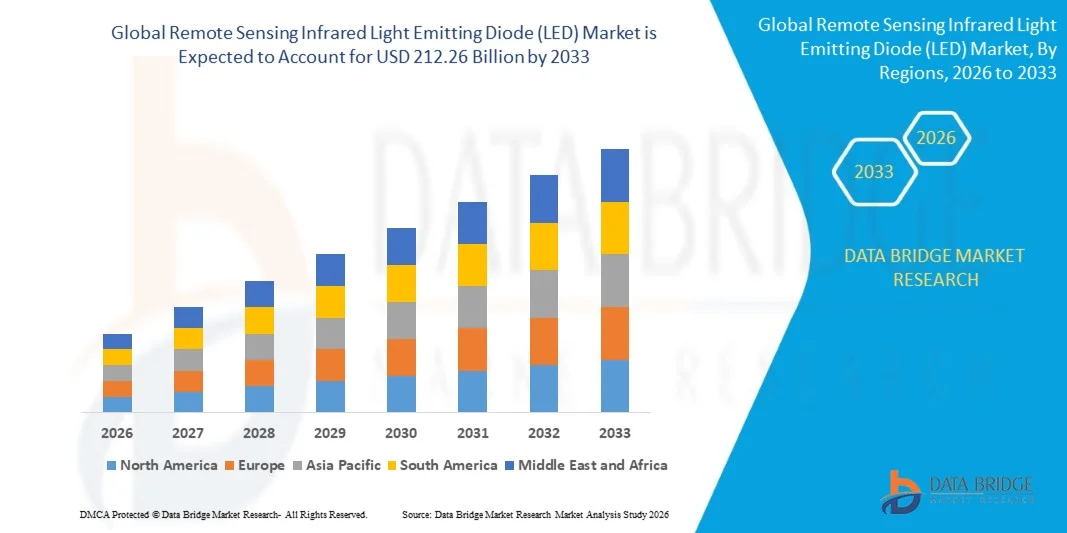
- As per Data Bridge Market Research analysis, the remote sensing infrared light emitting diode (LED) market was valued at USD 85.12 billion in 2025 and is projected to reach USD 212.26 billion by 2033, growing at a CAGR of 12.10% from 2026 to 2033.
- The market is experiencing consistent growth driven by rising demand for infrared LEDs in remote sensing and hyperspectral imaging, increasing adoption across consumer electronics and automotive applications, and growing requirements for high-security, low-power, and cost-effective sensing solutions.
- The increasing adoption of facial recognition, surveillance systems, smartphones, optical sensing, and advanced automotive technologies, combined with growing security concerns, is compelling industries to integrate infrared LED-based sensing technologies. Advancements in NIR, MIR, and FIR LEDs, along with improved efficiency, miniaturization, and longer operating life, are further expanding their use across security, industrial automation, healthcare, and environmental monitoring applications.
Market Size & Forecast
- Global Market Value (2025): USD 85.12 Billion
- Expected Market Value (2033): USD 212.26 Billion
- Forecast CAGR (2026–2033): 12.10%
- Leading Region in 2025: Asia Pacific
- Fastest Growing Region: North America
What are the Major Takeaways of the Remote Sensing Infrared Light Emitting Diode (LED) Market?
- Asia Pacific dominated the remote sensing infrared light emitting diode (LED) market with the largest revenue share of 45.2% in 2025, supported by strong demand for consumer electronics and increasing adoption of infrared sensing technologies in major economies such as China and India.
- North America is expected to be the fastest-growing region at a CAGR of 25.0% from 2026 to 2033, fueled by rising demand for security and surveillance sensing systems, consumer electronics, and advanced infrared sensing technologies.
- The 700nm–850nm segment led the market with a 35% share in 2025, driven by its broad applicability in optical sensing, imaging, surveillance, and short-range remote sensing systems.
- 940nm–1020nm are the fastest-growing spectral range type, projected to register a CAGR of 9%, reflecting the surge in demand for near-infrared sensing and camera-based applications.
- The IR LED package segment dominated the technology category with a 50% revenue share in 2025, led by its extensive integration into surveillance cameras, optical sensors, biometric devices, automotive systems, and consumer electronics.
- Surveillance accounted for 30% of the market share in 2025, preferred by extensive use of infrared LEDs in security cameras and night time monitoring systems.
- The optical sensing segment is the fastest-growing application category, with a CAGR of 10.9%, driven by increasing adoption of infrared sensing across automotive, industrial, healthcare, and consumer electronics applications.
Report Scope and Remote Sensing Infrared Light Emitting Diode (LED) Market Segmentation
|
Attributes |
Remote Sensing Infrared Light Emitting Diode (LED) Key Market Insights |
|
Segments Covered |
|
|
Countries Covered |
North America
Europe
Asia-Pacific
Middle East and Africa
South America
|
|
Key Market Players |
|
|
Market Opportunities |
|
|
Value Added Data Infosets |
In addition to the insights on market scenarios such as market value, growth rate, segmentation, geographical coverage, and major players, the market reports curated by the Data Bridge Market Research also include in-depth expert analysis, geographically represented company-wise production and capacity, network layouts of distributors and partners, detailed and updated price trend analysis and deficit analysis of supply chain and demand. |
What is the Key Trend in the Remote Sensing Infrared Light Emitting Diode (LED) Market?
- Infrared LED manufacturers are increasingly developing higher-power, compact, and thermally efficient emitters to support advanced remote sensing, surveillance, automotive sensing, and machine-vision applications requiring stronger and more reliable illumination.
- For instance, in January 2026, ams OSRAM showcased next-generation infrared LED technology at CES 2026, with its IR:6 LEDs delivering up to 50% higher brightness and 33% improved efficiency at 930 nm, highlighting the market trend toward higher-efficiency, low-red-glow infrared illumination for camera-based sensing and automotive applications.
- 940 nm infrared illumination is becoming increasingly important for camera-based sensing because it provides effective near-infrared illumination while reducing visible red glow, improving user acceptance in automotive and consumer applications.
- The integration of infrared LEDs with camera-based sensing, driver monitoring, occupant monitoring, gesture recognition, and biometric systems is expanding the addressable market beyond conventional remote-control and surveillance applications.
- LiDAR and advanced optical sensing are creating new demand for infrared technologies in smart transportation, autonomous vehicles, robotics, and industrial automation, with real-time sensing enabling improved navigation, detection, and environmental perception.
- For instance, in May 2025, ROHM expanded its infrared LED portfolio with compact surface-mount near-infrared LEDs, targeting space-constrained sensing applications and demonstrating the industry's shift toward smaller, more efficient infrared emitters for advanced sensing systems.
- Security and surveillance applications are shifting toward higher radiant-flux and higher-efficiency infrared LEDs, as professional surveillance systems increasingly require longer-range and clearer low-light imaging capabilities.
What are the Key Drivers of the Remote Sensing Infrared Light Emitting Diode (LED) Market?
- The rapid expansion of automotive sensing and safety systems is increasing demand for infrared LEDs used in driver monitoring, occupant monitoring, gesture sensing, night-time sensing, and advanced driver-assistance applications.
- For instance, in May 2024, Vishay Intertechnology introduced eight AEC-Q102-qualified 850 nm and 940 nm high-power infrared emitters for automotive applications, capable of up to 1.5 A continuous and 5 A pulsed drive currents, with radiant intensity up to 6,000 mW/sr, supporting the growing use of IR LEDs in advanced automotive sensing and driver-monitoring systems.
- Increasing vehicle automation and stricter safety requirements are encouraging automotive manufacturers to integrate camera-based infrared illumination into next-generation vehicle electronic architectures.
- The expansion of security and surveillance infrastructure is creating sustained demand for infrared LEDs capable of delivering high radiant flux and efficient illumination for nighttime monitoring and low-light imaging.
- Growing industrial automation and machine-vision adoption is expanding infrared LED applications in object detection, inspection, robotics, access control, and automated sensing systems across manufacturing environments.
- For instance, in April 2025, Vishay introduced its AEC-Q100-qualified VEML6046X00 RGBIR automotive color sensor with a dedicated infrared channel, enabling applications including automotive displays, rearview-mirror dimming, heads-up displays, color recognition, and laser front-light monitoring, demonstrating expanding integration of IR sensing into vehicle electronics
- Rising adoption of infrared sensing in consumer electronics, healthcare, biometrics, and smart devices is further increasing demand for miniaturized, energy-efficient, and application-specific infrared emitters.
Which Factors are Challenging the Growth of the Remote Sensing Infrared Light Emitting Diode (LED) Market?
- Advanced infrared LEDs for demanding remote sensing and automotive applications require high optical power, precise wavelength control, thermal management, and application-specific packaging, increasing development and manufacturing complexity.
- For instance, in December 2024, China expanded export controls on gallium and other critical minerals to the U.S.; by May 2025, gallium prices outside China had reached approximately USD 687/kg, more than 150% above pre-control levels, highlighting the supply-chain and raw-material cost risks for compound-semiconductor devices used in infrared LEDs.
- High-power infrared emitters generate greater thermal loads, requiring effective heat dissipation to maintain optical performance, reliability, and operating lifetime in compact sensing systems.
- Stringent eye-safety and regulatory requirements can increase testing, certification, and product-development costs, particularly for high-power infrared LEDs used in surveillance, automotive, and industrial sensing systems. ICNIRP notes that excessive infrared exposure can cause thermal injury to the eye, requiring exposure limits based on wavelength, intensity, and duration.
- Dependence on specialized semiconductor materials and supply chains can constrain production and increase cost volatility, as infrared LEDs commonly rely on compound-semiconductor materials such as GaAs, while gallium and indium supplies
- For instance, in June 2025, a study published in Light: Science & Applications highlighting thermal management as a critical challenge for semiconductor LEDs, noting that inadequate heat dissipation reduces efficiency and shortens device lifetime; the study demonstrated that improved cooling could reduce LED temperature by up to 7.8°C indoors and 4.4°C outdoors.
- The use of compound-semiconductor materials such as GaAs and InP can increase manufacturing costs and create supply-chain challenges compared with conventional silicon-based technologies.
How is the Remote Sensing Infrared Light Emitting Diode (LED) Market Segmented?
The remote sensing infrared light emitting diode (LED) market is segmented on the basis of spectral range, technology, application, and end-use.
- By Spectral Range
On the basis of spectral range, the remote sensing infrared LED market is segmented into 700nm–850nm, 850nm–940nm, 940nm–1020nm, and 1020nm–1720nm. The 700nm–850nm segment dominated the market with 35% share in 2025, owing to its broad applicability in optical sensing, imaging, surveillance, and short-range remote sensing systems. LEDs within this wavelength range work effectively with widely used silicon-based photodetectors and imaging sensors. Their established manufacturing ecosystem also supports cost-effective deployment across multiple applications. The segment benefits from strong demand for infrared illumination in security cameras, machine vision, and consumer sensing devices.
The 940nm–1020nm segment is projected to register the fastest growth at 9% CAGR during forecast period, driven by increasing demand for near-infrared sensing and camera-based applications. The 940nm range is particularly suitable for applications requiring reduced visible red glow, including biometric authentication and automotive in-cabin sensing. Its use in driver monitoring, occupant monitoring, facial recognition, and advanced imaging is expanding the addressable market. Increasing adoption of sophisticated optical sensors is further supporting demand for this wavelength range. Improvements in infrared LED efficiency and optical output are making these emitters increasingly suitable for compact sensing systems.
- By Technology
On the basis of technology, the remote sensing infrared LED market is segmented into IR LED chip, IR LED package, and IR LED module. The IR LED package segment dominated the market with 50% share in 2025, supported by its extensive integration into surveillance cameras, optical sensors, biometric devices, automotive systems, and consumer electronics. Packaged LEDs provide manufacturers with ready-to-integrate infrared light sources while combining the semiconductor die with optical and thermal-management components. Their standardized configurations simplify integration into different electronic and sensing platforms. Increasing demand for compact and reliable infrared components is supporting the use of packaged solutions. Automotive-grade packages are also gaining importance as sensing systems require higher reliability and durability.
The IR LED module segment is projected to register the fastest growth at 10% CAGR during forecast period, driven by increasing demand for integrated infrared illumination solutions. Modules can combine multiple infrared emitters with optics and supporting electrical components, simplifying system-level integration. They are increasingly suitable for surveillance cameras, machine vision, biometric systems, and automotive sensing platforms. Demand for compact, application-specific illumination is encouraging manufacturers to move toward integrated module solutions. Improvements in optical design can provide more uniform and targeted infrared illumination for sophisticated sensing applications.
- By Application
On the basis of application, the remote sensing infrared LED market is segmented into biometrics, imaging, lighting, remote sensing, surveillance, optical sensing, and infrared communication. The surveillance segment dominated the market with 30% share in 2025, driven by extensive use of infrared LEDs in security cameras and nighttime monitoring systems. Infrared illumination allows cameras to capture images in low-light and dark environments without requiring visible lighting. Increasing security requirements across residential, commercial, transportation, and public infrastructure are supporting deployment. The growth of high-resolution surveillance cameras is also increasing demand for efficient and higher-output infrared illumination. Integration of artificial intelligence and video analytics is further expanding the use of infrared-enabled surveillance systems.
The optical sensing segment is projected to register the fastest growth at 10.9% CAGR during forecast period, supported by increasing adoption of infrared sensing across automotive, industrial, healthcare, and consumer electronics applications. Optical sensing systems use infrared illumination to identify objects, movement, distance, and changes in surrounding conditions. Growing deployment of driver-monitoring and occupant-monitoring technologies is creating additional automotive demand. Industrial automation and machine-vision systems are also increasingly using infrared illumination for object detection and inspection. In consumer electronics, optical sensing supports biometric authentication, gesture recognition, and interactive functions. Continued improvements in infrared emitter efficiency and sensor performance are expected to strengthen the segment's growth.
- By End-Use
On the basis of end-use, the remote sensing infrared LED market is segmented into aerospace and defense, automotive, banking, financial services and insurance (BFSI), consumer electronics, education, healthcare, retail, and industrial. The consumer electronics segment dominated the market with 35% share in 2025, supported by widespread integration of infrared LEDs into smartphones, biometric devices, cameras, smart-home products, and other electronic equipment. Infrared emitters are increasingly used for facial recognition, proximity sensing, gesture detection, and optical monitoring. Growing smartphone adoption and demand for secure biometric authentication are supporting continued usage. Miniaturized infrared components allow manufacturers to incorporate advanced sensing capabilities into compact devices. Rising consumer demand for connected and intelligent electronics is creating additional applications.
The automotive segment is projected to register the fastest growth at 11% CAGR during forecast period, driven by increasing adoption of driver monitoring, occupant monitoring, advanced driver-assistance systems, and autonomous driving technologies. Infrared LEDs provide controlled illumination for camera-based sensing under both daytime and nighttime conditions. Growing emphasis on vehicle safety is encouraging manufacturers to incorporate systems that monitor driver attention and occupant conditions. Increasing vehicle automation is also expanding the number of cameras and sensors installed in modern vehicles. The transition toward software-defined vehicles is increasing demand for sophisticated sensing hardware. Automotive qualification requirements are encouraging development of reliable, high-performance infrared emitters.
Which Region Holds the Largest Share of the Remote Sensing Infrared Light Emitting Diode (LED) Market?
- Asia Pacific dominated the remote sensing infrared light emitting diode (LED) market with the largest revenue share of 45.2% in 2025, supported by strong demand for consumer electronics and increasing adoption of infrared sensing technologies in major economies such as China and India.
- The region also benefits from its large semiconductor and electronics manufacturing base, growing deployment of security and surveillance systems, expanding automotive sensing applications, and increasing investments in industrial automation and smart infrastructure. The concentration of infrared LED manufacturers and the rapid adoption of consumer electronics further strengthen Asia-Pacific's leadership position in the global market.
The Japan Remote Sensing Infrared Light Emitting Diode (LED) Market Insight
The Japan remote sensing infrared LED market is witnessing consistent growth due to rising investments in automotive sensing, robotics, industrial automation, and advanced consumer electronics. Automotive manufacturers and technology companies are increasingly adopting infrared LEDs for driver monitoring, optical sensing, imaging, and safety applications. Moreover, increasing integration of artificial intelligence, camera-based sensing, and robotics technologies, together with Japan’s strong electronics and semiconductor ecosystem, is further contributing to market growth.
China Remote Sensing Infrared Light Emitting Diode (LED) Market Insight
The China remote sensing infrared LED market is growing rapidly, driven by expanding consumer electronics manufacturing, automotive production, surveillance infrastructure, and industrial automation. Growing adoption of infrared-enabled cameras, biometric systems, optical sensors, and intelligent vehicles is significantly boosting market demand. In addition, rising investments in semiconductor manufacturing, smart-city infrastructure, autonomous driving technologies, and advanced sensing systems are positioning China as one of the fastest-growing markets for remote sensing infrared LEDs globally.
North America Remote Sensing Infrared Light Emitting Diode (LED) Market Insight
The North America remote sensing infrared LED market is expected to be the fastest-growing regional market, driven by increasing adoption of infrared sensing technologies across automotive, defense, industrial automation, surveillance, and healthcare applications. The region benefits from strong R&D capabilities, advanced semiconductor and optoelectronics infrastructure, and rapid adoption of smart sensing technologies. The U.S. is particularly supporting regional demand through increasing use of infrared LEDs in ADAS, biometric authentication, machine vision, and security systems. The region also benefits from rising deployment of IR-based surveillance cameras, automotive driver-monitoring systems, industrial automation, and healthcare devices, while growing investment in domestic semiconductor and photonics capabilities is strengthening the regional supply chain.
U.K. Remote Sensing Infrared Light Emitting Diode (LED) Market Insight
The U.K. remote sensing infrared LED market is experiencing steady growth, supported by rising adoption of infrared sensing technologies in security and surveillance, healthcare, automotive, defense, and industrial applications. Increasing investments in advanced sensing infrastructure and growing demand for compact, energy-efficient infrared illumination solutions are contributing to market growth. Furthermore, integration of infrared technologies with artificial intelligence, machine vision, and autonomous systems is expanding application opportunities and strengthening the U.K.’s position in advanced sensing technologies.
Germany Remote Sensing Infrared Light Emitting Diode (LED) Market Insight
The Germany remote sensing infrared LED market is expanding steadily due to the country’s strong automotive manufacturing base, industrial automation capabilities, and advanced optical technology ecosystem. Automotive manufacturers and industrial companies are increasingly utilizing infrared LEDs for driver monitoring, machine vision, optical sensing, and vehicle safety applications. Continuous advancements in infrared emitter efficiency, camera-based sensing, and autonomous driving technologies, along with Germany’s strong focus on industrial innovation and vehicle safety, are further driving market growth.
Which are the Top Companies in Remote Sensing Infrared Light Emitting Diode (LED) Market?
The remote sensing infrared light emitting diode (LED) industry is primarily led by well-established companies, including:
- ams-OSRAM AG (Austria)
- Vishay Intertechnology, Inc. (U.S.)
- ROHM Co., Ltd. (Japan)
- EVERLIGHT ELECTRONICS CO., LTD. (Taiwan)
- STANLEY ELECTRIC CO., LTD. (Japan)
- Harvatek Corporation (Taiwan)
- Kingbright America, LLC (U.S.)
- Hamamatsu Photonics K.K. (Japan)
- TOSHIBA ELECTRONIC DEVICES & STORAGE CORPORATION (Japan)
- Semiconductor Components Industries, LLC (U.S.)
- Marktech Optoelectronics, Inc. (U.S.)
- Excelitas Technologies Corp. (U.S.)
- Lumileds Holding B.V. (Netherlands)
- LITE-ON Technology Corporation (Taiwan)
- CITIZEN ELECTRONICS CO., LTD. (Japan)
- Nichia Corporation (Japan)
- Epistar Corporation (Taiwan)
- Bridgelux, Inc. (U.S.)
- Seoul Viosys Co., Ltd. (South Korea)
- Seoul Semiconductor Co., Ltd. (South Korea)
What are Latest Developments in Remote Sensing Infrared Light Emitting Diode (LED) Market?
- In May 2025, ROHM Semiconductor introduced new compact surface-mount near-infrared (NIR) LEDs, expanding its portfolio with top-view devices optimized for VR/AR equipment, industrial optical sensors, and human-detection sensors. The new products address growing demand for miniaturized, energy-efficient infrared sensing components and support applications including eye tracking, iris recognition, biosensing, and industrial automation. This development highlights the industry's shift toward compact and higher-performance infrared emitters for advanced sensing applications.
- In October 2024, ams OSRAM introduced its new IR:6 infrared LED chip technology, offering 850 nm, 940 nm, and a new 920 nm wavelength option. The technology increased brightness by up to 35% and efficiency by up to 42% compared with the company's previous IR LED chip technology. The first products based on IR:6 included OSLON P1616 and OSLON Black LEDs targeting security cameras, biometric authentication, medical equipment, and IR-camera applications. This development demonstrates continued advances in infrared LED efficiency and optical performance.
- In June 2024, ROHM Semiconductor announced the development of its VCSELED infrared light-source technology, combining characteristics of VCSELs and LEDs to provide narrow-spectrum, low-visibility infrared illumination. The technology was developed for automotive driver-monitoring and in-cabin monitoring systems, with ROHM highlighting its low temperature dependence, wide-angle emission, uniform light output, and faster response characteristics. Prototype samples were made available, with automotive mass-production samples planned for 2025. This development reflects the growing integration of infrared illumination into advanced automotive sensing systems.
- In May 2024, Vishay Intertechnology released eight new AEC-Q102-qualified 850 nm and 940 nm high-power infrared emitters for automotive applications. The devices offered drive currents up to 1.5 A DC and 5 A pulsed, with typical radiant intensity reaching 6,000 mW/sr at 5 A pulse current. Their compact 3.4 mm × 3.4 mm packages were designed for ADAS, driver and cabin monitoring, eye tracking, and CCTV applications. The launch strengthened the availability of high-power, automotive-qualified infrared emitters for next-generation sensing systems.
- In January 2021, ROHM Semiconductor introduced the CSL1501RW ultra-compact side-emitting infrared LED, designed for head-mounted displays, industrial headsets, and VR/MR/AR systems. The 860 nm device measured only 1.0 mm × 0.55 mm with a 0.5 mm thickness and reduced power consumption by more than 20% compared with the company's conventional product. Its side-emitting structure provided greater design flexibility for compact wearable devices and supported infrared eye-tracking applications. This launch demonstrated the early movement toward miniaturized infrared LEDs for emerging wearable and remote-sensing applications

- Interactive Data Analysis Dashboard
- Company Analysis Dashboard for high growth potential opportunities
- Research Analyst Access for customization & queries
- Competitor Analysis with Interactive dashboard
- Latest News, Updates & Trend analysis
- Harness the Power of Benchmark Analysis for Comprehensive Competitor Tracking
Global Remote Sensing Infrared Led Market, Supply Chain Analysis and Ecosystem Framework
To support market growth and help clients navigate the impact of geopolitical shifts, DBMR has integrated in-depth supply chain analysis into its Global Remote Sensing Infrared Led Market research reports. This addition empowers clients to respond effectively to global changes affecting their industries. The supply chain analysis section includes detailed insights such as Global Remote Sensing Infrared Led Market consumption and production by country, price trend analysis, the impact of tariffs and geopolitical developments, and import and export trends by country and HSN code. It also highlights major suppliers with data on production capacity and company profiles, as well as key importers and exporters. In addition to research, DBMR offers specialized supply chain consulting services backed by over a decade of experience, providing solutions like supplier discovery, supplier risk assessment, price trend analysis, impact evaluation of inflation and trade route changes, and comprehensive market trend analysis.
Data collection and base year analysis are done using data collection modules with large sample sizes. The stage includes obtaining market information or related data through various sources and strategies. It includes examining and planning all the data acquired from the past in advance. It likewise envelops the examination of information inconsistencies seen across different information sources. The market data is analysed and estimated using market statistical and coherent models. Also, market share analysis and key trend analysis are the major success factors in the market report. To know more, please request an analyst call or drop down your inquiry.
The key research methodology used by DBMR research team is data triangulation which involves data mining, analysis of the impact of data variables on the market and primary (industry expert) validation. Data models include Vendor Positioning Grid, Market Time Line Analysis, Market Overview and Guide, Company Positioning Grid, Patent Analysis, Pricing Analysis, Company Market Share Analysis, Standards of Measurement, Global versus Regional and Vendor Share Analysis. To know more about the research methodology, drop in an inquiry to speak to our industry experts.
Data Bridge Market Research is a leader in advanced formative research. We take pride in servicing our existing and new customers with data and analysis that match and suits their goal. The report can be customized to include price trend analysis of target brands understanding the market for additional countries (ask for the list of countries), clinical trial results data, literature review, refurbished market and product base analysis. Market analysis of target competitors can be analyzed from technology-based analysis to market portfolio strategies. We can add as many competitors that you require data about in the format and data style you are looking for. Our team of analysts can also provide you data in crude raw excel files pivot tables (Fact book) or can assist you in creating presentations from the data sets available in the report.













