


What is the Global Remotely Operated Vehicle (ROV) Underwater Robotics Market Size and Growth Rate?
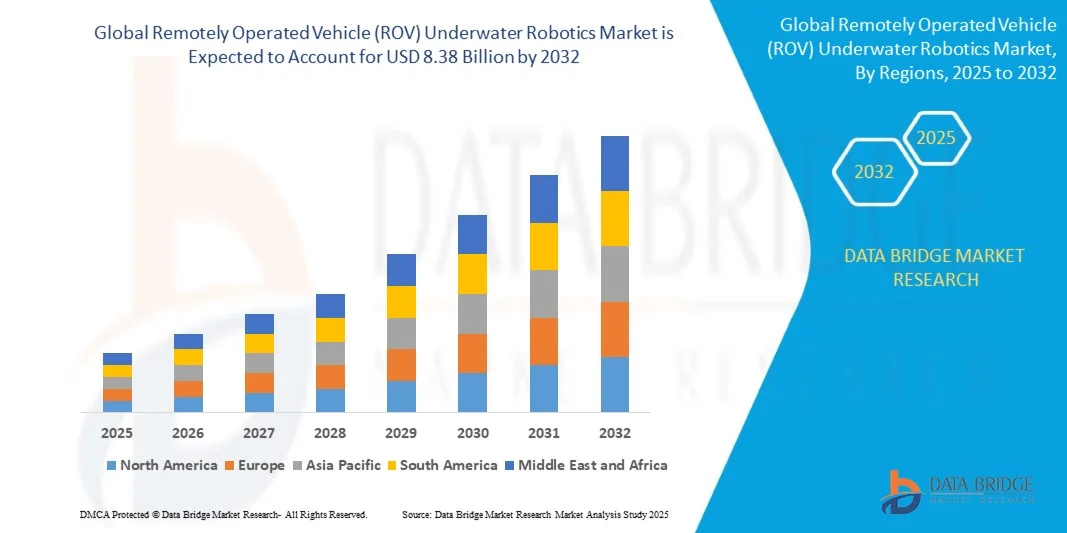
- The global remotely operated vehicle (ROV) underwater robotics market size was valued at USD 3.11 billion in 2024 and is expected to reach USD 8.38 billion by 2032, at a CAGR of 13.20% during the forecast period
- The growing number of undersea mineral exploration activities, rising usages of underwater robotics in military applications, rising adoption of advanced robotics technology in oil and gas industry, rising need for continuous surveillance of submerged ocean areas, advanced underwater robots can generate high-resolution sound waves, optical, and oceanographic surveys in deep oceans are some of the major as well as important factors which will likely to accelerate the growth of the remotely operated vehicle (ROV) underwater robotics market
What are the Major Takeaways of Remotely Operated Vehicle (ROV) Underwater Robotics Market?
- Technological advancement in the field of sensors along with growing number of research and development activities which will further contribute by generating immense opportunities that will led to the growth of the remotely operated vehicle (ROV) underwater robotics market in the above-mentioned projected timeframe
- High cost of research and development activities in developing economies along with increasing difficulty in underwater communication and navigation which will likely to act as market restraints factor for the growth of the remotely operated vehicle (ROV) underwater robotics in the above-mentioned forecasted period
- Europe dominated the remotely operated vehicle (ROV) underwater robotics market with the largest revenue share of 41.5% in 2024, primarily driven by strong investments in offshore energy development, subsea mining, and marine research activities
- The Asia-Pacific remotely operated vehicle (ROV) underwater robotics market is anticipated to grow at the fastest CAGR of 8.69% during 2025–2032, driven by rapid industrialization, expansion of offshore oil exploration, and increasing investment in underwater infrastructure projects across countries such as China, Japan, and India
- The Work Class ROV segment dominated the market with the largest revenue share of 46.8% in 2024, primarily due to its extensive use in deepwater oil and gas exploration, subsea construction, and maintenance operations
Report Scope and Remotely Operated Vehicle (ROV) Underwater Robotics Market Segmentation
|
Attributes |
Remotely Operated Vehicle (ROV) Underwater Robotics Key Market Insights |
|
Segments Covered |
|
|
Countries Covered |
North America
Europe
Asia-Pacific
Middle East and Africa
South America
|
|
Key Market Players |
|
|
Market Opportunities |
|
|
Value Added Data Infosets |
In addition to the insights on market scenarios such as market value, growth rate, segmentation, geographical coverage, and major players, the market reports curated by the Data Bridge Market Research also include in-depth expert analysis, pricing analysis, brand share analysis, consumer survey, demography analysis, supply chain analysis, value chain analysis, raw material/consumables overview, vendor selection criteria, PESTLE Analysis, Porter Analysis, and regulatory framework. |
What is the Key Trend in the Remotely Operated Vehicle (ROV) Underwater Robotics Market?
“Integration of Artificial Intelligence (AI) and Advanced Autonomy”
- A major emerging trend in the global remotely operated vehicle (ROV) underwater robotics market is the incorporation of AI-driven automation and autonomous navigation capabilities. These technologies enhance underwater mission efficiency, reduce operator dependency, and enable real-time decision-making in complex subsea environments
- AI algorithms are being used to improve path planning, object recognition, and obstacle avoidance, allowing ROVs to perform more sophisticated inspection, repair, and maintenance tasks with minimal human intervention
- The trend also includes real-time data analytics and predictive maintenance, where AI helps interpret sensor data for early fault detection and operational optimization
- For instance, Oceaneering International, Inc. and Saab Seaeye Ltd have launched AI-enhanced ROV systems capable of semi-autonomous operations for offshore oil, gas, and renewable energy sectors
- This shift toward intelligent and adaptive ROVs is redefining underwater operations by improving safety, reducing costs, and expanding the range of viable subsea missions
What are the Key Drivers of Remotely Operated Vehicle (ROV) Underwater Robotics Market?
- The increasing demand for offshore oil and gas exploration, coupled with the expansion of offshore renewable energy projects, is a primary driver fueling the growth of the ROV market
- Rising investments in underwater infrastructure inspection and maintenance, such as pipelines, cables, and subsea equipment, are further accelerating adoption
- In addition, ROVs are being increasingly deployed for defense, scientific research, and underwater archaeology, reflecting their growing versatility across industries
- For instance, in March 2024, TechnipFMC plc collaborated with TotalEnergies to develop advanced ROVs designed for deepwater inspection and intervention tasks, improving operational efficiency and reducing downtime
- The increasing shift toward digitization and remote operations in offshore industries is also driving ROV demand, as these systems minimize human exposure to hazardous underwater environment
- Overall, technological advancements and the growing need for efficient underwater asset management are key drivers supporting sustained market growth
Which Factor is Challenging the Growth of the Remotely Operated Vehicle (ROV) Underwater Robotics Market?
- One of the major challenges in the ROV market is the high cost of deployment and maintenance, especially for deepwater applications that require specialized hardware and communication systems
- Furthermore, cybersecurity vulnerabilities associated with remotely controlled and network-connected ROVs present significant risks, particularly for defense and critical infrastructure operations
- Environmental challenges such as extreme underwater pressure, corrosion, and visibility limitations also constrain ROV performance and lifespan
- For instance, ATLAS ELEKTRONIK GmbH has highlighted ongoing efforts to improve system robustness through enhanced materials and sensor calibration to mitigate operational risks in deep-sea missions
- The limited availability of skilled operators and the complexity of integrating ROV systems with existing infrastructure can further slow market expansion
- Addressing these challenges through AI-based automation, cost-effective manufacturing, and improved cybersecurity protocols will be essential for the market’s long-term growth and sustainability
How is the Remotely Operated Vehicle (ROV) Underwater Robotics Market Segmented?
The remotely operated vehicle (ROV) underwater robotics market is segmented on the basis of type, application, and end user.
• By Type
On the basis of type, the market is segmented into Work Class ROV, Observation Class ROV, and Intervention/Inspection Class ROV. The Work Class ROV segment dominated the market with the largest revenue share of 46.8% in 2024, primarily due to its extensive use in deepwater oil and gas exploration, subsea construction, and maintenance operations. These ROVs are equipped with heavy-duty manipulators and advanced sensors, allowing them to perform complex underwater tasks efficiently.
The Observation Class ROV segment is projected to witness the fastest CAGR from 2025 to 2032, driven by increasing demand for lightweight, cost-effective, and portable systems used for marine research, infrastructure inspection, and aquaculture monitoring. Their smaller size and affordability make them suitable for academic and industrial applications.
• By Application
On the basis of application, the market is segmented into Commercial Exploration, Defence and Security, and Scientific Research. The Commercial Exploration segment accounted for the largest market revenue share of 52.3% in 2024, driven by the growing demand for subsea inspections, oil and gas exploration, and offshore wind farm installations. ROVs play a crucial role in monitoring pipelines, inspecting underwater assets, and performing maintenance operations at significant ocean depths.
The Defence and Security segment is expected to record the fastest CAGR during 2025–2032, fueled by increasing government investments in naval modernization and underwater surveillance. ROVs are used for mine countermeasures, harbor security, and intelligence gathering.
• By End User
On the basis of end user, the market is segmented into Industries, Governments, Scientific Research Organisations, and Others. The Industrial segment held the largest market share of 49.7% in 2024, attributed to the widespread adoption of ROVs by oil and gas companies, offshore renewable energy developers, and subsea service providers. These users rely on ROVs for pipeline inspections, construction support, and underwater asset management.
The Government segment is projected to witness the fastest growth rate from 2025 to 2032, driven by increasing defense budgets, maritime security initiatives, and national oceanographic research programs. Governments worldwide are deploying ROVs for border protection, underwater surveillance, and naval maintenance.
Which Region Holds the Largest Share of the Remotely Operated Vehicle (ROV) Underwater Robotics Market?
- Europe dominated the remotely operated vehicle (ROV) underwater robotics market with the largest revenue share of 41.5% in 2024, primarily driven by strong investments in offshore energy development, subsea mining, and marine research activities. The region’s mature oil and gas sector, coupled with an accelerating shift towards offshore renewable energy projects, continues to boost the demand for advanced ROV systems
- The European market benefits from robust technological expertise, well-established infrastructure, and increasing adoption of ROVs for inspection, maintenance, and decommissioning operations in deep and ultra-deep waters
- In addition, the region’s commitment to ocean sustainability and environmental monitoring supports continuous innovation in underwater robotics, reinforcing Europe’s leading position in the global ROV market
U.K. Remotely Operated Vehicle (ROV) Underwater Robotics Market Insight
The U.K. ROV underwater robotics market captured the largest share of 38% within Europe in 2024, driven by the country’s extensive offshore oil and gas fields, offshore wind farms, and marine research initiatives. The U.K. North Sea region remains one of the most active hubs for subsea operations, fostering significant demand for work-class and inspection-class ROVs. Continuous government support for clean energy transition and deep-sea exploration further enhances market opportunities. The presence of leading companies and advanced R&D facilities positions the U.K. as a key player in the development of next-generation underwater robotic systems.
Norway Remotely Operated Vehicle (ROV) Underwater Robotics Market Insight
The Norway ROV underwater robotics market is expected to expand steadily during the forecast period, supported by the nation’s dominance in offshore oil and gas exploration and its strong maritime engineering expertise. Norwegian companies are increasingly integrating autonomous features and AI-driven systems into ROVs to enhance precision and operational safety in harsh subsea environments. Moreover, the country’s focus on sustainable offshore projects and Arctic exploration is fueling continuous innovation and deployment of advanced underwater robotics solutions across industrial and scientific applications.
Germany Remotely Operated Vehicle (ROV) Underwater Robotics Market Insight
The Germany ROV underwater robotics market is projected to witness notable growth during 2025–2032, driven by increasing adoption in marine research, defense, and environmental monitoring. Germany’s strong focus on automation, engineering excellence, and environmental conservation underpins the rising use of ROVs for oceanographic exploration and pollution assessment. The integration of ROV technologies with AI and advanced sensors is enhancing their efficiency and precision, contributing to Germany’s growing influence in Europe’s marine robotics landscape.
Which Region is the Fastest Growing Region in the Remotely Operated Vehicle (ROV) Underwater Robotics Market?
The Asia-Pacific remotely operated vehicle (ROV) underwater robotics market is anticipated to grow at the fastest CAGR of 8.69% during 2025–2032, driven by rapid industrialization, expansion of offshore oil exploration, and increasing investment in underwater infrastructure projects across countries such as China, Japan, and India. The region’s growing emphasis on marine resource development and coastal security is significantly boosting demand for advanced ROV systems.
China Remotely Operated Vehicle (ROV) Underwater Robotics Market Insight
The China ROV underwater robotics market accounted for the largest share within Asia-Pacific in 2024, supported by extensive offshore oil production, subsea mining operations, and marine scientific research programs. The country’s strong manufacturing base and government-backed initiatives to advance underwater technology are driving innovation and domestic production of ROVs. In addition, China’s participation in international deep-sea exploration missions further strengthens its role as a key regional and global contributor in underwater robotics development.
Japan Remotely Operated Vehicle (ROV) Underwater Robotics Market Insight
The Japan ROV underwater robotics market is gaining momentum due to its technological sophistication, maritime heritage, and focus on ocean research and security applications. Japan’s increasing use of ROVs for underwater infrastructure inspection, renewable energy projects, and marine ecosystem monitoring reflects its growing reliance on robotics for precision and sustainability. The government’s continued investment in deep-sea exploration and robotics innovation ensures Japan’s strong presence in the rapidly expanding Asia-Pacific underwater robotics market.
India Remotely Operated Vehicle (ROV) Underwater Robotics Market Insight
The India ROV underwater robotics market is projected to expand rapidly over the forecast period, fueled by the nation’s investments in offshore oil exploration, port development, and coastal security programs. The government’s “Make in India” initiative is encouraging local manufacturing of ROVs and collaboration with global players for technology transfer. With rising research activities and defense modernization efforts, India is emerging as a promising hub for ROV deployment in both commercial and strategic underwater operations.
Which are the Top Companies in Remotely Operated Vehicle (ROV) Underwater Robotics Market?
The remotely operated vehicle (ROV) Underwater Robotics industry is primarily led by well-established companies, including:
- ATLAS ELEKTRONIK GmbH (Germany)
- Oceaneering International, Inc. (U.S.)
- Saab Seaeye Ltd (U.K.)
- TechnipFMC plc (U.K.)
- KONGSBERG (Norway)
- Deep Ocean Engineering, Inc. (U.S.)
- Bluebird Marine Systems Ltd. (U.K.)
- ECA GROUP (France)
- International Submarine Engineering Limited (Canada)
- Soil Machine Dynamics Ltd. (U.K.)
- General Dynamics Mission Systems, Inc. (U.S.)
- Eddyfi (Canada)
- Subsea Tech (France)
- Mariscope Meerestechnik (Germany)
- Future Robot Lu (China)
- Planys Technologies (India)
- Modus Seabed Intervention Limited (U.K.)
- ROVOP (U.K.)
- Fugro (Netherlands)
- Innova STEM Education (Norway)
What are the Recent Developments in Global Remotely Operated Vehicle (ROV) Underwater Robotics Market?
- In May 2023, Advanced Navigation, a leader in AI robotics and navigation technology, introduced the underwater docking feature for its micro autonomous underwater vehicle during ICRA 2023 in London. This demonstration showcased the company’s groundbreaking innovations, highlighting two revolutionary technologies for underwater operations in the U.K. This advancement strengthens Advanced Navigation’s position as a pioneer in autonomous underwater systems and robotics innovation
- In April 2023, Nauticus Robotics, a specialist in autonomous robots and AI-driven data collection for ocean industries, unveiled its second-generation Aquanauts, known as “Mark 2” (MK2). Following commissioning exercises, the company plans to deploy these Aquanauts in the North Sea and the Gulf of Mexico in the coming months. This launch reinforces Nauticus Robotics’ commitment to advancing ocean autonomy and expanding its operational capabilities worldwide
- In November 2020, Schilling Robotics integrated Energid's Actin software into its state-of-the-art work-class remotely operated vehicles (ROVs). The integration aimed to utilize Actin’s advanced motion control features to enhance the precision and efficiency of the Gemini manipulators. This collaboration marks a pivotal step in improving underwater robotic manipulation and operational performance
- In March 2020, ECA GROUP delivered its K-STER underwater robot to the Lithuanian Navy, providing a reliable ROV solution for sea mine clearance. The K-STER system was designed to bolster naval capabilities in conducting mine countermeasure operations. This supply deal strengthens ECA GROUP’s role in supporting global naval defense and underwater safety operations
- In January 2020, NOAA’s Office of Ocean Exploration and Research partnered with Ocean Infinity to develop advanced deep-water autonomous technologies for ultra-high-resolution ocean data collection. The collaboration aimed to improve the exploration and mapping of the U.S. Exclusive Economic Zone using AI-powered unmanned systems. This partnership highlights a significant move toward sustainable and intelligent ocean exploration technologies

- Interactive Data Analysis Dashboard
- Company Analysis Dashboard for high growth potential opportunities
- Research Analyst Access for customization & queries
- Competitor Analysis with Interactive dashboard
- Latest News, Updates & Trend analysis
- Harness the Power of Benchmark Analysis for Comprehensive Competitor Tracking
Global Remotely Operated Vehicle Rov Underwater Robotics Market, Supply Chain Analysis and Ecosystem Framework
To support market growth and help clients navigate the impact of geopolitical shifts, DBMR has integrated in-depth supply chain analysis into its Global Remotely Operated Vehicle Rov Underwater Robotics Market research reports. This addition empowers clients to respond effectively to global changes affecting their industries. The supply chain analysis section includes detailed insights such as Global Remotely Operated Vehicle Rov Underwater Robotics Market consumption and production by country, price trend analysis, the impact of tariffs and geopolitical developments, and import and export trends by country and HSN code. It also highlights major suppliers with data on production capacity and company profiles, as well as key importers and exporters. In addition to research, DBMR offers specialized supply chain consulting services backed by over a decade of experience, providing solutions like supplier discovery, supplier risk assessment, price trend analysis, impact evaluation of inflation and trade route changes, and comprehensive market trend analysis.
Data collection and base year analysis are done using data collection modules with large sample sizes. The stage includes obtaining market information or related data through various sources and strategies. It includes examining and planning all the data acquired from the past in advance. It likewise envelops the examination of information inconsistencies seen across different information sources. The market data is analysed and estimated using market statistical and coherent models. Also, market share analysis and key trend analysis are the major success factors in the market report. To know more, please request an analyst call or drop down your inquiry.
The key research methodology used by DBMR research team is data triangulation which involves data mining, analysis of the impact of data variables on the market and primary (industry expert) validation. Data models include Vendor Positioning Grid, Market Time Line Analysis, Market Overview and Guide, Company Positioning Grid, Patent Analysis, Pricing Analysis, Company Market Share Analysis, Standards of Measurement, Global versus Regional and Vendor Share Analysis. To know more about the research methodology, drop in an inquiry to speak to our industry experts.
Data Bridge Market Research is a leader in advanced formative research. We take pride in servicing our existing and new customers with data and analysis that match and suits their goal. The report can be customized to include price trend analysis of target brands understanding the market for additional countries (ask for the list of countries), clinical trial results data, literature review, refurbished market and product base analysis. Market analysis of target competitors can be analyzed from technology-based analysis to market portfolio strategies. We can add as many competitors that you require data about in the format and data style you are looking for. Our team of analysts can also provide you data in crude raw excel files pivot tables (Fact book) or can assist you in creating presentations from the data sets available in the report.













