


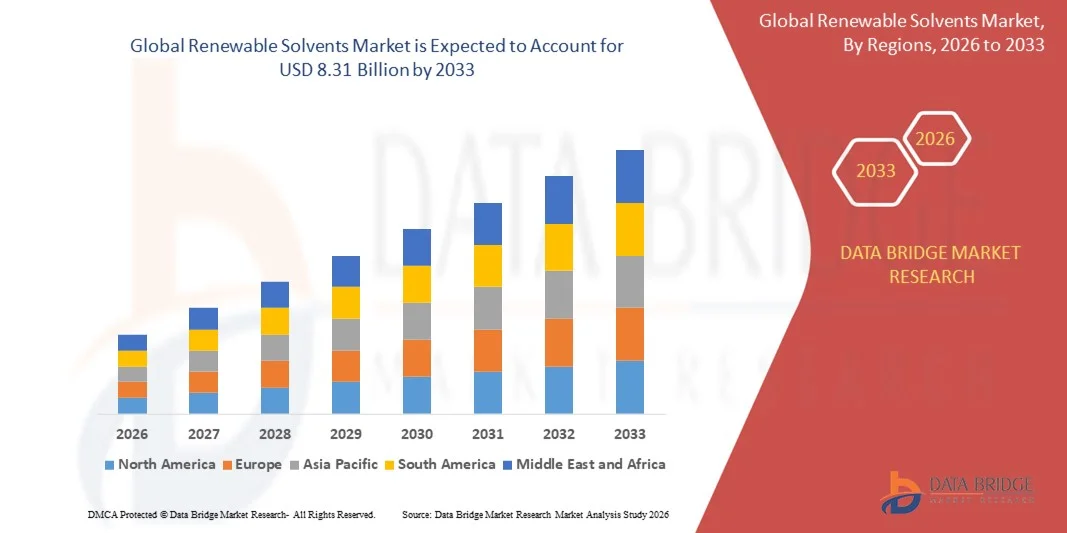
What is the Global Renewable Solvents Market Size and Growth Rate?
- The global renewable solvents market size was valued at USD 5.60 billion in 2025 and is expected to reach USD 8.31 billion by 2033, at a CAGR of 5.06% during the forecast period
- Increasing number of regulations on the solvents derived from petroleum feedstock, rapid urbanization across the globe, increasing number of construction activities along with growth of the paints and coatings industry, rise in urban population coupled with increase in disposable income are some of the major as well as important factors which will such asly to accelerate the growth of the renewable solvents market
What are the Major Takeaways of Renewable Solvents Market?
- Growing industrialization across the world is expected to up surge the demand for industrial cleaners along with rise in the demand for industrial cleaners which will further contribute by generating immense opportunities that will led to the growth of the renewable solvents market in the above mentioned projected timeframe
- Requirement of novel manufacturing technologies along with high cost of product which will such asly to act as market restraints factor for the growth of the renewable solvents
- North America dominated the renewable solvents market with the largest revenue share of 43.54% in 2025, driven by a well-established industrial base, stringent environmental regulations favoring green chemistry, and strong adoption of sustainable manufacturing practices
- The Asia-Pacific renewable solvents market is poised to grow at the fastest CAGR of 8.5% during 2026 to 2033, driven by rapid industrialization, rising environmental awareness, and growing demand for sustainable products in countries such as China, Japan, and India
- The agriculture-derived segment dominated the market with a revenue share of 58% in 2025, driven by the widespread availability of agricultural feedstocks such as sugarcane, corn, and wheat, which are cost-effective and scalable for industrial solvent production
Report Scope and Renewable Solvents Market Segmentation
|
Attributes |
Renewable Solvents Key Market Insights |
|
Segments Covered |
|
|
Countries Covered |
North America
Europe
Asia-Pacific
Middle East and Africa
South America
|
|
Key Market Players |
|
|
Market Opportunities |
|
|
Value Added Data Infosets |
In addition to the insights on market scenarios such as market value, growth rate, segmentation, geographical coverage, and major players, the market reports curated by the Data Bridge Market Research also include in-depth expert analysis, pricing analysis, brand share analysis, consumer survey, demography analysis, supply chain analysis, value chain analysis, raw material/consumables overview, vendor selection criteria, PESTLE Analysis, Porter Analysis, and regulatory framework. |
What is the Key Trend in the Renewable Solvents Market?
Shift Towards Sustainable and Bio-Based Solvents
- A major trend driving the global Renewable Solvents market is the growing shift from petrochemical-based solvents to sustainable, bio-based alternatives derived from renewable feedstocks such as sugarcane, corn, and cellulose. This trend is being fueled by environmental regulations, corporate sustainability goals, and increasing consumer preference for eco-friendly products
- For instance, companies such as BASF SE and ADM are developing bio-based solvents with reduced VOC (volatile organic compounds) emissions, enabling manufacturers in paints, coatings, and cleaning industries to meet stricter environmental standards
- Renewable solvents are increasingly being formulated for compatibility with existing industrial processes, offering similar or superior performance to conventional solvents while lowering carbon footprints. This includes applications in coatings, adhesives, cleaning agents, and personal care products
- The emphasis on green chemistry and sustainable supply chains is reshaping procurement strategies across multiple industries, with companies actively replacing traditional solvents with bio-based options to meet regulatory and ESG targets
- The demand for renewable solvents is rising across commercial, industrial, and household applications, as both manufacturers and end-users prioritize sustainability without compromising on efficiency or performance
- Overall, the market trend towards renewable, environmentally safe, and high-performance solvents is expected to continue, driven by global sustainability initiatives and increasing consumer awareness of green products
What are the Key Drivers of Renewable Solvents Market?
- The increasing regulatory pressure on reducing VOC emissions and hazardous chemical usage is a primary driver for the adoption of renewable solvents. Governments worldwide are implementing stringent environmental regulations, compelling industries to switch to greener alternatives
- For instance, in 2025, the European Union reinforced its REACH (Registration, Evaluation, Authorisation, and Restriction of Chemicals) regulations, promoting the adoption of bio-based solvents in paints, coatings, and industrial cleaning applications
- Corporate sustainability goals and green chemistry initiatives are further accelerating demand. Companies are actively seeking solvents with lower environmental impact to improve their ESG scores and meet stakeholder expectations
- The versatility of renewable solvents across multiple industries, including coatings, adhesives, pharmaceuticals, and personal care products, also supports market expansion. Their ability to serve as drop-in replacements for petrochemical-based solvents encourages widespread adoption
- Consumer awareness of eco-friendly products is growing, driving demand for end-products formulated with sustainable ingredients, thereby indirectly boosting the renewable solvents market
Which Factor is Challenging the Growth of the Renewable Solvents Market?
- The high production cost of renewable solvents compared to traditional petrochemical solvents poses a significant challenge to broader market adoption. Manufacturing bio-based solvents often requires advanced fermentation, purification, or chemical modification processes, increasing overall costs
- For instance, solvents derived from sugarcane or corn can be 20–40% more expensive than conventional solvents, limiting their appeal for cost-sensitive industrial applications.
- Another barrier is supply chain and feedstock availability, as fluctuations in agricultural commodity prices or seasonal production can affect manufacturing continuity
- Performance concerns in specific industrial applications can also hinder adoption. While many renewable solvents match conventional solvents in cleaning or coating efficiency, certain high-temperature or specialty chemical processes may require further formulation adjustments
- Overcoming these challenges will require technological innovation to reduce production costs, scale-up manufacturing capacities, and improve performance consistency. Increased government incentives, investment in sustainable feedstocks, and broader awareness of environmental benefits will be key to sustaining market growth
How is the Renewable Solvents Market Segmented?
The market is segmented on the basis of source, raw material type, solvent type, function, and application.
- By Source
On the basis of source, the renewable solvents market is segmented into agriculture and forestry. The agriculture-derived segment dominated thae market with a revenue share of 58% in 2025, driven by the widespread availability of agricultural feedstocks such as sugarcane, corn, and wheat, which are cost-effective and scalable for industrial solvent production. Agricultural sources are preferred due to lower environmental impact, easy processing, and compatibility with various chemical conversion technologies.
The forestry-derived segment is anticipated to witness the fastest growth at a CAGR of 22% from 2026 to 2033, fueled by increasing utilization of lignocellulosic biomass and wood residues for bio-based solvents. Advancements in biorefinery processes, along with government incentives for sustainable forestry practices, are supporting growth in this segment, especially in Europe and North America, where sustainable forestry initiatives are gaining traction.
- By Raw Material Type
On the basis of raw material type, the market is segmented into cellulose and starch, and oil. The cellulose and starch segment dominated the market with a revenue share of 63% in 2025, attributed to its versatility and high availability for producing ethanol, ethyl lactate, and other bio-solvents. Starch and cellulose-based feedstocks enable large-scale production at lower costs while reducing environmental footprint compared to petroleum-derived solvents.
The oil-based segment is expected to witness the fastest CAGR of 21% from 2026 to 2033, driven by the adoption of vegetable oils, waste cooking oils, and other renewable lipids as feedstocks for ethyl esters and green acetals. Oil-based raw materials offer high solvent yields and functional diversity, making them increasingly attractive for applications such as paints, coatings, and industrial cleaning solutions.
- By Solvent Type
On the basis of solvent type, the market is segmented into ethanol, ethyl acetate, ethyl lactate, 1,3-butylene glycol, green acetals, ethyl levulinate, 2-methyltetrahydrofuran, bio-methanol, bio-butanol, levoglucosenone, and dimethyl iso-sorbide. The ethanol segment dominated the market with a revenue share of 37% in 2025, driven by its low toxicity, biodegradability, and widespread industrial usage across paints, coatings, and personal care applications.
The fastest-growing segment is ethyl levulinate, expected to record a CAGR of 23% from 2026 to 2033, due to its high potential as a bio-based solvent for food and pharmaceutical applications and its increasing adoption in eco-friendly cleaning formulations. Innovations in solvent synthesis and purification are enhancing performance and scalability, fueling demand across multiple sectors globally.
- By Function
On the basis of function, the market is segmented into extraction, purification, cleaning, reaction medium, and others. The cleaning segment dominated the Renewable Solvents market with a revenue share of 41% in 2025, primarily due to increasing demand from industrial cleaning, home care, and hygiene applications. Renewable solvents in cleaning provide low toxicity, faster evaporation rates, and eco-friendly alternatives to conventional petrochemical solvents.
The extraction segment is projected to witness the fastest CAGR of 20% from 2026 to 2033, driven by growth in pharmaceutical, food, and nutraceutical industries where bio-based solvents are preferred for extracting active compounds without residual toxicity. The increasing focus on green chemistry and regulatory mandates for sustainable processing is propelling growth in this segment.
- By Application
On the basis of application, the renewable solvents market is segmented into paints and coatings, pharmaceuticals, adhesives, home and personal care, industrial cleaning, plastics and polymers, agrochemicals, and food and beverage. The paints and coatings segment dominated the market with a revenue share of 35% in 2025, attributed to the growing demand for eco-friendly coatings and low-VOC formulations.
The home and personal care segment is anticipated to witness the fastest CAGR of 22% from 2026 to 2033, driven by increasing consumer preference for green personal care and cleaning products. Rising awareness of health and environmental impacts, coupled with regulatory pressures to reduce VOC emissions, is accelerating the adoption of renewable solvents across personal care, household cleaning, and cosmetic applications globally.
Which Region Holds the Largest Share of the Renewable Solvents Market?
- North America dominated the renewable solvents market with the largest revenue share of 43.54% in 2025, driven by a well-established industrial base, stringent environmental regulations favoring green chemistry, and strong adoption of sustainable manufacturing practices
- Companies and consumers in the region are increasingly opting for renewable solvents due to their lower environmental footprint, compatibility with existing production systems, and compliance with VOC regulations
- The market’s growth is further supported by high R&D investments, the presence of leading chemical manufacturers, and a technologically advanced population that prioritizes eco-friendly products across industrial, pharmaceutical, and personal care applications
U.S. Renewable Solvents Market Insight
The U.S. renewable solvents market captured the largest revenue share of 82% in North America in 2025, driven by strong government incentives promoting bio-based products and the increasing adoption of sustainable manufacturing processes. The country’s focus on reducing carbon emissions in chemical production and stringent environmental standards is boosting the demand for renewable solvents in paints and coatings, pharmaceuticals, and industrial cleaning. Leading companies are investing in domestic production facilities and R&D to meet growing sustainability requirements, reinforcing North America’s dominance.
Europe Renewable Solvents Market Insight
The Europe renewable solvents market is projected to expand at a notable CAGR during the forecast period, supported by strict environmental regulations and the rising shift toward green and bio-based chemical products. Countries such as Germany and France are leading in sustainable chemical adoption, driven by both industrial demand and government policies promoting eco-friendly solutions. Renewable solvents are increasingly incorporated in industrial cleaning, pharmaceuticals, and home and personal care segments across the region.
U.K. Renewable Solvents Market Insight
The U.K. renewable solvents market is expected to witness steady growth during the forecast period, driven by the growing awareness of sustainable chemicals in industrial applications and rising consumer preference for eco-friendly products. Government regulations on emissions and VOC levels, coupled with a robust chemical and pharmaceutical manufacturing sector, are supporting market expansion.
Germany Renewable Solvents Market Insight
The Germany renewable solvents market is experiencing substantial growth, fueled by the country’s emphasis on green chemistry, sustainability, and innovation. Germany’s industrial and pharmaceutical sectors are increasingly adopting bio-based solvents to comply with stringent environmental regulations. The integration of renewable solvents into paints, coatings, adhesives, and cleaning products is accelerating, reflecting the country’s focus on eco-conscious industrial practices.
Which Region is the Fastest Growing Region in the Renewable Solvents Market?
The Asia-Pacific renewable solvents market is poised to grow at the fastest CAGR of 8.5% during 2026 to 2033, driven by rapid industrialization, rising environmental awareness, and growing demand for sustainable products in countries such as China, Japan, and India. The region’s shift toward greener chemical alternatives, supported by government initiatives promoting bio-based production, is accelerating the adoption of renewable solvents across multiple industries.
Japan Renewable Solvents Market Insight
The Japan renewable solvents market is gaining traction due to the country’s high environmental awareness, advanced chemical industry, and increasing adoption of green manufacturing practices. Japanese companies are integrating renewable solvents in industrial cleaning, pharmaceuticals, and home care products to meet sustainability targets and regulatory requirements.
China Renewable Solvents Market Insight
The China renewable solvents market accounted for the largest market revenue share in Asia-Pacific in 2025, driven by expanding industrialization, urbanization, and rising regulatory emphasis on reducing environmental impact. The country is increasingly investing in bio-based solvent production facilities, making renewable solvents more affordable and accessible. Adoption is growing rapidly in paints and coatings, adhesives, pharmaceuticals, and home care applications, with local manufacturers playing a significant role in market expansion.
Which are the Top Companies in Renewable Solvents Market?
The renewable solvents industry is primarily led by well-established companies, including:
- Neste (Finland)
- Liberty Chemicals SRL (Italy)
- InKemia Green Chemicals, Inc. (Spain)
- ADM (U.S.)
- Vertec BioSolvents (U.S.)
- Cargill, Incorporated (U.S.)
- Dow (U.S.)
- CREMER OLEO GmbH & Co. KG (Germany)
- Wilmar Sugar Pty Ltd. (Australia)
- GODAVARI BIOREFINERIES LTD (India)
- Genomatica, Inc. (U.S.)
- Akzo Nobel N.V. (Netherlands)
- BASF SE (Germany)
- Shenzhen Esun Industrial Co., Ltd (China)
- Pinova, Inc. (U.S.)
- LyondellBasell Industries Holdings B.V. (Netherlands)
- Huntsman International LLC. (U.S.)
- Finasucre SA (Belgium)
- Gevo (U.S.)
- Florida Chemical Company (U.S.)
What are the Recent Developments in Global Renewable Solvents Market?
- In April 2025, Merck introduced Cyrene, a sustainable dipolar aprotic solvent produced in just two steps from renewable cellulose. This innovative solvent provides an eco-friendly alternative to traditional DMF and NMP, supporting the growing demand for green chemistry solutions
- In January 2025, Syensqo invested USD 2.1 million in Bioeutectics, an emerging company focused on green solvent production. By leveraging Natural Deep Eutectic Solvents (NADES) technology, Bioeutectics replicates plant-based solvent production using entirely renewable resources, strengthening sustainable solvent availability
- In January 2023, BASF acquired the bio-based solvents business of Verenium Corporation for an undisclosed amount. This acquisition expands BASF’s portfolio of green solvents, enabling it to better meet the rising demand for sustainable alternatives to petroleum-derived solvents
- In February 2023, Archer Daniels Midland (ADM) acquired the biosolvents commercial business of Myriant Corporation for $100 million. This move positions ADM as a leading provider of bio-based solvents for multiple applications, including paints, coatings, and adhesives, supporting the industry’s shift toward sustainability
- In March 2023, DowDuPont acquired the biosolvents business of Genomatica for $350 million. This acquisition enhances DowDuPont’s sustainable product offerings for the electronics, automotive, and personal care sectors, meeting the increasing demand for eco-friendly solvents

- Interactive Data Analysis Dashboard
- Company Analysis Dashboard for high growth potential opportunities
- Research Analyst Access for customization & queries
- Competitor Analysis with Interactive dashboard
- Latest News, Updates & Trend analysis
- Harness the Power of Benchmark Analysis for Comprehensive Competitor Tracking
Global Renewable Solvents Market, Supply Chain Analysis and Ecosystem Framework
To support market growth and help clients navigate the impact of geopolitical shifts, DBMR has integrated in-depth supply chain analysis into its Global Renewable Solvents Market research reports. This addition empowers clients to respond effectively to global changes affecting their industries. The supply chain analysis section includes detailed insights such as Global Renewable Solvents Market consumption and production by country, price trend analysis, the impact of tariffs and geopolitical developments, and import and export trends by country and HSN code. It also highlights major suppliers with data on production capacity and company profiles, as well as key importers and exporters. In addition to research, DBMR offers specialized supply chain consulting services backed by over a decade of experience, providing solutions like supplier discovery, supplier risk assessment, price trend analysis, impact evaluation of inflation and trade route changes, and comprehensive market trend analysis.
Data collection and base year analysis are done using data collection modules with large sample sizes. The stage includes obtaining market information or related data through various sources and strategies. It includes examining and planning all the data acquired from the past in advance. It likewise envelops the examination of information inconsistencies seen across different information sources. The market data is analysed and estimated using market statistical and coherent models. Also, market share analysis and key trend analysis are the major success factors in the market report. To know more, please request an analyst call or drop down your inquiry.
The key research methodology used by DBMR research team is data triangulation which involves data mining, analysis of the impact of data variables on the market and primary (industry expert) validation. Data models include Vendor Positioning Grid, Market Time Line Analysis, Market Overview and Guide, Company Positioning Grid, Patent Analysis, Pricing Analysis, Company Market Share Analysis, Standards of Measurement, Global versus Regional and Vendor Share Analysis. To know more about the research methodology, drop in an inquiry to speak to our industry experts.
Data Bridge Market Research is a leader in advanced formative research. We take pride in servicing our existing and new customers with data and analysis that match and suits their goal. The report can be customized to include price trend analysis of target brands understanding the market for additional countries (ask for the list of countries), clinical trial results data, literature review, refurbished market and product base analysis. Market analysis of target competitors can be analyzed from technology-based analysis to market portfolio strategies. We can add as many competitors that you require data about in the format and data style you are looking for. Our team of analysts can also provide you data in crude raw excel files pivot tables (Fact book) or can assist you in creating presentations from the data sets available in the report.













