


What is the Retail Point-Of-Sale Terminals Market Size and Growth Rate?
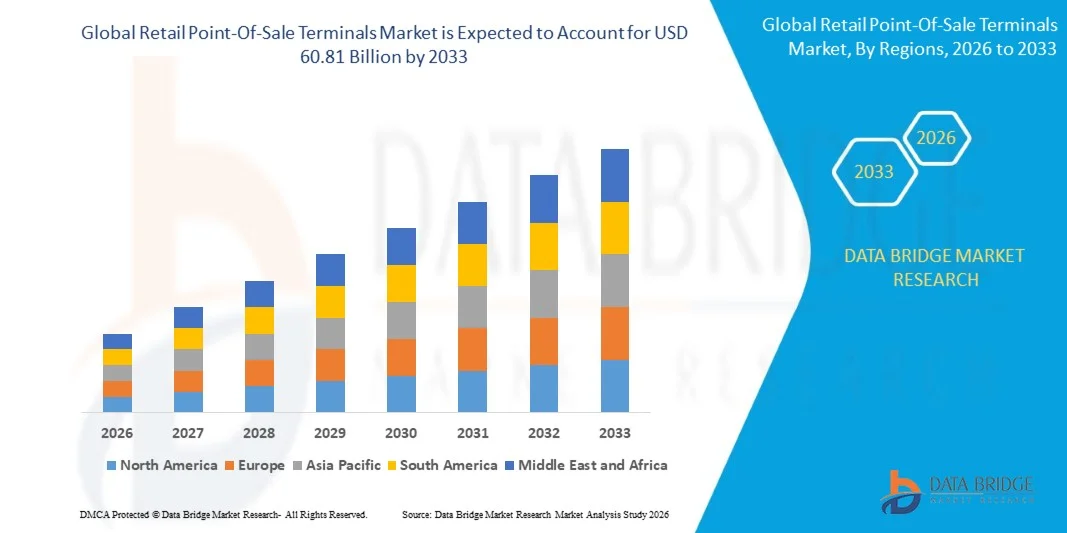
- As per Data Bridge Market Research analysis, the retail point-of-sale terminals market was valued at USD 36.20 billion in 2025 and is projected to reach USD 60.81 billion by 2033, growing at a CAGR of 6.70% from 2026 to 2033.
- The market is experiencing consistent growth driven by rising adoption of digital payment technologies, increasing demand for efficient and integrated retail transaction solutions, and expanding deployment of POS terminals across supermarkets, convenience stores, specialty stores, and other retail establishments.
- The increasing shift toward cashless transactions globally, combined with growing e-commerce and omnichannel retail integration, is compelling retailers to adopt advanced POS technologies. Cloud-based systems, mobile POS terminals, contactless payment capabilities, and real-time inventory management are enhancing transaction efficiency, customer experience, and operational visibility across the retail sector.
Market Size & Forecast
- Global Market Value (2025): USD 36.20 Billion
- Expected Market Value (2033): USD 60.81 Billion
- Forecast CAGR (2026–2033): 6.70%
- Leading Region in 2025: North America
- Fastest Growing Region: Asia Pacific
What are the Major Takeaways of the Retail Point-Of-Sale Terminals Market?
- North America dominated the retail point-of-sale market with the largest revenue share of 38.65% in 2025, supported by widespread adoption of advanced transaction systems, mobile POS technologies, and integrated retail solutions.
- Asia-Pacific is expected to be the fastest-growing region at a CAGR of 8.2% from 2026 to 2033, fueled by rapid digital payment adoption, expanding organized retail, increasing POS deployments, and supportive government initiatives promoting cashless transactions
- The fixed POS terminals segment led the market with a 58.9% share in 2025, driven by their widespread deployment across supermarkets, hypermarkets, specialty stores, and other high-volume retail environments.
- Mobile POS terminals are the fastest-growing product type, projected to register a CAGR of 10%, reflecting the surge in demand for flexible checkout and assisted-selling solutions.
- The hardware segment dominated the component category with a 61.8% revenue share in 2025, led by continued demand for POS terminals, payment devices, barcode scanners, displays, receipt printers, and other physical equipment.
- On-premise accounted for 71.6% of the market share in 2025, preferred by the continued use of established POS infrastructure within retail stores
- The convenience stores segment is the fastest-growing application category, with a CAGR of 8%, driven by expanding convenience retail formats and the need for rapid transaction processing
Report Scope and Retail Point-Of-Sale Terminals Market Segmentation
|
Attributes |
Retail Point-Of-Sale Terminals Key Market Insights |
|
Segments Covered |
|
|
Countries Covered |
North America
Europe
Asia-Pacific
Middle East and Africa
South America
|
|
Key Market Players |
|
|
Market Opportunities |
|
|
Value Added Data Infosets |
In addition to the insights on market scenarios such as market value, growth rate, segmentation, geographical coverage, and major players, the market reports curated by the Data Bridge Market Research also include in-depth expert analysis, geographically represented company-wise production and capacity, network layouts of distributors and partners, detailed and updated price trend analysis and deficit analysis of supply chain and demand. |
What is the Key Trend in the Retail Point-Of-Sale Terminals Market?
- Retailers are increasingly adopting cloud-based and mobile POS systems to unify in-store transactions, inventory, customer data, and omnichannel operations across physical and digital retail environments.
- For instance, in January 2025, Salesforce introduced Retail Cloud with Modern POS, a cloud-based system that brings online and offline shopping data onto a single platform, integrating mobile POS, clienteling, endless aisle, mixed-cart transactions, omnichannel fulfillment, and inventory management, demonstrating the growing shift toward cloud-connected and unified retail POS platforms.
- The growing deployment of mobile POS is enabling retailers to reduce checkout queues, provide flexible payment options, and allow sales associates to complete transactions from anywhere within the store.
- Retailers are also integrating AI-powered capabilities into POS infrastructure to improve transaction reliability, automate operational tasks, and generate real-time insights from sales and customer data.
- For instance, in May 2025, Block launched Square Handheld, a portable POS device priced at USD 399 that combines card and contactless payments, barcode scanning, inventory management, and a full-day battery, demonstrating the growing shift toward mobile and flexible checkout terminals.
- As retailers increasingly prioritize unified commerce, mobile checkout, and intelligent payment infrastructure, the adoption of cloud-connected, AI-enabled, and mobile POS terminals is expected to accelerate, reinforcing POS technology as a core component of modern retail operations.
What are the Key Drivers of the Retail Point-Of-Sale Terminals Market?
- The rapid shift toward cashless and contactless payments has significantly increased demand for POS terminals capable of supporting NFC, digital wallets, cards, and other electronic payment methods across retail environments.
- For instance, in April 2025, Block launched the next-generation Square Point of Sale app, consolidating retail, payments, inventory management, and other business functions into a single platform; Block reported that feature discovery and usage among new sellers increased by nearly 80%, demonstrating how integrated POS platforms are driving retailers toward more efficient and connected transaction management.
- Retailers, payment providers, and technology companies are increasingly deploying integrated POS platforms to connect payment processing with inventory, customer engagement, loyalty, analytics, and omnichannel retail operations.
- For instance, in May 2025, Square launched Square Handheld, a portable POS terminal featuring barcode scanning, inventory management, contactless and chip payments, and all-day battery capability; Square stated that retail and restaurant businesses accounted for 50% of its gross payment volume in 2024, highlighting the growing demand for flexible POS solutions that support transactions and operations beyond fixed checkout counters.
- With retailers increasingly prioritizing faster transactions, seamless payment experiences, and integrated store management, advanced POS terminals will remain indispensable for improving operational efficiency and delivering connected customer experiences across modern retail environments.
Which Factors are Challenging the Growth of the Retail Point-Of-Sale Terminals Market?
- Advanced retail POS systems require significant upfront investment because retailers must integrate terminals with payment infrastructure, inventory systems, security technologies, software platforms, and existing store networks.
- For instance, in November 2025, Sophos reported that 58% of retail organizations affected by ransomware paid the ransom to recover encrypted data, while the median ransom demand doubled to USD 2 million, highlighting the growing cybersecurity and financial risks associated with connected retail infrastructure, including POS environments.
- These costs can limit adoption among small retailers and independent merchants, particularly when businesses require multiple terminals, software subscriptions, maintenance services, cybersecurity infrastructure, and continuous technology upgrades.
- The growing complexity of POS infrastructure also increases cybersecurity, connectivity, maintenance, and interoperability requirements, creating additional operational challenges for retailers managing large networks of connected checkout devices.
- For instance, in March 2025, the PCI Security Standards Council emphasized new PCI DSS requirements for payment-page script authorization, integrity checks, and tamper monitoring, demonstrating how increasingly stringent payment-security requirements can add compliance complexity and operational costs for retailers using connected POS and payment infrastructure.
- The high capital requirements, recurring technology costs, cybersecurity concerns, and integration complexities associated with advanced POS infrastructure continue to restrict adoption, particularly among small and medium-sized retailers, slowing technology upgrades in price-sensitive markets.
How is the Retail Point-Of-Sale Terminals Market Segmented?
The retail point-of-sale terminals market is segmented on the basis of product, component, deployment, application, and end user
- By Product
On the basis of product, the retail point-of-sale terminals market is segmented into fixed POS terminals and mobile POS terminals. The fixed POS terminals segment dominated the market with a 58.9% share in 2025, owing to their widespread deployment across supermarkets, hypermarkets, specialty stores, and other high-volume retail environments. Fixed terminals provide stable transaction processing and support peripherals such as barcode scanners, receipt printers, cash drawers, and payment devices. They are particularly suitable for established checkout counters where retailers require reliable and continuous transaction processing. Their integration with inventory management, payment processing, loyalty programs, and other retail systems further supports adoption. Large retail chains continue to use fixed terminals because they provide standardized checkout operations across multiple stores.
The mobile POS terminals segment is projected to register the fastest growth at a CAGR of 10% from 2026 to 2033, driven by increasing demand for flexible checkout and assisted-selling solutions. Mobile POS systems allow retail employees to process transactions directly from the sales floor, helping reduce queues and improve customer convenience. These terminals can support payments, barcode scanning, inventory access, and customer engagement through portable devices. Increasing adoption of cloud-based retail platforms is further improving their flexibility and scalability. Retailers are using mobile POS for line-busting, pop-up stores, curbside transactions, and personalized customer service. Growing contactless payment adoption is also strengthening demand for portable payment-enabled devices.
- By Component
On the basis of component, the retail point-of-sale terminals market is segmented into hardware, software, and services. The hardware segment dominated the market with a 61.8% share in 2025, supported by continued demand for POS terminals, payment devices, barcode scanners, displays, receipt printers, and other physical equipment. Hardware remains essential because retailers require reliable devices to execute transactions and connect stores with digital payment infrastructure. Increasing adoption of contactless and electronic payments is encouraging retailers to upgrade terminals with modern payment capabilities. Retail chains also require multiple terminals across individual stores, creating recurring demand for replacement and technology upgrades. Hardware In addition provides the physical foundation for integrated checkout and inventory-management systems.
The software segment is projected to be the fastest-growing component at a CAGR of 10.5% from 2026 to 2033, supported by increasing demand for integrated payment, inventory, analytics, loyalty, and customer-management capabilities. Cloud-connected POS software enables retailers to access sales and inventory information across multiple locations in real time. Modern platforms can connect physical stores with e-commerce, accounting, supply-chain, and customer-engagement applications. Subscription-based software models are also lowering technology barriers for smaller retailers. Artificial intelligence and advanced analytics are expanding POS software capabilities by supporting forecasting, customer insights, and operational optimization. Retailers are increasingly treating POS software as a central operating platform rather than simply a transaction-processing application.
- By Deployment
On the basis of deployment, the retail point-of-sale terminals market is segmented into cloud and on-premise. The on-premise segment dominated the market with a 71.6% share in 2025, reflecting the continued use of established POS infrastructure within retail stores. On-premise systems provide retailers with direct control over their transaction environment, software configuration, data management, and store-level operations. They remain particularly relevant for large retailers that have already invested substantially in existing hardware and enterprise IT infrastructure. Retailers with high transaction volumes may also prefer established on-premise environments because of their reliability and integration with legacy applications. Some businesses continue to prioritize direct control over operational and transaction data.
The cloud segment is projected to register the fastest growth at a CAGR of 11% from 2026 to 2033, driven by growing demand for centralized management, scalability, and real-time access to retail data. Cloud POS platforms allow retailers to manage sales, inventory, software updates, and analytics across multiple locations through centralized systems. They reduce dependence on extensive store-level IT infrastructure and simplify software updates and maintenance. Subscription-based models can also reduce upfront infrastructure requirements for retailers. Cloud systems facilitate integration between physical stores and e-commerce platforms, supporting unified inventory and customer information. They are particularly attractive to retailers pursuing omnichannel strategies and flexible store operations.
- By Application
On the basis of application, the retail point-of-sale terminals market is segmented into supermarkets/hypermarkets, convenience stores, grocery stores, specialty stores, gas stations, and others. The supermarkets/hypermarkets segment dominated the market with a 48.8% share in 2025, supported by high transaction volumes and extensive inventory requirements. These large-format retailers require POS systems capable of processing transactions efficiently while supporting barcode scanning, inventory tracking, loyalty programs, and payment management. POS systems also provide centralized sales and inventory information that helps retailers optimize store operations. Large supermarket and hypermarket chains require numerous checkout terminals across their store networks, creating substantial equipment demand. Integration with inventory and automated checkout technologies further strengthens the role of POS terminals in this segment.
The convenience stores segment is expected to witness the fastest growth at a CAGR of 8% from 2026 to 2033, driven by expanding convenience retail formats and the need for rapid transaction processing. These stores generally operate with limited space and require compact POS systems capable of handling frequent transactions efficiently. Cloud-connected POS solutions enable operators to monitor sales and inventory across multiple locations. Contactless payment capabilities are also increasingly important as consumers demand faster checkout experiences. POS platforms can combine payment processing with inventory tracking, promotions, loyalty programs, and sales monitoring. Expansion of convenience stores in urban areas and emerging markets is creating additional demand for efficient retail technology.
- By End User
On the basis of end user, the retail point-of-sale terminals market is segmented into large enterprises and SMEs. Large enterprises dominated the market with 65% in 2025, supported by extensive retail networks requiring large numbers of POS terminals and integrated enterprise-level systems. Major retailers typically require advanced capabilities for centralized inventory management, payment processing, loyalty programs, analytics, and omnichannel fulfillment. Large enterprises also have greater capacity to invest in hardware upgrades, software integration, cybersecurity, and managed POS services. Their high transaction volumes generate substantial demand for reliable and scalable POS infrastructure. Multi-location retailers benefit from centralized management of sales and operational data across stores.
The SMEs segment is expected to register the fastest growth at a CAGR of 9% from 2026 to 2033, as affordable cloud-based and mobile POS solutions reduce barriers to adoption. Subscription-based platforms allow smaller retailers to access payment processing, inventory management, analytics, and customer-management capabilities without extensive upfront infrastructure investment. Mobile POS systems are particularly suitable for SMEs because they can operate through tablets, smartphones, or compact dedicated terminals. Increasing digital payment adoption is encouraging smaller merchants to replace cash-oriented transaction systems with electronic payment solutions. Cloud platforms also provide remote access to sales and inventory information without requiring dedicated in-house IT infrastructure.
Which Region Holds the Largest Share of the Retail Point-Of-Sale Terminals Market?
- North America dominated the retail point-of-sale market with the largest revenue share of 38.65% in 2025, supported by widespread adoption of advanced transaction systems, mobile POS technologies, and integrated retail solutions.
- The region also benefits from high penetration of contactless payments, mobile POS systems, cloud-based retail platforms, and omnichannel commerce. Retailers across the U.S. and Canada are increasingly adopting POS technologies that connect physical stores with digital shopping channels and provide real-time visibility into sales and inventory. The expansion of self-checkout and assisted-selling solutions is creating additional demand for advanced POS terminals. Strong investments in cybersecurity and payment infrastructure are also encouraging replacement of older systems with more secure and capable technologies.
U.S. Retail Point-Of-Sale Terminals Market Insight
The U.S. retail point-of-sale terminals market is witnessing strong growth due to rising adoption of digital payments, contactless transactions, mobile POS systems, and integrated retail technologies. The country’s mature retail ecosystem, along with increasing deployment of cloud-based POS platforms and self-checkout technologies, is driving demand across supermarkets, specialty stores, convenience stores, and other retail applications. In addition, growing emphasis on omnichannel commerce, real-time inventory visibility, and personalized customer experiences is accelerating the adoption of advanced POS terminals among retailers.
Asia-Pacific Retail Point-of-Sale Terminals Market Insight
The Asia-Pacific retail point-of-sale terminals market is expected to witness rapid growth, driven by increasing digital payment adoption, expanding organized retail, and rising investments in modern retail infrastructure across countries such as China, India, and Japan. Growing smartphone penetration, increasing use of contactless payments, and adoption of mobile and cloud-based POS solutions are supporting regional market expansion. In addition, the rapid development of e-commerce and omnichannel retail, along with government initiatives promoting cashless transactions, is accelerating POS terminal adoption across the region.
Japan Retail Point-of-Sale Terminals Market Insight
The Japan retail point-of-sale terminals market is witnessing consistent growth due to rising investments in digital payment infrastructure, retail automation, and advanced transaction technologies. Retailers, supermarkets, convenience stores, and specialty stores are increasingly adopting sophisticated POS systems for faster transactions, inventory management, and customer engagement. Moreover, increasing integration of contactless payments, self-checkout systems, cloud-based platforms, and data analytics is further contributing to market growth.
China Retail Point-of-Sale Terminals Market Insight
The China retail point-of-sale terminals market is growing rapidly, driven by widespread digital payment adoption, expanding retail infrastructure, and increasing deployment of mobile and smart POS systems. Growing use of QR-code payments, contactless transactions, and integrated retail platforms across supermarkets, convenience stores, and specialty retailers is significantly boosting market demand. In addition, rising investments in retail digitalization, omnichannel commerce, artificial intelligence, and cloud-based POS technologies are positioning China as one of the fastest-growing markets for retail point-of-sale terminals globally.
U.K. Retail Point-of-Sale Terminals Market Insight
The U.K. retail point-of-sale terminals market is experiencing steady growth, supported by widespread adoption of contactless payments, mobile POS technologies, and integrated retail management systems. Increasing investments in cloud-based POS infrastructure and demand for faster, more convenient checkout experiences are contributing to market growth. Furthermore, the integration of POS platforms with inventory management, loyalty programs, e-commerce, and customer analytics is improving retail operational efficiency, positioning the U.K. as an important market for advanced POS technologies.
Germany Retail Point-of-Sale Terminals Market Insight
The Germany retail point-of-sale terminals market is expanding steadily due to the country’s developed retail sector, increasing digital payment adoption, and growing investments in modern retail technologies. Supermarkets, specialty stores, convenience retailers, and other businesses are increasingly utilizing POS terminals for secure transactions, inventory management, and integrated customer services. Continuous advancements in contactless payment technology, cloud-based POS platforms, self-checkout solutions, and retail automation, along with growing demand for efficient transaction processing, are further driving market growth in Germany.
Which are the Top Companies in Retail Point-Of-Sale Terminals Market?
The retail point-of-sale terminals industry is primarily led by well-established companies, including:
- Block, Inc. (U.S.)
- NCR Voyix Corporation (U.S.)
- Verifone Systems, Inc. (U.S.)
- Ingenico (France)
- Posiflex (Taiwan)
- Toshiba Tec Corporation (Japan)
- Diebold Nixdorf, Incorporated (U.S.)
- HP Development Company, L.P. (U.S.)
- Fujitsu Limited (Japan)
- Samsung Electronics Co., Ltd. (South Korea)
- Panasonic Corporation (Japan)
- Fujian Newland Payment Technology Co., Ltd. (China)
- Fiserv, Inc. (U.S.)
- Lightspeed Commerce Inc. (Canada)
- Shopify Inc. (Canada)
- Toast, Inc. (U.S.)
- Oracle Corporation (U.S.)
- Agilysys, Inc. (U.S.)
- Aptos, Inc. (U.S.)
What are Latest Developments in Retail Point-Of-Sale Terminals Market?
- In April 2025, Square, a Block company, launched its next-generation Square Point of Sale app, consolidating payments and business-management capabilities for retail, restaurants, and services into a single personalized platform. The new POS combines vertical-specific functionality with a unified interface, helping sellers manage transactions and operations more efficiently and demonstrating the industry's shift toward integrated, flexible POS platforms
- In January 2025, Salesforce introduced Retail Cloud with Modern POS, a cloud-based POS platform designed to connect online and offline shopping and inventory data on a single platform. The solution provides retail associates with mobile checkout, clienteling, endless-aisle capabilities, and omnichannel fulfillment tools, highlighting the growing adoption of cloud-connected POS systems for unified retail operations
- In April 2024, NCR Voyix announced a new-generation self-checkout solution for retailers, designed to provide greater flexibility and improve the checkout experience for shoppers. The solution was presented at NRF 2024 as retailers increasingly sought modern self-service technologies capable of supporting changing customer expectations and improving checkout efficiency.
- In April 2023, Square expanded its retail POS capabilities through nearly 100 new product features, including the launch of Square for Retail on Square Terminal in Australia, France, Ireland, and Spain. The expansion enabled retailers to provide mobile, on-the-go checkout and introduced additional POS capabilities such as customer receipts, loyalty tools, and integrations, reinforcing the move toward flexible and connected retail terminals.
- In January 2021, Square launched Square for Retail, a full POS system designed to help retailers manage inventory and sell across physical and online channels. The platform addressed retailers' need to digitize operations by combining selling and inventory-management capabilities, supporting the industry's transition toward integrated POS solutions capable of connecting in-store and online commerce

- Interactive Data Analysis Dashboard
- Company Analysis Dashboard for high growth potential opportunities
- Research Analyst Access for customization & queries
- Competitor Analysis with Interactive dashboard
- Latest News, Updates & Trend analysis
- Harness the Power of Benchmark Analysis for Comprehensive Competitor Tracking
Global Retail Point Of Sale Terminals Market, Supply Chain Analysis and Ecosystem Framework
To support market growth and help clients navigate the impact of geopolitical shifts, DBMR has integrated in-depth supply chain analysis into its Global Retail Point Of Sale Terminals Market research reports. This addition empowers clients to respond effectively to global changes affecting their industries. The supply chain analysis section includes detailed insights such as Global Retail Point Of Sale Terminals Market consumption and production by country, price trend analysis, the impact of tariffs and geopolitical developments, and import and export trends by country and HSN code. It also highlights major suppliers with data on production capacity and company profiles, as well as key importers and exporters. In addition to research, DBMR offers specialized supply chain consulting services backed by over a decade of experience, providing solutions like supplier discovery, supplier risk assessment, price trend analysis, impact evaluation of inflation and trade route changes, and comprehensive market trend analysis.
Data collection and base year analysis are done using data collection modules with large sample sizes. The stage includes obtaining market information or related data through various sources and strategies. It includes examining and planning all the data acquired from the past in advance. It likewise envelops the examination of information inconsistencies seen across different information sources. The market data is analysed and estimated using market statistical and coherent models. Also, market share analysis and key trend analysis are the major success factors in the market report. To know more, please request an analyst call or drop down your inquiry.
The key research methodology used by DBMR research team is data triangulation which involves data mining, analysis of the impact of data variables on the market and primary (industry expert) validation. Data models include Vendor Positioning Grid, Market Time Line Analysis, Market Overview and Guide, Company Positioning Grid, Patent Analysis, Pricing Analysis, Company Market Share Analysis, Standards of Measurement, Global versus Regional and Vendor Share Analysis. To know more about the research methodology, drop in an inquiry to speak to our industry experts.
Data Bridge Market Research is a leader in advanced formative research. We take pride in servicing our existing and new customers with data and analysis that match and suits their goal. The report can be customized to include price trend analysis of target brands understanding the market for additional countries (ask for the list of countries), clinical trial results data, literature review, refurbished market and product base analysis. Market analysis of target competitors can be analyzed from technology-based analysis to market portfolio strategies. We can add as many competitors that you require data about in the format and data style you are looking for. Our team of analysts can also provide you data in crude raw excel files pivot tables (Fact book) or can assist you in creating presentations from the data sets available in the report.













