


Retinoids Lymphedema Therapy Market Size
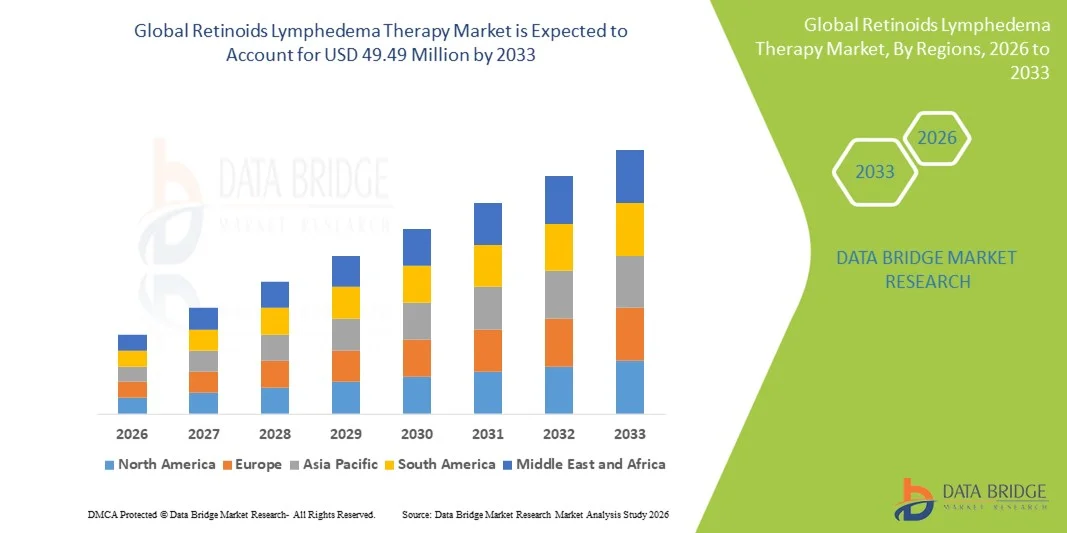
- The global retinoids lymphedema therapy market size was valued at USD 24.53 million in 2025 and is expected to reach USD 49.49 million by 2033, at a CAGR of 9.17% during the forecast period
- The market growth is largely driven by the increasing prevalence of lymphedema and dermatological conditions, coupled with growing awareness of the benefits of retinoid-based therapies in improving skin health, tissue regeneration, and lymphatic management
- Furthermore, rising patient demand for effective, non-invasive, and multi-modal treatment solutions, along with advancements in drug delivery systems and targeted therapies, is positioning retinoids lymphedema therapy as a preferred treatment option. These factors are collectively accelerating market adoption, thereby substantially boosting the industry's growth
Retinoids Lymphedema Therapy Market Analysis
- Retinoids lymphedema therapies, offering pharmacologic, topical, and compression-based interventions for primary and secondary lymphedema as well as skin disorders, anti-aging, and psoriasis, are increasingly vital components of modern healthcare and dermatology management in both clinical and homecare settings due to their efficacy in improving lymphatic function, enhancing skin health, and supporting tissue repair
- The escalating demand for retinoids lymphedema therapy is primarily fueled by the rising prevalence of lymphedema and dermatological conditions, growing patient awareness about multi-modal treatment options, and a preference for non-invasive, effective, and integrated therapies that can be used alongside conventional care
- North America dominated the retinoids lymphedema therapy market with the largest revenue share of 43% in 2025, characterized by advanced healthcare infrastructure, high patient awareness, and a strong presence of key pharmaceutical and dermatology players, with the U.S. experiencing substantial growth in the adoption of compression therapy, pharmacologic treatments, and topical retinoid formulations driven by innovations from both established companies and research-focused startups
- Asia-Pacific is expected to be the fastest-growing region in the retinoids lymphedema therapy market during the forecast period, projected to capture a CAGR-driven share increase, due to increasing healthcare accessibility, rising disposable incomes, and expanding clinical research and dermatology initiatives
- Compression therapy dominated the market with a market share of 39.2% in 2025, driven by its proven efficacy, ease of use, and preference among patients and healthcare providers for effective, non-invasive solutions
Report Scope and Retinoids Lymphedema Therapy Market Segmentation
|
Attributes |
Retinoids Lymphedema Therapy Key Market Insights |
|
Segments Covered |
|
|
Countries Covered |
North America
Europe
Asia-Pacific
Middle East and Africa
South America
|
|
Key Market Players |
|
|
Market Opportunities |
|
|
Value Added Data Infosets |
In addition to the insights on market scenarios such as market value, growth rate, segmentation, geographical coverage, and major players, the market reports curated by the Data Bridge Market Research also include in-depth expert analysis, patient epidemiology, pipeline analysis, pricing analysis, and regulatory framework |
Retinoids Lymphedema Therapy Market Trends
Integration of Multi-Modal Therapies for Enhanced Patient Outcomes
- A significant and accelerating trend in the global retinoids lymphedema therapy market is the increasing combination of compression therapy with topical and pharmacologic retinoid formulations to improve lymphatic function and skin health
- For instance, clinical protocols integrating compression garments with retinoid-based topical applications have shown improved skin texture and reduced swelling, enhancing patient adherence and outcomes
- Advanced delivery systems are enabling targeted retinoid administration, improving efficacy while reducing side effects such as irritation or redness, and supporting better patient management
- Treatment regimens are increasingly personalized, combining pharmacologic, topical, and device-based therapies based on patient-specific lymphedema type and severity
- This trend towards integrated, multi-modal, and patient-centric therapies is reshaping clinical practice, prompting pharmaceutical and medical device companies to develop novel combination products
- The adoption of such therapies is growing rapidly across hospitals, clinics, and homecare settings, as patients and healthcare providers increasingly prioritize convenience, efficacy, and holistic lymphedema management
Retinoids Lymphedema Therapy Market Dynamics
Driver
Rising Prevalence of Lymphedema and Dermatological Conditions
- The increasing incidence of primary and secondary lymphedema, along with skin disorders such as psoriasis and aging-related dermatological issues, is a major driver for the growing adoption of retinoids lymphedema therapies
- For instance, recent clinical studies indicate a higher uptake of retinoid-based topical and pharmacologic treatments in patients with coexisting skin disorders, boosting market demand
- Rising patient awareness about the benefits of multi-modal therapies, including compression and drug-based approaches, is further propelling adoption in both hospital and homecare settings
- The need for effective, non-invasive, and easy-to-administer therapies is increasing among patients and healthcare providers, strengthening the market growth trajectory
- Growing investments by pharmaceutical and dermatology companies in novel retinoid formulations and combination therapies are also expanding the therapy options available
- These converging factors are driving the rapid uptake of retinoids lymphedema therapy across multiple regions and patient segments, supporting sustained market growth
Restraint/Challenge
Skin Irritation Issues and Regulatory Compliance Hurdle
- Side effects such as skin irritation, redness, or sensitivity associated with retinoid therapies present a key challenge to patient adherence and market penetration
- For instance, some patients discontinue topical retinoid use due to discomfort or mild dermatitis, limiting widespread acceptance of these therapies
- Strict regulatory requirements for pharmacologic and topical formulations, including clinical trial validation and safety approvals, can delay product launches and increase costs
- High treatment costs, particularly for combination therapy regimens involving compression devices and retinoids, can restrict adoption among price-sensitive patients in developing regions
- Educating patients and healthcare providers about correct application, dosing, and safety protocols is critical to overcoming compliance and safety concerns
- Addressing these challenges through improved formulations, enhanced patient education, and streamlined regulatory processes will be essential for sustained market expansion
Retinoids Lymphedema Therapy Market Scope
The market is segmented on the basis of type, therapy type, and end user.
- By Type
On the basis of type, the retinoids lymphedema therapy market is segmented into primary lymphedema, secondary lymphedema, skin disorders, anti-aging, and psoriasis. Secondary Lymphedema dominated the market with the largest revenue share in 2025, driven by its higher prevalence compared to primary lymphedema, often resulting from cancer treatments such as surgery or radiation. Patients and healthcare providers prioritize effective management of secondary lymphedema due to the associated risk of infections and chronic swelling. The segment benefits from strong adoption of compression therapy combined with pharmacologic and topical retinoid treatments, which improve lymphatic drainage and skin integrity. Increasing awareness among clinicians and patients regarding early intervention and multi-modal treatment approaches further reinforces its market dominance. Healthcare infrastructure in North America and Europe supports widespread clinical adoption, ensuring accessibility to a range of therapy options. Moreover, research initiatives focusing on improving patient outcomes in secondary lymphedema are driving consistent demand for advanced retinoid therapies.
Skin Disorders is anticipated to witness the fastest growth rate from 2026 to 2033, fueled by rising incidences of dermatological conditions such as psoriasis, eczema, and aging-related skin issues. Retinoid-based topical and pharmacologic treatments are highly effective in managing these conditions, promoting cellular regeneration and improving skin elasticity. Increasing consumer preference for non-invasive, home-based treatment options is further accelerating growth. In addition, growing awareness about cosmetic benefits, combined with dermatology clinic initiatives to integrate retinoid therapies with lymphedema management, supports expansion. The market also sees adoption in research and academic settings for clinical studies, enhancing accessibility and visibility of these therapies. Rising disposable incomes and healthcare expenditure in Asia-Pacific contribute to the rapid uptake of skin disorder-focused retinoid therapies.
- By Therapy Type
On the basis of therapy type, the market is segmented into compression therapy, drug therapy, pharmacologic therapy, laser therapy, and others. Compression Therapy dominated the market with the largest revenue share of 39.2% in 2025, due to its critical role in managing lymphedema symptoms by promoting lymphatic drainage and preventing fluid accumulation. Compression garments, bandaging systems, and pneumatic devices are widely recommended by clinicians, often in combination with retinoid-based therapies to improve skin health. Patients favor compression therapy for its immediate visible benefits in swelling reduction and long-term prevention of complications. The segment’s dominance is supported by hospitals and clinics in developed regions that provide access to advanced compression solutions. Strong clinical guidelines and insurance coverage in key markets also encourage adoption. Innovations such as adjustable compression systems and integration with wearable monitoring devices enhance patient compliance and therapeutic outcomes.
Drug Therapy is expected to witness the fastest CAGR from 2026 to 2033, driven by increased research and development in pharmacologic retinoid formulations targeting both lymphedema and associated dermatological conditions. Drug therapies offer a convenient, non-invasive alternative for patients unable to use compression devices consistently. Advances in targeted drug delivery, including sustained-release formulations, are improving efficacy while minimizing side effects. Homecare adoption of oral or topical drugs is growing, supported by telemedicine consultations and patient monitoring. The segment is also expanding due to rising clinical trials and research initiatives exploring combination therapies for multi-condition management. Increased patient awareness and accessibility in emerging markets are further fueling rapid growth.
- By End User
On the basis of end user, the market is segmented into hospitals, clinics, ambulatory surgical centers, home therapy, dermatology & cosmetic clinics, and research & academic institutes. Hospitals dominated the market with the largest revenue share in 2025, driven by their comprehensive healthcare infrastructure and early adoption of multi-modal retinoids lymphedema therapies. Hospitals provide access to compression devices, pharmacologic treatments, and clinical monitoring, ensuring optimal patient outcomes. The dominance is reinforced by strong clinical protocols, availability of specialist care, and higher patient footfall in both inpatient and outpatient settings. Hospitals also serve as key centers for pilot studies and adoption of innovative therapies, including advanced topical retinoids and combination approaches. Healthcare insurance coverage in key regions supports affordability and accessibility, boosting adoption. In addition, hospitals play a central role in educating patients on proper therapy usage and adherence, enhancing treatment effectiveness.
Home Therapy is anticipated to witness the fastest growth rate from 2026 to 2033, due to rising patient preference for convenient, self-managed lymphedema care integrated with topical retinoid applications. Home-based adoption is supported by portable compression devices, user-friendly drug delivery options, and telemedicine guidance from healthcare providers. Increasing awareness of non-invasive therapy benefits and cost savings compared to frequent hospital visits drives growth. The trend is further supported by growing availability of approved home-use retinoid formulations and wearable monitoring technologies. Rising disposable incomes, especially in Asia-Pacific, and the desire for privacy and independence in care are accelerating this segment’s expansion. In addition, online platforms and pharmacies are making these therapies more accessible for home users.
Retinoids Lymphedema Therapy Market Regional Analysis
- North America dominated the retinoids lymphedema therapy market with the largest revenue share of 43% in 2025, characterized by advanced healthcare infrastructure, high patient awareness, and a strong presence of key pharmaceutical and dermatology players
- Patients and healthcare providers in the region highly value the effectiveness, non-invasive nature, and multi-modal treatment options offered by retinoid therapies in combination with compression therapy, enhancing skin health and lymphatic function
- This widespread adoption is further supported by high patient awareness, strong presence of key pharmaceutical and dermatology players, and access to advanced clinical protocols, establishing retinoids lymphedema therapy as a preferred treatment option across hospitals, clinics, and homecare settings
U.S. Retinoids Lymphedema Therapy Market Insight
The U.S. retinoids lymphedema therapy market captured the largest revenue share of 81% in 2025 within North America, fueled by the high prevalence of secondary lymphedema and growing awareness of effective multi-modal treatment options. Patients and healthcare providers increasingly prioritize therapies combining compression therapy with retinoid-based pharmacologic and topical treatments. The growing preference for home-based, non-invasive care solutions, coupled with advanced clinical protocols and robust healthcare infrastructure, further propels the market. Moreover, research initiatives and pharmaceutical innovations in targeted retinoid formulations are significantly contributing to the market's expansion.
Europe Retinoids Lymphedema Therapy Market Insight
The Europe retinoids lymphedema therapy market is projected to expand at a substantial CAGR throughout the forecast period, primarily driven by rising incidence of lymphedema and dermatological conditions. Stringent healthcare standards, increasing urbanization, and higher patient awareness are fostering the adoption of multi-modal therapies. European patients and clinics are also drawn to the effectiveness, safety, and convenience offered by retinoid-based treatments. The market is witnessing significant growth across hospitals, clinics, and homecare applications, with therapies being incorporated into both new clinical protocols and ongoing patient care programs.
U.K. Retinoids Lymphedema Therapy Market Insight
The U.K. retinoids lymphedema therapy market is anticipated to grow at a noteworthy CAGR during the forecast period, driven by increasing adoption of multi-modal therapy approaches and a rising demand for non-invasive, patient-friendly treatments. Concerns regarding complications from untreated lymphedema are encouraging both patients and healthcare providers to choose integrated retinoid-based solutions. The U.K.’s strong healthcare infrastructure and awareness of dermatology and lymphatic management, alongside its robust clinical research environment, are expected to continue stimulating market growth.
Germany Retinoids Lymphedema Therapy Market Insight
The Germany retinoids lymphedema therapy market is expected to expand at a considerable CAGR during the forecast period, fueled by increasing awareness of lymphedema management and advanced treatment options. Germany’s well-developed healthcare infrastructure, emphasis on innovation, and growing clinical research initiatives promote the adoption of combination therapies involving compression and retinoids. Hospitals and dermatology clinics are increasingly integrating retinoid-based pharmacologic and topical treatments with routine lymphedema care. Furthermore, patients prefer safe, effective, and non-invasive options that align with regulatory guidelines and local healthcare standards.
Asia-Pacific Retinoids Lymphedema Therapy Market Insight
The Asia-Pacific retinoids lymphedema therapy market is poised to grow at the fastest CAGR during the forecast period of 2026 to 2033, driven by rising prevalence of lymphedema and skin disorders in countries such as China, Japan, and India. The region’s growing inclination towards advanced healthcare, supported by government initiatives promoting access to treatment, is driving therapy adoption. Moreover, increasing disposable incomes, growing awareness of non-invasive treatment options, and expanding home-based care solutions are further contributing to market growth. Asia-Pacific is also emerging as a hub for clinical research and pharmaceutical manufacturing of retinoid-based therapies, enhancing accessibility.
Japan Retinoids Lymphedema Therapy Market Insight
The Japan retinoids lymphedema therapy market is gaining momentum due to the country’s advanced healthcare system, aging population, and high patient awareness. Adoption is driven by the increasing number of patients seeking non-invasive, effective, and easy-to-use treatment options for lymphedema and skin disorders. Integration of retinoid therapies with compression treatment and home-based care is fueling market growth. Moreover, Japan’s focus on clinical research and innovation in topical and pharmacologic formulations supports the development of safer and more efficient therapies in both residential and clinical settings.
India Retinoids Lymphedema Therapy Market Insight
The India retinoids lymphedema therapy market accounted for the largest market revenue share in Asia-Pacific in 2025, attributed to the country’s expanding middle class, rapid urbanization, and increasing awareness of lymphedema care. India is witnessing strong adoption of multi-modal therapies combining compression and retinoid-based treatments across hospitals, clinics, and homecare. Government initiatives promoting healthcare access and smart home-such as healthcare solutions, along with availability of affordable retinoid formulations, are key factors propelling the market. Growing domestic pharmaceutical manufacturing is also supporting wider accessibility and treatment adoption.
Retinoids Lymphedema Therapy Market Share
The Retinoids Lymphedema Therapy industry is primarily led by well-established companies, including:
- medi GmbH & Co. KG (Germany)
- 3M (U.S.)
- SIGVARIS GROUP (Switzerland)
- Huntleigh Healthcare Limited. (U.K.)
- Tactile Medical (U.S.)
- Mego Afek Ltd. (Israel)
- ThermoTek Inc. (U.S.)
- L&R Group (Germany)
- HERANTIS PHARMA Plc (Finland)
- Bio Compression Systems Inc. (U.S.)
- Lympha Press (U.S.)
- BiaCare Medical LLC (U.S.)
- GENTAG Inc. (U.S.)
- Smiths Group (U.K.)
- Getinge AB (Sweden)
- Compression Dynamics LLC (U.S.)
- BSN medical GmbH (Germany)
- Lohmann & Rauscher GmbH & Co. KG (Germany)
- Smith & Nephew (U.K.)
- Hartmann Group (Germany)
What are the Recent Developments in Global Retinoids Lymphedema Therapy Market?
- In July 2024, a detailed review of the molecular pathology of secondary lymphedema highlighted inflammatory, oxidative‑stress, and immune‑dysregulation pathways as major drivers of disease, and pointed specifically to nuclear receptors such as RXRs (retinoid X receptors) as promising therapeutic targets
- In February 2023, a mechanistic study (presented as a conference abstract) reported that knockdown of RXRα in human lymphatic endothelial cells (LECs) reduced their proliferation, migration, and tube formation, even in the presence of 9‑cis RA. This reinforces the idea that RXRα is critical for 9‑cis RA–driven lymphangiogenesis
- In January 2023, researchers published findings showing that RXRα (retinoid X receptor alpha) in lymphatic endothelial cells is essential for the therapeutic action of 9‑cis RA. When RXRα was specifically deleted in these cells, 9‑cis RA failed to stimulate lymphangiogenesis in vitro and could not prevent postsurgical lymphedema in vivo, demonstrating that this nuclear receptor is a key mediator of its effects
- In November 2022, a patent (US 11484496B2) was granted for an implantable, sustained‑release pellet of 9‑cis RA, designed to deliver the compound over ~30 days directly at the site of lymphatic injury (in a mouse model). The implant was shown to reduce swelling, improve lymphatic clearance, and limit epidermal hyperplasia
- In May 2022, a preclinical study using a mouse tail lymphedema model demonstrated that long-term treatment with 9‑cis retinoic acid (9‑cis RA) significantly reduced tail volume, dermal and epidermal thickness, and improved functional lymphatic clearance. Importantly, the benefits were duration-dependent while short-duration therapy showed little effect, continuous dosing over weeks led to increased lymphatic vessel density at the injured site

- Interactive Data Analysis Dashboard
- Company Analysis Dashboard for high growth potential opportunities
- Research Analyst Access for customization & queries
- Competitor Analysis with Interactive dashboard
- Latest News, Updates & Trend analysis
- Harness the Power of Benchmark Analysis for Comprehensive Competitor Tracking
Data collection and base year analysis are done using data collection modules with large sample sizes. The stage includes obtaining market information or related data through various sources and strategies. It includes examining and planning all the data acquired from the past in advance. It likewise envelops the examination of information inconsistencies seen across different information sources. The market data is analysed and estimated using market statistical and coherent models. Also, market share analysis and key trend analysis are the major success factors in the market report. To know more, please request an analyst call or drop down your inquiry.
The key research methodology used by DBMR research team is data triangulation which involves data mining, analysis of the impact of data variables on the market and primary (industry expert) validation. Data models include Vendor Positioning Grid, Market Time Line Analysis, Market Overview and Guide, Company Positioning Grid, Patent Analysis, Pricing Analysis, Company Market Share Analysis, Standards of Measurement, Global versus Regional and Vendor Share Analysis. To know more about the research methodology, drop in an inquiry to speak to our industry experts.
Data Bridge Market Research is a leader in advanced formative research. We take pride in servicing our existing and new customers with data and analysis that match and suits their goal. The report can be customized to include price trend analysis of target brands understanding the market for additional countries (ask for the list of countries), clinical trial results data, literature review, refurbished market and product base analysis. Market analysis of target competitors can be analyzed from technology-based analysis to market portfolio strategies. We can add as many competitors that you require data about in the format and data style you are looking for. Our team of analysts can also provide you data in crude raw excel files pivot tables (Fact book) or can assist you in creating presentations from the data sets available in the report.












