What is the Rice Husk Ash Market Size and Growth Rate ?
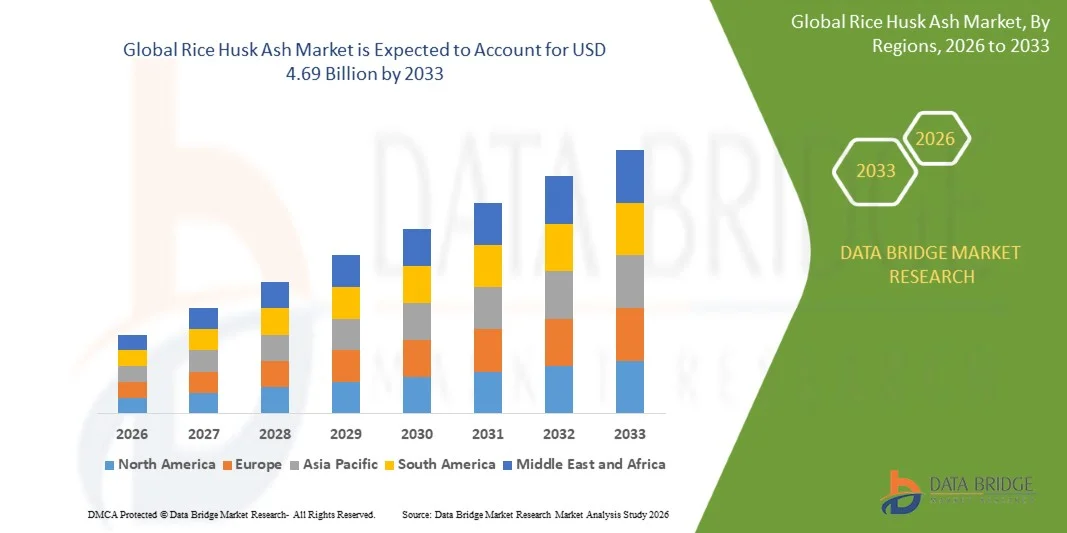
- As per Data Bridge Market Research Analysis the global rice husk ash market size was valued at USD 3.19 billion in 2025 and is expected to reach USD 4.69 billion by 2033, at a CAGR of 4.9% during the forecast period
- The market growth is largely driven by the increasing adoption of sustainable and eco-friendly construction materials, as Rice Husk Ash (RHA) serves as a high-performance supplementary cementitious material that enhances concrete durability and reduces carbon footprint
- Furthermore, rising demand from the construction and cement industries for cost-effective and environmentally responsible alternatives to traditional cement is positioning RHA as a preferred material. These factors are accelerating its adoption, thereby significantly boosting the market's growth
Market Size & Forecast
- Global Market Value (2025): USD 3.19 billion
- Expected Market Value (2033): USD 4.69 billion
- Forecast CAGR (2026–2033): 4.9%
What are the Major Takeaways of Rice Husk Ash Market ?
- Rice Husk Ash, produced from the controlled combustion of rice husks, is valued for its pozzolanic properties that improve strength, durability, and workability of concrete, making it a critical component in sustainable construction and cement applications
- The increasing demand for RHA is primarily fueled by the push for green building materials, government initiatives promoting waste-to-resource solutions, and the construction industry’s emphasis on reducing CO₂ emissions and enhancing the sustainability of concrete structures
- Asia-Pacific dominated the rice husk ash market with a share of 45.26% in 2025, due to rapid urbanization, expanding construction activities, and a strong presence of cement and concrete manufacturing hubs
- North America is expected to be the fastest growing region in the rice husk ash market during the forecast period due to rising demand for high-performance concrete, green building materials, and industrial applications
- Powder segment dominated the market with a market share of 48.1% in 2025, due to its wide applicability in cement and concrete mixes for enhancing strength and durability. Powdered rice husk ash is preferred due to its high reactivity and uniform particle size, which allows for consistent performance in high-performance concrete and other construction materials. The ease of blending powder into various formulations and its compatibility with other supplementary cementitious materials further strengthen its market presence
Report Scope and Rice Husk Ash Market Segmentation
Attributes |
Rice Husk Ash Key Market Insights |
||
|
Segments Covered |
|
||
|
Countries Covered |
North America
Europe
Asia-Pacific
Middle East and Africa
South America
|
||
|
Key Market Players |
|
||
|
Market Opportunities |
|
||
|
Value Added Data Infosets |
In addition to the insights on market scenarios such as market value, growth rate, segmentation, geographical coverage, and major players, the market reports curated by the Data Bridge Market Research also include import export analysis, production capacity overview, production consumption analysis, price trend analysis, climate change scenario, supply chain analysis, value chain analysis, raw material/consumables overview, vendor selection criteria, PESTLE Analysis, Porter Analysis, and regulatory framework. |
What is the Key Trend in the Rice Husk Ash Market ?
“Rising Adoption of Sustainable Construction Materials”
- A significant trend in the rice husk ash (RHA) market is the growing integration of RHA as an eco-friendly and high-performance supplementary cementitious material in concrete and cement production. Its pozzolanic properties enhance strength, durability, and workability, while reducing overall CO₂ emissions in construction projects
- For instance, companies such as UltraTech Cement and Ambuja Cements have incorporated rice husk ash into their blended cement products, promoting environmentally sustainable construction solutions and reducing dependency on traditional Portland cement
- The adoption of RHA in high-strength and lightweight concrete is gaining momentum, as it allows construction firms to meet green building certifications such as LEED and IGBC standards. These applications are encouraging the use of agricultural waste in construction, positioning RHA as a key contributor to circular economy practices
- The agricultural sector’s by-product utilization is driving RHA demand, as rice-producing countries seek economically viable ways to manage rice husk waste. This is particularly relevant in countries such as India and Vietnam, where rice cultivation generates large quantities of husks annually
- Concrete manufacturers are increasingly seeking RHA for its ability to enhance chemical resistance, reduce permeability, and improve long-term durability of structures. This is shaping stronger preference for materials that combine sustainability with performance
- Rising awareness about carbon footprint reduction and governmental support for eco-friendly building materials is accelerating the uptake of RHA. Initiatives by organizations such as the Indian Green Building Council (IGBC) are creating favorable market conditions for RHA adoption
Rice Husk Ash Market Dynamics
Driver
“Growing Demand for High-Performance Cementitious Materials”
- The growing focus on durable, sustainable, and high-performance concrete is driving demand for rice husk ash as a supplementary cementitious material. Its ability to replace a portion of cement while enhancing compressive strength and reducing environmental impact is a key factor in market growth
- For instance, UltraTech Cement uses RHA in its blended cement formulations, offering products that meet both sustainability targets and structural performance requirements, strengthening its market position
- The increasing requirement for lightweight, fire-resistant, and chemically durable concrete across industrial and infrastructure projects is fueling RHA adoption. Builders and contractors are turning to RHA-enhanced cement to achieve higher-quality construction outcomes
- Sustainability mandates and eco-certifications are encouraging construction firms to adopt materials that minimize greenhouse gas emissions. RHA, as a renewable by-product, aligns with these environmental objectives and regulatory compliance
- The expansion of urban infrastructure and high-rise developments in Asia-Pacific, particularly in India and Thailand, is boosting the need for innovative cementitious solutions. The performance benefits and cost-efficiency of RHA in such projects are further driving market growth
Restraint/Challenge
“Inconsistent Quality of Rice Husk Ash”
- The rice husk ash market faces challenges due to variability in combustion processes, which affects the consistency of silica content and pozzolanic properties. Inconsistent quality can lead to variable concrete performance and reduced adoption among conservative construction firms
- For instance, small-scale RHA producers in Southeast Asia often lack standardized combustion and grinding processes, leading to fluctuations in ash fineness and chemical composition
- Achieving uniform quality requires controlled burning, precise temperature management, and sophisticated grinding techniques, which can increase production costs and complexity
- The lack of standardization across the supply chain and differences in rice husk characteristics from region to region further contribute to quality challenges
- These inconsistencies restrict large-scale adoption by cement manufacturers seeking reliable performance, making quality assurance a critical concern for the market’s growth
How is the Rice Husk Ash Market Segmented ?
The market is segmented on the basis of form, silicon content, and downstream application.
• By Form
On the basis of form, the Rice Husk Ash market is segmented into pallets, powder, flake, and nodule/granules. The powder segment dominated the market with the largest market revenue share of 48.1% in 2025, driven by its wide applicability in cement and concrete mixes for enhancing strength and durability. Powdered rice husk ash is preferred due to its high reactivity and uniform particle size, which allows for consistent performance in high-performance concrete and other construction materials. The ease of blending powder into various formulations and its compatibility with other supplementary cementitious materials further strengthen its market presence. Manufacturers also favor powder form for its efficient transport, storage, and ease of handling, making it a preferred choice in large-scale construction projects.
The nodule/granules segment is anticipated to witness the fastest growth rate from 2026 to 2033, fueled by increasing adoption in refractory bricks, metal sheets, and specialized insulation applications. Granular forms provide controlled release of silica during high-temperature processes, making them ideal for refractory and industrial applications. Their shape and size uniformity also improve packing density and thermal performance in engineered products. In addition, the versatility of nodule/granules in industrial chemical formulations is boosting demand across multiple downstream sectors, including water-proofing chemicals and pesticides.
• By Silicon Content
On the basis of silicon content, the Rice Husk Ash market is segmented into 80-84%, 85-89%, 90-94%, and more than 95%. The 90-94% silicon content segment dominated the market in 2025 due to its optimal balance of reactivity, strength enhancement, and cost-effectiveness for cement and concrete applications. This range provides superior pozzolanic properties, ensuring improved durability, reduced permeability, and higher compressive strength in concrete structures. Its widespread use in the construction industry for both residential and commercial projects sustains its dominance. Moreover, this segment aligns with environmental sustainability goals, as it allows significant replacement of Portland cement, reducing CO₂ emissions.
The more than 95% silicon content segment is expected to witness the fastest growth rate from 2026 to 2033, driven by increasing industrial demand in high-performance refractory materials, metal casting, and advanced insulation solutions. High-silica rice husk ash offers exceptional thermal stability and chemical inertness, making it ideal for critical engineering applications. Its adoption in specialized products such as high-strength concrete and precision casting further fuels growth. Industries seeking ultra-pure silica for electronics and specialty chemicals are also contributing to this segment’s rapid expansion.
• By Downstream Application
On the basis of downstream application, the Rice Husk Ash market is segmented into concrete mixes, building blocks, refractory bricks, metal sheets, roofing shingles, insulators, waterproofing chemicals, pesticides, and others. The concrete mixes segment dominated the market with the largest market revenue share in 2025 due to the extensive use of rice husk ash as a supplementary cementitious material that enhances strength, durability, and sustainability. Its ability to partially replace cement while improving workability and reducing heat of hydration has made it a preferred choice for large-scale construction projects. Concrete manufacturers benefit from the consistent quality, pozzolanic reactivity, and environmental advantages offered by rice husk ash. The segment’s dominance is also reinforced by regulatory encouragement for greener construction materials in many countries.
The refractory bricks segment is anticipated to witness the fastest growth rate from 2026 to 2033, fueled by increasing demand for high-temperature resistant construction materials in steel, glass, and ceramic industries. Rice husk ash in refractory bricks improves thermal insulation, reduces shrinkage, and enhances mechanical strength under extreme conditions. Its chemical stability and silica-rich composition make it highly suitable for industrial furnaces and kilns. The growth of metal and glass manufacturing sectors, especially in emerging markets, further drives adoption in this segment.
Which Region Holds the Rice Husk Ash Market ?
- Asia-Pacific dominated the rice husk ash market with the largest revenue share of 45.26% in 2025, driven by rapid urbanization, expanding construction activities, and a strong presence of cement and concrete manufacturing hubs
- The region’s cost-effective production landscape, growing investments in sustainable building materials, and rising adoption of high-performance concrete solutions are accelerating market expansion
- Availability of skilled labor, favorable government initiatives promoting eco-friendly construction, and rapid industrialization across developing economies are contributing to increased consumption of rice husk ash in both construction and industrial applications
China Rice Husk Ash Market Insight
China held the largest share in the Asia-Pacific Rice Husk Ash market in 2025, owing to its position as the world’s leading cement producer and rapid infrastructure development. The country’s strong industrial base, government support for sustainable building practices, and high demand for supplementary cementitious materials are major growth drivers. Continuous investments in high-performance concrete, refractory materials, and industrial applications further bolster market demand.
India Rice Husk Ash Market Insight
India is witnessing the fastest growth in the Asia-Pacific region, fueled by increasing infrastructure projects, expansion of residential and commercial construction, and rising awareness of sustainable building materials. Government initiatives such as the Smart Cities Mission, along with growing adoption of eco-friendly cement substitutes, are strengthening demand for rice husk ash. In addition, rising exports of building materials and industrial use in refractory bricks and insulators are contributing to robust market expansion.
Europe Rice Husk Ash Market Insight
The Europe Rice Husk Ash market is expanding steadily, supported by stringent environmental regulations, growing emphasis on green construction, and increasing investments in sustainable and energy-efficient building materials. The region places strong focus on quality, compliance with sustainability standards, and adoption of innovative construction technologies. Rising use of rice husk ash in high-performance concrete and specialty industrial applications is further enhancing market growth.
Germany Rice Husk Ash Market Insight
Germany’s market is driven by its leadership in sustainable construction practices, advanced cement and concrete manufacturing, and strong emphasis on environmental compliance. Well-established R&D networks and collaborations between academic institutions and industrial players foster innovation in high-performance building materials. Demand is particularly strong in precast concrete, refractory products, and industrial applications requiring high-purity rice husk ash.
U.K. Rice Husk Ash Market Insight
The U.K. market is supported by a mature construction industry, growing adoption of sustainable building materials, and government initiatives promoting eco-friendly infrastructure. Increasing focus on green building certifications, energy-efficient construction, and sustainable industrial applications is driving rice husk ash consumption. Strong R&D focus and partnerships between academia and industry further support market development.
North America Rice Husk Ash Market Insight
North America is projected to grow at the fastest CAGR from 2026 to 2033, driven by rising demand for high-performance concrete, green building materials, and industrial applications. Growing construction and infrastructure projects, along with increasing awareness of sustainable alternatives to traditional cement, are boosting market adoption. In addition, rising reshoring of construction materials production and collaboration between industrial and research entities are supporting market expansion.
U.S. Rice Husk Ash Market Insight
The U.S. accounted for the largest share in the North America market in 2025, underpinned by its expansive construction and industrial sectors, strong R&D infrastructure, and investment in sustainable building materials. The country’s focus on eco-friendly practices, regulatory compliance, and high-performance concrete solutions is encouraging the use of rice husk ash. Presence of key players and a mature supply chain for industrial-grade ash further solidify the U.S.'s leading position in the region.
Which are the Top Companies in Rice Husk Ash Market ?
The rice husk ash industry is primarily led by well-established companies, including:
- Astrra Chemicals (India)
- Global Recycling GmbH (Germany)
- K V Metachem (India)
- Brisil Technologies Pvt. Ltd. (India)
- The Agrilectric Companies (India)
- Rice Husk Ash (Thailand) (Thailand)
- Guru Corporation / Guru Metachem Pvt. Ltd. (India)
- JASORIYA RICE MILL (India)
- PIONEER Carbon Company Pvt. Ltd. (India)
- Usher Agro Ltd. (India)
- Yihai Kerry Investments Co. Ltd. (China)
- Deelert Co. Ltd. (Thailand)
- Steelcon Industries Pvt. Ltd. (India)
- Refsteel Solutions Pvt. Ltd. (India)
- M.G. Industries (India)
What are Latest Developments in Rice Husk Ash Market ?
- In January 2026, the global Rice Husk Ash market has been witnessing significant growth, driven by increasing use of RHA as a supplementary cementitious material and its expanding applications in sustainable construction and industrial sectors. The rising production of high-quality silica from rice husks and growing adoption in soil stabilization, refractory products, and eco-friendly building solutions are reinforcing the material’s importance. This trend is boosting investor confidence, encouraging new entrants, and driving further research into high-performance RHA formulations for diverse industrial applications
- In November 2025, Ashtech acquired GreenRHA Technologies to scale up production of rice husk ash granules specifically designed for cement and geopolymer applications. This strategic expansion enhances Ashtech’s manufacturing capabilities, allowing it to meet growing demand for sustainable construction additives while improving product consistency and quality. The acquisition strengthens the company’s competitive position and is expected to accelerate broader adoption of RHA in both commercial and industrial construction projects
- In January 2024, Rescon (India) Pvt. Ltd. collaborated with research institutions and industry partners to develop innovative RHA-based solutions for sustainable construction and infrastructure. These initiatives focus on advanced concrete formulations, eco-friendly building materials, and soil stabilization technologies that leverage RHA’s unique properties. The partnerships are enhancing material performance, promoting environmentally responsible construction practices, and increasing market awareness of RHA as a high-value alternative to traditional cementitious materials
- In November 2023, Yihai Kerry Investments Co., Ltd. expanded its rice husk ash production capacity and upgraded manufacturing facilities to address growing global demand for high-quality RHA. These improvements enhanced operational efficiency, ensured consistent product quality, and maintained cost competitiveness. The expansion supports increased supply for diverse applications, including high-performance concrete, refractory bricks, and industrial additives, thereby reinforcing the company’s market leadership
- In February 2021, Wuhan Kangqiang Pharmaceutical Co., Ltd. invested in research and development to explore new applications for RHA in advanced materials, pharmaceuticals, and environmental remediation. The company focused on unlocking the material’s full potential in value-added products, enabling its adoption in emerging industries. These efforts are broadening the scope of RHA applications beyond construction, highlighting its versatility and supporting long-term market growth

- Interactive Data Analysis Dashboard
- Company Analysis Dashboard for high growth potential opportunities
- Research Analyst Access for customization & queries
- Competitor Analysis with Interactive dashboard
- Latest News, Updates & Trend analysis
- Harness the Power of Benchmark Analysis for Comprehensive Competitor Tracking
Data collection and base year analysis are done using data collection modules with large sample sizes. The stage includes obtaining market information or related data through various sources and strategies. It includes examining and planning all the data acquired from the past in advance. It likewise envelops the examination of information inconsistencies seen across different information sources. The market data is analysed and estimated using market statistical and coherent models. Also, market share analysis and key trend analysis are the major success factors in the market report. To know more, please request an analyst call or drop down your inquiry.
The key research methodology used by DBMR research team is data triangulation which involves data mining, analysis of the impact of data variables on the market and primary (industry expert) validation. Data models include Vendor Positioning Grid, Market Time Line Analysis, Market Overview and Guide, Company Positioning Grid, Patent Analysis, Pricing Analysis, Company Market Share Analysis, Standards of Measurement, Global versus Regional and Vendor Share Analysis. To know more about the research methodology, drop in an inquiry to speak to our industry experts.
Data Bridge Market Research is a leader in advanced formative research. We take pride in servicing our existing and new customers with data and analysis that match and suits their goal. The report can be customized to include price trend analysis of target brands understanding the market for additional countries (ask for the list of countries), clinical trial results data, literature review, refurbished market and product base analysis. Market analysis of target competitors can be analyzed from technology-based analysis to market portfolio strategies. We can add as many competitors that you require data about in the format and data style you are looking for. Our team of analysts can also provide you data in crude raw excel files pivot tables (Fact book) or can assist you in creating presentations from the data sets available in the report.