What is the Rice Seeds Market Size and Overview?
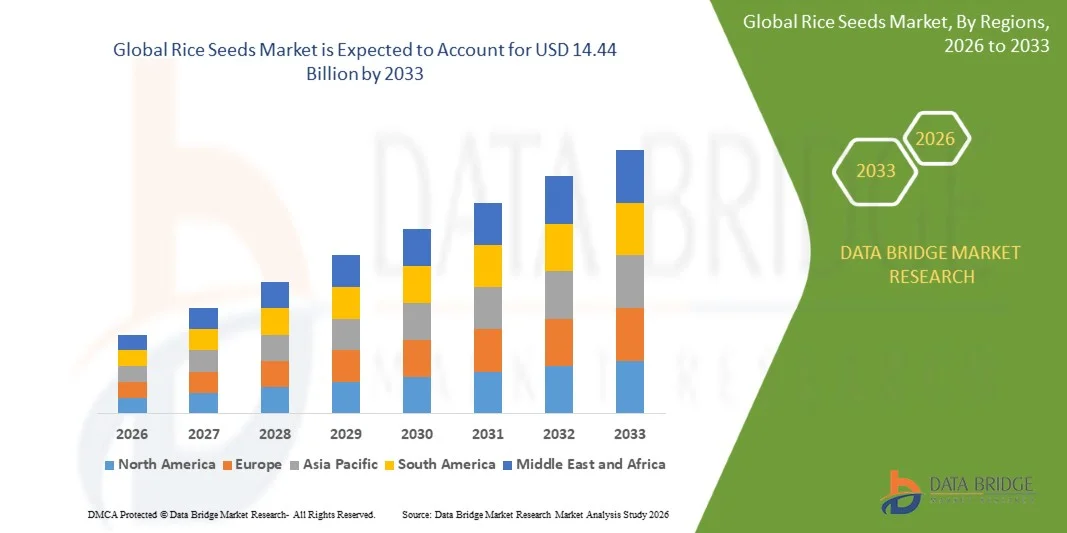
As per Data Bridge Market Research Analysis the rice seeds market was valued at USD 8.37 billion in 2025 and is projected to reach USD 14.44 billion by 2033, growing at a CAGR of 7.05 % from 2026 to 2033. Market growth is primarily driven by the increasing demand for high-yield and climate-resilient rice varieties, rising adoption of certified and hybrid seeds, and growing government initiatives to improve agricultural productivity and food security. Continuous advancements in seed breeding technologies, including hybridization and biotechnology, along with increasing investments in agricultural research and development, are further supporting market expansion.
The growing demand for rice as a staple food, coupled with the need to enhance crop yields under changing climatic conditions, is creating sustained demand for improved rice seeds. Increasing awareness among farmers regarding the benefits of certified seeds, such as higher productivity, disease resistance, and better grain quality, is accelerating market adoption. Furthermore, supportive government subsidy programs, expansion of modern farming practices, and ongoing innovations in stress-tolerant and hybrid rice seed development are expected to strengthen the growth of the rice seeds market throughout the forecast period.
Market Size & Forecast
- Market Value (2025): USD 8.37 Billion
- Expected Market Value (2033): USD 14.44 Billion
- Forecast CAGR (2026–2033): 7.05%
- Leading Region in 2025: Asia-Pacific
- Fastest Growing Region: North America
Key Market Trends & Insights
- Asia-Pacific dominated the rice seeds market with the largest revenue share of 73.4% in 2025, supported by extensive rice cultivation, strong adoption of certified and hybrid seeds, supportive government initiatives, and the presence of major rice-producing countries such as China, and Thailand.
- North America rice seeds market is expected to witness the fastest growth rate from 2026 to 2033, primarily driven by increasing adoption of certified rice seeds, precision agriculture, and advanced seed breeding technologies.
- The open-pollinated varieties segment held the largest market revenue share approximately 64.6% in 2025, driven by lower seed costs, the ability to save and reuse seeds for subsequent planting seasons, and widespread adoption among cost-conscious farmers, particularly across South and Southeast Asia.
- The commercial hybrids segment is expected to witness the fastest growth during the forecast period from 2026 to 2033, driven by increasing demand for higher-yielding and disease-resistant rice varieties.
- The three-line segment held the largest market revenue share in 2025, driven by its long-established commercial adoption, reliable hybrid seed production system, and widespread cultivation across major rice-producing countries, including China, India, Bangladesh, and Vietnam.
- The untreated seeds segment is expected to witness the fastest growth during the forecast period from 2026 to 2033, driven by their lower cost and continued adoption among smallholder farmers who rely on traditional cultivation practices and farm-saved seeds.
Report Scope and Rice Seeds Market Segmentation
|
Attributes |
Rice Seeds Key Market Segments |
|
Segments Covered |
|
|
Countries Covered |
North America
Europe
Asia-Pacific
Middle East and Africa
South America
|
|
Key Market Players |
|
|
Market Opportunities |
|
|
Value Added Data Infosets |
In addition to the insights on market scenarios such as market value, growth rate, segmentation, geographical coverage, and major players, the market reports curated by the Data Bridge Market Research also include import export analysis, production capacity overview, production consumption analysis, price trend analysis, climate change scenario, supply chain analysis, value chain analysis, raw material/consumables overview, vendor selection criteria, PESTLE Analysis, Porter Analysis, and regulatory framework. |
What is the Key Trend in the Rice Seeds Market?
Trend: Rising Adoption of Direct-Seeded Rice (DSR) Systems and Genome-Edited Rice Varieties
The rice seeds market is witnessing a significant shift toward sustainable cultivation practices and advanced breeding technologies as governments and seed companies focus on improving productivity, reducing environmental impact, and enhancing climate resilience. Increasing concerns over water scarcity, labor shortages, and climate change are accelerating the adoption of direct-seeded rice (DSR) systems, hybrid seed technologies, and genome-edited rice varieties. Seed manufacturers are increasingly integrating improved genetics with seed treatment technologies and crop protection solutions to optimize crop establishment, increase yields, and reduce production costs. Advancements in gene-editing technologies are also enabling the development of high-yielding, drought-tolerant, and salinity-resistant rice varieties that support long-term food security and sustainable agricultural production.
For instance, in May 2024, RiceTec, through its Indian affiliate Savannah Seeds, in collaboration with ADAMA, launched the FullPage Rice Cropping Solution in India. The integrated solution combines SmartRice hybrid genetics, SQUAD seed treatment, and Vezir herbicide to support direct-seeded rice (DSR) cultivation. The technology is designed to reduce groundwater consumption, lower labor requirements, and decrease greenhouse gas emissions while improving productivity through integrated seed and crop management.
The increasing adoption of direct-seeded rice systems and advanced breeding technologies is expected to accelerate sustainable rice cultivation and drive long-term growth in the rice seeds market.
Rice Seeds Market Dynamics
Key Market Driver: Rising Demand for High-Yielding and Pest-Resistant Rice Seed Varieties
The rice seeds market is primarily driven by the increasing demand for high-yielding, pest-resistant, and climate-resilient rice varieties to improve agricultural productivity and strengthen food security. Rising rice consumption, coupled with increasing pest and disease pressure, is encouraging farmers to adopt certified hybrid seeds that offer superior yield potential, improved resistance to biotic and abiotic stresses, and better grain quality. Government initiatives promoting certified seed distribution, modern breeding technologies, and sustainable agricultural practices are further accelerating the replacement of farm-saved seeds with improved commercial varieties. Continuous investments in hybrid breeding and biotechnology are supporting the development of innovative rice seed solutions capable of enhancing productivity under changing environmental conditions.
For instance, in June 2022, Bayer CropScience launched Arize INH 16019, its first hybrid rice seed with built-in tolerance to Bacterial Leaf Blight (BLB) and Brown Plant Hopper (BPH). According to the company, the hybrid delivers a 20–30% yield advantage over susceptible varieties during pest and disease outbreaks, helping improve crop productivity and reduce yield losses.
The growing demand for high-yielding and pest-resistant rice seed varieties is expected to remain a key driver supporting innovation and market expansion.
Key Restraint/Challenge: Price Competition in Mature Markets and Regulatory Barriers to Biotech Rice Seeds
The rice seeds market faces challenges from increasing price competition in mature rice-producing regions and regulatory uncertainty surrounding biotechnology-based rice varieties. Market saturation and oversupply have intensified pricing pressure, while evolving biosafety regulations continue to delay the commercialization and adoption of advanced rice seed technologies. These factors reduce profitability for seed manufacturers and slow the introduction of innovative rice varieties into commercial agriculture.
For instance, in November 2025 business year, Yuan Longping High-Tech Agriculture reported a decline in operating revenue due to weak global food prices and increasing inventory pressure across the seed industry. The company responded by optimizing its marketing channels and sales strategies, highlighting the ongoing impact of pricing pressure and market saturation on the rice seed industry.
Increasing price competition and regulatory barriers for biotechnology-based rice seeds are expected to remain key challenges restraining market growth.
Key Market Opportunity: Rising Demand for Biofortified and Climate-Resilient Rice Seed Varieties
The rice seeds market is creating significant growth opportunities through the development of biofortified and climate-resilient rice varieties that improve nutritional value while enhancing productivity under challenging environmental conditions. Rising concerns over food security, micronutrient deficiencies, and climate change are encouraging governments, research institutions, and seed companies to invest in advanced breeding technologies. These developments are enabling manufacturers to commercialize value-added rice seed varieties that improve farmer incomes while supporting sustainable agricultural production.
For instance, in July 2025, the International Rice Research Institute (IRRI), in collaboration with ICAR–Indian Institute of Rice Research (IIRR) and the University of Agricultural Sciences, Raichur, launched Spoorthi (GNV 1906), a zinc-rich rice variety containing 26 ppm zinc, significantly higher than conventional rice varieties. The initiative supports commercialization of nutrition-enhanced rice seeds while addressing food security and nutritional challenges.
Growing investments in biofortified and climate-resilient rice seed varieties are expected to create substantial long-term growth opportunities for the rice seeds market.
How is the Rice Seeds Market Segmented?
The rice seeds market is segmented based on type, hybridization technique, grain size, and treatment.
- By Type
On the basis of type, the market is segmented into open-pollinated varieties and commercial hybrids. The open-pollinated varieties segment held the largest market revenue share approximately 64.6% in 2025, driven by lower seed costs, the ability to save and reuse seeds for subsequent planting seasons, and widespread adoption among cost-conscious farmers, particularly across South and Southeast Asia. These varieties continue to offer reliable performance and remain the preferred choice in regions where affordability and seed self-sufficiency are key purchasing factors.
The commercial hybrids segment is expected to witness the fastest growth during the forecast period from 2026 to 2033, driven by increasing demand for higher-yielding and disease-resistant rice varieties. Growing adoption of herbicide-tolerant hybrids, advancements in cytoplasmic male sterility (CMS) breeding, and the emergence of two-line hybridization systems that reduce parental maintenance costs and accelerate varietal development are expected to support segment growth. Increasing investments in climate-resilient hybrid breeding and government initiatives promoting certified hybrid seeds are further accelerating adoption across major rice-producing countries.
- By Hybridization Technique
On the basis of hybridization technique, the market is segmented into three-line and two-line. The three-line segment held the largest market revenue share in 2025, driven by its long-established commercial adoption, reliable hybrid seed production system, and widespread cultivation across major rice-producing countries, including China, India, Bangladesh, and Vietnam. Its proven yield performance, stable seed production, and well-established breeding infrastructure continue to support the segment's market leadership.
The two-line segment is expected to witness the fastest growth during the forecast period from 2026 to 2033, driven by its simplified breeding process, lower seed production costs, and greater breeding flexibility compared to conventional three-line systems. Increasing investments in advanced hybrid breeding technologies and growing demand for high-yielding, climate-resilient rice varieties are expected to accelerate segment growth.
- By Grain Size
On the basis of grain size, the market is segmented into long, medium, and short.The long segment held the largest market revenue share in 2025, driven by its extensive cultivation, strong domestic consumption, and high export demand across major rice-producing countries. Superior cooking characteristics, longer shelf life, and suitability for a wide range of food applications continue to support the segment's market leadership.
The medium segment is expected to witness the fastest growth during the forecast period from 2026 to 2033, driven by increasing consumption in East Asia and rising demand from the food processing and foodservice industries. Its soft texture, versatility in regional cuisines, and expanding use in value-added food products are expected to support segment growth.
- By Treatment
On the basis of treatment, the market is segmented into treated seeds and untreated seeds.The treated seeds segment held the largest market revenue share in 2025, driven by increasing farmer awareness regarding seed protection technologies that improve germination rates, enhance early crop establishment, and reduce losses caused by seed-borne diseases and soil-borne pests. Growing adoption of certified seeds and modern agricultural practices, particularly across major rice-producing countries, continues to strengthen the segment's market leadership.
The untreated seeds segment is expected to witness the fastest growth during the forecast period from 2026 to 2033, driven by their lower cost and continued adoption among smallholder farmers who rely on traditional cultivation practices and farm-saved seeds. Increasing cultivation in price-sensitive markets and gradual improvements in seed availability are expected to support segment growth during the forecast period.
Which Region Holds the Largest Share of the Rice Seeds Market?
Asia-Pacific Rice Seeds Market Insight
Asia-Pacific dominated the rice seeds market with the largest revenue share of 73.4% in 2025, supported by extensive rice cultivation, strong adoption of certified and hybrid seeds, supportive government initiatives, and the presence of major rice-producing countries such as China, and Thailand. Rising investments in advanced breeding technologies, increasing demand for climate-resilient and high-yielding rice varieties, and expanding seed replacement programs continue to strengthen regional market growth. Growing efforts to improve agricultural productivity and ensure food security are further accelerating the adoption of improved rice seeds across the region.
China Rice Seeds Market Insight
China accounted for the largest share of the Asia-Pacific rice seeds market in 2025, driven by its extensive rice cultivation area and widespread adoption of hybrid rice varieties. Continuous investments in hybrid breeding technologies, government support for food security, and the development of climate-resilient rice varieties continue to support market growth. Increasing focus on improving productivity and sustainable rice cultivation is expected to further strengthen the country's market position.
Japan Rice Seeds Market Insight
Japan is expected to witness the fastest growth rate from 2026 to 2033, driven by increasing adoption of premium-quality certified rice seeds, advanced breeding technologies, and precision farming practices. Rising demand for high-quality rice varieties, coupled with continued investments in sustainable agriculture and climate-resilient seed development, is expected to support steady market growth.
North America Rice Seeds Market Insight
North America rice seeds market is expected to witness the fastest growth rate from 2026 to 2033, primarily driven by increasing adoption of certified rice seeds, precision agriculture, and advanced seed breeding technologies. Rising demand for premium-quality rice, continuous investments in agricultural research, and the development of high-yielding and climate-resilient rice varieties are expected to support sustained market growth across the region.
U.S. Rice Seeds Market Insight
The U.S. is expected to witness the fastest growth rate from 2026 to 2033, driven by increasing adoption of certified and high-performance rice seeds, expanding precision agriculture practices, and strong investments in agricultural research and seed breeding technologies. Growing demand for premium-quality rice, improved crop productivity, and climate-resilient rice varieties continues to support market growth across the country.
Europe Rice Seeds Market Insight
Europe is expected to witness the fastest growth rate from 2026 to 2033, supported by increasing demand for certified rice seeds, adoption of sustainable agricultural practices, and continuous advancements in rice breeding technologies. Growing emphasis on improving crop productivity, climate resilience, and seed quality, along with supportive agricultural policies, is expected to strengthen market growth across the region.
Germany Rice Seeds Market Insight
Germany is expected to witness the fastest growth rate from 2026 to 2033, supported by strong investments in agricultural biotechnology, seed research, and sustainable farming practices. Increasing focus on crop improvement, certified seed adoption, and climate-resilient breeding technologies is expected to support continued market growth.
U.K. Rice Seeds Market Insight
The U.K. rice seeds market is expected to witness the fastest growth rate from 2026 to 2033, driven by increasing investments in agricultural innovation, rising adoption of certified seeds, and growing emphasis on sustainable crop production. Expanding research into resilient crop varieties and improved seed technologies is expected to support steady market growth.
Which are the Top Companies in Compound Feed Market?
The rice seeds market Analysis is primarily led by well-established companies, including:
- Bayer AG (Germany)
- Corteva, Inc. (U.S.)
- Syngenta Group (Switzerland)
- BASF SE (Germany)
- Advanta Seeds (India)DCM Shriram (India)
- Nuziveedu Seeds LTD (India)
- Mahyco (India)
- SL Agritech Corporation (Philippines)
- Yuan Longping High-Tech Agriculture Co., Ltd. (China)
- China National Seed Group Co., Ltd. (China)
- Beidahuang Kenfeng Seed Co., Ltd. (China)
- Hefei Hefeng Seed Co., Ltd. (China)
- Winall Hi-tech Seed Co., Ltd. (China)
- Bioseed (India)
- Rasi Seeds (India)
- JK Agri Genetics Limited (India)
- RiceTec, Inc. (India)
- Crystal Crop Protection Ltd (India)
What are Latest Developments in Compound Feed Market?
- In October 2025, the African Development Bank Group approved a USD 22.8 million grant through the African Development Fund to support the development of Mozambique’s rice value chain and strengthen climate resilience. The initiative is designed to benefit approximately 30,000 smallholder farmers across four provinces by promoting climate-smart agricultural practices, improving rice productivity, enhancing food security, and supporting sustainable rural economic development.
- In August 2025, researchers at the International Rice Research Institute (IRRI) identified promising OsIRO2 gene variants that improve rice performance under drought conditions. The gene variants were incorporated into the widely cultivated DRR Dhan 44 rice variety, demonstrating the potential to enhance drought tolerance and maintain higher yields, supporting the development of climate-resilient rice seed varieties for water-stressed environments.
- In October 2024, the CGIAR Global Rice Science Partnership announced the completion of genome sequencing for 500 traditional rice varieties from Africa and Asia. The initiative established a valuable genetic resource for rice breeding programs, enabling researchers and seed developers to accelerate the development of high-yielding, climate-resilient, and disease-resistant rice varieties through advanced genomic research and breeding technologies.

- Interactive Data Analysis Dashboard
- Company Analysis Dashboard for high growth potential opportunities
- Research Analyst Access for customization & queries
- Competitor Analysis with Interactive dashboard
- Latest News, Updates & Trend analysis
- Harness the Power of Benchmark Analysis for Comprehensive Competitor Tracking
Data collection and base year analysis are done using data collection modules with large sample sizes. The stage includes obtaining market information or related data through various sources and strategies. It includes examining and planning all the data acquired from the past in advance. It likewise envelops the examination of information inconsistencies seen across different information sources. The market data is analysed and estimated using market statistical and coherent models. Also, market share analysis and key trend analysis are the major success factors in the market report. To know more, please request an analyst call or drop down your inquiry.
The key research methodology used by DBMR research team is data triangulation which involves data mining, analysis of the impact of data variables on the market and primary (industry expert) validation. Data models include Vendor Positioning Grid, Market Time Line Analysis, Market Overview and Guide, Company Positioning Grid, Patent Analysis, Pricing Analysis, Company Market Share Analysis, Standards of Measurement, Global versus Regional and Vendor Share Analysis. To know more about the research methodology, drop in an inquiry to speak to our industry experts.
Data Bridge Market Research is a leader in advanced formative research. We take pride in servicing our existing and new customers with data and analysis that match and suits their goal. The report can be customized to include price trend analysis of target brands understanding the market for additional countries (ask for the list of countries), clinical trial results data, literature review, refurbished market and product base analysis. Market analysis of target competitors can be analyzed from technology-based analysis to market portfolio strategies. We can add as many competitors that you require data about in the format and data style you are looking for. Our team of analysts can also provide you data in crude raw excel files pivot tables (Fact book) or can assist you in creating presentations from the data sets available in the report.