What is the Rigid Exoskeleton Market Size and Growth Rate?
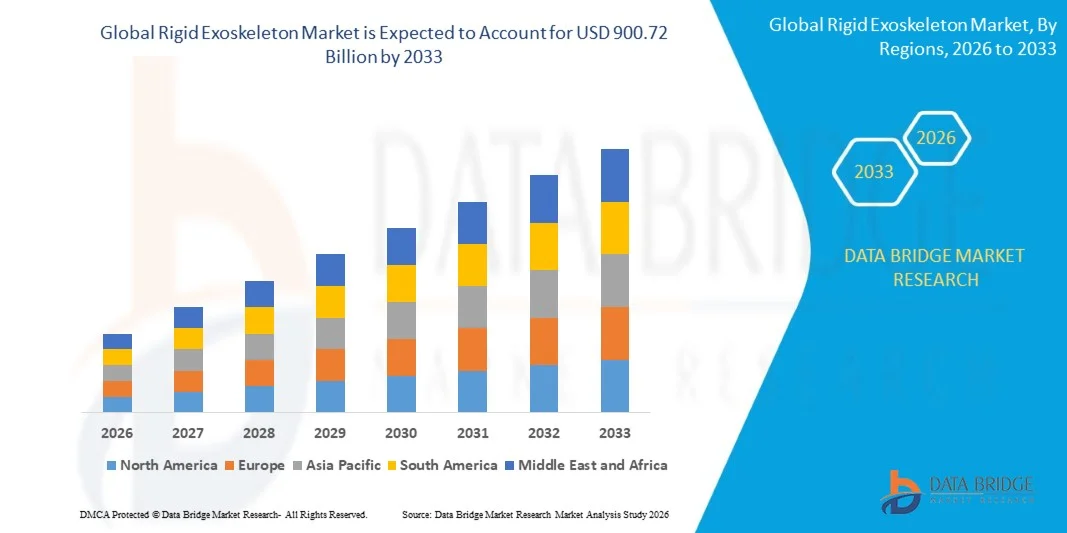
- As per Data Bridge Market Research analysis, the rigid exoskeleton market was valued at USD 54.18 billion in 2025 and is projected to reach USD 900.72 billion by 2033, growing at a CAGR of 42.10% from 2026 to 2033.
- The market is experiencing rapid growth driven by rising demand for wearable robotic assistance, increasing adoption of exoskeletons for rehabilitation and industrial applications, and technological advancements in lightweight materials, sensors, actuators, and artificial intelligence.
- The increasing need to reduce workplace musculoskeletal injuries, combined with the growing prevalence of mobility impairments and demand for physical assistance, is compelling healthcare providers, industrial organizations, and defense agencies to adopt rigid exoskeleton technologies. Powered and passive exoskeleton systems are increasingly being deployed to support rehabilitation, enhance worker strength and endurance, reduce physical strain, and improve mobility in demanding environments.
Market Size & Forecast
- Global Market Value (2025): USD 54.18 Billion
- Expected Market Value (2033): USD 900.72 Billion
- Forecast CAGR (2026–2033): 42.10%
- Leading Region in 2025: North America
- Fastest Growing Region: Asia Pacific
What are the Major Takeaways of the Rigid Exoskeleton Market?
- North America dominated the rigid exoskeleton market with the largest revenue share of 40.65% in 2025, supported by advanced healthcare infrastructure, strong robotics capabilities, and growing adoption across industrial and defense applications.
- Asia-Pacific is expected to be the fastest-growing region at a CAGR of 26.87% from 2026 to 2033, fueled by expanding healthcare infrastructure, aging populations, industrial automation, and increasing adoption of wearable robotics in China, Japan, and South Korea.
- The hardware segment led the market with a 73.05% share in 2025, driven by the extensive requirement for structural frames, sensors, actuators, power systems, control units, and joint mechanisms in rigid exoskeletons.
- Software are the fastest-growing component type, projected to register a CAGR of 32.1%, reflecting the surge in integration of artificial intelligence, motion-control algorithms, sensor integration, and real-time data analytics.
- The powered segment dominated the power type category with a 71.4% revenue share in 2025, led by its ability to actively assist users through motors, actuators, batteries, and electronic control systems.
- Mobile accounted for 62.6% of the market share in 2025, preferred by the flexibility offered by wearable systems that allow users to move while receiving mechanical assistance.
- The full-body segment is the fastest-growing body part category, with a CAGR of 32.5%, driven by growing interest in comprehensive human augmentation and load-bearing applications.
Report Scope and Rigid Exoskeleton Market Segmentation
|
Attributes |
Rigid Exoskeleton Key Market Insights |
|
Segments Covered |
|
|
Countries Covered |
North America
Europe
Asia-Pacific
Middle East and Africa
South America
|
|
Key Market Players |
|
|
Market Opportunities |
|
|
Value Added Data Infosets |
In addition to the insights on market scenarios such as market value, growth rate, segmentation, geographical coverage, and major players, the market reports curated by the Data Bridge Market Research also include in-depth expert analysis, geographically represented company-wise production and capacity, network layouts of distributors and partners, detailed and updated price trend analysis and deficit analysis of supply chain and demand. |
What is the Key Trend in the Rigid Exoskeleton Market?
- Advanced mobility-assistance technology is transforming rigid exoskeletons through intelligent control, adaptive support, lightweight structures, and improved movement tracking, enabling greater independence and comfort across rehabilitation, industrial, and personal mobility applications.
- For instance, in May 2025, German Bionic launched Exia, an augmented-AI exoskeleton that uses billions of real-world motion data points to anticipate users’ movements and adjust assistance in real time, highlighting the trend toward intelligent, adaptive, and data-driven rigid exoskeletons across industrial and healthcare environments.
- Healthcare providers are increasingly integrating rigid exoskeletons into rehabilitation programs to support gait training, improve mobility outcomes, and provide repeatable assistance for patients recovering from spinal cord injuries and neurological disorders.
- Industrial organizations are adopting powered rigid exoskeletons to reduce physical strain during lifting, repetitive handling, and demanding tasks while supporting worker endurance, ergonomics, and workplace safety across manufacturing, logistics, and construction environments.
- For instance, in May 2025, Wandercraft reported clinical findings showing that users of its self-balancing Personal Exoskeleton achieved a median 100% success rate across 16 critical mobility tasks after only five training sessions, supporting the trend toward self-balancing, user-adaptive exoskeletons designed for real-world home and community mobility.
- As exoskeleton manufacturers continue improving intelligence, adaptability, and ergonomic performance, adoption of rigid systems is expected to accelerate, strengthening their role in rehabilitation, workplace assistance, and personal mobility while expanding practical real-world use.
What are the Key Drivers of the Rigid Exoskeleton Market?
- The rising prevalence of neurological disorders, spinal cord injuries, and mobility impairments is increasing demand for rigid exoskeletons that provide structured gait assistance, weight-bearing support, and greater independence during rehabilitation and daily movement.
- For instance, in March 2025, a study published in the Journal of Biomechanics showing that a passive back-support exoskeleton significantly reduced perceived exertion and lumbar muscle activity during repetitive lifting, while also enabling faster task completion. This supports growing adoption of rigid exoskeletons for physically demanding workplace activities.
- Growing industrial focus on ergonomic safety and musculoskeletal injury prevention is encouraging manufacturers, logistics operators, and construction companies to deploy rigid exoskeletons for lifting, repetitive handling, overhead work, and physically demanding operations.
- For instance, in May 2025, a study published in Applied Ergonomics evaluated 24 weeks of back-supporting exoskeleton use among logistics workers performing daily order-picking tasks. The study reported significant reductions in back-muscle activity during lifting and lower perceived work intensity among workers, supporting the use of exoskeletons for physically demanding logistics operations.
- With healthcare, industrial, and defense organizations increasingly seeking technologies that improve human mobility, reduce physical strain, and enhance operational performance, rigid exoskeleton adoption is expected to expand across demanding applications and rehabilitation environments globally
What Factors are Challenging the Growth of the Rigid Exoskeleton Market?
- Rigid exoskeleton systems require substantial upfront investment because advanced actuators, sensors, batteries, control systems, structural materials, and specialized fitting technologies increase manufacturing and procurement costs for healthcare and industrial users.
- For instance, in March 2024, a study published in the International Journal of Industrial Ergonomics identified cost justification as one of the most critical barriers to adopting passive exoskeletons in construction, alongside fit, weight, and catch-and-snag risks.
- These financial requirements can restrict adoption among smaller rehabilitation facilities, individual users, and cost-sensitive organizations, particularly where reimbursement coverage, procurement budgets, and supporting technical infrastructure remain limited or underdeveloped.
- For instance, in September 2024, a Journal of Safety Research study found that incompatibility with other devices can be a major barrier to exoskeleton adoption and concluded that exoskeletons require adjustments to suit construction-industry requirements
- The high acquisition cost, maintenance requirements, user training, and need for specialized technical support continue to challenge widespread deployment, particularly among smaller organizations and emerging markets despite growing demand for advanced mobility-assistance technologies.
How is the Rigid Exoskeleton Market Segmented?
The rigid exoskeleton market is segmented on the basis of component, power type, mobility, body part, and end-user
- By Component
On the basis of component, the rigid exoskeleton market is segmented into software and hardware. The hardware segment dominated the market with an estimated 73.05% share in 2025, owing to the extensive requirement for structural frames, sensors, actuators, power systems, control units, and joint mechanisms in rigid exoskeletons. Hardware provides the physical structure required to support and augment human movement. Increasing adoption across industrial, healthcare, and defense applications is supporting demand for durable and lightweight hardware components. Advances in sensors and actuators are improving movement assistance and system responsiveness. Manufacturers are also focusing on lightweight materials to improve wearer comfort and endurance.
The software segment is projected to register the fastest growth at CAGR of 32.1% from 2026 to 2033, driven by increasing integration of artificial intelligence, motion-control algorithms, sensor integration, and real-time data analytics. Software enables exoskeletons to interpret user movements and provide more precise assistance. AI-based control systems are improving the adaptability of exoskeletons to different users and activities. Increasing adoption of remote monitoring and analytics is creating additional software applications. Rehabilitation monitoring and cloud-connected platforms are also expanding software functionality. As exoskeleton systems become more intelligent, software is gaining importance in improving performance, personalization, and operational efficiency.
- By Power Type
On the basis of power type, the rigid exoskeleton market is segmented into passive and powered. The powered segment dominated the market with an estimated 71.4% share in 2025, supported by its ability to actively assist users through motors, actuators, batteries, and electronic control systems. Powered systems can deliver greater mechanical assistance for demanding physical activities and mobility applications. They are increasingly used in healthcare rehabilitation, industrial operations, and defense applications. Improvements in actuator technology are enabling more precise and responsive movement assistance. Battery technology improvements are also supporting longer operating periods and greater mobility.
The passive segment is projected to register the fastest growth at CAGR of 28.5% from 2026 to 2033, driven by demand for simpler and energy-efficient exoskeleton solutions. Passive systems use mechanical components such as springs and linkages to redistribute loads without requiring continuous external power. Their lower power requirements make them suitable for prolonged industrial and occupational applications. Passive systems can also reduce dependence on batteries and charging infrastructure. Increasing focus on workplace ergonomics is encouraging organizations to evaluate passive systems for lifting and repetitive tasks. Improvements in lightweight mechanical structures are further enhancing comfort and usability.
- By Mobility
On the basis of mobility, the rigid exoskeleton market is segmented into mobile and stationary. The mobile segment dominated the market with an estimated 62.6% share in 2025, driven by the flexibility offered by wearable systems that allow users to move while receiving mechanical assistance. Mobile exoskeletons are increasingly used in industrial, healthcare, construction, logistics, and defense environments. Their ability to support walking, lifting, carrying, and other physical activities expands their application range. Improvements in battery systems and lightweight materials are enhancing portability. Mobile configurations also allow users to perform tasks across larger working areas compared with stationary systems. The increasing emphasis on wearable human augmentation is therefore supporting the continued dominance of mobile exoskeletons.
The stationary segment is projected to register the fastest growth at CAGR of 29.0% from 2026 to 2033, supported by increasing applications in rehabilitation centers, clinical environments, and specialized industrial workstations. Stationary systems can provide controlled and stable mechanical assistance during repetitive or therapeutic activities. Their fixed configuration allows manufacturers to incorporate robust support mechanisms and precise control systems. Healthcare providers can use these systems for structured rehabilitation and movement training. Industrial facilities can also deploy stationary systems for specific repetitive tasks where mobility is not essential. Growing demand for controlled robotic assistance and rehabilitation technologies is expected to strengthen this segment.
- By Body Part
On the basis of body part, the rigid exoskeleton market is segmented into full body, upper extremities, and lower extremities. The lower extremities segment dominated the market with an estimated 40.7% share in 2025, owing to extensive applications in mobility assistance, gait training, rehabilitation, and lower-body load support. Lower-extremity systems are particularly relevant for users requiring assistance with walking and standing. Healthcare providers increasingly use these systems in rehabilitation and mobility-support programs. Industrial applications are also expanding as organizations seek technologies that can reduce physical strain during demanding activities. Improvements in robotic joints and movement-control systems are enhancing lower-body assistance.
The full-body segment is projected to register the fastest growth at CAGR of 32.5% from 2026 to 2033, driven by growing interest in comprehensive human augmentation and load-bearing applications. Full-body systems can provide coordinated assistance across multiple body regions rather than supporting only one extremity. This makes them particularly relevant for defense, heavy industrial activities, and physically demanding operations. Increasing interest in military load-carriage technologies is supporting development of full-body configurations. Advances in lightweight structural materials and control systems are improving their practicality. Growing demand for technologies capable of enhancing overall endurance and physical performance is expected to accelerate adoption of full-body rigid exoskeletons.
- By End-User
On the basis of end-user, the rigid exoskeleton market is segmented into defense, healthcare, industrial, and others. The healthcare segment dominated the market with an estimated 48.8% share in 2025, supported by extensive adoption of exoskeleton systems for rehabilitation, mobility assistance, and gait training. Healthcare applications benefit from the ability of exoskeletons to provide controlled and repeatable movement assistance. Rehabilitation centers and hospitals are increasingly evaluating robotic technologies to support mobility recovery. Growing demand for advanced assistive technologies is supporting adoption among patients with mobility limitations. Integration of sensors and software is also enabling more personalized therapy and progress monitoring. The established clinical application base and continued development of rehabilitation robotics support healthcare's leading position.
The industrial segment is projected to register the fastest growth at CAGR of 30.2% from 2026 to 2033, driven by increasing demand for ergonomic assistance in manufacturing, logistics, construction, and other physically demanding workplaces. Industrial exoskeletons can help reduce physical strain during repetitive lifting, overhead activities, and material handling. Growing emphasis on workplace safety and prevention of musculoskeletal injuries is encouraging organizations to evaluate wearable assistance technologies. Manufacturers are also developing lighter and more adaptable systems for industrial environments. Increasing automation and human-machine collaboration are creating additional opportunities for exoskeleton deployment. The growing focus on worker productivity, safety, and physical endurance is expected to accelerate industrial adoption.
Which Region Holds the Largest Share of the Rigid Exoskeleton Market?
- North America dominated the rigid exoskeleton market with the largest revenue share of 40.65% in 2025, supported by advanced healthcare infrastructure, strong robotics capabilities, and growing adoption across industrial and defense applications.
- The region also benefits from the presence of leading technology developers, growing demand for rehabilitation and mobility-assistance solutions, and increasing use of exoskeletons to improve worker ergonomics and reduce physical strain. Strong research and development activities, government-backed innovation, and rising investment in human-augmentation technologies continue to strengthen North America's leadership position in the global market.
U.S. Rigid Exoskeleton Market Insight
The U.S. rigid exoskeleton market is witnessing strong growth due to rising investments in rehabilitation robotics, industrial automation, defense technologies, and workplace safety solutions. The country’s advanced healthcare infrastructure, strong research and development ecosystem, and presence of established robotics companies are driving demand across medical, industrial, and defense applications. In addition, growing emphasis on reducing workplace injuries, improving worker ergonomics, and supporting mobility rehabilitation is accelerating exoskeleton adoption across hospitals, manufacturing facilities, and military organizations.
Asia-Pacific Rigid Exoskeleton Market Insight
The Asia-Pacific rigid exoskeleton market is expected to witness rapid growth, driven by increasing industrialization, expanding healthcare infrastructure, and rising investments in robotics and automation across countries such as China, Japan, and South Korea. Growing demand for workplace safety, rehabilitation technologies, and advanced assistive devices is supporting regional market expansion. In addition, increasing manufacturing activity, aging populations, and technological advancements in wearable robotics are accelerating exoskeleton adoption across healthcare, industrial, and defense sectors.
Japan Rigid Exoskeleton Market Insight
The Japan rigid exoskeleton market is witnessing consistent growth due to rising investments in healthcare robotics, elderly-care technologies, industrial automation, and rehabilitation solutions. Healthcare institutions, manufacturers, and research organizations are increasingly adopting exoskeleton systems to support mobility, rehabilitation, and physically demanding workplace activities. Moreover, Japan’s focus on addressing labor shortages, improving worker productivity, and integrating robotics into healthcare and industrial operations is further contributing to market growth.
China Rigid Exoskeleton Market Insight
The China rigid exoskeleton market is growing rapidly, driven by expanding industrial automation, increasing healthcare infrastructure, and rising government focus on advanced robotics and intelligent manufacturing. Growing adoption of exoskeleton technologies across manufacturing, rehabilitation, logistics, and defense applications is significantly boosting market demand. In addition, increasing investments in domestic robotics research, workplace safety initiatives, and human-machine collaboration are positioning China as one of the fastest-growing markets for rigid exoskeletons globally.
U.K. Rigid Exoskeleton Market Insight
The U.K. rigid exoskeleton market is experiencing steady growth, supported by rising adoption of robotic rehabilitation systems, industrial ergonomics technologies, and advanced assistive devices. Increasing investments in healthcare robotics and research programs, along with growing demand for solutions that reduce physical strain and improve worker safety, are contributing to market growth. Furthermore, integration of artificial intelligence, sensors, and advanced control technologies is improving exoskeleton functionality and supporting adoption across healthcare, industrial, and defense applications.
Germany Rigid Exoskeleton Market Insight
The Germany rigid exoskeleton market is expanding steadily due to the country’s strong industrial manufacturing base, advanced engineering capabilities, and increasing adoption of human-assistance technologies. Manufacturing companies, healthcare institutions, and research organizations are increasingly utilizing exoskeletons for workplace ergonomics, rehabilitation, and physically demanding applications. Continuous advancements in lightweight materials, robotics, sensor technologies, and intelligent control systems, along with strong focus on industrial safety and automation, are further driving market growth in Germany.
Which are the Top Companies in Rigid Exoskeleton Market?
The rigid exoskeleton industry is primarily led by well-established companies, including:
- Ottobock SE & Co. KGaA (Germany)
- Comau S.p.A. (Italy)
- German Bionic Systems GmbH (Germany)
- CYBERDYNE Inc. (Japan)
- Lifeward Ltd. (Israel)
- Myomo, Inc. (U.S.)
- Wandercraft SAS (France)
- HeroWear (U.S.)
- B-Temia (Canada)
- Hangzhou RoboCT Technology Development CO.,Ltd (China)
- ULS Robotics (China)
- Gogoa Mobility Robots S.L. (Spain)
- RB3D (France)
- Skel-Ex B.V. (Netherlands)
- exoIQ GmbH (Germany)
- Auxivo AG (Switzerland)
- ErgoSanté (France)
- TECHNAID, S.L. (Spain)
- INNOPHYS Co., Ltd. (Japan)
- Biomotum, Inc. (U.S.)
What are Latest Developments in Rigid Exoskeleton Market?
- In November 2025, Ottobock announced the market launch of the IX BACK VOLTON, an intelligent battery-powered exoskeleton developed by SUITX by Ottobock for physically demanding activities in industrial and logistics environments. The system is designed to reduce back strain during lifting and entered series production following its earlier presentation at Hannover Messe. This launch highlights continued development of intelligent, lightweight rigid exoskeletons for occupational applications.
- In March 2025, SUITX by Ottobock unveiled the IX BACK VOLTON, an intelligent back exoskeleton featuring motor technology, battery power, and movement-adaptive assistance for physically demanding industrial and logistics work. The company stated that pilot projects would begin in April, with the global market launch planned for later in the year. The development demonstrates increasing integration of intelligent control and AI-related technologies into occupational exoskeletons.
- In February 2024, Wandercraft received FDA clearance for its Atalante X self-balancing exoskeleton for rehabilitation of individuals with spinal cord injuries. The clearance expanded the device's clinical indication following its earlier clearance for stroke rehabilitation. The development represents continued advancement of self-balancing robotic exoskeletons for medical rehabilitation and mobility assistance.
- In October 2023, SUITX by Ottobock launched the IX BACK AIR exoskeleton, combining the mechanical support characteristics of rigid systems with the comfort of soft wearable designs. The system was developed for logistics and other physically demanding workplace activities and became the first product introduced under the SUITX by Ottobock umbrella brand. The launch marked an expansion of commercially available occupational exoskeleton solutions.
- In April 2022, Ottobock unveiled the Ottobock Shoulder exoskeleton, a next-generation wearable system designed to support workers performing strenuous overhead activities in logistics, production, maintenance, and skilled trades. The system was developed as a further advancement of the company's Paexo Shoulder platform and focused on reducing physical strain during repetitive overhead work. This development strengthened the use of rigid-support exoskeleton technology for occupational ergonomics.
- Interactive Data Analysis Dashboard
- Company Analysis Dashboard for high growth potential opportunities
- Research Analyst Access for customization & queries
- Competitor Analysis with Interactive dashboard
- Latest News, Updates & Trend analysis
- Harness the Power of Benchmark Analysis for Comprehensive Competitor Tracking
Global Rigid Exoskeleton Market, Supply Chain Analysis and Ecosystem Framework
To support market growth and help clients navigate the impact of geopolitical shifts, DBMR has integrated in-depth supply chain analysis into its Global Rigid Exoskeleton Market research reports. This addition empowers clients to respond effectively to global changes affecting their industries. The supply chain analysis section includes detailed insights such as Global Rigid Exoskeleton Market consumption and production by country, price trend analysis, the impact of tariffs and geopolitical developments, and import and export trends by country and HSN code. It also highlights major suppliers with data on production capacity and company profiles, as well as key importers and exporters. In addition to research, DBMR offers specialized supply chain consulting services backed by over a decade of experience, providing solutions like supplier discovery, supplier risk assessment, price trend analysis, impact evaluation of inflation and trade route changes, and comprehensive market trend analysis.
Data collection and base year analysis are done using data collection modules with large sample sizes. The stage includes obtaining market information or related data through various sources and strategies. It includes examining and planning all the data acquired from the past in advance. It likewise envelops the examination of information inconsistencies seen across different information sources. The market data is analysed and estimated using market statistical and coherent models. Also, market share analysis and key trend analysis are the major success factors in the market report. To know more, please request an analyst call or drop down your inquiry.
The key research methodology used by DBMR research team is data triangulation which involves data mining, analysis of the impact of data variables on the market and primary (industry expert) validation. Data models include Vendor Positioning Grid, Market Time Line Analysis, Market Overview and Guide, Company Positioning Grid, Patent Analysis, Pricing Analysis, Company Market Share Analysis, Standards of Measurement, Global versus Regional and Vendor Share Analysis. To know more about the research methodology, drop in an inquiry to speak to our industry experts.
Data Bridge Market Research is a leader in advanced formative research. We take pride in servicing our existing and new customers with data and analysis that match and suits their goal. The report can be customized to include price trend analysis of target brands understanding the market for additional countries (ask for the list of countries), clinical trial results data, literature review, refurbished market and product base analysis. Market analysis of target competitors can be analyzed from technology-based analysis to market portfolio strategies. We can add as many competitors that you require data about in the format and data style you are looking for. Our team of analysts can also provide you data in crude raw excel files pivot tables (Fact book) or can assist you in creating presentations from the data sets available in the report.