


What is the RISC-V Market Size and Growth Rate?
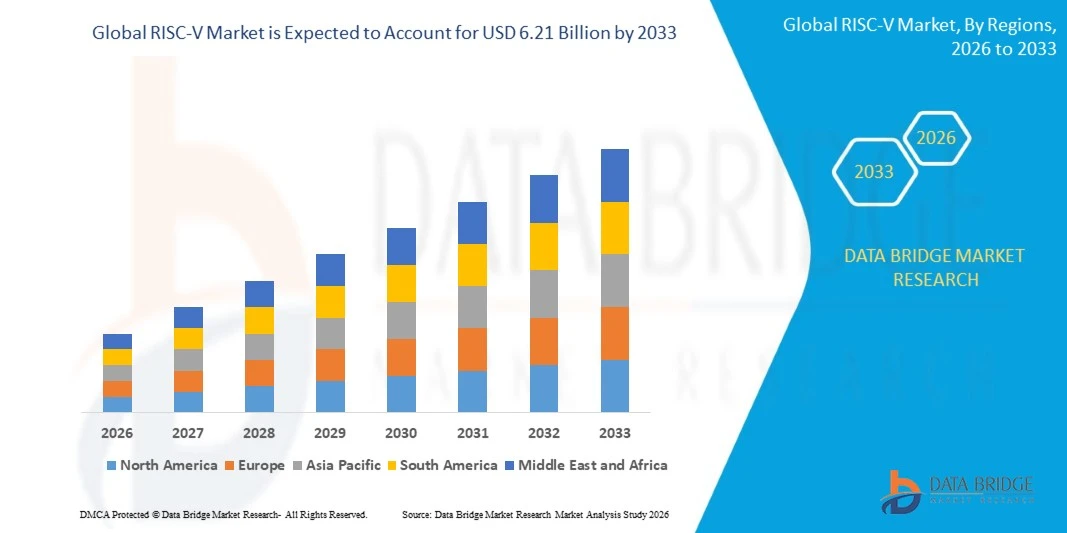
- As per Data Bridge Market Research analysis, the RISC-V market was valued at USD 1.13 billion in 2025 and is projected to reach USD 6.21 billion by 2033, growing at a CAGR of 23.70% from 2026 to 2033.
- The market is experiencing consistent growth driven by increasing adoption of open-source processor architectures, rising demand for customizable and energy-efficient computing solutions, and growing utilization of RISC-V-based processors across automotive, consumer electronics, industrial, telecommunications, data center, healthcare, and aerospace and defense applications.
- The increasing demand for flexible processor architectures, growing investment in semiconductor innovation, rising adoption of edge computing and IoT devices, and the need for cost-efficient and application-specific processing solutions are encouraging semiconductor companies, OEMs, technology developers, and research institutions to adopt RISC-V technology. The open and customizable instruction set architecture enables greater design flexibility, reduced licensing dependencies, improved processor customization, and broader ecosystem development across emerging computing applications.
Market Size & Forecast
- Global Market Value (2025): USD 1.13 Billion
- Expected Market Value (2033): USD 6.21 Billion
- Forecast CAGR (2026–2033): 23.70%
- Leading Region in 2025: North America
- Fastest Growing Region: Asia Pacific
What are the Major Takeaways of the RISC-V Market?
- North America dominated the RISC-V market with the largest revenue share of 36.4% in 2025, supported by strong semiconductor design capabilities, increasing investments in advanced computing technologies, and growing adoption of RISC-V processors across automotive, consumer electronics, industrial, telecommunications, and data center applications.
- Asia-Pacific is expected to be the fastest-growing region at a CAGR of 27.6% from 2026 to 2033, fueled by expanding semiconductor manufacturing, government initiatives supporting domestic chip development, rapid growth of consumer electronics and automotive industries, and increasing adoption of RISC-V-based processors across China, India, Japan, South Korea, and Southeast Asia.
- Hardware led the market with a 57.8% share in 2025, driven by the essential role of RISC-V processors, microcontrollers, microprocessors, application processors, and RISC-V cores across embedded computing, consumer electronics, automotive, and industrial applications.
- Software is the fastest-growing component type, projected to a CAGR of 26.8% from 2026 to 2033, reflecting increasing demand for operating systems, development tools, compilers, software stacks, and application support for RISC-V-based processors.
- Microcontrollers dominated the processor type category with a 43.6% revenue share in 2025, supported by increasing adoption of low-power and cost-efficient RISC-V microcontrollers across automotive, consumer electronics, industrial, telecommunications, and healthcare applications.
- Application processors are the fastest-growing processor type, projected to a CAGR of 28.9% from 2026 to 2033, driven by increasing demand for higher-performance RISC-V computing platforms across automotive, consumer electronics, industrial, telecommunications, data centers, aerospace and defense, and healthcare applications.
- Consumer electronics dominated the application category with a 29.7% revenue share in 2025, supported by increasing integration of RISC-V processors into smart devices, connected electronics, embedded systems, and other consumer products.
Report Scope and RISC-V Market Segmentation
|
Attributes |
RISC-V Key Market Insights |
|
Segments Covered |
|
|
Countries Covered |
North America
Europe
Asia-Pacific
Middle East and Africa
South America
|
|
Key Market Players |
|
|
Market Opportunities |
|
|
Value Added Data Infosets |
In addition to the insights on market scenarios such as market value, growth rate, segmentation, geographical coverage, and major players, the market reports curated by the Data Bridge Market Research also include in-depth expert analysis, geographically represented company-wise production and capacity, network layouts of distributors and partners, detailed and updated price trend analysis and deficit analysis of supply chain and demand. |
What is the Key Trend in the RISC-V Market?
- Organizations and semiconductor companies are increasingly adopting RISC-V for AI, edge computing, automotive, embedded systems, data centers, and high-performance computing, supported by its open, modular, and customizable instruction set architecture.
- For instance, in September 2025, RISC-V International highlighted the growing use of RISC-V as an AI-native architecture, with applications extending from edge AI to high-performance AI computing and transformer workloads.
- Workload-specific processor design is becoming an important trend, as organizations use RISC-V's modular architecture to customize processors for specific performance, power, security, and application requirements across different industry verticals.
- RISC-V adoption is increasingly expanding across automotive and software-defined vehicle platforms, where customizable processors can support applications ranging from microcontrollers and vehicle control systems to advanced driver-assistance and AI workloads.
- For instance, in March 2025, Infineon Technologies announced a new RISC-V-based automotive microcontroller family, expanding its automotive microcontroller portfolio and targeting applications ranging from entry-level to high-performance automotive systems.
- As RISC-V adoption expands across AI, automotive, data centers, embedded systems, and other applications, the development of standardized profiles, software ecosystems, security capabilities, and workload-specific processors is expected to accelerate its commercial deployment globally.
What are the Key Drivers of the RISC-V Market?
- The increasing demand for customizable, energy-efficient, and cost-effective processor architectures is significantly increasing adoption of RISC-V across consumer electronics, industrial systems, automotive applications, telecommunications, data centers, aerospace and defense, and healthcare applications.
- For instance, in 2025, RISC-V International reported accelerating industry adoption across automotive, data center, high-performance computing, embedded systems, space, and AI applications, reflecting growing commercial deployment of the architecture.
- Organizations are increasingly using RISC-V to reduce vendor dependence and develop workload-specific processors, allowing semiconductor companies and OEMs to tailor processor architectures for specific performance, power, security, and application requirements.
- For instance, in February 2025, Cortus announced its MINERVA 64-bit RISC-V processor platform, designed for automotive applications with a configurable architecture supporting different compute requirements and successfully running Linux on prototype silicon.
- As demand for AI, edge computing, connected devices, software-defined vehicles, and specialized computing increases, RISC-V is expected to gain further adoption by enabling flexible processor customization, workload optimization, software portability, and reduced dependence on proprietary instruction-set architectures.
What Factors are Challenging the Growth of the RISC-V Market?
- Software ecosystem maturity remains a key challenge for RISC-V adoption, particularly for application processors, high-performance computing, data centers, and other applications requiring extensive operating-system, middleware, development-tool, and application support.
- For instance, in 2025, RISC-V International identified software as one of the major challenges facing the ecosystem, particularly for high-performance computing, highlighting the need for hardware and software development to evolve together.
- Processor customization can create software fragmentation, as customized extensions may require additional software development and support, potentially increasing development complexity for semiconductor companies, OEMs, and software developers.
- Security, verification, interoperability, and certification requirements can also create challenges, particularly in automotive, aerospace and defense, healthcare, industrial, and data center applications where processors must meet stringent reliability and security requirements.
- For instance, in March 2025, Infineon highlighted the importance of safety, security, flexibility, scalability, and software portability when introducing its RISC-V-based automotive microcontroller development, demonstrating the additional requirements associated with deploying RISC-V in safety-critical automotive environments.
- These challenges can increase development time, software-enablement requirements, testing complexity, and adoption costs, potentially slowing RISC-V deployment in applications where established processor architectures already have mature software ecosystems and extensive commercial support.
How is the RISC-V Market Segmented?
The RISC-V market is segmented on the basis of component, processor type, application, industry vertical, and end user.
- By Component
On the basis of component, the RISC-V market is segmented into hardware, software, and services. The hardware segment dominated the market with 57.8% share in 2025, owing to the essential role of RISC-V processors, microcontrollers, microprocessors, application processors, and RISC-V cores across embedded computing, consumer electronics, automotive, and industrial applications. Hardware represents the core physical foundation of RISC-V-based computing systems and is increasingly being integrated into devices requiring low-power, customizable, and efficient processing capabilities. Growing adoption of RISC-V-based semiconductor designs and increasing deployment across connected and embedded devices are further supporting hardware demand. The expansion of RISC-V into automotive, telecommunications, industrial, and data center applications is also broadening hardware opportunities.
The software segment is projected to achieve the fastest growth at a CAGR of 26.8% during the forecast period, driven by increasing demand for operating systems, compilers, development tools, software stacks, debugging solutions, and application support for RISC-V-based processors. Software enables developers and organizations to build, optimize, test, and deploy applications across different RISC-V processor configurations. Increasing development of AI, edge computing, embedded, automotive, and data center applications is creating additional demand for compatible software ecosystems. Growing efforts to improve software portability, interoperability, and development support are further strengthening the role of software within the RISC-V ecosystem. The increasing shift toward customized and workload-specific processor architectures is expected to support continued software development.
- By Processor Type
On the basis of processor type, the RISC-V market is segmented into microcontrollers, microprocessors, application processors, and RISC-V cores. The microcontrollers segment dominated the market with 43.6% share in 2025, owing to increasing adoption of low-power and cost-efficient RISC-V microcontrollers across automotive, consumer electronics, industrial, telecommunications, and healthcare applications. RISC-V-based microcontrollers provide flexibility for embedded applications while supporting customized processor implementations. Growing demand for connected devices, industrial automation, sensors, and intelligent embedded systems is further supporting adoption. The ability of RISC-V to scale from ultra-efficient microcontrollers to more advanced processors is also supporting its adoption across embedded applications.
The application processors segment is projected to achieve the fastest growth at a CAGR of 28.9% during the forecast period, driven by increasing demand for higher-performance computing platforms across automotive, consumer electronics, industrial, telecommunications, data centers, aerospace and defense, and healthcare applications. Application processors can support complex workloads involving artificial intelligence, edge computing, operating systems, graphics, and advanced data processing. Increasing demand for customizable computing architectures is encouraging semiconductor companies and original equipment manufacturers to explore RISC-V-based application processors. The adoption of standardized application processor profiles is also helping improve compatibility and expand the range of supported applications.
- By Application
On the basis of application, the RISC-V market is segmented into automotive, consumer electronics, industrial, telecommunications, data centers, aerospace and defense, healthcare, and others. The consumer electronics segment dominated the market with 29.7% share in 2025, owing to increasing adoption of customizable, energy-efficient, and cost-effective processors in smart devices, connected electronics, embedded products, and consumer applications. RISC-V provides flexibility for manufacturers developing application-specific computing solutions while supporting integration of specialized processing capabilities. Increasing demand for connected devices and intelligent electronics is further supporting adoption across consumer electronics.
The data centers segment is projected to achieve the fastest growth at a CAGR of 30.2% during the forecast period, driven by increasing demand for energy-efficient computing, specialized processors, artificial intelligence workloads, and high-performance data processing. RISC-V enables processor customization for specific workloads, supporting optimization of computing performance and energy consumption. Increasing development of RISC-V solutions for data center infrastructure, AI, and high-performance computing is expected to create additional opportunities for adoption.
- By Industry Vertical
On the basis of industry vertical, the RISC-V market is segmented into automotive, electronics and semiconductor, IT and telecommunications, industrial, healthcare, aerospace and defense, and others. The electronics and semiconductor segment dominated the market with 31.5% share in 2025, owing to increasing adoption of RISC-V architectures by semiconductor companies, chip designers, and electronics manufacturers. The open and customizable architecture enables companies to develop processors for specific applications while supporting greater flexibility in processor design. Increasing investments in semiconductor development and demand for customized silicon are further supporting adoption within the electronics and semiconductor industry. RISC-V International
The automotive segment is projected to achieve the fastest growth at a CAGR of 29.8% during the forecast period, driven by increasing vehicle electronics content, software-defined vehicles, advanced driver-assistance systems, and demand for flexible computing architectures. RISC-V can support applications ranging from microcontrollers and vehicle control systems to high-performance processors and AI workloads. Increasing development of connected and intelligent vehicles is expected to create further opportunities for RISC-V adoption across automotive electronics.
- By End User
On the basis of end user, the RISC-V market is segmented into enterprises, original equipment manufacturers, semiconductor companies, research and academic institutions, and others. The semiconductor companies segment dominated the market with 35.2% share in 2025, owing to increasing development of RISC-V-based processors, customized silicon, microcontrollers, application processors, and processor intellectual property. Semiconductor companies are increasingly exploring RISC-V to develop application-specific processor solutions and expand their processor portfolios. Growing investments in chip design and increasing demand for flexible processor architectures are further supporting segment growth.
The original equipment manufacturers segment is projected to achieve the fastest growth at a CAGR of 27.9% during the forecast period, driven by increasing demand for customizable processor solutions, product differentiation, cost optimization, and supply-chain diversification. OEMs across automotive, consumer electronics, industrial, telecommunications, and other applications are increasingly exploring RISC-V-based solutions for integrating processing capabilities into their products. Growing demand for application-specific computing and greater control over processor design is expected to support increasing RISC-V adoption among OEMs. RISC-V's multi-vendor ecosystem can also provide OEMs with greater flexibility in processor sourcing and product-roadmap development.
Which Region Holds the Largest Share of the RISC-V Market?
- North America dominated the RISC-V market with the largest revenue share of 36.4% in 2025, supported by strong investments in semiconductor innovation, advanced processor development, artificial intelligence, data centers, and high-performance computing applications.
- The region also benefits from the presence of major semiconductor and technology companies, increasing adoption of customizable processor architectures, and growing investments in AI, edge computing, automotive electronics, and specialized computing platforms. The increasing use of RISC-V for workload-specific processor development and energy-efficient computing continues to strengthen North America's position in the global market.
U.S. RISC-V Market Insight
The U.S. RISC-V market is witnessing strong growth due to rising investments in semiconductor technology, processor design, artificial intelligence, and high-performance computing. The country's established technology ecosystem, large-scale data center infrastructure, and strong presence of semiconductor and chip-design companies are supporting the adoption of RISC-V across automotive, consumer electronics, industrial, telecommunications, and data center applications. In addition, increasing demand for customizable and energy-efficient processors is encouraging organizations to develop workload-specific computing solutions based on the RISC-V architecture.
Asia-Pacific RISC-V Market Insight
The Asia-Pacific RISC-V market is expected to witness rapid growth, driven by expanding semiconductor manufacturing capabilities, increasing investments in processor development, and rising adoption of RISC-V across consumer electronics, automotive, industrial, telecommunications, and embedded applications in countries such as China, Japan, India, and South Korea. Growing demand for energy-efficient and customizable processors, along with increasing development of AI-enabled devices, connected systems, and edge computing platforms, is supporting regional market expansion. In addition, the growth of semiconductor design and manufacturing ecosystems across the region is accelerating the adoption of RISC-V-based processor technologies.
Japan RISC-V Market Insight
The Japan RISC-V market is witnessing consistent growth due to rising investments in semiconductor technologies, automotive electronics, industrial automation, and advanced embedded systems. Automotive manufacturers, electronics companies, and industrial technology providers are increasingly exploring RISC-V for customizable microcontrollers, processors, and application-specific computing solutions. Moreover, growing demand for energy-efficient computing, connected devices, and advanced automotive systems is further contributing to the adoption of RISC-V technology in Japan.
China RISC-V Market Insight
The China RISC-V market is growing rapidly, driven by increasing investments in domestic semiconductor development, processor design, artificial intelligence, and advanced computing technologies. Growing adoption of RISC-V across consumer electronics, automotive, industrial, telecommunications, and embedded applications is significantly boosting market demand. In addition, increasing development of AI-enabled devices, edge computing platforms, data center infrastructure, and customized semiconductor solutions is accelerating the adoption of RISC-V-based processors, positioning China as one of the important markets for RISC-V technology globally.
U.K. RISC-V Market Insight
The U.K. RISC-V market is experiencing steady growth, supported by increasing investments in semiconductor research, artificial intelligence, high-performance computing, and advanced processor technologies. Research institutions, technology companies, automotive organizations, and electronics developers are increasingly exploring RISC-V for customizable processor development and specialized computing applications. Furthermore, growing interest in energy-efficient computing, AI workloads, embedded systems, and secure processor architectures is contributing to the expansion of RISC-V adoption across the U.K.
Germany RISC-V Market Insight
The Germany RISC-V market is expanding steadily due to the country's strong automotive and industrial sectors, advanced semiconductor ecosystem, and increasing adoption of customizable computing technologies. Automotive manufacturers, industrial companies, electronics developers, and research organizations are increasingly exploring RISC-V for microcontrollers, embedded processors, automotive computing, and industrial applications. Continuous advancements in software-defined vehicles, industrial automation, edge computing, and energy-efficient processor technologies are further supporting RISC-V adoption and market growth in Germany.
Which are the Top Companies in RISC-V Market?
The RISC-V industry is primarily led by well-established companies, including:
- SiFive, Inc. (U.S.)
- Andes Technology Corporation (Taiwan)
- Codasip GmbH (Germany)
- Tenstorrent Inc. (U.S.)
- Shanghai StarFive Semiconductor Co., Ltd. (China)
- Nuclei System Technology Co., Ltd. (China)
- Efinix, Inc. (U.S.)
- Espressif Systems (China)
- Ventana Micro Systems, Inc. (U.S.)
- Alibaba Group (China)
- Huawei Technologies Co., Ltd. (China)
- Qualcomm Technologies, Inc. (U.S.)
- NVIDIA Corporation (U.S.)
- Infineon Technologies AG (Germany)
- Renesas Electronics Corporation (Japan)
- Microchip Technology Inc. (U.S.)
- MediaTek Inc. (Taiwan)
- Realtek Semiconductor Corporation (Taiwan)
- STMicroelectronics N.V. (Switzerland)
- NEC Corporation (Japan)
What are Latest Developments in RISC-V Market?
- In September 2025, RISC-V International highlighted the growing adoption of RISC-V across artificial intelligence applications, including edge AI, high-performance computing, and AI workloads. The developments focused on the use of open and customizable processor architectures for AI-focused computing and workload-specific silicon.
- In March 2025, Infineon Technologies announced its new family of automotive microcontrollers based on RISC-V technology. The development focused on providing scalable and flexible processing solutions for automotive applications, supporting the increasing adoption of RISC-V in software-defined vehicles and advanced automotive electronics.
- In February 2025, Cortus announced its MINERVA 64-bit RISC-V processor platform for automotive applications. The platform was designed to support automotive computing requirements and expand the use of customizable RISC-V processor technology in next-generation vehicle systems.
- In January 2025, RISC-V International highlighted increasing industry adoption of RISC-V across automotive, data centers, high-performance computing, embedded systems, space, and artificial intelligence applications. The developments reflected the expanding use of RISC-V for specialized and workload-specific processor development.
- In April 2025, RISC-V International highlighted workload-specific silicon as an important area of RISC-V adoption, enabling companies to customize processor architectures according to specific performance, power, security, and application requirements. The development supported the broader shift toward specialized computing across AI, edge, automotive, and data center applications.

- Interactive Data Analysis Dashboard
- Company Analysis Dashboard for high growth potential opportunities
- Research Analyst Access for customization & queries
- Competitor Analysis with Interactive dashboard
- Latest News, Updates & Trend analysis
- Harness the Power of Benchmark Analysis for Comprehensive Competitor Tracking
Global Risc V Market, Supply Chain Analysis and Ecosystem Framework
To support market growth and help clients navigate the impact of geopolitical shifts, DBMR has integrated in-depth supply chain analysis into its Global Risc V Market research reports. This addition empowers clients to respond effectively to global changes affecting their industries. The supply chain analysis section includes detailed insights such as Global Risc V Market consumption and production by country, price trend analysis, the impact of tariffs and geopolitical developments, and import and export trends by country and HSN code. It also highlights major suppliers with data on production capacity and company profiles, as well as key importers and exporters. In addition to research, DBMR offers specialized supply chain consulting services backed by over a decade of experience, providing solutions like supplier discovery, supplier risk assessment, price trend analysis, impact evaluation of inflation and trade route changes, and comprehensive market trend analysis.
Data collection and base year analysis are done using data collection modules with large sample sizes. The stage includes obtaining market information or related data through various sources and strategies. It includes examining and planning all the data acquired from the past in advance. It likewise envelops the examination of information inconsistencies seen across different information sources. The market data is analysed and estimated using market statistical and coherent models. Also, market share analysis and key trend analysis are the major success factors in the market report. To know more, please request an analyst call or drop down your inquiry.
The key research methodology used by DBMR research team is data triangulation which involves data mining, analysis of the impact of data variables on the market and primary (industry expert) validation. Data models include Vendor Positioning Grid, Market Time Line Analysis, Market Overview and Guide, Company Positioning Grid, Patent Analysis, Pricing Analysis, Company Market Share Analysis, Standards of Measurement, Global versus Regional and Vendor Share Analysis. To know more about the research methodology, drop in an inquiry to speak to our industry experts.
Data Bridge Market Research is a leader in advanced formative research. We take pride in servicing our existing and new customers with data and analysis that match and suits their goal. The report can be customized to include price trend analysis of target brands understanding the market for additional countries (ask for the list of countries), clinical trial results data, literature review, refurbished market and product base analysis. Market analysis of target competitors can be analyzed from technology-based analysis to market portfolio strategies. We can add as many competitors that you require data about in the format and data style you are looking for. Our team of analysts can also provide you data in crude raw excel files pivot tables (Fact book) or can assist you in creating presentations from the data sets available in the report.













