


What is the Robot-as-a-Service (RaaS) Market Size and Growth Rate?
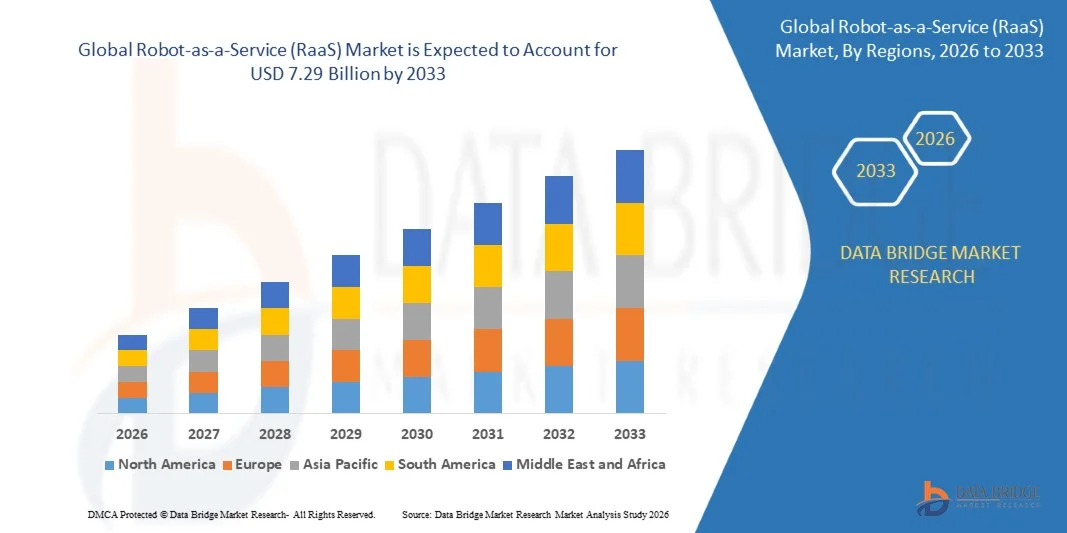
- As per Data Bridge Market Research analysis, the Robot-as-a-Service (RaaS) market was valued at USD 1.90 billion in 2025 and is projected to reach USD 7.29 billion by 2033, growing at a CAGR of 18.30% from 2026 to 2033.
- The market is experiencing strong growth driven by increasing adoption of automation, rising demand for flexible and cost-effective robotic solutions, and the growing need for robotics across manufacturing, logistics, healthcare, retail, food and beverages, and other industries.
- The increasing demand for automation without high upfront capital expenditure, combined with advancements in artificial intelligence, cloud computing, machine learning, sensors, and connectivity, is encouraging businesses to adopt Robot-as-a-Service (RaaS) solutions. The subscription-based and pay-per-use models are also improving access to advanced robotic technologies, enabling businesses to scale automation, enhance operational efficiency, reduce labor-intensive activities, and support flexible deployment across diverse applications.
Market Size & Forecast
- Global Market Value (2025): USD 1.90 Billion
- Expected Market Value (2033): USD 7.29 Billion
- Forecast CAGR (2026–2033): 18.30%
- Leading Region in 2025: North America
- Fastest Growing Region: Asia Pacific
What are the Major Takeaways of the Robot-as-a-Service (RaaS) Market?
- North America dominated the Robot-as-a-Service (RaaS) market with a revenue share of 36.8% in 2025, supported by the early adoption of robotics-as-a-service models, strong investments in automation and artificial intelligence, established robotics infrastructure, and the presence of major technology and robotics providers.
- Asia-Pacific is projected to be the fastest-growing region, registering a CAGR of 20.1% from 2026 to 2033, driven by rapid industrial automation, expansion of manufacturing and logistics operations, rising labor costs, and increasing adoption of subscription-based robotic solutions across China, Japan, South Korea, and India.
- The large enterprises segment dominated the enterprise size category with a revenue share of 68.5% in 2025, supported by higher technology investment capabilities, established automation infrastructure, and the increasing deployment of robotic systems for material handling, manufacturing, warehouse operations, and other repetitive activities.
- The small and medium enterprises segment is projected to be the fastest-growing enterprise-size category, with a CAGR of 20.0% from 2026 to 2033, as subscription-based and pay-per-use models reduce upfront investment requirements and enable smaller businesses to access advanced robotic technologies.
- The handling segment accounted for the largest application share at 35.8% in 2025, driven by increasing deployment of RaaS solutions for material movement, picking, loading and unloading, warehouse operations, and repetitive industrial tasks. The segment is projected to grow at a CAGR of 18.7% from 2026 to 2033.
- The automotive segment dominated the end-use industry category with a revenue share of 17.4% in 2025, supported by increasing automation in assembly, welding, material handling, inspection, and other production activities.
- The logistics and warehousing segment is projected to be among the fastest-growing end-use categories, registering a CAGR of 20.4% from 2026 to 2033, driven by the expansion of e-commerce, warehouse automation, labor shortages, demand for faster order fulfillment, and increasing deployment of autonomous mobile and collaborative robotic systems.
Report Scope and Robot-as-a-Service (RaaS) Market Segmentation
|
Attributes |
Robot-as-a-Service (RaaS) Key Market Insights |
|
Segments Covered |
|
|
Countries Covered |
North America
Europe
Asia-Pacific
Middle East and Africa
South America
|
|
Key Market Players |
|
|
Market Opportunities |
|
|
Value Added Data Infosets |
In addition to the market insights such as market value, growth rate, market segments, geographical coverage, market players, and market scenario, the market report curated by the Data Bridge Market Research team includes in-depth expert analysis, import/export analysis, pricing analysis, production consumption analysis, and pestle analysis. |
What is the Key Trend in the Robot-as-a-Service (RaaS) Market?
- RaaS is increasingly shifting toward AI-enabled and cloud-connected robotic fleets, allowing businesses to remotely monitor robot performance, optimize routes, assign tasks, and manage multiple robotic systems through centralized platforms.
- For instance, in June 2026, industry coverage highlighted the growing adoption of artificial intelligence, machine learning, autonomous navigation, and cloud robotics in RaaS deployments, particularly across warehouse and fulfillment operations.
- The integration of AI, machine learning, IoT, and real-time analytics is improving autonomous decision-making, predictive maintenance, fleet coordination, and operational visibility, helping RaaS providers improve robot utilization and reduce downtime.
- Subscription, rental, pay-per-use, and outcome-based models are becoming increasingly important as businesses seek to automate operations without making large upfront capital investments. The International Federation of Robotics reported that RaaS fleets grew by 31% in 2024, while RaaS adoption in transportation and logistics applications increased by 42%.
- RaaS is expanding beyond traditional manufacturing into logistics, warehousing, healthcare, retail, hospitality, and other service applications, supported by demand for flexible automation and solutions that can be scaled according to operational requirements.
- Modular and reconfigurable robotic systems are gaining attention because they allow businesses to modify robotic capabilities, add additional units, and adjust automation capacity according to changes in production volumes, warehouse demand, and workforce requirements.
- For instance, in 2025, the International Federation of Robotics reported that professional service robot sales reached almost 200,000 units in 2024, with transportation and logistics representing the largest application category at more than 102,900 units.
- As businesses increasingly seek scalable automation with lower capital requirements, the combination of AI-enabled robotics, cloud fleet management, flexible pricing models, remote monitoring, and predictive maintenance is expected to accelerate the adoption of RaaS across industrial and commercial applications.
What are the Key Drivers of the Robot-as-a-Service (RaaS) Market?
- The growing demand for flexible automation with lower upfront investment is increasing RaaS adoption because subscription and rental models allow organizations to shift robotics expenditure from capital investment toward operating expenditure.
- For instance, in 2025, logistics automation providers increasingly promoted RaaS models that combine robotic deployment, system integration, maintenance, and ongoing support, enabling warehouse operators to scale automation according to demand without purchasing complete robotic systems upfront.
- Rising labor shortages across logistics, manufacturing, healthcare, and other labor-intensive industries are encouraging businesses to deploy robotic systems for repetitive, physically demanding, and high-turnover activities while maintaining operational continuity.
- Expanding warehouse automation and e-commerce fulfillment is creating strong demand for RaaS solutions, particularly autonomous mobile robots and material-handling systems used for inventory movement, order fulfillment, transportation, and picking operations.
- Advances in artificial intelligence, autonomous navigation, cloud computing, IoT connectivity, and fleet-management software are improving robotic autonomy and enabling centralized monitoring, real-time task allocation, predictive maintenance, and remote software updates.
- For instance, in December 2025, industry analysis identified AI integration, cloud-based platforms, and collaborative robotics as major factors improving the flexibility, scalability, and accessibility of RaaS solutions across logistics, manufacturing, healthcare, and retail applications.
- The increasing need for scalable and rapidly deployable automation is supporting RaaS adoption among small and medium-sized businesses because robotic capacity can be expanded, reduced, or reconfigured according to operational requirements without the long implementation cycles associated with traditional automation purchases
Which Factors are Challenging the Growth of the Robot-as-a-Service (RaaS) Market?
- RaaS providers continue to face high service costs for complex robotic applications, particularly where deployments require customized hardware, system integration, specialized software, extensive training, and ongoing technical support.
- The integration of robotic hardware with existing enterprise systems, warehouse-management systems, manufacturing platforms, IoT infrastructure, and cloud environments can increase deployment complexity and require significant technical expertise.
- Data security, cybersecurity, safety, and regulatory compliance remain important challenges because connected robotic fleets continuously exchange operational data between robots, cloud platforms, enterprise systems, and remote management environments.
- For instance, in 2025, RaaS market analysis identified subscription-model complexity, fleet scalability, and pricing sustainability as key challenges as providers attempt to balance recurring service costs with customer expectations for flexible and cost-effective automation.
- The performance of RaaS depends on reliable connectivity, cloud infrastructure, sensors, autonomous navigation, and fleet-management platforms, making service continuity more difficult in facilities with inadequate digital infrastructure or unstable network environments.
- The increasing number of robots deployed across multiple locations creates challenges related to fleet maintenance, software updates, interoperability, spare parts, and technical support, particularly as businesses scale from individual robotic deployments to large multi-site fleets.
- For instance, in April 2026, Robot Service Map highlighted the growing adoption of subscription and pay-per-use RaaS models, with robotic systems increasingly bundled with software, maintenance, and support.
- The combination of integration complexity, cybersecurity requirements, recurring service costs, infrastructure dependency, and the need for reliable long-term robot performance continues to challenge RaaS commercialization, particularly for complex applications requiring high availability, safety, and precise operational control.
How is the Robot-as-a-Service (RaaS) Market Segmented?
The robot-as-a-service market is segmented on the basis of robot type, application, enterprise size, and end-use industry.
- By Robot Type
On the basis of robot type, the robot-as-a-service market is segmented into professional and personal. The professional segment dominated the market with a 67.5% share in 2025, supported by the widespread deployment of robotic solutions across logistics, manufacturing, healthcare, retail, and other commercial environments. Professional robots include industrial robots, autonomous mobile robots, logistics and warehouse robots, medical robots, and other commercial service robots that are increasingly offered through subscription and usage-based models. The strong demand for automation, labor shortages, and the need to reduce upfront capital expenditure are encouraging businesses to access professional robotic systems through flexible service contracts. Professional RaaS deployments also benefit from integrated fleet management, maintenance, software updates, and technical support, making them suitable for large-scale enterprise operations. Current market analysis identifies professional robotics as the dominant type segment.
The personal segment is projected to register the fastest growth at a CAGR of 24.9% during the forecast period, driven by increasing adoption of domestic cleaning robots, companion robots, educational robots, entertainment robots, and healthcare-support robots through service-based models. Personal RaaS solutions reduce the need for consumers to purchase expensive robotic equipment outright and instead provide access through subscription, rental, or usage-based arrangements. Improvements in voice interfaces, artificial intelligence, smart-home connectivity, and autonomous navigation are increasing the functionality of personal robots. Growing consumer acceptance of service-based access to robotics is expected to create additional opportunities for this segment
- By Application
On the basis of application, the robot-as-a-service market is segmented into handling, assembling and disassembling, dispensing, processing, welding and soldering, and others. The handling segment dominated the market with a 35.2% share in 2025, supported by increasing demand for automated material movement, order picking, sorting, packaging, palletizing, and warehouse operations. Autonomous mobile robots and robotic arms are increasingly deployed through RaaS models to improve throughput and operational flexibility without requiring customers to make large upfront investments. The expansion of e-commerce, increasing warehouse automation, and labor shortages are further supporting demand for robotic handling solutions. Handling also represents one of the most established RaaS applications across logistics, manufacturing, and distribution environments.
The assembling and dispensing segment is projected to register the fastest growth at a CAGR of 25.4% during the forecast period, driven by increasing demand for flexible and precision-based automation in manufacturing environments. RaaS-based assembly robots can support repetitive production tasks while allowing manufacturers to scale robotic capacity according to production requirements. The increasing adoption of collaborative robots, AI-enabled vision systems, and flexible manufacturing technologies is improving the ability of robots to perform precision assembly and dispensing operations. Demand from electronics, automotive, consumer goods, and other manufacturing industries is expected to further accelerate adoption of these applications.
- By Enterprise Size
On the basis of enterprise size, the robot-as-a-service market is segmented into small and medium enterprises and large enterprises. The large enterprises segment dominated the market with a 69.0% share in 2025, owing to the greater availability of technology budgets, established automation infrastructure, and higher demand for large-scale robotic deployments. Large organizations are increasingly adopting RaaS to automate logistics, manufacturing, warehouse, healthcare, and other operational processes while shifting robotics expenditure from capital expenditure to operating expenditure. RaaS providers also offer customization, system integration, fleet management, maintenance, and technical support, which enables large enterprises to deploy robotic systems across multiple facilities. The ability to scale robotic fleets according to operational requirements further supports adoption among large organizations.
The small and medium enterprises segment is projected to register the fastest growth during the forecast period, driven by the increasing availability of subscription-based, pay-per-use, and flexible robotic deployment models. SMEs traditionally face challenges associated with the high upfront investment, maintenance requirements, and technical expertise needed for conventional robotics adoption. RaaS reduces these barriers by allowing businesses to access robotic capabilities without purchasing the entire robotic infrastructure. Increasing competition among RaaS providers, modular robotic solutions, simplified deployment, and flexible pricing are further improving accessibility for SMEs. The growing need for automation to address labor shortages and improve productivity is expected to accelerate SME adoption.
- By End-Use Industry
On the basis of end-use industry, the robot-as-a-service market is segmented into manufacturing, automotive, food and beverages, logistics and transportation, healthcare, retail, telecom and IT, BFSI, defense, and others. The logistics and transportation segment dominated the market with a 30.0% share in 2025, supported by increasing adoption of autonomous mobile robots, automated material handling, warehouse picking, sorting, inventory movement, and fulfillment solutions. The rapid expansion of e-commerce and increasingly complex supply chains are encouraging logistics operators to deploy robotic fleets through flexible RaaS contracts. RaaS enables logistics companies to scale robotic capacity according to order volumes while reducing upfront investment and maintenance responsibilities. Current market analysis identifies logistics as a leading end-user segment because of strong demand for warehouse automation and e-commerce fulfillment.
The manufacturing segment is projected to register the fastest growth at a CAGR of 23.0% during the forecast period, driven by increasing adoption of smart manufacturing, Industry 4.0 technologies, collaborative robots, and automated production processes. Manufacturers are increasingly using RaaS for assembly, processing, welding, material handling, inspection, and machine-tending activities. The ability to deploy robotic systems without substantial upfront capital investment is particularly attractive for manufacturers seeking flexible automation across changing production requirements. Integration of artificial intelligence, machine vision, IoT connectivity, and cloud-based fleet management is further improving robotic performance and enabling manufacturers to monitor and optimize operations in real time.
Which Region Holds the Largest Share of the Robot-as-a-Service (RaaS) Market?
- North America dominated the robot-as-a-service market with the largest revenue share of 35.2% in 2025, supported by the presence of leading robotics companies, advanced automation infrastructure, and strong investments in artificial intelligence, cloud robotics, and autonomous systems. The region benefits from early adoption of robotics-as-a-service models across logistics, manufacturing, healthcare, retail, and warehouse automation.
- The region also benefits from increasing labor shortages, strong e-commerce activity, and growing demand for flexible automation solutions that reduce upfront capital expenditure. The increasing adoption of autonomous mobile robots, collaborative robots, robotic picking systems, and cloud-based fleet management is further strengthening North America's leadership position. Growing availability of subscription-based, pay-per-use, and outcome-based robotic services is expected to support continued market expansion.
U.S. Robot-as-a-Service (RaaS) Market Insight
The U.S. robot-as-a-service market is witnessing strong growth due to rising investments in warehouse automation, autonomous mobile robots, artificial intelligence, and cloud-based robotics platforms. The country's mature technology ecosystem and presence of major robotics providers are supporting the deployment of RaaS solutions across logistics, manufacturing, healthcare, retail, and other commercial applications. Increasing labor shortages and the need to improve warehouse productivity are encouraging businesses to adopt robotic systems through subscription and usage-based models. In addition, the growing integration of AI, machine vision, autonomous navigation, predictive maintenance, and remote fleet monitoring is improving the scalability and operational efficiency of robotic deployments in the U.S.
Asia-Pacific Robot-as-a-Service (RaaS) Market Insight
The Asia-Pacific robot-as-a-service market is expected to witness rapid growth, driven by expanding manufacturing activities, increasing industrial automation, rising labor costs, and growing investments in robotics and artificial intelligence across countries such as China, Japan, and South Korea. The region's large manufacturing and logistics industries are creating strong demand for autonomous mobile robots, robotic arms, warehouse automation, and collaborative robotic solutions. Increasing adoption of flexible subscription-based automation is also enabling businesses to access robotic technologies without substantial upfront investment. In addition, government-supported smart manufacturing initiatives, expanding e-commerce, and advancements in AI, cloud connectivity, and robotic fleet management are accelerating robot-as-a-service adoption across industrial and commercial sectors.
Japan Robot-as-a-Service (RaaS) Market Insight
The Japan robot-as-a-service market is witnessing consistent growth due to the country's advanced robotics ecosystem, aging workforce, labor shortages, and strong focus on automation. Automotive manufacturers, electronics companies, logistics operators, healthcare organizations, and service providers are increasingly adopting robotic systems to improve productivity and address workforce constraints. The growing integration of artificial intelligence, autonomous navigation, sensors, machine vision, and cloud-based fleet management is supporting the deployment of RaaS solutions. Moreover, Japan's established robotics manufacturing capabilities and emphasis on human-robot collaboration are creating favorable conditions for the expansion of subscription-based and service-oriented robotic solutions.
China Robot-as-a-Service (RaaS) Market Insight
The China robot-as-a-service market is growing rapidly, driven by expanding manufacturing infrastructure, increasing warehouse automation, rising investments in artificial intelligence, and strong government support for advanced robotics development. Growing demand for autonomous mobile robots, robotic arms, automated guided vehicles, and intelligent warehouse systems is boosting RaaS adoption across manufacturing, logistics, automotive, electronics, and e-commerce applications. In addition, increasing labor costs and the need to improve production efficiency are encouraging businesses to shift toward flexible robotic deployment models. Rapid advancements in AI, machine vision, cloud connectivity, and robotic fleet management are further positioning China as one of the fastest-growing markets for robot-as-a-service globally.
U.K. Robot-as-a-Service (RaaS) Market Insight
The U.K. robot-as-a-service market is experiencing steady growth, supported by increasing adoption of warehouse automation, autonomous mobile robots, healthcare robotics, and flexible manufacturing technologies. Growing labor shortages across logistics, manufacturing, and healthcare are encouraging organizations to adopt robotics through subscription and usage-based models. The expansion of e-commerce and fulfillment operations is also increasing demand for robotic picking, sorting, transportation, and inventory-management solutions. Furthermore, increasing integration of artificial intelligence, cloud platforms, machine vision, and remote fleet monitoring is improving the adaptability and efficiency of RaaS deployments across the U.K.
Germany Robot-as-a-Service (RaaS) Market Insight
The Germany robot-as-a-service market is expanding steadily due to the country's strong industrial manufacturing base, advanced automation capabilities, and increasing adoption of Industry 4.0 technologies. Automotive manufacturers, logistics operators, electronics companies, and industrial facilities are increasingly utilizing robotic systems for material handling, assembly, inspection, machine tending, and warehouse operations. The shift from capital-intensive robotics purchases toward flexible subscription and pay-per-use models is creating additional opportunities for RaaS providers. Continuous advancements in artificial intelligence, collaborative robotics, machine vision, cloud-based fleet management, and predictive maintenance, combined with Germany's strong focus on smart manufacturing, are further driving the adoption of robot-as-a-service solutions.
Which are the Top Companies in Robot-as-a-Service (RaaS) Market?
The Robot-as-a-Service (RaaS) industry is primarily led by well-established companies, including:
- Locus Robotics, Inc. (U.S.)
- KUKA SE & Co. KGaA (Germany)
- ABB Ltd. (Switzerland)
- FANUC CORPORATION (Japan)
- Yaskawa Electric Corporation (Japan)
- Aethon, Inc. (U.S.)
- inVia Robotics, Inc. (U.S.)
- Exotec (France)
- Sarcos Technology and Robotics Corporation (U.S.)
- 6 River Systems, Inc. (U.S.)
- Avidbots Corporation (Canada)
- Mobile Industrial Robots A/S (Denmark)
- Omron Corporation (Japan)
- Seegrid Corporation (U.S.)
- GreyOrange Pte. Ltd. (Singapore)
- Starship Technologies (U.S.)
- Knightscope, Inc. (U.S.)
- Cobalt Robotics, Inc. (U.S.)
- Relay Robotics, Inc. (U.S.)
- Savioke, Inc. (U.S.)
- Fetch Robotics, Inc. (U.S.)
- Nuro, Inc. (U.S.)
- Cyberdyne Inc. (Japan)
- Soft Robotics, Inc. (U.S.)
- Hirebotics, Inc. (U.S.)
What are Latest Developments in Robot-as-a-Service (RaaS) Market?
- In June 2025, according to Humro, ARAPL RaaS rebranded as Humro to strengthen its focus on human-robot collaboration and autonomous material-handling solutions. The company highlighted the use of robotics to automate repetitive and labor-intensive tasks while supporting human workers in operational environments. The development reflects the growing adoption of robot-as-a-service models for improving productivity and addressing workforce constraints across industrial applications.
- In June 2024, according to GXO Logistics and Agility Robotics, the companies signed a multi-year robot-as-a-service agreement to deploy Digit humanoid robots in GXO's logistics operations. The deployment integrated Digit with Agility Arc, a cloud-based platform designed for fleet deployment, workflow management, operational monitoring, and troubleshooting. The development represented an important advancement in RaaS adoption for warehouse and logistics applications, demonstrating the potential of service-based robotic deployment to scale automation without conventional robot ownership.
- In January 2023, according to H3 Dynamics and ARO, the companies introduced a bundled subscription model for DBX drone-in-a-box and software services as part of the emerging robot-as-a-service economy. The model replaced conventional robotics capital expenditure with a single monthly service fee covering hardware installation and on-demand aerial data services. The solution was designed to automate navigation, charging, data retrieval, and processing for remote industrial sites such as solar farms, demonstrating the expansion of RaaS toward autonomous inspection and remote-monitoring applications.
- In February 2022, according to Verdant Robotics, the company expanded its robot-as-a-service model to provide specialty crop farmers with access to an autonomous multi-action agricultural robot. The system combined millimeter-accurate spraying, laser weeding, and AI-based digital crop modeling to support agricultural operations. The development demonstrated how RaaS can provide access to advanced autonomous robotics without requiring farmers to make large upfront investments, supporting wider adoption of robotics in precision agriculture.
- In 2024, according to Anyware Robotics, the company announced that its Pixmo autonomous robot for container and truck unloading would be offered through both direct purchase and robot-as-a-service models. The AI-powered mobile robot was designed to autonomously unload boxes from trucks and containers and could be deployed within days. The RaaS option was positioned to allow logistics companies to scale robotic unloading capacity according to operational requirements, highlighting the growing use of flexible service-based robotics in warehouse and logistics operations

- Interactive Data Analysis Dashboard
- Company Analysis Dashboard for high growth potential opportunities
- Research Analyst Access for customization & queries
- Competitor Analysis with Interactive dashboard
- Latest News, Updates & Trend analysis
- Harness the Power of Benchmark Analysis for Comprehensive Competitor Tracking
Data collection and base year analysis are done using data collection modules with large sample sizes. The stage includes obtaining market information or related data through various sources and strategies. It includes examining and planning all the data acquired from the past in advance. It likewise envelops the examination of information inconsistencies seen across different information sources. The market data is analysed and estimated using market statistical and coherent models. Also, market share analysis and key trend analysis are the major success factors in the market report. To know more, please request an analyst call or drop down your inquiry.
The key research methodology used by DBMR research team is data triangulation which involves data mining, analysis of the impact of data variables on the market and primary (industry expert) validation. Data models include Vendor Positioning Grid, Market Time Line Analysis, Market Overview and Guide, Company Positioning Grid, Patent Analysis, Pricing Analysis, Company Market Share Analysis, Standards of Measurement, Global versus Regional and Vendor Share Analysis. To know more about the research methodology, drop in an inquiry to speak to our industry experts.
Data Bridge Market Research is a leader in advanced formative research. We take pride in servicing our existing and new customers with data and analysis that match and suits their goal. The report can be customized to include price trend analysis of target brands understanding the market for additional countries (ask for the list of countries), clinical trial results data, literature review, refurbished market and product base analysis. Market analysis of target competitors can be analyzed from technology-based analysis to market portfolio strategies. We can add as many competitors that you require data about in the format and data style you are looking for. Our team of analysts can also provide you data in crude raw excel files pivot tables (Fact book) or can assist you in creating presentations from the data sets available in the report.













