


Robotic Exoskeletons for Rehabilitation Market Size
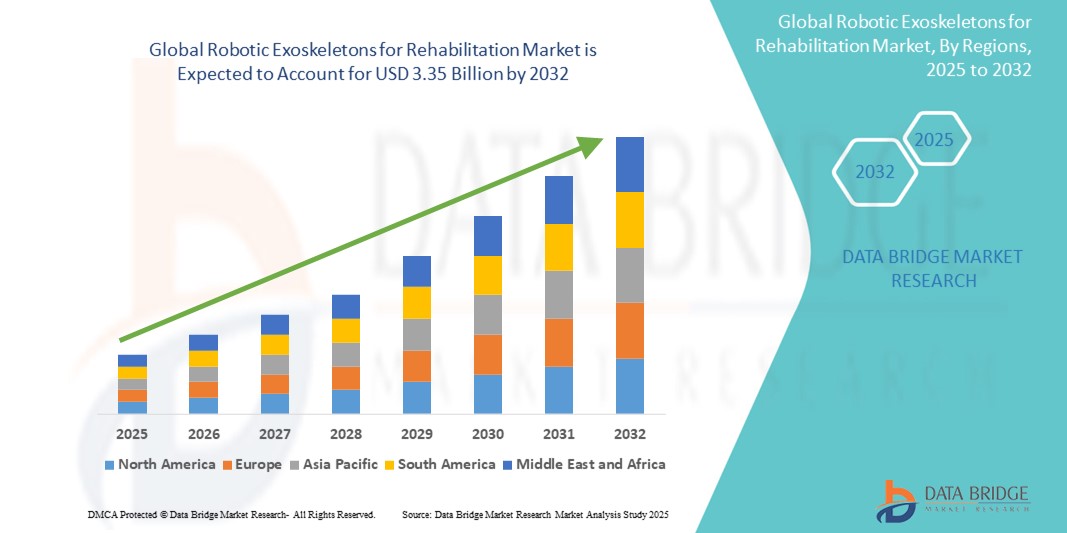
- The global robotic exoskeletons for rehabilitation market size was valued at USD 1.17 billion in 2024 and is expected to reach USD 3.35 billion by 2032, at a CAGR of 14.00% during the forecast period
- The market growth is largely fueled by the increasing adoption of advanced assistive technologies and continuous innovation in robotic mobility systems, contributing to enhanced recovery outcomes in both clinical and home-based rehabilitation environments. robotic exoskeletons are becoming essential tools for physical therapy and post-injury care due to their ability to support patient mobility and accelerate neurorehabilitation
- Furthermore, rising demand for user-friendly, wearable robotic systems that enable personalized, repetitive movement training is positioning robotic exoskeletons as a next-generation rehabilitation solution. These combined factors are significantly accelerating the uptake of Robotic Exoskeletons for Rehabilitation solutions, thereby propelling strong market growth across healthcare institutions and home care settings
Robotic Exoskeletons for Rehabilitation Market Analysis
- Robotic exoskeletons, designed to aid mobility and muscle strength, are becoming vital components of modern rehabilitation practices in both clinical and homecare settings due to their ability to enhance physical therapy outcomes, restore motor functions, and improve quality of life for patients with neurological or musculoskeletal impairments
- The escalating demand for robotic exoskeletons is primarily fueled by advancements in wearable robotics, increasing cases of spinal cord injuries, stroke, and age-related mobility challenges, as well as a growing preference for non-invasive, tech-driven recovery solutions
- North America dominated the robotic exoskeletons for rehabilitation market with the largest revenue share of 41.6% in 2024, driven by robust healthcare infrastructure, early adoption of advanced rehabilitation technologies, high healthcare spending, and the presence of key players such as Ekso Bionics and ReWalk Robotics
- Asia-Pacific is expected to be the fastest-growing region in the robotic exoskeletons for rehabilitation market, projected to expand at a CAGR of 17.4% from 2025 to 2032, driven by increasing investments in healthcare, rising incidences of physical disabilities, expanding elderly population, and growing awareness of robotic rehabilitation benefits in countries such as China, Japan, and India
- The mobile exoskeletons segment dominated the robotic exoskeletons for rehabilitation market with a revenue share of 46.3% in 2024, attributed to their portability, flexibility in rehabilitation settings, and suitability for both clinical and home-based use. These systems enable greater patient mobility, facilitate dynamic therapy sessions, and support a wider range of rehabilitation programs, positioning them as the preferred choice for enhancing patient engagement and outcomes in diverse care environments
Report Scope and Robotic Exoskeletons for Rehabilitation Market Segmentation
|
Attributes |
Robotic Exoskeletons for Rehabilitation Key Market Insights |
|
Segments Covered |
|
|
Countries Covered |
North America
Europe
Asia-Pacific
Middle East and Africa
South America
|
|
Key Market Players |
|
|
Market Opportunities |
|
|
Value Added Data Infosets |
In addition to the insights on market scenarios such as market value, growth rate, segmentation, geographical coverage, and major players, the market reports curated by the Data Bridge Market Research also include in-depth expert analysis, pricing analysis, brand share analysis, consumer survey, demography analysis, supply chain analysis, value chain analysis, raw material/consumables overview, vendor selection criteria, PESTLE Analysis, Porter Analysis, and regulatory framework. |
Robotic Exoskeletons for Rehabilitation Market Trends
“Technological Advancements Reshaping Rehabilitation Therapies”
- A significant and accelerating trend in the global robotic exoskeletons for rehabilitation market is the integration of advanced technologies such as artificial intelligence (AI), real-time data analytics, and sensor-enabled feedback systems, which are enhancing the precision and customization of patient therapies
- For instance, modern robotic exoskeletons are equipped with adaptive algorithms that adjust resistance levels and motion patterns based on the patient's progress and biomechanical data, allowing for personalized rehabilitation sessions. Some systems also offer voice-assistance features for ease of operation, improving accessibility for both patients and caregivers
- These innovations are enabling hands-free control, automated therapy adjustments, and real-time feedback, thus making rehabilitation more engaging and less dependent on continuous clinical supervision. In parallel, cloud-connected platforms are facilitating remote monitoring, allowing healthcare providers to track recovery metrics and adapt treatment protocols from afar
- Manufacturers are also leveraging these technologies to design compact, wearable exoskeletons suitable for home-based rehabilitation, addressing the rising demand for decentralized care, especially in post-acute and long-term care scenarios
- This trend is transforming traditional rehabilitation methods by offering greater autonomy to patients, reducing the burden on healthcare facilities, and supporting improved long-term outcomes through data-driven, continuous care
- As healthcare systems increasingly prioritize personalized medicine and remote therapeutic solutions, the demand for technologically enhanced robotic exoskeletons is projected to grow rapidly across both developed and emerging markets
Robotic Exoskeletons for Rehabilitation Market Dynamics
Driver
“Growing Need Due to Rising Disability Rates and Technological Advancements”
- The increasing prevalence of neurological and musculoskeletal disorders, along with a growing aging population, is significantly driving demand for robotic exoskeletons for rehabilitation. These devices are increasingly recognized for their role in enhancing patient mobility, reducing physical strain on therapists, and accelerating recovery in stroke, spinal cord injury, and orthopedic rehabilitation
- For instance, in April 2024, Ekso Bionics launched a next-generation rehabilitation exoskeleton integrated with advanced motion sensors and real-time feedback systems, aimed at improving gait training outcomes. Such innovations from key market players are expected to drive the Robotic Exoskeletons for Rehabilitation industry growth during the forecast period
- The growing demand for personalized rehabilitation programs and data-driven therapy is pushing hospitals and therapy centers to adopt intelligent exoskeleton solutions. These devices not only track patient progress but also adapt assistance levels based on individual recovery needs
- Furthermore, technological progress in sensors, batteries, and lightweight materials has made robotic exoskeletons more compact, energy-efficient, and user-friendly. This makes them suitable for both clinical and home settings, further expanding their applications across the care continuum
- Increasing funding for assistive technologies from government agencies and favorable reimbursement scenarios in developed economies are also accelerating adoption. In addition, partnerships between tech companies and rehabilitation centers are contributing to faster commercialization and product deployment in underserved markets
Restraint/Challenge
“High Cost of Technology and Limited Awareness in Developing Regions”
- The high initial cost of robotic exoskeletons for rehabilitation remains a major barrier to widespread adoption, especially in developing countries with limited healthcare budgets. Advanced models with features such as real-time biofeedback, AI-based control systems, and wireless connectivity can cost tens of thousands of dollars, which may be unaffordable for many hospitals or patients
- For instance, full-body rehabilitation exoskeletons for spinal cord injury patients can range from USD 40,000 to USD 120,000 per unit, posing a challenge for healthcare providers in resource-limited settings
- Moreover, a lack of awareness and trained personnel to operate these systems further limits their implementation outside top-tier hospitals and rehabilitation centers. In rural and semi-urban healthcare settings, infrastructure limitations also restrict usage
- Addressing these challenges will require coordinated efforts in developing low-cost exoskeleton solutions, offering leasing or rental options, and providing extensive training programs for therapists. Public-private partnerships and supportive government policies can also play a critical role in expanding access
- As companies invest in scalable manufacturing, modular designs, and simplified user interfaces, the cost curve is expected to decline, enabling broader adoption and improving access to high-quality rehabilitation globally
Robotic Exoskeletons for Rehabilitation Market Scope
The market is segmented on the basis of type, mobility, technology, application, and end user.
• By Type
On the basis of type, the robotic exoskeletons for rehabilitation market is segmented into lower body exoskeletons, upper body exoskeletons, full body exoskeletons, and others. The lower body exoskeletons segment dominated the market with the largest revenue share of 38.6% in 2024, driven by their extensive use in stroke and spinal cord rehabilitation.
The full body exoskeletons segment is anticipated to register the fastest growth with a CAGR of 12.7% from 2025 to 2032, due to increasing applications in neuromuscular therapy and occupational support.
• By Mobility
On the basis of mobility, the robotic exoskeletons for rehabilitation market is segmented into mobile exoskeletons, stationary exoskeletons, and fixed exoskeletons. The mobile exoskeletons segment held the largest market share of 46.3% in 2024, attributed to their portability, flexibility in rehabilitation settings, and suitability for both clinical and home-based use.
The Stationary Exoskeletons segment is expected to witness the fastest CAGR of 11.8% from 2025 to 2032, due to their high precision and support in intensive clinical therapy.
• By Technology
On the basis of technology, the robotic exoskeletons for rehabilitation market is segmented into mechanically powered, electronically powered, pneumatically powered, hydraulically powered, and others. The electronically powered segment accounted for the largest share of 41.5% in 2024, driven by the prevalence of battery-operated exoskeletons in therapeutic rehabilitation.
The pneumatically powered segment is projected to grow at the highest CAGR of 13.9% from 2025 to 2032, due to its ability to deliver smoother motion and reduced mechanical resistance.
• By Application
On the basis of application, the robotic exoskeletons for rehabilitation market is segmented into rehabilitation, assistive, defense, industrial, and others. The rehabilitation segment led the market with a revenue share of 49.2% in 2024, supported by its widespread use in neurorehabilitation, orthopedic recovery, and post-surgical therapy.
The assistive segment is anticipated to expand at the fastest CAGR of 14.3% from 2025 to 2032, driven by the need for mobility support for elderly and disabled populations.
• By End User
On the basis of end user, the robotic exoskeletons for rehabilitation market is segmented into rehabilitation centers, hospitals, long term care centers, and homecare settings. The rehabilitation centers segment dominated the market with a 45.7% revenue share in 2024, as these facilities are key hubs for robotic exoskeleton adoption in therapy programs.
The homecare settings segment is expected to register the fastest CAGR of 15.6% from 2025 to 2032, owing to the rise of remote care models and increasing accessibility of wearable rehab devices.
Robotic Exoskeletons for Rehabilitation Market Regional Analysis
- North America dominated the robotic exoskeletons for rehabilitation market with the largest revenue share of 41.6% in 2024, driven by rising adoption of advanced rehabilitation technologies, an aging population, and strong reimbursement frameworks across the U.S. and Canada
- The region benefits from a high level of healthcare expenditure, increasing incidence of neurological and musculoskeletal disorders, and government funding supporting robotic innovation in the healthcare sector
- In particular, demand is growing across rehabilitation centers and long-term care facilities where robotic exoskeletons enhance patient mobility outcomes and reduce caregiver strain
U.S. Robotic Exoskeletons for Rehabilitation Market Insight
The U.S. robotic exoskeletons for rehabilitation market captured a dominant share of the North American robotic exoskeletons for rehabilitation market in 2024, fueled by high investment in healthcare robotics, expanding veteran and senior care programs, and robust clinical trial activities. The U.S. is home to several leading manufacturers and research institutions focused on neurorehabilitation and spinal injury recovery, creating a thriving innovation ecosystem. Favorable FDA approvals and growing insurance coverage are further accelerating adoption across hospitals and outpatient rehab clinics.
Europe Robotic Exoskeletons for Rehabilitation Market Insight
The Europe robotic exoskeletons for rehabilitation market is projected to expand at a substantial CAGR throughout the forecast period, supported by stringent safety standards, aging demographics, and a growing emphasis on patient mobility and independence. Countries such as Germany, France, and the U.K. are investing in digital healthcare transformation, including robotic-assisted therapy in both public and private rehabilitation centers. EU-funded initiatives aimed at reducing hospital stays and improving rehabilitation outcomes are driving deployment of robotic exoskeletons across various care settings.
U.K. Robotic Exoskeletons for Rehabilitation Market Insight
The U.K. robotic exoskeletons for rehabilitation market is anticipated to grow at a noteworthy CAGR during the forecast period, propelled by the increasing adoption of assistive robotics in elderly and neurological care. National Health Service (NHS) pilot programs, growing awareness of stroke rehabilitation innovations, and government incentives for technology adoption in healthcare are boosting demand. Moreover, research collaborations between universities and med-tech firms are helping launch new wearable exoskeleton models for gait training and post-operative rehab.
Germany Robotic Exoskeletons for Rehabilitation Market Insight
The Germany robotic exoskeletons for rehabilitation market is expected to expand at a considerable CAGR during the forecast period, driven by rising demand for high-precision rehabilitation tools, strong engineering expertise, and healthcare digitization strategies. Robotic exoskeletons are being deployed in both acute and chronic care settings, especially for patients recovering from traumatic injuries, spinal cord damage, and stroke. Germany's aging population and emphasis on innovative care delivery support the long-term growth of this market.
Asia-Pacific Robotic Exoskeletons for Rehabilitation Market Insight
The Asia-Pacific robotic exoskeletons for rehabilitation market is projected to grow at the fastest CAGR of 17.4% during the forecast period (2025–2032), driven by increasing disability rates, rising awareness about robotic therapy, and significant investments in healthcare infrastructure. China, Japan, and India are the key contributors, with rising demand for both hospital-based and home-based rehabilitation. Supportive government policies for assistive technology and rapidly expanding private rehabilitation centers are further accelerating the market.
Japan Robotic Exoskeletons for Rehabilitation Market Insight
The Japan robotic exoskeletons for rehabilitation market is gaining momentum with an expected CAGR of 12.5%, driven by the country’s super-aged population and strong robotics R&D sector. Japan is a global leader in robotics innovation, with companies such as CYBERDYNE developing advanced exoskeletons for neurorehabilitation and mobility support. The growing focus on home-based care, labor shortages in eldercare, and public health initiatives are expanding the application of robotic exoskeletons across the continuum of care.
China Robotic Exoskeletons for Rehabilitation Market Insight
The China robotic exoskeletons for rehabilitation market is expected to witness the highest CAGR of 38.4% of the Asia-Pacific market in 2024. Growth is fueled by the country’s rapid urbanization, increased healthcare spending, and national policies encouraging medical device innovation. The presence of domestic robotics firms, government funding for rehabilitation programs, and widespread adoption of assistive technologies in public hospitals are driving strong demand. China is also witnessing rapid deployment of robotic exoskeletons for aging-related mobility challenges and post-surgical rehabilitation.
Robotic Exoskeletons for Rehabilitation Market Share
The robotic exoskeletons for rehabilitation industry is primarily led by well-established companies, including:
- Ekso Bionics (U.S.)
- Lifeward, Inc. (Israel)
- CYBERDYNE Inc. (Japan)
- Hocoma (Switzerland)
- Parker Hannifin Corp (U.S.)
- Bionik Laboratories Corp. (Canada)
- Myomo, Inc. (U.S.)
- LockHeed Martin Corporation (U.S.)
- Rex Bionics Ltd. (New Zealand)
- Wearable Robotics srl (Italy)
- SuitX (U.S.)
- Technaid (Spain)
- Honda Motor Co., Ltd. (Japan)
- Fourier (China)
- B-Temia (Canada)
- GOGOA Mobility Robots (Spain)
- Hyundai Motor Company (South Korea)
- Wandercraft (France)
- INNOPHYS Co., Ltd. (Japan)
- Ottobock (Germany)
Latest Developments in Global Robotic Exoskeletons for Rehabilitation Market
- In June 2025, researchers at Northern Arizona University launched OpenExo, a groundbreaking open-source platform for robotic exoskeletons. Designed for rehabilitation and mobility applications, OpenExo offers global developers access to design files, control software, and documentation, democratizing access to exoskeleton research tools and accelerating innovation in the rehabilitation space. This initiative marks a significant step toward enhancing accessibility and customization of robotic rehabilitation technologies worldwide
- In January 2025, Ekso Bionics expanded its clinical footprint by partnering with Allegheny Health Network to deploy EksoNR in outpatient neurorehabilitation settings. This marked the first FDA-cleared robotic exoskeleton used outside inpatient rehab for stroke and brain injury patients. The expansion aims to make robotic gait therapy more accessible, improving recovery timelines and patient outcomes in community-based settings
- In June 2025, Wandercraft announced a successful Series D funding round totaling USD 75 million, aimed at accelerating global expansion and commercialization of its AI-powered robotic exoskeleton, Atalante X. In addition, Wandercraft secured FDA clearance for Atalante X—its second FDA nod—making it one of the few exoskeletons approved for rehabilitation in the U.S. healthcare system. These milestones underscore the company's leadership in full lower-limb exoskeleton technologies for stroke and neurological rehab
- In December 2024, engineers at KAIST (Korea Advanced Institute of Science and Technology) unveiled the WalkON Suit F1, a full-body robotic exoskeleton capable of assisting paraplegic users with walking, stair-climbing, and side-stepping. The exosuit, weighing 50kg and powered by 12 motors, received gold at the Cybathlon 2024 in the exoskeleton race. The suit represents a new frontier in assistive wearable technology tailored for independence and mobility in daily life
- In February 2025, ReWalk Robotics Ltd. announced clinical trials for its ReStore Exo-Suit, designed for stroke rehabilitation and mobility improvement in outpatient settings. Early findings show significant improvements in gait speed and balance among users. The company plans broader commercialization following regulatory reviews in North America and Europe, highlighting the increasing role of wearable robotics in physical therapy and patient mobility support

- Interactive Data Analysis Dashboard
- Company Analysis Dashboard for high growth potential opportunities
- Research Analyst Access for customization & queries
- Competitor Analysis with Interactive dashboard
- Latest News, Updates & Trend analysis
- Harness the Power of Benchmark Analysis for Comprehensive Competitor Tracking
Data collection and base year analysis are done using data collection modules with large sample sizes. The stage includes obtaining market information or related data through various sources and strategies. It includes examining and planning all the data acquired from the past in advance. It likewise envelops the examination of information inconsistencies seen across different information sources. The market data is analysed and estimated using market statistical and coherent models. Also, market share analysis and key trend analysis are the major success factors in the market report. To know more, please request an analyst call or drop down your inquiry.
The key research methodology used by DBMR research team is data triangulation which involves data mining, analysis of the impact of data variables on the market and primary (industry expert) validation. Data models include Vendor Positioning Grid, Market Time Line Analysis, Market Overview and Guide, Company Positioning Grid, Patent Analysis, Pricing Analysis, Company Market Share Analysis, Standards of Measurement, Global versus Regional and Vendor Share Analysis. To know more about the research methodology, drop in an inquiry to speak to our industry experts.
Data Bridge Market Research is a leader in advanced formative research. We take pride in servicing our existing and new customers with data and analysis that match and suits their goal. The report can be customized to include price trend analysis of target brands understanding the market for additional countries (ask for the list of countries), clinical trial results data, literature review, refurbished market and product base analysis. Market analysis of target competitors can be analyzed from technology-based analysis to market portfolio strategies. We can add as many competitors that you require data about in the format and data style you are looking for. Our team of analysts can also provide you data in crude raw excel files pivot tables (Fact book) or can assist you in creating presentations from the data sets available in the report.













