


What is the Robotic Palletizers Market Size and Growth Rate?
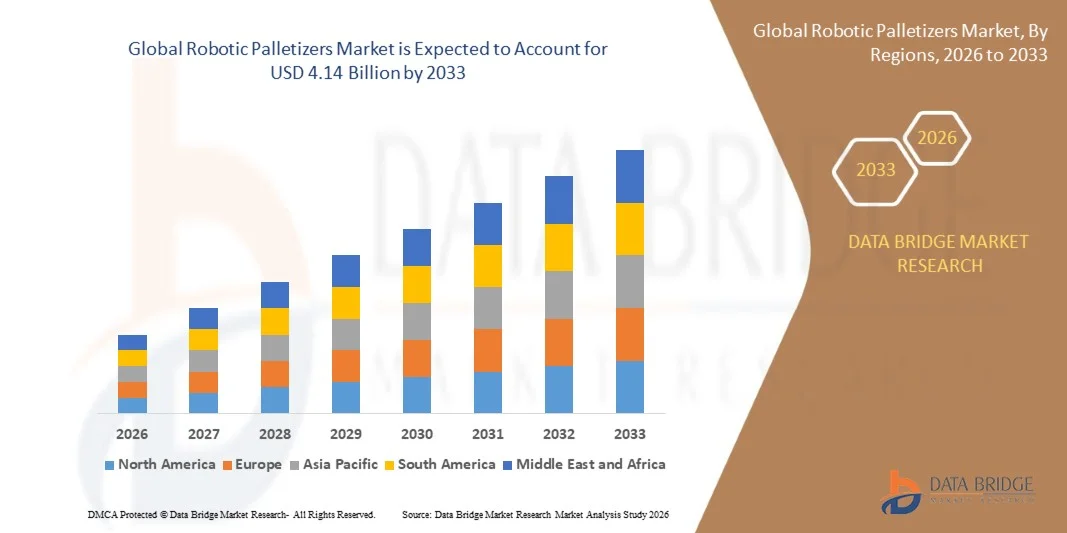
- As per Data Bridge Market Research analysis, the robotic palletizers market was valued at USD 2.74 billion in 2025 and is projected to reach USD 4.14 billion by 2033, growing at a CAGR of 5.3% from 2026 to 2033.
- The market is experiencing steady growth driven by the persistent labor shortages in warehousing and manufacturing, rising e-commerce order volumes requiring high-throughput end-of-line automation, and increasing adoption of flexible robotic systems capable of handling diverse product formats across food, beverage, and consumer goods industries.
- The growing emphasis on workplace safety, operational efficiency, and consistent packaging quality is compelling manufacturers and logistics providers to replace manual and semi-automated palletizing processes with fully robotic systems. Collaborative robotic palletizers are increasingly complementing traditional articulated robots, offering smaller manufacturers and mixed-SKU operations a lower-cost, easier-to-deploy automation pathway.
- The integration of robotic palletizers with broader warehouse execution systems and automated storage and retrieval infrastructure is enabling manufacturers to achieve seamless, end-to-end automation from production line to warehouse racking, further strengthening the business case for robotic palletizing investment.
Market Size & Forecast
- Global Market Value (2025): USD 2.74 Billion
- Expected Market Value (2033): USD 4.14 Billion
- Forecast CAGR (2026–2033): 5.3%
- Leading Region in 2025: Asia-Pacific
- Fastest Growing Region: North America
What are the Major Takeaways of the Robotic Palletizers Market?
- Asia-Pacific dominated the global robotic palletizers market with the largest revenue share of 36.92% in 2025, supported by extensive manufacturing infrastructure, rapid growth in e-commerce logistics, and strong government initiatives promoting industrial automation across China, Japan, and South Korea.
- North America is expected to be the fastest-growing region at a CAGR of 6.9% from 2026 to 2033, fueled by persistent warehouse labor shortages, rising minimum wage costs, and accelerating adoption of automation across food & beverage and consumer goods manufacturing.
- The articulated robotic palletizers segment led the market with a 47.83% share in 2025, driven by its versatility, wide range of motion, and ability to handle diverse product sizes and packaging formats across multiple industries.
- The collaborative robotic palletizers segment is the fastest-growing robot type, projected to register a CAGR of 8.4%, reflecting rising demand from small and mid-sized manufacturers seeking lower-cost, easier-to-deploy automation without extensive safety fencing requirements.
- The food & beverage application segment dominated the application category with a 34.61% revenue share in 2025, led by high-volume, repetitive palletizing needs and stringent hygiene and safety standards favoring automated handling.
- Vacuum gripper end-of-arm tooling accounted for 41.27% of the market share in 2025, preferred for its ability to handle a wide variety of case, bag, and box formats without product damage.
- The e-commerce & logistics application segment is the fastest-growing category, with a CAGR of 7.8%, driven by surging parcel volumes and warehouse automation investment among third-party logistics providers and fulfillment centers.
- The multi-layer palletizing segment accounted for 62.35% of the market share in 2025, reflecting its ability to maximize pallet density and warehouse storage efficiency for standard case and box products.
- The medium payload capacity segment held a 44.16% share in 2025, supported by its widespread suitability for standard case and box palletizing applications across food, beverage, and consumer goods manufacturing.
Report Scope and Robotic Palletizers Market Segmentation
|
Attributes |
Robotic Palletizers Key Market Insights |
|
Segments Covered |
|
|
Countries Covered |
North America
Europe
Asia-Pacific
Middle East and Africa
South America
|
|
Key Market Players |
|
|
Market Opportunities |
|
|
Value Added Data Infosets |
In addition to the insights on market scenarios such as market value, growth rate, segmentation, geographical coverage, and major players, the market reports curated by the Data Bridge Market Research also include import export analysis, production capacity overview, production consumption analysis, price trend analysis, climate change scenario, supply chain analysis, value chain analysis, raw material/consumables overview, vendor selection criteria, PESTLE Analysis, Porter Analysis, and regulatory framework. |
What is the Key Trend in the Robotic Palletizers Market?
- Manufacturers are shifting toward systems that operate safely alongside workers without heavy safety caging, reducing deployment costs for small and mid-sized operations.
- For instance, in June 2026, Doosan Robotics unveiled its advanced AI-powered palletizing solution, PalletizHD+, designed to remove deployment complexities and enhance high-speed performance for SME manufacturers.
- Advanced machine vision allows robotic palletizers to autonomously identify, orient, and stack irregular or mixed-SKU products dynamically without heavy manual reprogramming.
- For instance, in January 2026, ABB Robotics partnered with Jacobi Robotics to integrate OmniPalletizer AI software across its network, giving system integrators automated path planning and vision capabilities for complex mixed-case palletizing.
- Warehouses are deploying mobile, re-locatable palletizers capable of moving between various production lines or loading docks to offer maximum layout flexibility.
- For instance, in September 2025, automation specialist TRAPO expanded deployment of the TRAPO Cobot Palletizer (TCP), a mobile, fence-free robotic system built to be easily moved between multiple workstations and production lines via a hand pallet truck.
- Subscription and leasing models are replacing large upfront capital expenditures, lowering the financial threshold for smaller businesses to adopt automation.
- For instance, in January 2025, automation providers and certified regional integrators partnering with brands like Universal Robots expanded flexible monthly subscription frameworks, allowing mid-sized food and beverage producers to deploy pre-engineered palletizing cells without large upfront equipment purchases.
What are the Key Drivers of the Robotic Palletizers Market?
- The persistent shortage of warehouse and manufacturing labor across major economies has significantly increased demand for automated palletizing solutions capable of maintaining consistent throughput without reliance on manual labor availability.
- For instance, in April 2025, FANUC Corporation expanded its robotic palletizer manufacturing capacity in North America to meet rising demand from food and beverage manufacturers accelerating automation investment amid ongoing labor shortages.
- The rapid growth of e-commerce order fulfillment has significantly increased demand for high-speed, flexible palletizing systems capable of handling diverse package sizes and shapes across distribution and fulfillment center operations.
- For instance, in December 2024, KUKA AG expanded its palletizing robot product line with a new high-speed model specifically designed for e-commerce fulfillment centers requiring rapid, mixed-SKU pallet building capabilities.
- Rising awareness of workplace ergonomic injuries associated with repetitive manual palletizing tasks is prompting occupational safety regulators and insurers in several markets to encourage or incentivize automation adoption, further supporting robotic palletizer investment among manufacturers seeking to reduce workplace injury claims.
- For instance, in October 2024, a national occupational safety agency in Europe published updated ergonomic guidelines recommending automation of repetitive heavy lifting tasks, including manual palletizing, prompting several manufacturers to accelerate robotic palletizer procurement plans.
- With rising labor costs, growing e-commerce volumes, and increasing emphasis on workplace safety and operational efficiency, robotic palletizing systems will remain essential to modern manufacturing and logistics operations worldwide.
Which Factors are Challenging the Growth of the Robotic Palletizers Market?
- Robotic palletizing systems require substantial upfront capital investment in robots, end-of-arm tooling, safety infrastructure, and system integration, creating cost barriers for smaller manufacturers with limited automation budgets.
- These high implementation costs limit adoption among small and mid-sized enterprises, particularly in price-sensitive and emerging markets where manual labor remains comparatively less expensive than automation investment.
- For instance, in September 2024, several small-scale food packaging companies reported that the total cost of ownership for a fully integrated robotic palletizing cell, including safety fencing and system integration, remained prohibitively high relative to their production volumes, delaying automation adoption.
- The need for specialized technical expertise to program, maintain, and troubleshoot robotic palletizing systems creates an ongoing workforce skills gap, particularly for smaller manufacturers lacking dedicated automation engineering staff or access to qualified system integrators.
- Highly variable or low-volume production environments may not generate sufficient return on investment to justify robotic palletizing automation, as the flexibility and reprogramming effort required for frequent product changeovers can offset labor savings in certain operational contexts.
- The high capital investment and lengthy return-on-investment timelines associated with robotic palletizing systems continue to restrict adoption, particularly among smaller manufacturers and operations with variable or seasonal production volumes. This cost barrier slows market penetration in price-sensitive segments, limiting the widespread adoption of robotic palletizing despite growing demand for automated end-of-line solutions.
How is the Robotic Palletizers Market Segmented?
The robotic palletizers market is segmented on the basis of robot type, payload capacity, end-of-arm tooling, application, end user, and layer configuration.
- By Robot Type
On the basis of robot type, the global robotic palletizers market is segmented into articulated robotic palletizers, cartesian/gantry robotic palletizers, delta/parallel robotic palletizers, and collaborative robotic palletizers. The articulated robotic palletizers segment dominated the market with a 47.83% share in 2025, owing to its versatility, wide range of motion, and ability to handle diverse product sizes and packaging formats across multiple industries. These robots remain the preferred choice for high-volume manufacturers seeking maximum flexibility in pallet pattern configuration.
The collaborative robotic palletizers segment is projected to register the fastest growth at a CAGR of 8.4% from 2026 to 2033, driven by rising demand from small and mid-sized manufacturers seeking lower-cost, easier-to-deploy automation without extensive safety fencing requirements. Advances in force-sensing technology and simplified programming interfaces are accelerating segment expansion.
- By Payload Capacity
On the basis of payload capacity, the global robotic palletizers market is segmented into low payload, medium payload, and high payload. The medium payload segment led the market with a 44.16% share in 2025, supported by its widespread suitability for standard case and box palletizing applications across food, beverage, and consumer goods manufacturing.
The low payload segment is expected to experience the fastest growth at a CAGR of 7.6% from 2026 to 2033, driven by increasing demand for compact, cost-effective palletizing solutions suited to lightweight product handling in pharmaceutical and small-format consumer goods applications.
- By End-of-Arm Tooling
On the basis of end-of-arm tooling, the global robotic palletizers market is segmented into vacuum gripper, clamp gripper, fork/platen gripper, and others. The vacuum gripper segment dominated the market with a share of 41.27% in 2025 due to its ability to handle a wide variety of case, bag, and box formats without product damage. the growing preference for gentle, damage-free handling across food and consumer goods applications is reinforcing this segment’s leading position.
The fork/platen gripper segment is expected to witness the fastest CAGR of 6.9% from 2026 to 2033, driven by this growth is fueled by rising adoption in bag and sack palletizing applications common in building materials, chemicals, and agricultural product handling requiring robust, high-throughput gripping solutions.
- By Application
On the basis of application, the global robotic palletizers market is segmented into food & beverage, pharmaceuticals, chemicals, consumer goods & FMCG, building materials, e-commerce & logistics, and others. The food & beverage segment dominated the market with a share of 34.61% in 2025 due to high-volume, repetitive palletizing needs and stringent hygiene and safety standards favoring automated handling over manual labor. the continued expansion of packaged food and beverage production capacity is reinforcing the dominance of this segment.
The e-commerce & logistics segment is expected to witness the fastest CAGR of 7.8% from 2026 to 2033, driven by surging parcel volumes and warehouse automation investment among third-party logistics providers and fulfillment centers requiring flexible, high-speed mixed-SKU palletizing capabilities.
- By End User
On the basis of end user, the global robotic palletizers market is segmented into food & beverage manufacturers, pharmaceutical companies, logistics & warehousing providers, consumer goods manufacturers, and chemical & industrial manufacturers. The food & beverage manufacturers segment dominated the market with a share of 33.84% in 2025 due to widespread automation adoption to meet high production volumes, hygiene standards, and consistent packaging quality requirements. the growing trend toward automated end-of-line operations across bottling and packaging facilities is reinforcing this segment’s leading position.
The logistics & warehousing providers segment is expected to witness the fastest CAGR of 8.1% from 2026 to 2033, driven by rising investment in distribution center automation to manage growing e-commerce order volumes and address ongoing warehouse labor shortages. additionally, growing adoption of robotic palletizing within third-party logistics operations is further accelerating adoption across this segment.
- By Layer Configuration
On the basis of layer configuration, the global robotic palletizers market is segmented into single-layer palletizing and multi-layer palletizing. The multi-layer palletizing segment dominated the market with a share of 62.35% in 2025 due to its ability to maximize pallet density and warehouse storage efficiency for standard case and box products. established programming capabilities for complex, interlocking pallet patterns continue to support strong demand for multi-layer palletizing systems.
The single-layer palletizing segment is expected to witness the fastest CAGR of 6.4% from 2026 to 2033, driven by rising adoption in applications requiring simplified, rapid palletizing cycles for lightweight or fragile products where layer-by-layer stacking speed takes priority over maximum pallet density.
Which Region Holds the Largest Share of the Robotic Palletizers Market?
- Asia-Pacific dominated the robotic palletizers market and accounted for the largest revenue share of 36.92% in 2025, supported by extensive manufacturing infrastructure, rapid growth in e-commerce logistics, and strong government initiatives promoting industrial automation across the region.
- The region also benefits from a large concentration of robotics manufacturers, growing domestic demand for packaged food and consumer goods, and increasing investment in warehouse automation to support expanding e-commerce fulfillment networks. Continued government focus on smart manufacturing and Industry 4.0 initiatives continues to strengthen Asia-Pacific’s leadership position in the global market.
China Robotic Palletizers Market Insight
China robotic palletizers market is growing rapidly, driven by extensive manufacturing automation investment, rising labor costs, and rapid growth in e-commerce logistics infrastructure. Growing adoption of robotic palletizing systems across food and beverage, consumer goods, and logistics sectors is significantly boosting market demand. In addition, rising domestic robotics manufacturing capabilities and increasing government support for smart factory initiatives are positioning China as the largest and fastest-growing market for robotic palletizers in the region.
Japan Robotic Palletizers Market Insight
The Japan robotic palletizers market is witnessing consistent growth due to the country’s advanced robotics manufacturing industry, aging workforce driving automation adoption, and strong presence of leading robotic system manufacturers. Food and beverage producers and consumer goods manufacturers continue to invest in robotic palletizing to address labor shortages and maintain consistent production quality. Moreover, continued innovation in compact, high-speed palletizing robot designs is further contributing to market growth in Japan.
Europe Robotic Palletizers Market Insight
Europe’s robotic palletizer market expands steadily, anchored by a mature industrial infrastructure across powerhouse economies like Germany, the UK, and France. Regional growth relies heavily on strict manufacturing standards, widespread logistics automation, and the integration of flexible collaborative robots (cobots) for small and medium enterprises. Prioritizing long-term sustainability, European enterprises continuously integrate smart hardware and advanced end-of-arm tooling to optimize supply chain efficiency.
Germany Robotic Palletizers Market Insight
The Germany robotic palletizers market is expanding steadily, supported by the country’s strong industrial automation base, advanced robotics manufacturing capabilities, and increasing adoption of Industry 4.0 technologies across manufacturing sectors. Manufacturers and logistics companies are increasingly integrating robotic palletizing systems with broader warehouse automation and material handling infrastructure. Continued government support for advanced manufacturing and robotics research is further driving market growth in Germany.
France Robotic Palletizers Market Insight
France’s robotic palletizer market exhibits strong growth, driven by rapid adoption across semiconductor, electronics, and manufacturing sectors. Emphasizing Industry 4.0 modernization, French industries increasingly utilize automated systems to counteract labor shortages, reduce operational expenses, and enhance workplace safety. Government backing for digital transformation initiatives further accelerates demand, positioning the country as a competitive regional automation hub.
Which are the Top Companies in Robotic Palletizers Market?
The robotic palletizers industry is primarily led by well-established companies, including:
- ABB Ltd. (Switzerland)
- KUKA AG (Germany)
- FANUC Corporation (Japan)
- Yaskawa Electric Corporation (Japan)
- Kawasaki Heavy Industries, Ltd. (Japan)
- Comau S.p.A. (Italy)
- Krones AG (Germany)
- Columbia Machine, Inc. (U.S.)
- Brenton Engineering (ProMach) (U.S.)
- Premier Tech Ltd. (Canada)
- Schneider Packaging Equipment Co., Inc. (U.S.)
- Wulftec International Inc. (Canada)
- A-B-C Packaging Machine Corporation (U.S.)
- Bastian Solutions, LLC (Toyota Advanced Logistics) (U.S.)
- Honeyville Metal, Inc. (Cousins Packaging) (Canada)
- Material Transfer & Storage, Inc. (U.S.)
- Signode Industrial Group LLC (U.S.)
- BEUMER Group GmbH & Co. KG (Germany)
- Vanderlande Industries B.V. (Netherlands)
- Grenzebach Group (Germany)
What are Latest Developments in Robotic Palletizers Market?
- In September 2025, ABB Ltd. launched a new generation of high-speed robotic palletizers featuring integrated AI-based vision systems, enabling automatic recognition and stacking of mixed-SKU products without manual reprogramming, targeting food and beverage manufacturers with high product variability.
- In January 2025, KUKA AG expanded its palletizing robot manufacturing facility in North America to increase production capacity and reduce lead times for customers accelerating automation adoption amid ongoing labor shortages.
- In November 2025, FANUC Corporation introduced a new collaborative robotic palletizer model designed for small and mid-sized manufacturers, featuring simplified setup and reduced footprint requirements compared to traditional caged robotic cells.
- In November 2024, Yaskawa Electric Corporation launched an upgraded palletizing robot controller platform featuring enhanced motion planning algorithms, enabling faster cycle times and improved pallet pattern optimization for high-throughput distribution center applications.
- In June 2023, Bastian Solutions partnered with several regional food and beverage manufacturers to conduct field trials of its mobile robotic palletizing platform, demonstrating improved operational flexibility and reduced installation costs compared to fixed-position palletizing cells.
- In August 2024, Kawasaki Heavy Industries expanded its robotic palletizer product portfolio with a new compact model designed for small-footprint manufacturing facilities, addressing growing demand from mid-sized consumer goods producers with limited factory floor space.

- Interactive Data Analysis Dashboard
- Company Analysis Dashboard for high growth potential opportunities
- Research Analyst Access for customization & queries
- Competitor Analysis with Interactive dashboard
- Latest News, Updates & Trend analysis
- Harness the Power of Benchmark Analysis for Comprehensive Competitor Tracking
Global Robotic Palletizers Market, Supply Chain Analysis and Ecosystem Framework
To support market growth and help clients navigate the impact of geopolitical shifts, DBMR has integrated in-depth supply chain analysis into its Global Robotic Palletizers Market research reports. This addition empowers clients to respond effectively to global changes affecting their industries. The supply chain analysis section includes detailed insights such as Global Robotic Palletizers Market consumption and production by country, price trend analysis, the impact of tariffs and geopolitical developments, and import and export trends by country and HSN code. It also highlights major suppliers with data on production capacity and company profiles, as well as key importers and exporters. In addition to research, DBMR offers specialized supply chain consulting services backed by over a decade of experience, providing solutions like supplier discovery, supplier risk assessment, price trend analysis, impact evaluation of inflation and trade route changes, and comprehensive market trend analysis.
Data collection and base year analysis are done using data collection modules with large sample sizes. The stage includes obtaining market information or related data through various sources and strategies. It includes examining and planning all the data acquired from the past in advance. It likewise envelops the examination of information inconsistencies seen across different information sources. The market data is analysed and estimated using market statistical and coherent models. Also, market share analysis and key trend analysis are the major success factors in the market report. To know more, please request an analyst call or drop down your inquiry.
The key research methodology used by DBMR research team is data triangulation which involves data mining, analysis of the impact of data variables on the market and primary (industry expert) validation. Data models include Vendor Positioning Grid, Market Time Line Analysis, Market Overview and Guide, Company Positioning Grid, Patent Analysis, Pricing Analysis, Company Market Share Analysis, Standards of Measurement, Global versus Regional and Vendor Share Analysis. To know more about the research methodology, drop in an inquiry to speak to our industry experts.
Data Bridge Market Research is a leader in advanced formative research. We take pride in servicing our existing and new customers with data and analysis that match and suits their goal. The report can be customized to include price trend analysis of target brands understanding the market for additional countries (ask for the list of countries), clinical trial results data, literature review, refurbished market and product base analysis. Market analysis of target competitors can be analyzed from technology-based analysis to market portfolio strategies. We can add as many competitors that you require data about in the format and data style you are looking for. Our team of analysts can also provide you data in crude raw excel files pivot tables (Fact book) or can assist you in creating presentations from the data sets available in the report.













