


What is the Rose Oil Market Size and Overview?
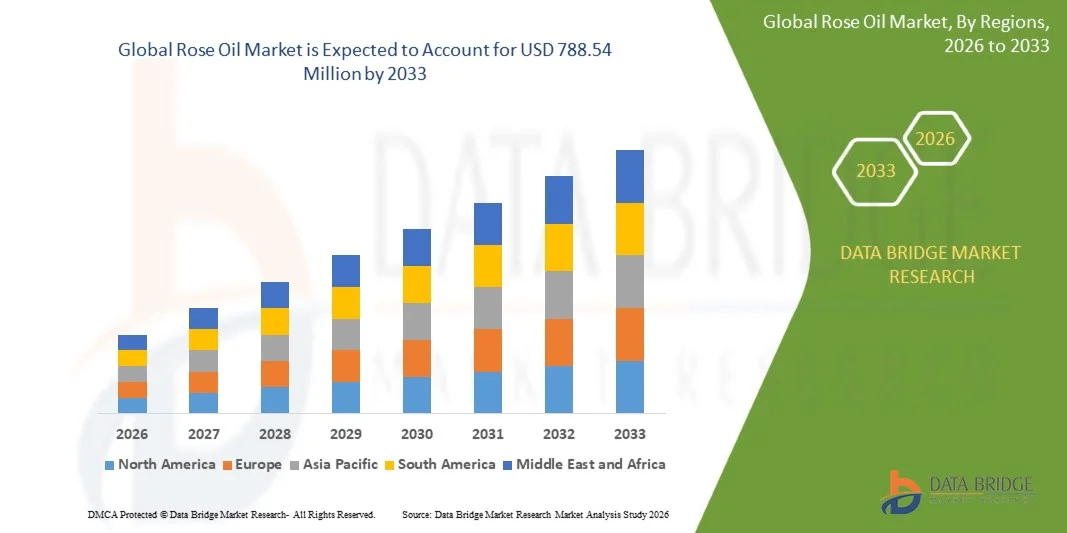
As per Data Bridge Market Research Analysis the global Rose Oil Market was valued at USD 452.47 Million in 2025 and is projected to reach USD 788.54 Million by 2033, growing at a CAGR of 7.19% from 2026 to 2033. The market is experiencing consistent growth driven by rising demand for natural and organic ingredients in cosmetics, increasing use of rose oil in premium fragrances, and growing consumer preference for plant based skincare products. Expanding applications across aromatherapy, personal care, and luxury perfumery, along with rising demand for clean label beauty formulations, are further supporting market expansion globally.
The increasing global shift toward natural wellness and sustainable beauty products, combined with growing awareness of chemical free personal care formulations, is significantly driving adoption of rose oil. Manufacturers are increasingly focusing on organic cultivation, ethical sourcing, and advanced extraction techniques such as steam distillation and supercritical CO2 extraction to improve oil purity and fragrance quality. Rising investments in premium cosmetics and expanding demand for high value essential oils across Europe, North America, and Asia Pacific are further strengthening market growth.
Market Size & Forecast
- Global Market Value (2025): USD 452.47 Million
- Expected Market Value (2033): USD 788.54 Million
- Forecast CAGR (2026–2033): 7.19%
- Leading Region in 2025: Europe
- Fastest Growing Region: Asia-Pacific
What are the Major Takeaways of Rose Oil Market?
- Europe dominated the Rose Oil Market with the largest revenue share of 40.7% in 2025, supported by strong historical dominance in rose cultivation, well established essential oil distillation industries, and high demand from luxury fragrance manufacturers
- The steam distillation segment led the market with a 72.5% share in 2025, driven by its cost effectiveness, scalability, and long standing industrial use in essential oil production. It remains the most widely adopted method due to established infrastructure and consistent output quality
- Asia-Pacific is expected to be the fastest-growing region at a CAGR of 8.5% from 2026 to 2033, fueled by rising disposable incomes, expanding personal care industries, and increasing demand for natural and herbal beauty products
- Supercritical carbon dioxide extraction is the fastest-growing technology type, projected to register a CAGR of 10.1% from 2026 to 2033, supported by its ability to produce high purity, solvent free rose oil with superior aroma retention
- The rosa damascene segment dominated the source category with a 64.8% revenue share in 2025, led by its high oil yield, superior fragrance quality, and extensive cultivation in countries such as Bulgaria, Turkey, and Iran
- Conventional accounted for 59.1% of the market in 2025, preferred by its wider availability, lower production cost, and established large scale cultivation practices across major rose oil producing regions
- The rosa centifolia segment is the fastest-growing source category, with a CAGR of 9.3% from 2026 to 2033, driven by increasing demand in premium cosmetics and niche fragrance applications
Report Scope and Rose Oil Market Segmentation
|
Attributes |
Rose Oil Key Market Insights |
|
Segments Covered |
|
|
Countries Covered |
North America
Europe
Asia-Pacific
Middle East and Africa
South America
|
|
Key Market Players |
|
|
Market Opportunities |
|
|
Value Added Data Infosets |
|
What is the Key Trend in Rose Oil Market?
Trend: Rising Demand for Natural and Organic Cosmetics
The Rose Oil Market is witnessing strong trend growth driven by increasing consumer preference for natural, organic, and chemical free cosmetic formulations. Rose oil is widely used in premium skincare, aromatherapy, and luxury fragrance products due to its therapeutic properties and high aromatic value. Rising awareness regarding clean label beauty products is further accelerating demand across developed and emerging markets.
Companies such as dsm-firmenich and Givaudan are increasingly incorporating natural rose oil into premium fragrance and personal care formulations, supporting the shift toward plant based ingredients in global beauty industries.
Rose Oil Market Dynamics
Key Market Driver: Increasing Use in Luxury Perfumes and Aromatherapy
The growing demand for luxury perfumes and aromatherapy products is significantly driving the Rose Oil market, as rose oil remains a core ingredient in high end fragrance formulations. Its rich floral aroma and therapeutic benefits make it highly preferred in premium perfumery and wellness applications. Rising disposable income and expansion of luxury beauty brands are further supporting demand across global markets.
Leading fragrance houses such as IFF (International Flavors & Fragrances) and Symrise extensively use rose oil in fine fragrance compositions, strengthening its demand in global luxury segments.
Key Restraint/Challenge: High Production Cost and Limited Raw Material Availability
The Rose Oil market faces a key challenge due to high production costs and limited availability of raw rose petals required for extraction. Rose oil production is highly labor intensive, requiring large quantities of flowers for small oil yields, which significantly increases pricing pressure. Seasonal cultivation and dependence on specific geographic regions such as Bulgaria’s Rose Valley further restrict supply consistency.
Producers such as BG Oils (Bulgaria) highlight the limited scalability of rose cultivation, which continues to constrain large scale commercial expansion.
Key Market Opportunity: Expansion of Premium Skincare and Wellness Use
The expansion of premium skincare, wellness, and aromatherapy applications is creating significant growth opportunities for the Rose Oil market. Increasing consumer focus on anti aging, stress relief, and natural therapeutic skincare products is driving higher integration of rose oil in cosmetic formulations. Demand is also rising in spa therapy and holistic wellness industries globally.
Brands such as L’Oréal and Estée Lauder are increasingly incorporating rose oil in premium skincare lines, reflecting strong market potential across high value personal care segments.
How is the Rose Oil Market Segmented?
The rose oil market is segmented on the basis of nature, source, technology, application, and distribution channel.
- By Nature
On the basis of nature, the Rose Oil Market is segmented into organic and conventional. The Conventional segment dominated the market with the largest share of 59.1% in 2025, driven by its wider availability, lower production cost, and established large scale cultivation practices across major rose oil producing regions. It is extensively used in commercial perfumery and cosmetics manufacturing due to consistent supply and cost efficiency. Strong demand from mass market personal care and fragrance industries further supports its dominance. Established supply chains and higher yield output reinforce its leading position in the market.
The Organic segment is projected to register the fastest growth at a CAGR of 9.2% from 2026 to 2033, driven by rising consumer preference for natural, chemical free, and sustainably sourced ingredients. Increasing demand for premium skincare and clean label cosmetics is accelerating adoption of organic rose oil. Certifications and traceability standards are further boosting consumer trust and market penetration. Expanding premium beauty and wellness products segment continues to support rapid growth.
- By Source
On the basis of source, the Rose Oil Market is segmented into Rosa Damascena, Rosa Centifolia, and others. The Rosa Damascena segment dominated the market with a share of 64.8% in 2025, driven by its high oil yield, superior fragrance quality, and extensive cultivation in countries such as Bulgaria, Turkey, and Iran. It is widely preferred in perfumery and aromatherapy due to its rich aromatic profile and high concentration of active compounds. Strong industrial demand from luxury fragrance manufacturers further reinforces its dominance. Established global supply chains ensure consistent availability and large scale production.
The Rosa Centifolia segment is projected to register the fastest growth at a CAGR of 9.3% from 2026 to 2033, driven by increasing demand in premium cosmetics and niche fragrance applications. Its delicate floral scent and limited seasonal production make it highly valued in high end perfumery. Growing consumer inclination toward artisanal and luxury fragrances is boosting adoption. Expansion of boutique fragrance brands further accelerates segment growth.
- By Technology
On the basis of technology, the Rose Oil Market is segmented into steam distillation, solvent extraction, and supercritical carbon dioxide extraction. The Steam Distillation segment dominated the market with a share of 72.5% in 2025, driven by its cost effectiveness, scalability, and long standing industrial use in essential oil production. It remains the most widely adopted method due to established infrastructure and consistent output quality. Strong demand from large scale cosmetic and fragrance manufacturers further supports its dominance. Ease of operation and lower production complexity reinforce its leading position.
The Supercritical Carbon Dioxide Extraction segment is projected to register the fastest growth at a CAGR of 10.1% from 2026 to 2033, driven by its ability to produce high purity, solvent free rose oil with superior aroma retention. Increasing demand for premium and organic essential oils is accelerating adoption of this advanced extraction method. It offers higher efficiency and better preservation of bioactive compounds compared to conventional methods. Growing investment in clean and green extraction technologies is further supporting segment expansion.
- By Application
On the basis of application, the Rose Oil Market is segmented into personal care and cosmetics, perfumes, and others. The Perfumes segment dominated the market with a share of 48.3% in 2025, driven by strong demand for luxury fragrances and widespread use of rose oil as a key aromatic ingredient. High value fragrance formulations from global brands rely heavily on rose oil for its premium scent profile. Expanding consumer preference for long lasting and natural fragrances further strengthens demand. Strong adoption across premium and designer perfume segments reinforces its leading position.
The Personal Care and Cosmetics segment is projected to register the fastest growth at a CAGR of 9.0% from 2026 to 2033, driven by increasing use of rose oil in skincare, anti aging, and wellness products. Rising consumer awareness regarding natural and plant based ingredients is boosting demand in this segment. Expanding premium skincare and spa product industries are further accelerating adoption. Growing focus on clean label beauty formulations continues to support rapid growth.
- By Distribution Channel
On the basis of distribution channel, the Rose Oil Market is segmented into direct sale and indirect sale. The Indirect Sale segment dominated the market with a share of 61.9% in 2025, driven by strong presence of distributors, wholesalers, and retail channels that ensure wide market accessibility. It enables efficient supply chain management and broader reach across global cosmetic and fragrance manufacturers. Established B2B distribution networks further support consistent product availability. Strong reliance on intermediaries in bulk procurement reinforces its dominance.
The Direct Sale segment is projected to register the fastest growth at a CAGR of 8.6% from 2026 to 2033, driven by increasing adoption of online B2B platforms and manufacturer to brand partnerships. Direct procurement allows better pricing control, quality assurance, and customized supply agreements. Rising digitalization of essential oil trade is further supporting this shift. Growing preference for transparent sourcing and traceability is accelerating segment expansion.
Which Region Holds the Largest Share of the Rose Oil Market?
Europe dominated the rose oil market and accounted for the largest revenue share of 40.7% in 2025, driven by strong historical dominance in rose cultivation, well established essential oil distillation industries, and high demand from luxury fragrance manufacturers. Countries such as Bulgaria, France, and Turkey play a key role in large scale production and export of high quality rose oil used in perfumes and cosmetics. The region benefits from advanced extraction technologies, strong artisanal production expertise, and established supply chains for premium fragrance ingredients. Rising demand for natural and organic ingredients in luxury personal care products continues to reinforce Europe’s leadership position in the global market.
U.K. Rose Oil Market Insight
The U.K. Rose Oil market is experiencing steady growth supported by strong demand from premium fragrance brands, expanding natural cosmetics industry, and rising consumer preference for plant based ingredients. Luxury perfume houses and niche beauty brands are increasingly incorporating rose oil into high end formulations to enhance product differentiation. The country’s strong retail and e commerce channels further support distribution of rose oil based products. In addition, growing focus on clean label and sustainable beauty products is accelerating adoption across the U.K. personal care industry.
Germany Rose Oil Market Insight
The Germany Rose Oil market is expanding steadily due to strong demand from organic cosmetics, aromatherapy, and pharmaceutical applications. German consumers show high preference for certified natural ingredients, driving adoption of organic and sustainably sourced rose oil. The country’s well developed cosmetic manufacturing industry and strong regulatory framework for product quality further support market growth. In addition, increasing use of rose oil in therapeutic and wellness applications is strengthening demand across both industrial and consumer segments.
North America Rose Oil Market Insight
The North America Rose Oil market is growing steadily, driven by rising demand for natural ingredients in personal care, cosmetics, and aromatherapy products. Increasing consumer shift toward organic and clean label beauty products is significantly boosting adoption of rose oil in skincare and fragrance formulations. Strong presence of premium cosmetic brands and expanding wellness industry are further supporting regional demand. In addition, growing imports of essential oils and expanding distribution networks across retail and online channels are accelerating market penetration in North America.
U.S. Rose Oil Market Insight
The U.S. Rose Oil market is witnessing strong growth due to increasing demand for premium skincare, natural fragrances, and wellness products. Major cosmetic and fragrance companies are incorporating rose oil into anti aging creams, perfumes, and therapeutic formulations to meet rising consumer preference for natural ingredients. Expanding aromatherapy and spa industries are further supporting market growth. In addition, strong e commerce penetration and high consumer awareness of plant based beauty products are accelerating adoption across the U.S.
Asia-Pacific Rose Oil Market Insight
The Asia-Pacific Rose Oil market is expected to register the fastest growth with a CAGR of 8.5% from 2026 to 2033, driven by rising disposable incomes, expanding personal care industries, and increasing demand for natural and herbal beauty products. Countries such as India, China, Japan, and South Korea are witnessing strong growth in cosmetics and fragrance consumption, boosting demand for rose oil. Expanding wellness and aromatherapy trends are further supporting market expansion. In addition, increasing local production of essential oils and growing e commerce penetration are accelerating regional growth.
Japan Rose Oil Market Insight
The Japan Rose Oil market is growing steadily due to strong demand for premium skincare, fragrance products, and aromatherapy applications. Japanese consumers show high preference for high quality, natural, and minimally processed ingredients, driving adoption of rose oil in cosmetics. The country’s advanced beauty and personal care industry further supports product innovation using botanical extracts. In addition, rising focus on wellness and relaxation products is increasing demand for rose oil based formulations.
China Rose Oil Market Insight
The China Rose Oil market is expanding rapidly due to rising demand for luxury fragrances, skincare products, and natural cosmetic ingredients. Growing middle class population and increasing beauty consciousness are driving consumption of rose oil based products. Domestic cosmetic brands are increasingly incorporating rose oil into premium product lines to meet consumer demand for natural and high quality ingredients. In addition, strong e commerce growth and expanding distribution channels are significantly accelerating market penetration across China.
Which are the Top Companies in Rose Oil Market?
The rose oil industry is primarily led by well-established companies, including:
- ROSE OFFICE GmbH (Germany)
- Advanced Biotech (U.S.)
- Albert Vieille SAS (France)
- Associate Allied Chemicals (India)
- Azelis Holding S.A. (Belgium)
- BERJÉ INC. (U.S.)
- Firmenich SA (Netherlands)
- Fleurchem Inc (U.S.)
- Indukern F&F Ingredients division (Spain)
- MOELLHAUSEN S.P.A. (Italy)
- Lluch Essence (Spain)
- Pell Wall (U.K.)
- Phoenix Aromas & Essential Oils, LLC (U.S.)
- SRS Aromatics Ltd (India)
- Synerzine, Inc. (U.S.)
- TAYTONN (Singapore)
- The Good Scents Company (tgsc) (U.S.)
- The Lermond Company, LLC (U.S.)
- Ultra International B.V. (Netherlands)
- Ernesto Ventós, S.A. (Spain)
- Zanos Ltd. (U.K.)
What are Latest Developments in Rose Oil Market?
- In February 2025, BG Oils, a leading Bulgarian rose oil producer, received certification from the Union for Ethical BioTrade (UEBT), reinforcing its commitment to ethical sourcing, biodiversity conservation, and socio-economic responsibility. This certification validates the company’s compliance with globally recognized sustainability standards across cultivation and processing practices in Bulgaria’s Rose Valley. It strengthens transparency across the supply chain and enhances consumer trust in ethically produced rose oil. This development also reinforces Bulgaria’s position as a premium global hub for high quality and sustainably sourced rose oil production
- In October 2024, Visagenics expanded its operations over 200 hectares of organic and bio farming land in Bulgaria’s renowned Rose Valley, strengthening its production capacity for premium essential oils. The expansion supports large scale cultivation under strict European Union quality and safety regulations, ensuring consistency in oil purity and fragrance profile. This move enhances supply stability in the Rose Oil Market, particularly for high end cosmetic and fragrance manufacturers. It also strengthens Bulgaria’s export competitiveness in the global essential oils industry
- In September 2024, AG Organica, a prominent manufacturer and supplier of organic essential oils, reinforced its leadership in steam and water distillation methods for rose oil extraction. The company’s focus on sustainable production practices and adherence to international quality standards improves product purity and consistency across its offerings. This development highlights growing industry preference for eco friendly extraction technologies that preserve natural aroma compounds. It further strengthens AG Organica’s position in the global rose oil supply chain serving cosmetics and aromatherapy markets
- In December 2022, Coloressence, a New Delhi based cosmetics brand, launched a rose oil infused product line at the Combo Nation retail store in Delhi, expanding its beauty portfolio. The collection includes kajal pencils, lipsticks, mascaras, foundations, and eyeliners enriched with rose oil for added skincare benefits. This introduction reflects rising consumer demand for botanical infused makeup products with natural and skin friendly ingredients. It also strengthens the brand’s presence in the Indian herbal cosmetics segment
- In May 2022, My Joy Beauty, a Texas based cosmetics brand, launched new skincare offerings including a limited edition brow kit and a rose gold facial oil formulated with a blend of six oils and Vitamin E. The product is designed to enhance hydration, skin nourishment, and overall skin glow, aligning with growing demand for multifunctional beauty oils. This launch expands the company’s presence in the natural skincare segment in the U.S. market. It also reflects increasing consumer preference for plant based and rose oil enriched personal care products

- Interactive Data Analysis Dashboard
- Company Analysis Dashboard for high growth potential opportunities
- Research Analyst Access for customization & queries
- Competitor Analysis with Interactive dashboard
- Latest News, Updates & Trend analysis
- Harness the Power of Benchmark Analysis for Comprehensive Competitor Tracking
Global Rose Oil Market, Supply Chain Analysis and Ecosystem Framework
To support market growth and help clients navigate the impact of geopolitical shifts, DBMR has integrated in-depth supply chain analysis into its Global Rose Oil Market research reports. This addition empowers clients to respond effectively to global changes affecting their industries. The supply chain analysis section includes detailed insights such as Global Rose Oil Market consumption and production by country, price trend analysis, the impact of tariffs and geopolitical developments, and import and export trends by country and HSN code. It also highlights major suppliers with data on production capacity and company profiles, as well as key importers and exporters. In addition to research, DBMR offers specialized supply chain consulting services backed by over a decade of experience, providing solutions like supplier discovery, supplier risk assessment, price trend analysis, impact evaluation of inflation and trade route changes, and comprehensive market trend analysis.
Data collection and base year analysis are done using data collection modules with large sample sizes. The stage includes obtaining market information or related data through various sources and strategies. It includes examining and planning all the data acquired from the past in advance. It likewise envelops the examination of information inconsistencies seen across different information sources. The market data is analysed and estimated using market statistical and coherent models. Also, market share analysis and key trend analysis are the major success factors in the market report. To know more, please request an analyst call or drop down your inquiry.
The key research methodology used by DBMR research team is data triangulation which involves data mining, analysis of the impact of data variables on the market and primary (industry expert) validation. Data models include Vendor Positioning Grid, Market Time Line Analysis, Market Overview and Guide, Company Positioning Grid, Patent Analysis, Pricing Analysis, Company Market Share Analysis, Standards of Measurement, Global versus Regional and Vendor Share Analysis. To know more about the research methodology, drop in an inquiry to speak to our industry experts.
Data Bridge Market Research is a leader in advanced formative research. We take pride in servicing our existing and new customers with data and analysis that match and suits their goal. The report can be customized to include price trend analysis of target brands understanding the market for additional countries (ask for the list of countries), clinical trial results data, literature review, refurbished market and product base analysis. Market analysis of target competitors can be analyzed from technology-based analysis to market portfolio strategies. We can add as many competitors that you require data about in the format and data style you are looking for. Our team of analysts can also provide you data in crude raw excel files pivot tables (Fact book) or can assist you in creating presentations from the data sets available in the report.













