


What is the Sapphire Materials Market Size and Growth Rate?
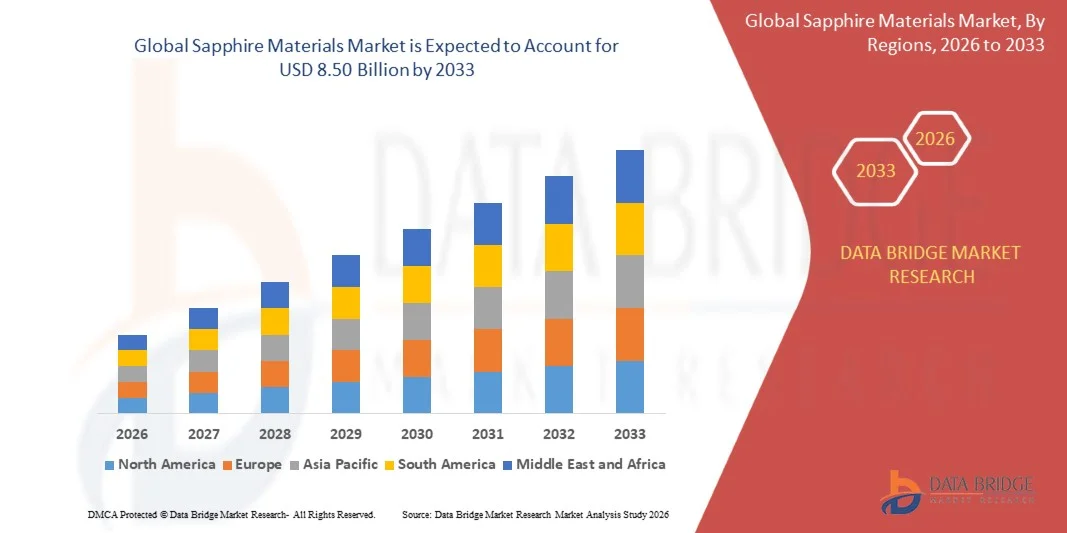
- As per Data Bridge Market Research analysis, the sapphire materials market was valued at USD 5.17 billion in 2025 and is projected to reach USD 8.50 billion by 2033, growing at a CAGR of 6.42% from 2026 to 2033.
- The market is experiencing steady growth driven by increasing demand for high-performance sapphire materials in consumer electronics, semiconductor manufacturing, optical components, and medical devices, along with continuous advancements in crystal growth and precision fabrication technologies.
- The rising adoption of sapphire materials in LED manufacturing, power electronics, and scratch-resistant display applications, coupled with expanding investments in semiconductor production and advanced optical systems, is accelerating market growth. Monocrystalline sapphire materials are increasingly being utilized across electronics, aerospace, healthcare, and industrial applications due to their exceptional hardness, thermal stability, optical transparency, and chemical resistance.
Market Size & Forecast
- Global Market Value (2025): USD 5.17 Billion
- Expected Market Value (2033): USD 8.50 Billion
- Forecast CAGR (2026–2033): 6.42%
- Leading Region in 2025: North America
- Fastest Growing Region: Asia Pacific
What are the Major Takeaways of the Sapphire Materials Market?
- North America dominated the sapphire materials market with the largest revenue share of 36.45% in 2025, supported by strong demand from the aerospace & defense, semiconductor, and advanced optical industries, along with significant investments in high-performance materials manufacturing.
- Asia-Pacific is expected to be the fastest-growing region at a CAGR of 6.87% from 2026 to 2033, fueled by expanding semiconductor fabrication, increasing LED manufacturing, and rising consumer electronics production across China, Japan, South Korea, and India.
- The monocrystalline sapphire segment led the market with a 61.1% share in 2025, driven by its superior optical transparency, exceptional hardness, high thermal conductivity, and outstanding chemical resistance.
- Polycrystalline sapphire is the fastest-growing type, projected to register a CAGR of 7.8%, reflecting the surge in demand for cost-effective sapphire materials in industrial and lighting applications.
- The sapphire wafers segment dominated the form category with a 47.5% revenue share in 2025, led by their extensive use as substrates in LED manufacturing, gallium nitride (GaN)-based semiconductors, RF devices, and optoelectronic applications.
- Optical accounted for 38.5% of the market share in 2025, preferred by widespread utilization of sapphire materials in optical windows, laser systems, infrared sensors, spectroscopy equipment, and scientific instruments.
- The semiconductor segment is the fastest-growing application category, with a CAGR of 8.8%, driven by increasing adoption of sapphire substrates in gallium nitride (GaN) and advanced compound semiconductor
Report Scope and Sapphire Materials Market Segmentation
|
Attributes |
Sapphire Materials Key Market Insights |
|
Segments Covered |
|
|
Countries Covered |
North America
Europe
Asia-Pacific
Middle East and Africa
South America
|
|
Key Market Players |
|
|
Market Opportunities |
|
|
Value Added Data Infosets |
In addition to the insights on market scenarios such as market value, growth rate, segmentation, geographical coverage, and major players, the market reports curated by the Data Bridge Market Research also include import export analysis, production capacity overview, production consumption analysis, price trend analysis, climate change scenario, supply chain analysis, value chain analysis, raw material/consumables overview, vendor selection criteria, PESTLE Analysis, Porter Analysis, and regulatory framework. |
What is the Key Trend in the Sapphire Materials Market?
- Sapphire materials are increasingly being adopted for advanced semiconductor substrates, precision optics, and high-performance optical windows due to their exceptional hardness, thermal stability, and optical transparency.
- For instance, in January 2025, the U.S. Department of Commerce announced proposed CHIPS Act funding of up to USD 79 million for Coherent Corp. to expand its Easton, Pennsylvania facility, increasing production capacity for 150 mm and 200 mm silicon carbide substrates and epitaxial wafers used in advanced semiconductor applications
- The growing integration of sapphire substrates in gallium nitride (GaN)-based power electronics and RF devices is enhancing device efficiency and reliability across industrial and automotive applications.
- Manufacturers are investing in larger-diameter sapphire crystal growth and precision processing technologies to improve production efficiency and meet increasing demand from electronics and aerospace industries.
- For instance, in February 2025, Kyocera showcased its single-crystal sapphire engineering solutions and sapphire apertures at Pittcon 2025, highlighting their applications in analytical instruments, life science equipment, chromatography, and mass spectrometry, reflecting the expanding adoption of sapphire materials in precision optical and scientific applications.
- As demand for high-performance optical and semiconductor materials continues to grow, sapphire materials are expected to witness increasing adoption across next-generation electronic, photonic, and industrial applications.
What are the Key Drivers of the Sapphire Materials Market?
- The rapid expansion of semiconductor manufacturing and gallium nitride (GaN)-based power electronics has significantly increased demand for high-purity sapphire substrates offering excellent thermal, optical, and mechanical properties.
- For instance, in October 2024, TSMC moved NVIDIA's cuLitho computational lithography platform into production to accelerate semiconductor manufacturing and improve fabrication efficiency for next-generation chips.
- Electronics manufacturers are increasingly integrating sapphire materials into smartphone camera lens covers, wearable devices, LEDs, and optical sensors to improve durability and performance.
- For instance, in September 2024, Apple introduced the Apple Watch Series 10, which continues to use sapphire crystal displays on titanium models, reinforcing sustained demand for engineered sapphire materials in premium wearable devices.
- With the electronics and semiconductor industries continuously investing in advanced materials to improve device performance and reliability, sapphire materials are expected to remain essential for next-generation electronic and optoelectronic applications.
Which Factors are Challenging the Growth of the Sapphire Materials Market?
- Sapphire material production requires energy-intensive crystal growth processes, precision machining, and specialized polishing technologies, resulting in significantly higher manufacturing costs than conventional engineering materials.
- For instance, in August 2024, researchers published a study in CrystEngComm demonstrating the growth of ultra-pure sapphire single crystals with record-low optical absorption using the Czochralski technique, highlighting continued advances in sapphire crystal growth for high-performance optical applications.
- These high production costs limit broader adoption in cost-sensitive consumer and industrial applications where alternative materials remain commercially attractive.
- Price volatility in raw materials, long production cycles, and stringent quality requirements further increase operational costs for sapphire manufacturers supplying semiconductor and optical industries.
- For instance, in July 2025, Alpha HPA reported ongoing quality improvement programs including reducing internal bubbles, low-angle grain zones, and contamination in sapphire crystal growth demonstrating the technical complexity and high production costs associated with manufacturing high-quality sapphire crystals.
- The combination of capital-intensive manufacturing processes and demanding quality specifications continues to restrain widespread adoption, particularly among small manufacturers and price-sensitive end-use sectors.
How is the Sapphire Materials Market Segmented?
The sapphire materials market is segmented on the basis of type, form, application, and end user.
- By Type
On the basis of type, the sapphire materials market is segmented into monocrystalline sapphire and polycrystalline sapphire. The monocrystalline sapphire segment dominated the market with an estimated share of 61.1% in 2025, owing to its superior optical transparency, exceptional hardness, high thermal conductivity, and outstanding chemical resistance. It is extensively used in semiconductor substrates, optical windows, smartphone camera lens covers, LED manufacturing, and precision medical devices where material purity is critical. The material offers excellent mechanical strength and dimensional stability under extreme operating conditions, making it suitable for aerospace and defense applications. Continuous advancements in crystal growth technologies have improved crystal quality and production efficiency, supporting wider commercial adoption. Increasing investments in high-performance electronics and photonics continue to reinforce its market leadership. Its ability to meet stringent performance requirements across multiple industries keeps it the dominant segment globally.
The polycrystalline sapphire segment is projected to witness the fastest growth at an estimated CAGR of 7.8% from 2026 to 2033, driven by increasing demand for cost-effective sapphire materials in industrial and lighting applications. It provides favorable mechanical durability while reducing manufacturing costs compared to single-crystal sapphire in selected applications. Growing adoption in LED components, industrial equipment, and thermal-resistant products is supporting segment expansion. Continuous improvements in processing technologies are enhancing its material performance and commercial viability. Rising industrialization and increasing demand for durable engineering materials across emerging economies are further accelerating growth. Expanding research into advanced ceramic materials is also creating new opportunities for polycrystalline sapphire products.
- By Form
On the basis of form, the sapphire materials market is segmented into sapphire boules, sapphire wafers, and sapphire sheets. The sapphire wafers segment dominated the market with an estimated share of 47.5% in 2025, owing to their extensive use as substrates in LED manufacturing, gallium nitride (GaN)-based semiconductors, RF devices, and optoelectronic applications. Their superior crystal quality, excellent thermal stability, and high optical transmission make them essential for advanced electronic manufacturing. Increasing investments in semiconductor fabrication and compound semiconductor technologies continue to strengthen demand. The rapid expansion of consumer electronics and high-performance computing applications further supports widespread wafer utilization. Continuous improvements in wafer diameter and surface quality are enhancing manufacturing efficiency. Strong demand from semiconductor and photonics industries continues to maintain the segment's leadership.
The sapphire sheets segment is anticipated to register the fastest growth at an estimated CAGR of 8.3% from 2026 to 2033, driven by rising adoption in protective windows, optical components, medical devices, and aerospace applications. Sapphire sheets provide exceptional scratch resistance, chemical durability, and optical clarity for demanding environments. Increasing demand for transparent armor, infrared windows, and laser optics is expanding their commercial adoption. Technological advancements in precision cutting and polishing are improving product availability and reducing manufacturing limitations. Growing investments in defense modernization and advanced medical equipment are further accelerating demand. Rising use in premium consumer electronics also supports future market growth.
- By Application
On the basis of application, the sapphire materials market is segmented into optical, electronics, semiconductor, aerospace, defense, and others. The optical segment dominated the market with an estimated share of 38.5% in 2025, due to widespread utilization of sapphire materials in optical windows, laser systems, infrared sensors, spectroscopy equipment, and scientific instruments. Sapphire's excellent light transmission, superior hardness, and resistance to harsh operating environments make it highly suitable for precision optical applications. Increasing deployment in aerospace imaging systems and defense surveillance equipment continues to support market demand. Growing investments in photonics and laser technologies are expanding commercial opportunities. The material's long operational life and excellent environmental resistance further strengthen its adoption. Continuous technological innovation in optical systems maintains the segment's dominant position.
The semiconductor segment is expected to register the fastest growth at an estimated CAGR of 8.8% from 2026 to 2033, driven by increasing adoption of sapphire substrates in gallium nitride (GaN) and advanced compound semiconductor devices. Rising demand for high-power electronics, RF components, LEDs, and electric vehicle power systems is accelerating market expansion. Sapphire materials offer superior thermal management and electrical insulation required for next-generation semiconductor manufacturing. Continuous investments in semiconductor fabrication facilities worldwide are creating significant growth opportunities. Increasing deployment of AI infrastructure, 5G networks, and advanced computing technologies further stimulates demand. Expanding production of high-efficiency electronic devices is expected to sustain rapid segment growth.
- By End User
On the basis of end user, the sapphire materials market is segmented into consumer electronics, industrial, automotive, aerospace & defense, healthcare, and others. The consumer electronics segment dominated the market with an estimated share of 44.0% in 2025, owing to increasing integration of sapphire materials into smartphone camera lens covers, wearable devices, display protection components, and optical sensors. Manufacturers increasingly utilize sapphire because of its exceptional scratch resistance, durability, and optical performance in premium electronic products. Growing demand for high-end smartphones, smartwatches, and other connected devices continues to drive product consumption. Continuous innovation in miniaturized electronic components further strengthens sapphire adoption. Rising consumer preference for durable, high-performance electronic products also supports market expansion. Strong investments by global electronics manufacturers continue to reinforce the segment's leading position.
The healthcare segment is projected to witness the fastest growth at an estimated CAGR of 8.1% from 2026 to 2033, driven by increasing use of sapphire materials in medical lasers, endoscopy systems, surgical instruments, implantable devices, and diagnostic equipment. Sapphire's outstanding biocompatibility, chemical inertness, and optical transparency make it highly suitable for demanding medical applications. Growing investments in minimally invasive surgical technologies and advanced diagnostic systems are accelerating adoption. Continuous advancements in laser-based medical treatments further support market growth. Increasing healthcare infrastructure development and rising demand for precision medical devices create additional opportunities. The expansion of advanced medical technologies is expected to sustain rapid growth throughout the forecast period.
Which Region Holds the Largest Share of the Sapphire Materials Market?
- North America dominated the sapphire materials market with the largest revenue share of 36.45% in 2025, supported by strong demand from the aerospace & defense, semiconductor, and advanced optical industries, along with significant investments in high-performance materials manufacturing.
- The region also benefits from the presence of leading semiconductor manufacturers, increasing adoption of sapphire substrates for compound semiconductors and optical applications, and continuous investments in photonics and defense technologies. Growing demand for high-performance materials across electronics, healthcare, and industrial applications continues to strengthen North America's leadership position in the global market.
U.S. Sapphire Materials Market Insight
The U.S. sapphire materials market is witnessing strong growth due to rising investments in semiconductor manufacturing, defense modernization, and advanced optical technologies. The country's expanding compound semiconductor ecosystem, increasing demand for sapphire substrates in gallium nitride (GaN) devices, and growing adoption of sapphire components in aerospace, medical, and photonics applications are driving market expansion. In addition, government support through the CHIPS and Science Act is accelerating domestic semiconductor production and strengthening demand for advanced substrate materials. In January 2025, the U.S. Department of Commerce announced proposed CHIPS Act funding of up to USD 79 million for Coherent Corp. to expand production of compound semiconductor substrates and epitaxial wafers.
Asia-Pacific Sapphire Materials Market Insight
The Asia-Pacific sapphire materials market is expected to witness rapid growth, driven by expanding semiconductor fabrication, large-scale LED manufacturing, and increasing consumer electronics production across China, Japan, South Korea, and India. The region benefits from a strong electronics manufacturing base, continuous investments in advanced materials, and growing adoption of sapphire substrates for LEDs, RF devices, and power electronics. In addition, increasing production of smartphones, wearable devices, and optoelectronic components is supporting regional market expansion. SEMI forecasts continued expansion of 300 mm semiconductor fabrication capacity across Asia-Pacific, reinforcing long-term demand for advanced substrate materials used throughout semiconductor manufacturing.
Japan Sapphire Materials Market Insight
The Japan sapphire materials market is witnessing consistent growth due to the country's leadership in precision optics, semiconductor equipment, and advanced ceramic technologies. Manufacturers are increasingly utilizing sapphire materials in optical windows, semiconductor processing equipment, laser systems, and medical instruments requiring superior durability and optical performance. Moreover, continuous investments in high-purity crystal technologies and precision manufacturing are further supporting market development. In February 2025, Kyocera showcased its single-crystal sapphire engineering solutions at Pittcon 2025 for analytical instruments, chromatography, mass spectrometry, and life science equipment.
China Sapphire Materials Market Insight
The China sapphire materials market is growing rapidly, driven by expanding semiconductor manufacturing, increasing LED production, and rising demand for consumer electronics and optical components. Government initiatives supporting semiconductor self-sufficiency and advanced manufacturing are significantly boosting investments in compound semiconductor materials and sapphire substrate production. In addition, increasing deployment of electric vehicles, 5G infrastructure, and industrial automation is accelerating sapphire material consumption. China's "Made in China 2025" strategy continues prioritizing semiconductor materials and advanced manufacturing capabilities to strengthen domestic high-tech production.
U.K. Sapphire Materials Market Insight
The U.K. sapphire materials market is experiencing steady growth, supported by increasing adoption of sapphire optics across aerospace, defense, photonics, and scientific research applications. Growing investments in quantum technologies, photonics innovation, and precision engineering are contributing to market expansion. Furthermore, increasing collaboration between research institutions and advanced manufacturing companies is strengthening demand for high-performance sapphire components. The U.K. National Quantum Technologies Programme continues supporting research and commercialization of advanced optical materials and photonic technologies.
Germany Sapphire Materials Market Insight
The Germany sapphire materials market is expanding steadily due to the country's strong semiconductor equipment industry, advanced optics manufacturing, and increasing investments in photonics and industrial automation. Manufacturers increasingly utilize sapphire materials in laser systems, semiconductor processing, precision optics, and medical technologies requiring exceptional durability and optical performance. Continuous investments in semiconductor manufacturing and industrial innovation are further supporting market growth. The European Chips Act is supporting semiconductor manufacturing expansion across Germany and Europe, increasing long-term demand for advanced substrate and optical materials.
Which are the Top Companies in Sapphire Materials Market?
The sapphire materials industry is primarily led by well-established companies, including:
- Monocrystal (Russia)
- Rubicon Technology (U.S.)
- KYOCERA Corporation (Japan)
- Coherent Corp. (U.S.)
- Saint-Gobain Group (France)
- SCHOTT AG (Germany)
- Precision Micro-Optics Inc. (U.S.)
- Swiss Jewel Company (U.S.)
- GTAT Corporation (U.S.)
- Namiki Precision Jewel Co., Ltd. (Japan)
- Crystran Ltd (U.K.)
- Meller Optics, Inc. (U.S.)
- Roditi International Corporation (U.K.)
- CRYSTEC Technology Trading GmbH (Germany)
- Knight Optical (U.K.)
- CrysTec GmbH (Germany)
- Alfa Chemistry (U.S.)
- MTI Corporation (U.S.)
- Shanghai Optics Inc. (U.S.)
What are Latest Developments in Sapphire Materials Market?
- In July 2025, KYOCERA announced that it would showcase new semiconductor and fine ceramic components, including advanced sapphire-based solutions, at The Advanced Ceramics Show 2025, targeting semiconductor manufacturing and high-performance industrial applications.
- In June 2025, KYOCERA introduced its latest sapphire wafer, sapphire window, and sapphire feedthrough solutions at World of Quantum 2025. The new products were designed for quantum computing applications, offering low dielectric loss, excellent thermal conductivity, and advanced optical performance for next-generation quantum systems
- In February 2025, KYOCERA announced the launch of its latest single-crystal sapphire engineering solutions, including sapphire apertures for analytical instrumentation, at Pittcon 2025. The products were developed for mass spectrometry, chromatography, and life science equipment requiring high optical transmission and chemical resistance
- In May 2024, researchers from Yale University introduced a heterogeneous sapphire-supported low-loss photonics platform capable of supporting visible photonics and solid-state laser applications. The platform demonstrated ultra-low optical loss and compatibility with sapphire substrates for next-generation integrated photonic devices
- In June 2021, researchers developed a new sapphire optical viewport designed for high-pressure and high-temperature spectroscopy applications. The product demonstrated reliable sealing and optical performance under extreme operating conditions, expanding sapphire's use in scientific instrumentation and industrial research

- Interactive Data Analysis Dashboard
- Company Analysis Dashboard for high growth potential opportunities
- Research Analyst Access for customization & queries
- Competitor Analysis with Interactive dashboard
- Latest News, Updates & Trend analysis
- Harness the Power of Benchmark Analysis for Comprehensive Competitor Tracking
Global Sapphire Materials Market, Supply Chain Analysis and Ecosystem Framework
To support market growth and help clients navigate the impact of geopolitical shifts, DBMR has integrated in-depth supply chain analysis into its Global Sapphire Materials Market research reports. This addition empowers clients to respond effectively to global changes affecting their industries. The supply chain analysis section includes detailed insights such as Global Sapphire Materials Market consumption and production by country, price trend analysis, the impact of tariffs and geopolitical developments, and import and export trends by country and HSN code. It also highlights major suppliers with data on production capacity and company profiles, as well as key importers and exporters. In addition to research, DBMR offers specialized supply chain consulting services backed by over a decade of experience, providing solutions like supplier discovery, supplier risk assessment, price trend analysis, impact evaluation of inflation and trade route changes, and comprehensive market trend analysis.
Data collection and base year analysis are done using data collection modules with large sample sizes. The stage includes obtaining market information or related data through various sources and strategies. It includes examining and planning all the data acquired from the past in advance. It likewise envelops the examination of information inconsistencies seen across different information sources. The market data is analysed and estimated using market statistical and coherent models. Also, market share analysis and key trend analysis are the major success factors in the market report. To know more, please request an analyst call or drop down your inquiry.
The key research methodology used by DBMR research team is data triangulation which involves data mining, analysis of the impact of data variables on the market and primary (industry expert) validation. Data models include Vendor Positioning Grid, Market Time Line Analysis, Market Overview and Guide, Company Positioning Grid, Patent Analysis, Pricing Analysis, Company Market Share Analysis, Standards of Measurement, Global versus Regional and Vendor Share Analysis. To know more about the research methodology, drop in an inquiry to speak to our industry experts.
Data Bridge Market Research is a leader in advanced formative research. We take pride in servicing our existing and new customers with data and analysis that match and suits their goal. The report can be customized to include price trend analysis of target brands understanding the market for additional countries (ask for the list of countries), clinical trial results data, literature review, refurbished market and product base analysis. Market analysis of target competitors can be analyzed from technology-based analysis to market portfolio strategies. We can add as many competitors that you require data about in the format and data style you are looking for. Our team of analysts can also provide you data in crude raw excel files pivot tables (Fact book) or can assist you in creating presentations from the data sets available in the report.













