


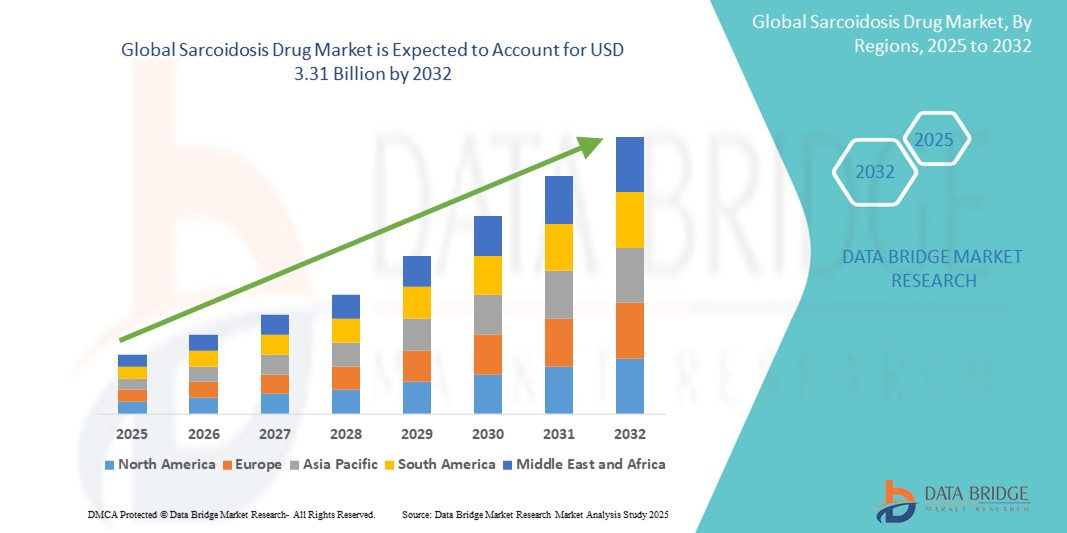
Sarcoidosis Drug Market Size
- The global sarcoidosis drug market size was valued at USD 1.84 billion in 2024 and is expected to reach USD 3.31 billion by 2032, at a CAGR of 7.63% during the forecast period
- The market growth is largely fueled by the increasing prevalence of sarcoidosis worldwide, coupled with a rising focus on public awareness initiatives by governmental and non-governmental organizations
- Furthermore, increased funding for research and development activities aimed at discovering new and effective therapies, along with advancements in diagnostic techniques, are significantly contributing to market expansion
Sarcoidosis Drug Market Analysis
- Sarcoidosis, a systemic inflammatory disease characterized by granuloma formation in various organs necessitates effective drug solutions due to its chronic and often debilitating nature
- The escalating demand for sarcoidosis drugs is primarily fueled by the rising incidence of the disease worldwide, significant funding for R&D from public and private sectors, and technological advancements in diagnostic methods that lead to earlier and more accurate diagnoses
- North America dominates the sarcoidosis drug market with the largest revenue share of 49.5% in 2024, characterized by high prevalence of the disease, well-established healthcare infrastructure, and extensive research and development programs by pharmaceutical companies
- Asia-Pacific is expected to be the fastest growing region in the sarcoidosis drug market during the forecast period due to increasing awareness about sarcoidosis treatment, rising healthcare expenditure, and the entry of key market players into the region
- Corticosteroid segment dominates the sarcoidosis drug market with a market share of 35.5% in 2024, driven by its established role as a first-line therapy due to strong anti-inflammatory and immunosuppressive effects
Report Scope and Sarcoidosis Drug Market Segmentation
|
Attributes |
Sarcoidosis Drug Key Market Insights |
|
Segments Covered |
|
|
Countries Covered |
North America
Europe
Asia-Pacific
Middle East and Africa
South America
|
|
Key Market Players |
|
|
Market Opportunities |
|
|
Value Added Data Infosets |
In addition to the insights on market scenarios such as market value, growth rate, segmentation, geographical coverage, and major players, the market reports curated by the Data Bridge Market Research also include in-depth expert analysis, pricing analysis, brand share analysis, consumer survey, demography analysis, supply chain analysis, value chain analysis, raw material/consumables overview, vendor selection criteria, PESTLE Analysis, Porter Analysis, and regulatory framework. |
Sarcoidosis Drug Market Trends
“Shift Towards Personalized & Targeted Therapies”
- A significant and accelerating trend in the global sarcoidosis drug market is the deepening understanding of disease heterogeneity and the shift towards personalized medicine and targeted therapies. This involves moving beyond broad-spectrum immunosuppressants to develop drugs that address specific disease pathways or patient profiles
- For instance, research is actively exploring therapies that target specific cytokines such as TNF-alpha, which plays a role in granuloma formation. Companies such as Xentria are developing novel TNF-alpha inhibitors (such as XTMAB-16) for pulmonary sarcoidosis. Similarly, aTyr Pharma is investigating Efzofitimod, a protein that targets a specific receptor to resolve inflammation, showing promising results in clinical trials for interstitial lung diseases including sarcoidosis
- Furthermore, the application of artificial intelligence (AI) and machine learning is emerging as a critical trend in sarcoidosis, particularly in diagnostics and prognostication. AI models are being developed to improve the accuracy and speed of identifying sarcoidosis, especially in complex presentations such as cardiac sarcoidosis, by analyzing imaging data. AI can also help in differentiating sarcoidosis from other conditions and in predicting disease progression
- The seamless integration of advanced diagnostic techniques with genetic and proteomic profiling facilitates a more precise understanding of individual patient responses. This allows for tailoring treatment regimens to optimize outcomes and minimize side effects, moving away from a one-size-fits-all approach. Researchers are exploring biomarkers to predict treatment response and identify optimal drug combinations
- This trend towards more intelligent, intuitive, and interconnected approaches to sarcoidosis management is fundamentally reshaping expectations for patient care. Consequently, pharmaceutical companies and research institutions are increasingly collaborating to leverage these advancements, focusing on developing novel drugs and diagnostic tools that offer more precise and effective solutions
- The demand for sarcoidosis drugs that offer personalized, targeted, and data-driven treatment options is growing rapidly across the healthcare sector, as clinicians increasingly prioritize precision medicine to improve patient outcomes and reduce the burden of long-term corticosteroid use
Sarcoidosis Drug Market Dynamics
Driver
“Rising Prevalence of Sarcoidosis and Advancements in Diagnosis”
- The increasing global incidence and prevalence of sarcoidosis, necessitating prompt diagnosis and effective therapies, is a significant driver for the heightened demand for sarcoidosis drugs. This growing patient pool creates a continuous need for both established and novel treatment options
- For instance, the Foundation for Sarcoidosis Research (FSR) actively collaborates with various organizations, including pharmaceutical companies and healthcare providers, to increase awareness and fund research into the disease. Such initiatives by key organizations are expected to accelerate drug development and adoption in the forecast period
- As healthcare professionals become more adept at identifying sarcoidosis, often through improved diagnostic techniques such as advanced imaging (for instance HRCT scans, PET scans for cardiac sarcoidosis) and non-invasive methods, there's a compelling push for a broader range of therapeutic interventions. Early and accurate diagnosis enables earlier initiation of treatment, aiming to prevent irreversible organ damage
- Furthermore, the growing focus on personalized medicine and the development of drugs that target specific disease pathways or molecular targets associated with sarcoidosis are making innovative therapies more accessible. This addresses the unmet needs of patients who may not respond well to conventional treatments or experience significant side effects
- The rise in clinical trials and increased funding from public and private sectors for sarcoidosis research are key factors propelling the development of new drug candidates. This commitment to understanding the complex etiology and progression of sarcoidosis is leading to a robust pipeline of promising treatments, offering hope for improved patient outcomes. The trend towards global collaborations in research and development further contributes to market growth
Restraint/Challenge
“High Cost of Novel Therapies and Lack of Definitive Biomarkers”
- The significant financial burden associated with novel and targeted sarcoidosis therapies, coupled with the persistent lack of definitive biomarkers for disease activity and treatment response, poses a significant challenge to broader market penetration and optimal patient management. Many advanced drugs, particularly biologics, come with a high price tag, impacting patient access and healthcare system budgets
- For instance, while drugs such as TNF-alpha inhibitors offer new hope, their high cost often limits their widespread use, especially in healthcare systems with budget constraints or for patients without robust insurance coverage. This financial barrier can lead to delayed or suboptimal treatment for many individuals suffering from sarcoidosis
- Addressing these cost concerns through greater affordability, generic/biosimilar development, and improved reimbursement policies is crucial for wider access. Companies are exploring patient assistance programs, but the fundamental cost of drug development remains a hurdle. In addition, the absence of reliable biomarkers makes it difficult to predict which patients will respond to a particular therapy, leading to a trial-and-error approach that prolongs treatment and increases healthcare costs
- Furthermore, the heterogeneity of sarcoidosis and its variable clinical course complicate the development of universally effective treatments. The lack of standardized endpoints and challenges in clinical trial design, due to the rarity and diverse manifestations of the disease, can prolong drug development and approval processes, further escalating costs
- While research is progressing, the perceived premium for targeted therapies and the complexities in assessing drug efficacy without clear biomarkers can still hinder widespread adoption, especially for those who do not see an immediate need for advanced features or for whom first-line, albeit toxic, treatments are sufficient
Sarcoidosis Drug Market Scope
The market is segmented on the basis of disease type, diagnosis, mechanism of action, drug type, end users, and distribution channel.
- By Disease Type
On the basis of disease type, the sarcoidosis drug market is segmented into pulmonary sarcoidosis, ocular sarcoidosis, neurosarcoidosis, cardiac sarcoidosis, musculoskeletal sarcoidosis, cutaneous sarcoidosis, renal sarcoidosis, hepatic sarcoidosis, and sarcoidosis of the spleen and bone marrow. Pulmonary Sarcoidosis held the largest market revenue share in 2024, due to the lungs being the most commonly affected organ in sarcoidosis patients, leading to a higher volume of diagnoses and subsequent drug prescriptions.
The cutaneous sarcoidosis segment is anticipated to witness the fastest CAGR from 2025 to 2032, fueled by increasing awareness and better diagnostic capabilities for skin manifestations, alongside a rising demand for cosmetic and symptomatic relief, driving the adoption of specialized treatments for cutaneous involvement.
- By Diagnosis
On the basis of diagnosis, the sarcoidosis drug market is influenced by methods such as chest X-rays, HRCT scan, pulmonary function (breathing) tests, and bronchoscopy. Chest X-rays dominated the market in 2024, given their widespread availability and cost-effectiveness. While not definitive, their routine use often flags potential pulmonary sarcoidosis, leading to a high volume of initial suspected cases.
HRCT Scan segment is expected to witness the fastest CAGR from 2025 to 2032, because they offer superior diagnostic precision for identifying sarcoidosis and its specific organ involvement (such as, cardiac sarcoidosis, neurosarcoidosis), which often necessitates more complex and targeted drug regimens, including high-cost biologics. The increasing reliance on these advanced and invasive methods for definitive diagnosis, especially in atypical or severe cases, leads to more confident and specialized drug prescriptions, thereby accelerating the demand for a diverse range of sarcoidosis drugs
- By Mechanism of Action
On the basis of mechanism of action, the sarcoidosis drug market is segmented into corticosteroid, immunosuppressants, antimalarial, and tumor necrosis factor-alpha (TNF-Alpha) inhibitors. The corticosteroid segment held the largest market revenue share of 35.5% in 2024, since they are widely considered the first-line treatment for sarcoidosis due to their potent anti-inflammatory and immunosuppressive properties, effectively managing acute symptoms and preventing organ damage across various affected systems.
The tumor necrosis factor-alpha (TNF-Alpha) inhibitors segment is expected to witness the fastest CAGR during the predicted timeframe. This rapid growth is driven by their efficacy in refractory cases or as corticosteroid-sparing agents, offering a more targeted approach for patients who do not respond to or tolerate traditional corticosteroids. The pipeline for novel biologics also heavily features TNF-alpha inhibitors.
- By Drug Type
On the basis of drug type, the sarcoidosis drug market is segmented into corticotropin, chloroquine, dexamethasone, colchicine, prednisone, methotrexate, hydroxychloroquine, azathioprine, and deltasone. The prednisone segment dominated the market with the highest share in 2024. As a widely used corticosteroid, prednisone's high market share is directly attributable to its established role as a foundational treatment for sarcoidosis due to its broad-spectrum anti-inflammatory effects and relatively long history of use.
The methotrexate segment is anticipated to grow at the fastest rate during the forecast period. Methotrexate is a frequently prescribed immunosuppressant and corticosteroid-sparing agent, offering a valuable alternative or adjunct for patients requiring long-term disease control or those with corticosteroid intolerance. Its growing adoption reflects the need for steroid-sparing strategies.
- By End User
On the basis of end users, the sarcoidosis drug market is segmented into hospitals, homecare, specialty clinics, and others. Hospitals segment dominated the market in 2024, as it provide comprehensive diagnostic and treatment facilities for sarcoidosis, especially for severe cases requiring hospitalization or specialized procedures. Specialty clinics, also play a crucial role in long-term management and drug prescription.
The homecare segment is projected to witness a fastest growth, in the coming years. This growth is driven by the increasing availability of patient-friendly drug administration methods and a growing preference for managing chronic conditions in a home setting, reducing the burden on inpatient facilities
- By Distribution Channel
On the basis of distribution channel, the sarcoidosis drug market is segmented into hospital pharmacies, retail pharmacies, online, and others. Hospital pharmacies held the largest market share in 2024, particularly for initial prescriptions and for drugs requiring specialized handling or immediate administration in an inpatient setting. Many high-cost or IV-administered sarcoidosis drugs are initially dispensed through hospital pharmacies.
The Retail Pharmacies segment is anticipated to witness strong growth during the forecast period. This growth is driven by increased patient convenience, the rising prevalence of chronic conditions requiring long-term medication.
Sarcoidosis Drug Market Regional Analysis
- North America dominates the sarcoidosis drug market with the largest revenue share of 49.5% in 2024, driven by high prevalence of the disease well-established healthcare infrastructure, and extensive research and development programs by pharmaceutical companies
- Consumers and healthcare providers in North America benefit from substantial investment in research and development by leading pharmaceutical companies, leading to the early adoption of innovative and often high-cost therapies
- This widespread adoption is further supported by high per capita healthcare expenditure, a strong focus on specialized medical care, and effective patient advocacy groups that increase awareness and drive demand for advanced treatments
U.S. Sarcoidosis Drug Market Insight
The U.S. sarcoidosis drug market captured a significant revenue share within North America in 2024, primarily driven by the high prevalence of sarcoidosis, particularly among African Americans, who often experience more severe forms of the disease. This is coupled with a highly developed healthcare system, extensive research and development activities, and a strong presence of key pharmaceutical companies. Patients in the U.S. benefit from advanced diagnostic capabilities and access to a wide range of therapies, including novel biologics and orphan drugs. The robust funding for sarcoidosis research and strategic collaborations between academic institutions and industry players further propel the market's growth, solidifying the U.S. as a leading force in sarcoidosis drug development and adoption.
Europe Sarcoidosis Drug Market Insight
The Europe sarcoidosis drug market is projected to expand at a substantial CAGR throughout the forecast period, primarily driven by a significant prevalence of sarcoidosis and well-established healthcare systems across the continent. Stringent regulatory frameworks for drug approval, coupled with increasing awareness campaigns and government initiatives to support rare disease research, foster the adoption of both conventional and emerging sarcoidosis therapies. The region is experiencing growth in the use of advanced diagnostics and targeted treatments, with an emphasis on improving long-term patient outcomes and reducing corticosteroid dependency.
U.K. Sarcoidosis Drug Market Insight
The U.K. sarcoidosis drug market is anticipated to grow at a noteworthy CAGR during the forecast period, driven by a rising prevalence of sarcoidosis and an increasing focus on specialized care and patient outcomes. The National Health Service (NHS) plays a crucial role in providing access to diagnostics and treatments, while growing awareness campaigns by patient advocacy groups contribute to earlier diagnosis and management. The U.K.'s robust research environment and participation in international clinical trials for sarcoidosis therapies further stimulate market growth, as new and effective drug options become available to a broader patient base.
Germany Sarcoidosis Drug Market Insight
The Germany sarcoidosis drug market is expected to expand at a considerable CAGR during the forecast period, fueled by a relatively high prevalence of sarcoidosis within Europe and a strong emphasis on medical innovation and high-quality patient care. Germany's advanced healthcare infrastructure, coupled with comprehensive health insurance coverage, promotes the widespread adoption of sarcoidosis drugs, including expensive targeted therapies. There is a strong preference for evidence-based medicine and collaboration between clinicians and researchers, which aids in the swift integration of new therapeutic advancements, aligning with local patient expectations for effective and well-researched treatment options
Asia-Pacific Sarcoidosis Drug Market Insight
The Asia-Pacific sarcoidosis drug market is poised to grow at the fastest CAGR of 9.8% during the forecast period of 2025 to 2032. This accelerated growth is driven by increasing healthcare expenditure, rising awareness about, and improving diagnostic capabilities in countries such as China, Japan, and India. The region's large and aging population, coupled with a growing focus on chronic disease management and the expansion of healthcare infrastructure, is driving the adoption of sarcoidosis drugs. Furthermore, as local pharmaceutical capabilities grow, potentially leading to more affordable generic and biosimilar options, the accessibility of sarcoidosis treatments is expanding to a wider consumer base
Japan Sarcoidosis Drug Market Insight
The Japan sarcoidosis drug market is gaining momentum due to its advanced healthcare system, high diagnostic rates for sarcoidosis, and a strong emphasis on specialized medical treatment. While the incidence of sarcoidosis in Japan is generally considered lower than in Western countries, there is a notable prevalence of specific manifestations such as cardiac and ocular sarcoidosis, which often require targeted and intensive drug therapies. The Japanese market places a significant emphasis on high-quality medical research and the adoption of cutting-edge treatments, fueling growth. Moreover, Japan's rapidly aging population is likely to spur demand for effective and long-term sarcoidosis management solutions in its sophisticated healthcare environment
India Sarcoidosis Drug Market Insight
The India sarcoidosis drug market accounted for a significant market revenue share in Asia Pacific in 2024, attributed to the country's vast population, increasing healthcare access, and a growing recognition of sarcoidosis cases, which were historically often misdiagnosed as tuberculosis due to overlapping symptoms. India stands as a rapidly evolving market for pharmaceutical products, and sarcoidosis drugs are becoming increasingly popular due to rising awareness and improved diagnostic facilities in urban and semi-urban areas. The push towards better chronic disease management and the availability of both affordable generic drugs and the increasing presence of specialized therapies are key factors propelling the market in India.
Sarcoidosis Drug Market Share
The sarcoidosis drug industry is primarily led by well-established companies, including:
- Pfizer Inc. (U.S.)
- Novartis AG (Switzerland)
- aTyr Pharma (U.S.)
- Xentria (U.S.)
- United Therapeutics Corporation (U.S.)
- Relief Therapeutics (Switzerland)
- Amgen Inc. (U.S.)
- Bristol Myers Squibb (U.S.)
- Mallinckrodt (Ireland)
- AbbVie Inc. (U.S.)
- Janssen Pharmaceutical Companies of Johnson & Johnson (U.S.)
- Kyorin Pharmaceutical Co., Ltd. (Japan)
- Kinevant Sciences GmbH (Austria)
- Molecure S.A. (Poland)
- GSK plc. (U.S.)
- Theravance Biopharma (U.S.)
- Boehringer Ingelheim International GmbH (Germany)
- Sanofi (France)
- Merck & Co., Inc. (U.S.)
Latest Developments in Global Sarcoidosis Drug Market
- In March 2025, aTyr Pharma, a clinical-stage biotechnology company, announced a fourth positive safety review from an independent data and safety monitoring board (DSMB) for its Phase 3 EFZO-FIT study of efzofitimod in patients with pulmonary sarcoidosis. The DSMB recommended continuation of the study without modifications, reinforcing confidence in the drug's favorable safety profile. This is a significant step towards positioning efzofitimod as a potential chronic, corticosteroid-sparing maintenance therapy for pulmonary sarcoidosis. Topline results from this global study are anticipated in the third quarter of 2025
- In March 2025, Xentria, Inc. announced significant progress in its XTMAB-16 study for pulmonary sarcoidosis, confirming the successful enrollment of patients for the dose-ranging study. XTMAB-16 is a novel anti-TNF-α monoclonal antibody being developed as a potential new biologic for pulmonary sarcoidosis. This advancement underscores Xentria's commitment to addressing the unmet need for targeted therapies in sarcoidosis, with the next phase of investigation, including further patient screening, anticipated to begin in Fall 2025.
- In May 2024, The Foundation for Sarcoidosis Research (FSR) launched the Coalition for Clinical Trial Equity (CTCTE) to address barriers faced by Black patients in participating in clinical trials for sarcoidosis. This initiative aims to increase diversity in trials, recognizing the disproportionate impact of sarcoidosis on Black communities and the need for inclusive research to develop more effective treatments for all patients. This highlights a critical effort to improve drug development processes by ensuring diverse patient representation.
- In April 2024, The Foundation for Sarcoidosis Research (FSR) partnered with Walgreens in Alabama to boost sarcoidosis awareness and promote spring vaccine education for April Awareness Month. This collaboration exemplifies ongoing efforts by patient advocacy groups to increase public and medical community understanding of sarcoidosis, which can lead to earlier diagnosis and, consequently, greater demand for effective drug therapies
- In January 2024, A research team led by Georg Stary at the Medical University of Vienna and CeMM (Research Center for Molecular Medicine of the Austrian Academy of Sciences) identified a new therapeutic approach for sarcoidosis, specifically demonstrating success in treating granulomas in the skin.

- Interactive Data Analysis Dashboard
- Company Analysis Dashboard for high growth potential opportunities
- Research Analyst Access for customization & queries
- Competitor Analysis with Interactive dashboard
- Latest News, Updates & Trend analysis
- Harness the Power of Benchmark Analysis for Comprehensive Competitor Tracking
Data collection and base year analysis are done using data collection modules with large sample sizes. The stage includes obtaining market information or related data through various sources and strategies. It includes examining and planning all the data acquired from the past in advance. It likewise envelops the examination of information inconsistencies seen across different information sources. The market data is analysed and estimated using market statistical and coherent models. Also, market share analysis and key trend analysis are the major success factors in the market report. To know more, please request an analyst call or drop down your inquiry.
The key research methodology used by DBMR research team is data triangulation which involves data mining, analysis of the impact of data variables on the market and primary (industry expert) validation. Data models include Vendor Positioning Grid, Market Time Line Analysis, Market Overview and Guide, Company Positioning Grid, Patent Analysis, Pricing Analysis, Company Market Share Analysis, Standards of Measurement, Global versus Regional and Vendor Share Analysis. To know more about the research methodology, drop in an inquiry to speak to our industry experts.
Data Bridge Market Research is a leader in advanced formative research. We take pride in servicing our existing and new customers with data and analysis that match and suits their goal. The report can be customized to include price trend analysis of target brands understanding the market for additional countries (ask for the list of countries), clinical trial results data, literature review, refurbished market and product base analysis. Market analysis of target competitors can be analyzed from technology-based analysis to market portfolio strategies. We can add as many competitors that you require data about in the format and data style you are looking for. Our team of analysts can also provide you data in crude raw excel files pivot tables (Fact book) or can assist you in creating presentations from the data sets available in the report.













