


Scleritis Market Size
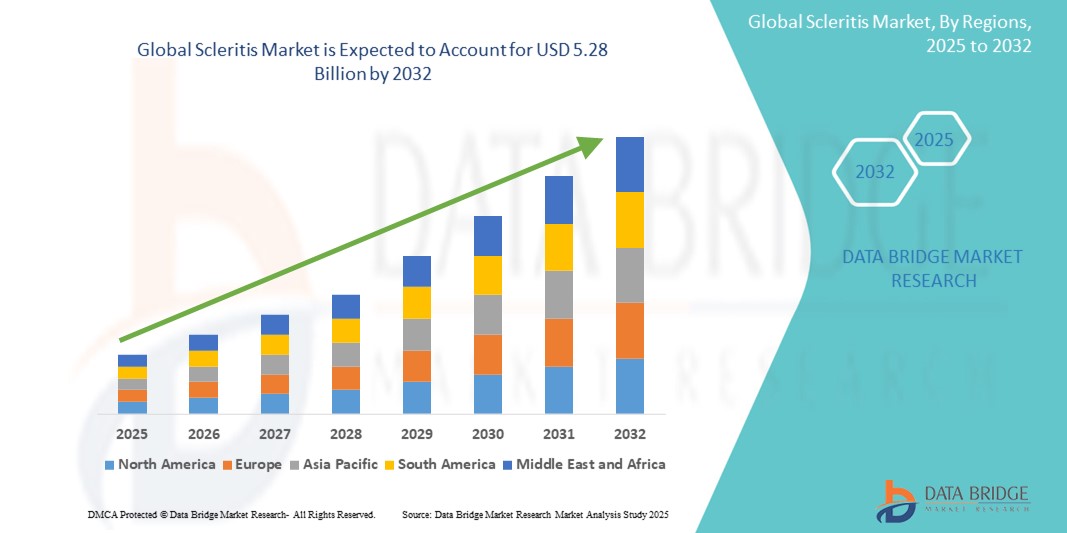
- The global scleritis market size was valued at USD 3.39 billion in 2024 and is expected to reach USD 5.28 billion by 2032, at a CAGR of 5.70% during the forecast period
- The market growth is largely fueled by the increasing prevalence of autoimmune disorders and infectious conditions, which are primary underlying causes of scleritis, thereby driving the demand for timely and effective treatment options
- Furthermore, advancements in diagnostic imaging technologies and the development of targeted biologic therapies are enhancing clinical outcomes and patient management. These converging factors are accelerating the uptake of scleritis treatment solutions, thereby significantly boosting the industry's growth
Scleritis Market Analysis
- Scleritis, a serious inflammatory eye disease, is increasingly recognized as a critical area in ophthalmology due to its association with systemic autoimmune disorders and potential for severe vision impairment if left untreated
- The rising incidence of autoimmune conditions such as rheumatoid arthritis and lupus, along with enhanced awareness and diagnostic capabilities in ophthalmic care, is fueling demand for effective scleritis treatments
- North America dominated the scleritis market with the largest revenue share of 41.7% in 2024, supported by advanced healthcare infrastructure, high awareness among patients, and the availability of innovative biologic therapies and immunosuppressants. The U.S. particularly leads in diagnosis and treatment volumes due to its large pool of specialists and access to advanced medications
- Asia-Pacific is expected to be the fastest-growing region in the scleritis market, projected to grow at a CAGR of 8.9% from 2025 to 2032, driven by increasing healthcare expenditures, a growing patient population, and expanding access to specialty ophthalmic care in countries such as India, China, and Japan
- Medication segment dominated the scleritis market with a market share of 77.6% in 2024, fueled by the widespread use of corticosteroids, immunosuppressants, and NSAIDs in scleritis management
Report Scope and Scleritis Market Segmentation
|
Attributes |
Scleritis Key Market Insights |
|
Segments Covered |
|
|
Countries Covered |
North America
Europe
Asia-Pacific
Middle East and Africa
South America
|
|
Key Market Players |
|
|
Market Opportunities |
|
|
Value Added Data Infosets |
In addition to the insights on market scenarios such as market value, growth rate, segmentation, geographical coverage, and major players, the market reports curated by the Data Bridge Market Research also include in-depth expert analysis, pricing analysis, brand share analysis, consumer survey, demography analysis, supply chain analysis, value chain analysis, raw material/consumables overview, vendor selection criteria, PESTLE Analysis, Porter Analysis, and regulatory framework. |
Scleritis Market Trends
“Enhanced Convenience Through AI and Advanced Diagnostic Integration in Scleritis Management”
- A significant and accelerating trend in the global scleritis market is the integration of artificial intelligence (AI) and advanced imaging technologies in ophthalmology, which is enhancing the precision and efficiency of diagnosing and managing scleritis
- For instance, AI-assisted fundus imaging and anterior segment OCT (Optical Coherence Tomography) are being employed to distinguish scleritis from episcleritis more effectively, reducing diagnostic delays and improving patient outcomes. These technologies can analyze subtle inflammatory changes that may be missed in conventional exams
- AI is also being used to predict disease progression and treatment response, allowing for more personalized treatment plans. Machine learning models trained on patient data can help ophthalmologists anticipate flare-ups or complications and adjust immunosuppressive therapy proactively
- Teleophthalmology platforms equipped with AI triage tools are expanding access to scleritis diagnosis and care, especially in remote or underserved regions. These platforms enable early intervention by facilitating real-time consultations and automated image analysis
- The growing adoption of biologic therapies such as TNF inhibitors and IL-6 blockers has further pushed for innovation in treatment monitoring. AI tools are being integrated with electronic health records (EHR) to track patient responses and side effects, improving adherence and long-term disease management
- This shift toward more intelligent, connected, and evidence-based scleritis care is reshaping expectations in ophthalmic practice. As healthcare systems adopt smart diagnostic platforms and predictive analytics, companies developing targeted therapies and AI-powered devices are well-positioned for growth in the scleritis market
Scleritis Market Dynamics
Driver
“Growing Need Due to Rising Autoimmune Disorders and Diagnostic Advancements”
- The increasing prevalence of autoimmune diseases and infectious conditions globally, coupled with rising awareness of ocular inflammatory disorders, is a significant driver for the heightened demand for effective scleritis diagnosis and treatment solutions
- For instance, in April 2024, leading pharmaceutical firms began investing in the development of targeted biologic therapies for rare ophthalmic conditions, including scleritis. These therapies aim to improve outcomes in patients who are unresponsive to conventional steroid-based treatments. Such R&D strategies are expected to drive scleritis industry growth in the forecast period
- As clinicians and patients become more aware of the risks associated with untreated scleritis—such as vision loss and corneal damage—there is an increasing preference for advanced diagnostic tools including anterior segment OCT and ultrasound biomicroscopy, which allow for more accurate detection and monitoring
- Furthermore, the growing integration of electronic health records (EHRs) and teleophthalmology platforms is enabling faster diagnosis and follow-up care, especially in remote or underserved areas. These platforms offer seamless integration with AI-based tools that can flag inflammation signs and suggest tailored treatment plans
- The demand for less invasive treatment options, such as immunomodulators and biologics, alongside minimally invasive intraocular drug delivery systems, is also propelling the adoption of new therapies in both hospital and outpatient settings. The trend toward personalized medicine and real-world data collection is further contributing to market growth
Restraint/Challenge
“Delayed Diagnosis and High Treatment Costs”
- Challenges surrounding delayed diagnosis due to the rarity and complexity of scleritis cases pose significant hurdles to effective patient management. The symptoms of scleritis often overlap with episcleritis and other ocular conditions, making clinical differentiation difficult without advanced imaging, which may not be readily available in all healthcare settings
- For instance, in developing regions, lack of access to specialist ophthalmic care and diagnostic infrastructure leads to underdiagnosis or misdiagnosis, delaying appropriate treatment initiation and increasing the risk of complications
- High costs associated with advanced biologic therapies, immunosuppressants, and ongoing patient monitoring can be a barrier to access, especially for uninsured populations. While corticosteroids remain a common first-line treatment, their long-term use is linked to side effects, leading to a need for more sustainable therapeutic approaches
- To overcome these challenges, stakeholders in the scleritis market must focus on enhancing clinical training, expanding teleophthalmology services, and offering subsidized access to advanced treatments. In parallel, investment in AI-powered diagnostic tools can help bridge the gap in early and accurate disease identification
Scleritis Market Scope
The market is segmented on the basis of type, diagnosis, treatment, end-users, and distribution channel.
• By Type
On the basis of type, the scleritis market is segmented into anterior scleritis, posterior scleritis, and others. The anterior scleritis segment dominated the market with the largest revenue share of 62.5% in 2024, driven by its higher prevalence and faster diagnosis due to visible clinical symptoms.
The posterior scleritis segment is projected to grow at the fastest CAGR of 8.7% from 2025 to 2032, owing to advancements in diagnostic imaging technologies and rising awareness among healthcare providers.
• By Diagnosis
On the basis of diagnosis, the scleritis market is segmented into physical examination, laboratory evaluations, biopsy, complete blood count (CBC), and others. The physical examination segment held the largest market share of 41.2% in 2024, as initial ophthalmic evaluations remain the primary diagnostic method.
The laboratory evaluations segment is expected to register the highest CAGR of 7.9% during the forecast period, driven by the need to identify autoimmune or infectious causes of scleritis through specialized testing.
• By Treatment
On the basis of treatment, the scleritis market is segmented into medication, surgery, and others. The medication segment accounted for the largest market share of 77.6% in 2024, fueled by the widespread use of corticosteroids, immunosuppressants, and NSAIDs in scleritis management.
The surgery segment is anticipated to expand at a CAGR of 6.3% from 2025 to 2032, particularly in severe or necrotizing cases where medical therapy is insufficient.
• By End-Users
On the basis of end-users, the scleritis market is segmented into hospitals, specialty clinics, home healthcare, and others. The hospitals segment led the market with a revenue share of 53.8% in 2024, attributed to comprehensive diagnostic setups and access to advanced ophthalmic interventions.
The specialty clinics segment is expected to grow at the fastest CAGR of 7.1%, due to the increasing shift toward outpatient care and rising demand for eye-specific clinical services.
• By Distribution Channel
On the basis of distribution channel, the scleritis market is segmented into direct tender, hospital pharmacy, retail pharmacy, online pharmacy, and others. The hospital pharmacy segment captured the largest revenue share of 45.4% in 2024, given its direct access to prescribed treatments within institutional setups.
The online pharmacy segment is projected to witness the highest CAGR of 9.2% during the forecast period, supported by growing digital health adoption and the convenience of home medication delivery.
Scleritis Market Regional Analysis
- North America dominated the scleritis market with the largest revenue share of 41.7% in 2024, driven by the high prevalence of autoimmune disorders such as rheumatoid arthritis and granulomatosis with polyangiitis, which are commonly associated with scleritis
- The region also benefits from a well-established healthcare infrastructure, advanced diagnostic capabilities, and early access to biologic treatments, all of which contribute to higher detection and management rates
- In addition, supportive reimbursement policies, increased awareness among ophthalmologists, and the presence of leading pharmaceutical and biotech firms investing in ocular inflammation therapies reinforce North America's dominance in the global Scleritis market
U.S. Scleritis Market Insight
The U.S. scleritis market alone contributed about 81% of North America’s market share in 2024. This substantial figure reflects the country’s robust healthcare spending, broad insurance coverage, and widespread access to specialty eye care. The increasing prevalence of systemic autoimmune diseases, such as rheumatoid arthritis and lupus, continues to drive demand for targeted treatment and diagnostics for Scleritis.
Europe Scleritis Market Insight
The Europe scleritis market is projected to expand at a substantial CAGR throughout the forecast period. The region’s growth is supported by advanced clinical research, strong regulatory frameworks, and growing public awareness of ocular inflammatory diseases. High disease surveillance rates and the availability of biosimilars also contribute to improved treatment accessibility across EU nations.
U.K. Scleritis Market Insight
The U.K. scleritis market is anticipated to grow at a noteworthy CAGR during the forecast period, driven by its emphasis on integrated healthcare services and proactive eye screening programs. Increasing incidence of autoimmune disorders and an expanding elderly population are key growth enablers.
Germany Scleritis Market Insight
The Germany scleritis market is expected to expand at a considerable CAGR during the forecast period. With a high standard of medical innovation and a focus on precision medicine, Germany is witnessing growing adoption of biologic drugs and advanced diagnostic imaging for inflammatory eye diseases.
Asia-Pacific Scleritis Market Insight
The Asia-Pacific scleritis market is emerging as the fastest-growing market, projected to register a CAGR of around 8.9% from 2025 to 2032 due to the increasing healthcare investments, rising awareness of eye health, and technological advancements are accelerating growth across countries such as China, Japan, and India.
Japan Scleritis Market Insight
The Japan scleritis market represents about 4.2% of the global market in 2024, underpinned by its technologically advanced healthcare infrastructure and an aging population more prone to inflammatory conditions. The nation is seeing growing demand for minimally invasive diagnostics and biologics in ophthalmology.
China Scleritis Market Insight
The China scleritis market accounted for 4.6% of the global scleritis market in 2024. Rapid urbanization, growing middle-class healthcare expenditure, and expansion of specialty eye hospitals are propelling the country’s market forward. In addition, local pharmaceutical companies are increasingly entering the ophthalmology segment, introducing cost-effective options.
Scleritis Market Share
The scleritis industry is primarily led by well-established companies, including:
- Zydus Pharmaceuticals, Inc. (India)
- Amgen Inc. (U.S.)
- CELLTRION INC. (South Korea)
- Pfizer Inc. (U.S.)
- Samsung Bioepis (South Korea)
- Baxter (U.S.)
- Novartis AG (Switzerland)
- F. Hoffmann-La Roche Ltd. (Switzerland)
- Fresenius SE & Co. KGaA (Germany)
- Accord Healthcare (U.K.)
- Horizon Therapeutics plc (U.S.)
- Sun Pharmaceutical Industries Ltd. (India)
- Bayer AG (Germany)
- Alvogen (U.S.)
- Perrigo Company plc (Ireland)
Latest Developments in Global Scleritis Market
- In March 2024, Amgen Inc. announced promising clinical trial results for a new biologic therapy targeting autoimmune-related ocular inflammation, including Scleritis. This advancement is part of Amgen’s broader pipeline strategy to address rare inflammatory diseases, leveraging its expertise in monoclonal antibody development to provide targeted, long-term relief for patients suffering from vision-threatening inflammation
- In February 2024, Novartis AG initiated a phase II clinical trial evaluating the efficacy of its IL-17A inhibitor in patients with refractory non-infectious Scleritis. The trial marks a significant step toward expanding the use of systemic immunotherapies in ophthalmology, particularly for patients unresponsive to corticosteroids or conventional immunosuppressants
- In January 2024, Horizon Therapeutics plc expanded its ophthalmology portfolio by launching a compassionate access program for its TNF-α inhibitor drug, used in severe Scleritis cases associated with systemic autoimmune diseases such as rheumatoid arthritis. This program aims to improve treatment access for patients in underserved regions
- In December 2023, Celltrion Inc. received approval from the European Medicines Agency (EMA) for a biosimilar version of infliximab for ocular inflammatory conditions, including posterior Scleritis. The approval opens up more cost-effective treatment options across Europe and is expected to significantly reduce the financial burden on healthcare systems and patients
- In November 2023, Zydus Lifesciences introduced a new corticosteroid formulation with improved ocular bioavailability, specifically developed for treating anterior Scleritis. The product launch supports the growing demand for topical and minimally invasive treatment alternatives, particularly in emerging markets where access to biologics may be limited

- Interactive Data Analysis Dashboard
- Company Analysis Dashboard for high growth potential opportunities
- Research Analyst Access for customization & queries
- Competitor Analysis with Interactive dashboard
- Latest News, Updates & Trend analysis
- Harness the Power of Benchmark Analysis for Comprehensive Competitor Tracking
Data collection and base year analysis are done using data collection modules with large sample sizes. The stage includes obtaining market information or related data through various sources and strategies. It includes examining and planning all the data acquired from the past in advance. It likewise envelops the examination of information inconsistencies seen across different information sources. The market data is analysed and estimated using market statistical and coherent models. Also, market share analysis and key trend analysis are the major success factors in the market report. To know more, please request an analyst call or drop down your inquiry.
The key research methodology used by DBMR research team is data triangulation which involves data mining, analysis of the impact of data variables on the market and primary (industry expert) validation. Data models include Vendor Positioning Grid, Market Time Line Analysis, Market Overview and Guide, Company Positioning Grid, Patent Analysis, Pricing Analysis, Company Market Share Analysis, Standards of Measurement, Global versus Regional and Vendor Share Analysis. To know more about the research methodology, drop in an inquiry to speak to our industry experts.
Data Bridge Market Research is a leader in advanced formative research. We take pride in servicing our existing and new customers with data and analysis that match and suits their goal. The report can be customized to include price trend analysis of target brands understanding the market for additional countries (ask for the list of countries), clinical trial results data, literature review, refurbished market and product base analysis. Market analysis of target competitors can be analyzed from technology-based analysis to market portfolio strategies. We can add as many competitors that you require data about in the format and data style you are looking for. Our team of analysts can also provide you data in crude raw excel files pivot tables (Fact book) or can assist you in creating presentations from the data sets available in the report.












