What is the Screw Top Jar Market Size and Growth Rate?
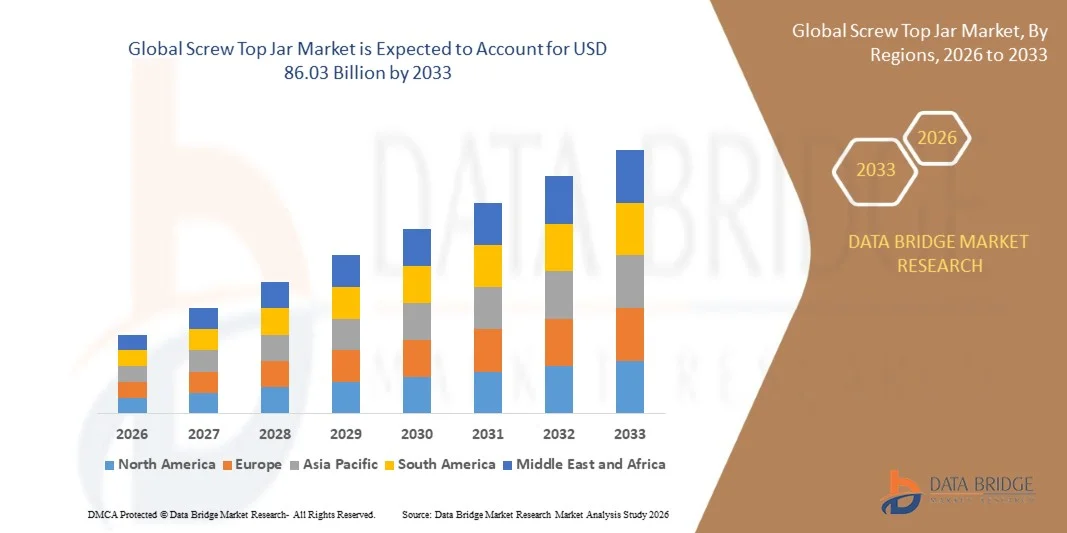
- As per Data Bridge Market Research analysis, the screw top jar market was valued at USD 56.92 billion in 2025 and is projected to reach USD 86.03 billion by 2033, growing at a CAGR of 5.30% from 2026 to 2033.
- The market is experiencing consistent growth driven by rising demand for convenient and reusable packaging solutions, increasing adoption across food and beverage, pharmaceutical, cosmetics, and household applications, and growing consumer preference for secure and airtight containers.
- The increasing focus on sustainable packaging, combined with demand for longer product shelf life and convenient storage, is encouraging manufacturers and end users to adopt screw top jars. Glass and plastic screw top jars are widely used for preserving food products, cosmetics, personal care products, pharmaceuticals, and household goods, while recyclable materials and reusable packaging formats are gaining importance as sustainability requirements continue to expand.
Market Size & Forecast
- Global Market Value (2025): USD 56.92 Billion
- Expected Market Value (2033): USD 86.03 Billion
- Forecast CAGR (2026–2033): 5.30%
- Leading Region in 2025: North America
- Fastest Growing Region: Asia Pacific
What are the Major Takeaways of the Screw Top Jar Market?
- North America dominated the screw top jar market with the largest revenue share of 35.0% in 2025, supported by established food and beverage, pharmaceutical, cosmetics, and household packaging industries and strong demand for convenient, resealable packaging solutions.
- Asia-Pacific is expected to be the fastest-growing region at a CAGR of 6.0% from 2026 to 2033, fueled by expanding food processing and consumer goods industries, rising urbanization, and increasing adoption of convenient and sustainable packaging formats.
- The oilseeds segment led the market with a 40.0% share in 2025, driven by the use of screw top jars for packaging sesame seeds, sunflower seeds, flaxseeds, and other oilseed products
- Cereals are the fastest-growing product type, projected to register a CAGR of 5.8%, reflecting the surge in demand for convenient, resealable, and moisture-resistant packaging for cereal products.
- The plastic segment dominated the material category with a 47.0% revenue share in 2025, led by lightweight construction, durability, cost efficiency, and broad suitability across major end-use applications.
- Food and beverages accounted for 49.0% of the market share in 2025, preferred by extensive use of screw top jars for food storage, preserves, jams, sauces, spices, condiments, and other packaged products
- The personal care segment is the fastest-growing application category, with a CAGR of 5.5%, driven by increasing demand for creams, balms, masks, scrubs, and other cosmetic formulations packaged in convenient containers.
Report Scope and Screw Top Jar Market Segmentation
|
Attributes |
Screw Top Jar Key Market Insights |
|
Segments Covered |
|
|
Countries Covered |
North America
Europe
Asia-Pacific
Middle East and Africa
South America
|
|
Key Market Players |
|
|
Market Opportunities |
|
|
Value Added Data Infosets |
In addition to the insights on market scenarios such as market value, growth rate, segmentation, geographical coverage, and major players, the market reports curated by the Data Bridge Market Research also include import export analysis, production capacity overview, production consumption analysis, price trend analysis, climate change scenario, supply chain analysis, value chain analysis, raw material/consumables overview, vendor selection criteria, PESTLE Analysis, Porter Analysis, and regulatory framework. |
What is the Key Trend in the Screw Top Jar Market?
- Screw top jar manufacturers are increasingly developing reusable, refillable, and recyclable jar formats to meet rising demand for sustainable packaging across food, cosmetics, personal care, and household applications.
- For instance, in October 2024, LUMENE introduced bio-based 50 ml moisturizer jars that used 44% less packaging material and had a carbon footprint up to 38% lower than its previous bio-based packaging.
- Premiumization is encouraging brands to adopt customized screw top jars with distinctive shapes, finishes, lightweight designs, and high-quality glass to improve shelf appeal and strengthen brand positioning.
- Refillable jar systems are gaining traction in cosmetics and personal care as brands seek to reduce packaging consumption while retaining durable outer containers for repeated product use.
- Screw top closure innovation is also shifting toward fiber-based and bio-based alternatives as manufacturers seek to reduce conventional plastic content while maintaining secure and functional jar closures.
- For instance, in April 2025, Ekam Global partnered with Blue Ocean Closures to commercially introduce cellulose-fiber screw caps in Australia for food, beverage, oil, and packaging applications.
- As packaging sustainability, premiumization, refill systems, and material innovation continue to influence purchasing decisions, manufacturers are expected to expand screw top jar designs that combine product protection, convenience, recyclability, and visual differentiation.
What are the Key Drivers of the Screw Top Jar Market?
- The growing demand for convenient, airtight, and resealable packaging is increasing the use of screw top jars across food, beverages, cosmetics, pharmaceuticals, nutraceuticals, and household products.
- For instance, in October 2025, Swedish nutraceutical brand Great Earth converted its entire supplement line to molded-fiber screw caps, replacing plastic closures across more than 70 products.
- The expansion of sustainable packaging initiatives is also driving demand for recyclable glass, recycled-content materials, reusable jars, and renewable-material plastic formats that reduce dependence on conventional packaging materials.
- The growing food and beverage, cosmetics, pharmaceutical, and personal care industries are increasing demand for jars that provide product protection, extended freshness, tamper evidence, and convenient repeated opening and closing.
- Growing consumer and regulatory emphasis on circular packaging is further encouraging manufacturers to develop reusable and recyclable screw top jars that can remain in packaging systems for multiple use cycles.
- For instance, in June 2025, Close the Glass Loop reported that EU glass packaging collection for recycling reached 80.8% in 2023, with more than 12 million tonnes collected, demonstrating the expanding infrastructure supporting circular glass packaging.
- As manufacturers prioritize secure closures, sustainable materials, and convenient packaging formats across major end-use industries, screw top jars will continue gaining adoption as versatile primary packaging solutions.
Which Factors are Challenging the Growth of the Screw Top Jar Market?
- Manufacturing and transportation costs can constrain screw top jar adoption, particularly for glass formats, because glass production is energy-intensive and finished jars are heavier than many alternative packaging formats.
- For instance, in June 2024, O-I Glass reported that more than 100 energy-reduction projects had eliminated approximately 34,950 tons of CO₂ emissions, highlighting the scale of energy-efficiency requirements within glass packaging manufacturing.
- Plastic screw top jars are also exposed to fluctuations in resin and petrochemical costs, which can increase manufacturing expenses and create uncertainty for packaging suppliers and end users.
- Glass jars can also increase logistics costs because their higher weight requires additional transportation capacity, encouraging manufacturers to invest in lightweight designs without compromising durability, sealing performance, or product protection.
- The cost of developing recyclable, refillable, lightweight, and tamper-evident screw top jars can further challenge smaller packaging manufacturers, particularly when specialized materials, closures, molds, and production equipment are required.
- For instance, in February 2024, O-I Glass launched its 390-gram Estampe wine bottle in France, approximately 22% lighter than a typical 500-gram bottle and reported to deliver about 25% lower carbon emissions than the conventional format.
- The combination of energy-intensive production, raw-material price volatility, transportation requirements, and investment in sustainable technologies continues to create cost pressures for screw top jar manufacturers, particularly in price-sensitive packaging applications.
How is the Screw Top Jar Market Segmented?
The screw top jar market is segmented on the basis of product, material, application, and end user.
- By Product
On the basis of product, the screw top jar market is segmented into oilseeds, cereals, and others. The oilseeds segment dominated the market with 40.0% share in 2025, supported by the use of screw top jars for packaging sesame seeds, sunflower seeds, flaxseeds, and other oilseed products. These jars provide an airtight and moisture-resistant environment that helps preserve freshness and product quality. Secure screw closures also help protect oilseeds from contamination and exposure to environmental conditions during storage. Growing consumption of healthy ingredients and plant-based foods is supporting demand for convenient packaging formats for oilseeds. Screw top jars also offer convenient repeated opening and closing, making them suitable for household and retail use.
The cereals segment is projected to register the fastest growth at 5.8% CAGR during forecast period, driven by increasing demand for convenient, resealable, and moisture-resistant packaging for cereal products. Screw top jars are suitable for granola, muesli, breakfast mixes, and other cereal-based products that require protection during storage. The airtight closure helps maintain product freshness while reducing exposure to moisture and contaminants. Growing demand for premium, organic, and health-oriented cereal products is creating additional opportunities for durable jar packaging. Reusable screw top jars also appeal to consumers seeking convenient food-storage solutions after opening. Increasing demand for attractive packaging among specialty food brands is further supporting adoption.
- By Material
On the basis of material, the screw top jar market is segmented into glass, plastic, metal, and others. The plastic segment dominated the market with a 47.0% share in 2025, supported by lightweight construction, durability, cost efficiency, and broad suitability across major end-use applications. Plastic screw top jars can be produced in different shapes, sizes, colors, and designs, providing flexibility for manufacturers and brands. Their lower weight compared with glass can also simplify handling and transportation. Plastic formats are widely applicable across food, personal care, household, and pharmaceutical packaging. Increasing availability of recyclable and recycled-content plastics is also supporting their continued use as sustainability requirements evolve.
The glass segment is projected to register the fastest growth at 5.0% CAGR during forecast period, supported by its strong barrier properties, recyclability, transparency, and premium appearance. Glass screw top jars help protect products from moisture, oxygen, and chemical interaction, making them suitable for food, pharmaceutical, cosmetic, and personal care applications. Their transparent structure allows consumers to see the packaged product, strengthening product presentation and purchasing appeal. Glass can also be repeatedly recycled without losing its fundamental material properties, supporting circular packaging initiatives. Premium brands increasingly use glass jars to communicate quality and enhance shelf differentiation. Demand for reusable and refillable packaging is further creating opportunities for glass screw top formats.
- By Application
On the basis of application, the screw top jar market is segmented into personal care, healthcare and pharmaceuticals, food and beverages, household, and others. The food and beverages segment dominated the market with 49.0% share in 2025, driven by extensive use of screw top jars for food storage, preserves, jams, sauces, spices, condiments, and other packaged products. Screw closures provide secure sealing while allowing consumers to repeatedly open and close the container. Jar packaging also supports product visibility and can help preserve freshness and quality. Glass screw top jars are particularly suitable for products requiring strong barrier protection and premium presentation. Growing consumption of packaged and specialty foods is supporting demand for practical and reusable packaging formats
The personal care segment is projected to register the fastest growth at 5.5% CAGR during forecast period, supported by increasing demand for creams, balms, masks, scrubs, and other cosmetic formulations packaged in convenient containers. Screw top jars provide easy access to thick and semi-solid formulations while supporting repeated opening and closing. Glass and premium plastic jars are increasingly used to create distinctive visual and tactile experiences for beauty products. Expansion of skincare, natural cosmetics, and specialty personal care products is creating additional demand for differentiated jar packaging. Refillable and reusable jar formats are also gaining attention as personal care brands seek to reduce packaging waste. Custom shapes, finishes, and closure designs provide further opportunities for product differentiation.
- By End User
On the basis of end user, the screw top jar market is segmented into food, beverages, personal care and home care, healthcare, and others. The food segment dominated the market with an 42.0% share in 2025, supported by widespread use of screw top jars for jams, sauces, spreads, pickles, spices, seeds, and other food products. Food manufacturers use screw closures because they provide secure sealing and facilitate convenient repeated access. Glass jars are particularly suitable for products requiring strong barrier protection and product visibility. Growing packaged-food consumption is increasing demand for reliable and reusable primary packaging formats. Screw top jars can also be reused by consumers for household storage after the original contents have been consumed.
The personal care and home care segment is projected to register the fastest growth at 5.6% CAGR during forecast period, driven by expanding demand for creams, lotions, balms, cleaning products, and other formulations requiring resealable packaging. Screw top jars provide convenient access and secure closure for products that are frequently used by consumers. Premium personal care brands are increasingly adopting distinctive jar shapes, finishes, and closures to strengthen visual differentiation. Sustainable packaging initiatives are also encouraging the use of recyclable, reusable, and refillable jar formats. Growth in skincare, cosmetics, household cleaning, and specialty home-care products is broadening demand for screw top packaging. E-commerce is In addition increasing the importance of durable packaging capable of withstanding handling throughout distribution.
Which Region Holds the Largest Share of the Screw Top Jar Market?
- North America dominated the screw top jar market with the largest revenue share of 35.0% in 2025, supported by established food and beverage, pharmaceutical, cosmetics, and household packaging industries and strong demand for convenient, resealable packaging solutions.
- The region also benefits from strong demand for food and beverage, personal care, pharmaceutical, and household packaging, along with growing consumer interest in reusable and recyclable jars. Established glass-packaging infrastructure, premium product demand, and sustainability initiatives are further supporting regional consumption. The United States remains the principal market within North America, while continued demand for convenient resealable packaging and home food preservation strengthens the region's position in the global screw top jar market.
U.S. Screw Top Jar Market Insight
The U.S. screw top jar market is witnessing steady growth due to strong demand for convenient, resealable, and durable packaging across food and beverage, personal care, pharmaceutical, and household applications. The country’s established packaging industry, extensive retail network, and growing preference for reusable and recyclable containers are supporting market expansion. In addition, increasing demand for premium food products, specialty foods, cosmetics, and home-storage solutions is accelerating the adoption of screw top jars across diverse end-use industries.
Asia-Pacific Screw Top Jar Market Insight
The Asia-Pacific screw top jar market is expected to witness rapid growth, driven by expanding food processing, personal care, pharmaceutical, and household-product industries across countries such as China, India, and Japan. Rising urbanization, increasing packaged-food consumption, and growing awareness of convenient and sustainable packaging solutions are supporting regional market expansion. In addition, the growing presence of consumer goods manufacturers and increasing adoption of recyclable and reusable packaging formats are accelerating screw top jar demand across commercial and household applications.
Japan Screw Top Jar Market Insight
The Japan screw top jar market is witnessing consistent growth due to rising demand for high-quality, convenient, and reliable packaging across food, beverages, cosmetics, pharmaceuticals, and household products. Manufacturers and consumer brands are increasingly adopting screw top jars for products requiring secure closure, product protection, and repeated access. Moreover, increasing emphasis on recyclable packaging, lightweight designs, premium presentation, and efficient resource utilization is further contributing to market growth.
China Screw Top Jar Market Insight
The China screw top jar market is growing rapidly, driven by expanding food and beverage production, rising personal care consumption, and increasing pharmaceutical and household-product manufacturing. Growing adoption of convenient and resealable packaging formats across retail and consumer goods industries is significantly boosting market demand. In addition, rising investments in sustainable packaging, increasing consumption of packaged foods, and rapid development of e-commerce distribution channels are supporting the expansion of screw top jar applications across China.
U.K. Screw Top Jar Market Insight
The U.K. screw top jar market is experiencing steady growth, supported by rising adoption of convenient and sustainable packaging across food, beverages, personal care, healthcare, and household applications. Increasing consumer preference for recyclable, reusable, and refillable packaging solutions is contributing to market growth. Furthermore, growing demand for premium food products, specialty cosmetics, and environmentally responsible packaging is encouraging manufacturers to develop innovative screw top jars with improved functionality, appearance, and sustainability.
Germany Screw Top Jar Market Insight
The Germany screw top jar market is expanding steadily due to the country’s strong food and beverage industry, advanced packaging capabilities, and increasing adoption of sustainable packaging technologies. Food manufacturers, cosmetics companies, pharmaceutical producers, and household-product brands are increasingly utilizing screw top jars for secure product storage and convenient consumer use. Continuous advancements in lightweight packaging, recyclable materials, refillable formats, and efficient manufacturing, along with strong emphasis on circular packaging solutions, are further supporting market growth.
Which are the Top Companies in Screw Top Jar Market?
The screw top jar industry is primarily led by well-established companies, including:
- Berry Global Inc. (U.S.)
- Berlin Packaging L.L.C. (U.S.)
- H&K Müller GmbH & Co. KG (Germany)
- River Packaging Limited (U.K.)
- Verallia Packaging (France)
- Vidrala (Spain)
- Vetropack Holding AG (Switzerland)
- Stoelzle Oberglas GmbH (Austria)
- William Croxson & Son Limited (U.K.)
- Ardagh Group S.A. (Luxembourg)
- Gerresheimer AG (Germany)
- Kilner (U.K.)
- Guangzhou JXPACK Technology Co., LTD. (China)
- Ajanta Bottle Private Limited (India)
- Alok Glass Works (India)
- Xuzhou Ant Glass Packaging Co., Ltd. (China)
- FJGLASS (China)
- River Packaging Limited (U.K.)
- H&K Müller GmbH & Co. KG (Germany)
- Stoelzle GmbH (Germany)
What are Latest Developments in Screw Top Jar Market?
- In October 2025, Great Earth, a Swedish nutraceutical brand, expanded its use of molded-fiber screw caps across its entire supplement range, replacing plastic closures on more than 70 products. The rollout followed a 2024 pilot with Blue Ocean Closures and represented a large-scale commercial application of fiber-based screw caps for supplement jars, highlighting the shift toward renewable and recyclable closure materials.
- In April 2025, Ekam Global partnered with Blue Ocean Closures to introduce a cellulose-fiber screw cap commercially in Australia. The closure was positioned as an alternative to conventional plastic screw caps and was made available for wine, beverage, oil, and food packaging applications, supporting the development of lower-plastic packaging solutions for jars and containers.
- In July 2024, Berry Global partnered with Grillo’s Pickles to introduce custom, nestable polypropylene pickle jars with continuous-thread screw closures. The new packaging was designed to provide spill-proof, easy opening and improved handling while maintaining wide recyclability, directly addressing consumer complaints about spillage when opening the previous jar design.
- In April 2023, Blue Ocean Closures partnered with Swed-jam and Research Institutes of Sweden (RISE) to develop bio-based fiber lids for jams, smoothies, compotes, and other lidded food and beverage products. The project focused on developing recyclable paper-based alternatives to conventional metal screw lids and was supported through Sweden’s BioInnovation strategic innovation program.
- In January 2022, Berry Global launched its 500 ml Staka stackable jar, featuring a 63 mm recessed base designed to accommodate its matching 63 mm closure and allow multiple jars to stack securely. The jar was developed for applications including spices and sauces, while its wide mouth supported easy filling and its design offered storage benefits for retail shelves, e-commerce distribution, and household use

- Interactive Data Analysis Dashboard
- Company Analysis Dashboard for high growth potential opportunities
- Research Analyst Access for customization & queries
- Competitor Analysis with Interactive dashboard
- Latest News, Updates & Trend analysis
- Harness the Power of Benchmark Analysis for Comprehensive Competitor Tracking
Global Screw Top Jar Market, Supply Chain Analysis and Ecosystem Framework
To support market growth and help clients navigate the impact of geopolitical shifts, DBMR has integrated in-depth supply chain analysis into its Global Screw Top Jar Market research reports. This addition empowers clients to respond effectively to global changes affecting their industries. The supply chain analysis section includes detailed insights such as Global Screw Top Jar Market consumption and production by country, price trend analysis, the impact of tariffs and geopolitical developments, and import and export trends by country and HSN code. It also highlights major suppliers with data on production capacity and company profiles, as well as key importers and exporters. In addition to research, DBMR offers specialized supply chain consulting services backed by over a decade of experience, providing solutions like supplier discovery, supplier risk assessment, price trend analysis, impact evaluation of inflation and trade route changes, and comprehensive market trend analysis.
Data collection and base year analysis are done using data collection modules with large sample sizes. The stage includes obtaining market information or related data through various sources and strategies. It includes examining and planning all the data acquired from the past in advance. It likewise envelops the examination of information inconsistencies seen across different information sources. The market data is analysed and estimated using market statistical and coherent models. Also, market share analysis and key trend analysis are the major success factors in the market report. To know more, please request an analyst call or drop down your inquiry.
The key research methodology used by DBMR research team is data triangulation which involves data mining, analysis of the impact of data variables on the market and primary (industry expert) validation. Data models include Vendor Positioning Grid, Market Time Line Analysis, Market Overview and Guide, Company Positioning Grid, Patent Analysis, Pricing Analysis, Company Market Share Analysis, Standards of Measurement, Global versus Regional and Vendor Share Analysis. To know more about the research methodology, drop in an inquiry to speak to our industry experts.
Data Bridge Market Research is a leader in advanced formative research. We take pride in servicing our existing and new customers with data and analysis that match and suits their goal. The report can be customized to include price trend analysis of target brands understanding the market for additional countries (ask for the list of countries), clinical trial results data, literature review, refurbished market and product base analysis. Market analysis of target competitors can be analyzed from technology-based analysis to market portfolio strategies. We can add as many competitors that you require data about in the format and data style you are looking for. Our team of analysts can also provide you data in crude raw excel files pivot tables (Fact book) or can assist you in creating presentations from the data sets available in the report.