


What is the Search and Rescue Robots Market Size and Growth Rate?
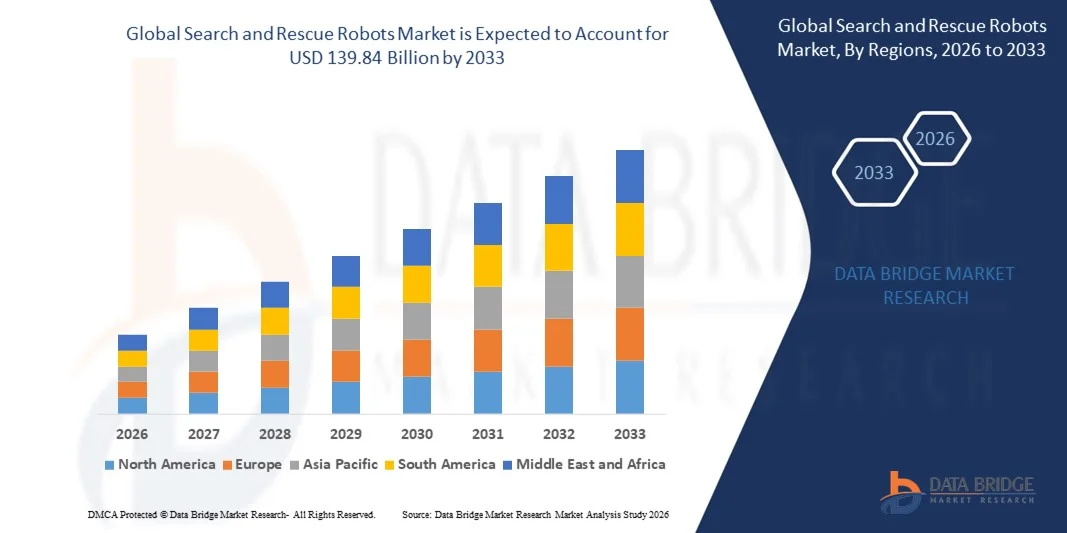
- As per Data Bridge Market Research Analysis the global search and rescue robots market size was valued at USD 32.30 billion in 2025 and is expected to reach USD 139.84 billion by 2033, at a CAGR of 20.10% during the forecast period
- The market growth is largely fueled by increasing investment in advanced robotics and autonomous systems for disaster response, defense, and emergency management, leading to enhanced operational efficiency and reduced human risk in hazardous environments
- Furthermore, rising demand from defense, homeland security, and public safety agencies for reliable, multifunctional, and rapid-response robotic solutions is establishing search and rescue robots as essential tools for mission-critical operations. These converging factors are accelerating the adoption of SAR robotics, thereby significantly boosting the market's growth
Market Size & Forecast
- Global Market Value (2025): USD 32.30 billion
- Expected Market Value (2033): USD 139.84 billion
- Forecast CAGR (2026–2033): 20.10%
Search and Rescue Robots Market Analysis
- Search and rescue robots, offering autonomous or remotely operated capabilities for disaster management, emergency response, and hazardous environment operations, are increasingly vital for both defense and civilian applications due to their ability to enhance safety, efficiency, and situational awareness
- The escalating demand for SAR robots is primarily fueled by technological advancements in AI, sensor integration, and autonomous navigation, growing frequency of natural and man-made disasters, and the need to minimize human exposure to dangerous conditions
- North America dominated the search and rescue robots market with a share of 38% in 2025, due to strong investment in defense and emergency response technologies, as well as increased government focus on disaster preparedness and public safety
- Asia-Pacific is expected to be the fastest growing region in the search and rescue robots market during the forecast period due to rapid urbanization, increasing government investments in disaster management, and rising adoption of advanced technologies in countries such as Japan, China, and India
- Remotely operated segment dominated the market with a market share of 52.8% in 2025, due to its high precision and control in hazardous or unpredictable environments. Rescue teams often rely on remotely operated robots to perform intricate maneuvers, avoid risks to human responders, and gather live visual and sensor data. The segment benefits from technological advancements in control interfaces, haptic feedback, and real-time monitoring, making it a preferred choice in disaster management operations
Report Scope and Search and Rescue Robots Market Segmentation
|
Attributes |
Search and Rescue Robots Key Market Insights |
|
Segments Covered |
|
|
Countries Covered |
North America
Europe
Asia-Pacific
Middle East and Africa
South America
|
|
Key Market Players |
|
|
Market Opportunities |
|
|
Value Added Data Infosets |
In addition to the market insights such as market value, growth rate, market segments, geographical coverage, market players, and market scenario, the market report curated by the Data Bridge Market Research team includes in-depth expert analysis, import/export analysis, pricing analysis, production consumption analysis, and pestle analysis. |
What is the Key Trend in the Search and Rescue Robots Market?
Rising Use of Multi-Terrain Search and Rescue Robots
- A significant trend in the search and rescue robots market is the growing adoption of multi-terrain robots capable of operating on ground, aerial, and marine environments, driven by the increasing need for versatile solutions in disaster response, defense, and emergency management. These robots are becoming critical in improving operational efficiency and safety while navigating complex and hazardous terrains
- For instance, Boston Dynamics’ Spot robot is deployed in disaster response and inspection missions, showcasing its ability to traverse rubble, stairs, and uneven surfaces, which strengthens the operational reliability of SAR teams in urban and industrial disaster scenarios
- The rising use of unmanned aerial vehicles (UAVs) for search and rescue operations is gaining traction, with companies such as Teledyne FLIR integrating thermal imaging and AI-based detection systems that allow rapid identification of survivors in floods, wildfires, or collapsed structures. This is positioning aerial SAR robots as essential tools for large-area reconnaissance and emergency monitoring
- Autonomous surface vehicles (ASVs) are being increasingly utilized for maritime rescue missions, with Hydronalix and Kongsberg Maritime providing systems capable of navigating complex waterways and performing remote operations. These marine platforms are reinforcing the demand for adaptable multi-environment SAR solutions
- The integration of modular robotics platforms, such as Carnegie Mellon University’s snake-like robots, highlights the trend toward flexible designs that can adapt to confined or underwater disaster environments, enhancing overall mission capabilities and reducing human risk
- Defense and homeland security organizations are expanding the deployment of these multi-terrain robots, as they allow coordinated operations across land, sea, and air. This trend is accelerating innovation in mobility, AI navigation, and sensor fusion, establishing multi-terrain SAR robots as indispensable assets for modern disaster and military operations
Search and Rescue Robots Market Dynamics
Driver
Advancements in Sensor and AI Technologies for Enhanced Rescue Operations
- The growing integration of AI, machine learning, and advanced sensor technologies is a major driver for the SAR robots market, enabling real-time navigation, victim detection, hazard assessment, and autonomous decision-making in disaster zones. These technologies are enhancing mission accuracy, speed, and operational safety
- For instance, Lockheed Martin has developed autonomous robotics platforms with AI-driven navigation and object recognition for emergency response, enabling precise movement through collapsed structures and dangerous environments, which reduces risk to human personnel
- Elbit Systems Ltd integrates advanced thermal, optical, and LIDAR sensors into robotic platforms, allowing efficient detection of heat signatures, obstacles, and structural hazards during rescue missions. These sensors improve situational awareness and operational decision-making for both defense and civil SAR operations
- The combination of AI and sensor data is facilitating predictive analytics in disaster response, allowing organizations to plan and optimize rescue routes, assess structural integrity, and prioritize victims. This capability is driving adoption in high-risk environments, where rapid, informed decision-making is critical
- The increasing demand for unmanned and autonomous platforms across defense, homeland security, and public safety sectors continues to reinforce the importance of AI and sensor-driven innovations as key market growth enablers
Restraint/Challenge
Limited Skilled Workforce for Operation and Maintenance of SAR Robots
- The search and rescue robots market faces challenges due to a shortage of trained personnel capable of operating, maintaining, and repairing advanced robotic systems, which require expertise in robotics, AI, and sensor technologies. This skill gap limits the effective deployment of sophisticated SAR solutions in field conditions
- For instance, organizations deploying Boston Dynamics’ Spot or Teledyne FLIR drones often require extensive operator training to handle AI navigation, sensor interpretation, and multi-terrain mobility, which can slow adoption and increase operational costs
- Maintaining modular or multi-environment platforms such as Carnegie Mellon University’s snake-like robots or Hydronalix autonomous surface vehicles demands specialized technical knowledge for calibration, system updates, and troubleshooting. The complexity of these operations presents a barrier for emergency services with limited technical staff
- The high reliance on skilled robotics engineers and field technicians for software, hardware, and AI maintenance increases operational expenditures and may constrain market expansion in developing regions with limited workforce availability
- In addition, the challenge of ensuring consistent and reliable performance in unpredictable disaster conditions underscores the need for a skilled workforce, without which the advanced capabilities of SAR robots cannot be fully leveraged, slowing overall adoption in critical applications
Search and Rescue Robots Market Scope
The market is segmented on the basis of platform type, operation, and end user.
- By Platform Type
On the basis of platform type, the search and rescue robots market is segmented into ground, marine, and aerial. The ground robots segment dominated the market with the largest market revenue share in 2025, driven by their versatility and capability to navigate through rubble, uneven terrain, and confined spaces during disaster scenarios. Ground robots are often prioritized for their robust design, stability, and ability to carry essential rescue equipment such as thermal cameras, sensors, and first-aid kits. The demand for ground robots is also fueled by their widespread adoption in earthquake, building collapse, and hazardous industrial accident responses, providing reliable and real-time situational awareness to rescue teams. Their compatibility with autonomous navigation systems and integration with communication protocols further enhance operational efficiency in challenging environments.
The aerial robots segment is anticipated to witness the fastest growth rate from 2026 to 2033, fueled by rising adoption in disaster-stricken areas requiring rapid aerial reconnaissance. For instance, companies such as DJI have developed drones equipped with high-resolution cameras and thermal imaging for locating missing persons in floods, wildfires, and remote terrains. Aerial robots offer the advantage of quickly covering large areas, accessing locations unreachable by ground robots, and providing critical data for planning rescue operations. Their increasing integration with AI-driven navigation and obstacle avoidance systems contributes to their growing popularity. The lightweight design, ease of deployment, and real-time data transmission capabilities further drive market growth in this segment.
- By Operation
On the basis of operation, the search and rescue robots market is segmented into autonomous and remotely operated robots. The remotely operated segment dominated the market with the largest market revenue share of 52.8% in 2025, driven by its high precision and control in hazardous or unpredictable environments. Rescue teams often rely on remotely operated robots to perform intricate maneuvers, avoid risks to human responders, and gather live visual and sensor data. The segment benefits from technological advancements in control interfaces, haptic feedback, and real-time monitoring, making it a preferred choice in disaster management operations. The ability to operate these robots safely from a distance while ensuring accurate data collection enhances operational efficiency and reliability during rescue missions.
The autonomous segment is expected to witness the fastest growth from 2026 to 2033, driven by increasing adoption of AI and machine learning technologies in disaster response. For instance, Boston Dynamics has introduced autonomous robots capable of navigating complex terrains, identifying survivors, and mapping disaster zones without direct human intervention. Autonomous robots provide faster response times, reduce reliance on operator availability, and optimize rescue strategies through predictive decision-making. The integration of autonomous navigation with sensor fusion and obstacle avoidance systems further enhances their effectiveness in time-critical scenarios. In addition, ongoing innovations are improving their energy efficiency and mission endurance, driving higher adoption rates.
- By End User
On the basis of end user, the search and rescue robots market is segmented into defense and homeland security. The defense segment dominated the market with the largest market revenue share in 2025, driven by the deployment of search and rescue robots in military operations, combat zones, and disaster relief missions. Defense agencies often utilize these robots for rapid reconnaissance, casualty extraction, and hazard assessment in hostile environments, minimizing risks to personnel. The segment benefits from continuous investment in R&D to develop rugged, high-performance robots capable of operating in diverse terrains and extreme conditions. Interoperability with existing defense communication systems and secure control networks further supports widespread adoption among military forces globally.
The homeland security segment is expected to witness the fastest growth from 2026 to 2033, driven by rising demand for emergency response and disaster preparedness in urban areas. For instance, companies such as Roboteam supply robots to emergency services for flood rescue, fire incidents, and counter-terrorism operations. Homeland security agencies increasingly rely on these robots for rapid deployment, real-time threat assessment, and casualty location in densely populated areas. The integration of advanced sensors, AI analytics, and mobile command interfaces enhances operational efficiency and situational awareness. In addition, public safety initiatives and government funding for disaster response technology accelerate adoption in this segment.
Search and Rescue Robots Market Regional Analysis
- North America dominated the search and rescue robots market with the largest revenue share of 38% in 2025, driven by strong investment in defense and emergency response technologies, as well as increased government focus on disaster preparedness and public safety
- Agencies and organizations in the region highly value advanced robotics solutions for rapid disaster response, real-time situational awareness, and enhanced operational efficiency, particularly in complex terrains and hazardous environments
- This widespread adoption is further supported by substantial R&D investments, high disposable incomes, and technologically skilled personnel, establishing search and rescue robots as essential tools for both defense and homeland security operations
U.S. Search and Rescue Robots Market Insight
The U.S. market captured the largest revenue share in 2025 within North America, fueled by extensive deployment of robotic solutions in military, disaster relief, and homeland security missions. Organizations prioritize the enhancement of operational safety and efficiency through unmanned ground and aerial robots equipped with advanced sensors and imaging technologies. Growing funding for robotics in defense and emergency management, coupled with integration capabilities with AI and IoT systems, further propels market growth. Moreover, the U.S.’s focus on developing autonomous navigation and real-time data analytics in robots significantly contributes to the market expansion.
Europe Search and Rescue Robots Market Insight
The Europe market is projected to expand at a substantial CAGR throughout the forecast period, primarily driven by stringent safety regulations and the increasing need for rapid disaster response solutions. Rising urbanization, coupled with a focus on technologically advanced emergency services, is fostering the adoption of search and rescue robots. European agencies are increasingly drawn to robotic solutions for risk reduction, operational efficiency, and enhanced situational awareness. The market is witnessing strong growth across defense and homeland security applications, with robots being deployed in both urban and industrial disaster scenarios.
U.K. Search and Rescue Robots Market Insight
The U.K. market is anticipated to grow at a noteworthy CAGR during the forecast period, driven by government initiatives to enhance emergency response capabilities and rising defense modernization programs. Concerns regarding natural disasters, terrorist threats, and industrial accidents are encouraging agencies to adopt robotic solutions for safe and efficient operations. The U.K.’s robust technology infrastructure, coupled with the adoption of AI and autonomous systems, is expected to continue stimulating market growth.
Germany Search and Rescue Robots Market Insight
The Germany market is expected to expand at a considerable CAGR during the forecast period, fueled by growing investments in defense technologies and emergency response systems. Germany’s well-established robotics industry, combined with a focus on innovation and sustainability, promotes the adoption of advanced ground and aerial robots. Integration with AI-powered navigation, sensor systems, and communication networks is increasingly prevalent, with organizations prioritizing reliability, safety, and operational efficiency in disaster management.
Asia-Pacific Search and Rescue Robots Market Insight
The Asia-Pacific market is poised to grow at the fastest CAGR during the forecast period of 2026 to 2033, driven by rapid urbanization, increasing government investments in disaster management, and rising adoption of advanced technologies in countries such as Japan, China, and India. The region’s growing focus on smart emergency response systems and technological innovation is driving demand for robotic solutions. In addition, APAC’s emergence as a manufacturing hub for robotics components enhances affordability and accessibility, expanding adoption across defense and homeland security applications.
Japan Search and Rescue Robots Market Insight
The Japan market is gaining momentum due to the country’s high-tech infrastructure, frequent natural disasters, and emphasis on safety and operational efficiency. Adoption of search and rescue robots is driven by increasing integration with AI, IoT, and autonomous navigation systems for rapid response in urban and disaster-prone areas. The aging population and high emphasis on secure, automated solutions are further propelling demand across residential, commercial, and public safety applications.
China Search and Rescue Robots Market Insight
The China market accounted for the largest revenue share in Asia-Pacific in 2025, attributed to strong government initiatives for disaster management, rapid urbanization, and technological advancement in robotics. China is investing heavily in emergency response infrastructure and deploying robots for flood, earthquake, and industrial disaster scenarios. The push for smart cities, coupled with domestic manufacturers producing cost-effective robotic solutions, is further driving the market. The increasing integration of AI, sensor technologies, and aerial reconnaissance capabilities enhances operational efficiency and situational awareness, supporting rapid adoption in defense and homeland security sectors.
Search and Rescue Robots Market Share
The search and rescue robots industry is primarily led by well-established companies, including:
- Boston Dynamics (U.S.)
- Hydronalix (U.S.)
- Kongsberg Maritime (Norway)
- Lockheed Martin Corporation (U.S.)
- Teledyne FLIR LLC (U.S.)
- Elbit Systems Ltd (Israel)
- Howe & Howe (U.S.)
- Northrop Grumman (U.S.)
- Pliant Energy Systems LLC (U.S.)
- Saab (Sweden)
- Thales Group (France)
Latest Developments in Global Search and Rescue Robots Market
- In March 2026, China unveiled a shape‑shifting rescue robot prototype capable of dynamically altering its form to navigate through tight, irregular, or hazardous environments, including partially submerged areas. This innovation allows robots to reach disaster zones previously inaccessible to traditional ground or aerial platforms, enabling more efficient victim detection and infrastructure inspection. The development is expected to drive adoption of highly adaptable robotics in both defense and civilian SAR operations, as agencies seek multifunctional robots capable of performing in diverse scenarios while reducing human risk
- In November 2023, Austal Australia announced a partnership with Greenroom Robotics to integrate its GAMA control software into the Sentinel platform, a decommissioned Armidale-class patrol boat, enabling autonomous navigation, remote pilotage, mission planning, and operational control for the Australian Navy. This advancement strengthens the use of unmanned surface vehicles in maritime SAR missions, increasing operational efficiency and response times during coastal and open-water emergencies. It also showcases how software integration with existing platforms can expand the capabilities of legacy naval assets, driving interest and investment in autonomous maritime robotics
- In May 2023, Squishy Robotics Inc., a U.S.-based company specializing in impact-resistant and customizable robots for public safety, military, and industrial applications, designed a spherical, skeletal robot funded through NASA ESI. The robot is capable of detecting gas leaks, hazardous materials, and structural threats at disaster sites, helping first responders determine safer approaches and optimize rescue strategies. This development highlights the growing role of specialized robots in hazard assessment and risk reduction, expanding the SAR market to include robots that actively support situational awareness and operational decision-making
- In April 2021, Carnegie Mellon University enhanced its snake-like modular robot to operate underwater, enabling inspections of ships, submarines, and infrastructure for damage. This capability extends the operational scope of SAR robots into aquatic environments, allowing deployment in floods, port accidents, or shipwreck scenarios. By demonstrating versatility across terrestrial and aquatic settings, the innovation promotes the development of multifunctional robots that can address diverse SAR challenges, increasing market demand for adaptable and intelligent robotic systems
- In April 2021, U.S. Army researchers developed an advanced communication resilience technique that allows robotic systems to function reliably even during irregular connectivity or signal loss on the battlefield. This improvement ensures mission continuity and operational safety in remote or contested areas where human intervention may be risky. The advancement boosts confidence in deploying autonomous and remotely operated SAR robots in military and disaster response scenarios, driving further adoption of robust, high-reliability platforms in defense and emergency management markets

- Interactive Data Analysis Dashboard
- Company Analysis Dashboard for high growth potential opportunities
- Research Analyst Access for customization & queries
- Competitor Analysis with Interactive dashboard
- Latest News, Updates & Trend analysis
- Harness the Power of Benchmark Analysis for Comprehensive Competitor Tracking
Data collection and base year analysis are done using data collection modules with large sample sizes. The stage includes obtaining market information or related data through various sources and strategies. It includes examining and planning all the data acquired from the past in advance. It likewise envelops the examination of information inconsistencies seen across different information sources. The market data is analysed and estimated using market statistical and coherent models. Also, market share analysis and key trend analysis are the major success factors in the market report. To know more, please request an analyst call or drop down your inquiry.
The key research methodology used by DBMR research team is data triangulation which involves data mining, analysis of the impact of data variables on the market and primary (industry expert) validation. Data models include Vendor Positioning Grid, Market Time Line Analysis, Market Overview and Guide, Company Positioning Grid, Patent Analysis, Pricing Analysis, Company Market Share Analysis, Standards of Measurement, Global versus Regional and Vendor Share Analysis. To know more about the research methodology, drop in an inquiry to speak to our industry experts.
Data Bridge Market Research is a leader in advanced formative research. We take pride in servicing our existing and new customers with data and analysis that match and suits their goal. The report can be customized to include price trend analysis of target brands understanding the market for additional countries (ask for the list of countries), clinical trial results data, literature review, refurbished market and product base analysis. Market analysis of target competitors can be analyzed from technology-based analysis to market portfolio strategies. We can add as many competitors that you require data about in the format and data style you are looking for. Our team of analysts can also provide you data in crude raw excel files pivot tables (Fact book) or can assist you in creating presentations from the data sets available in the report.













