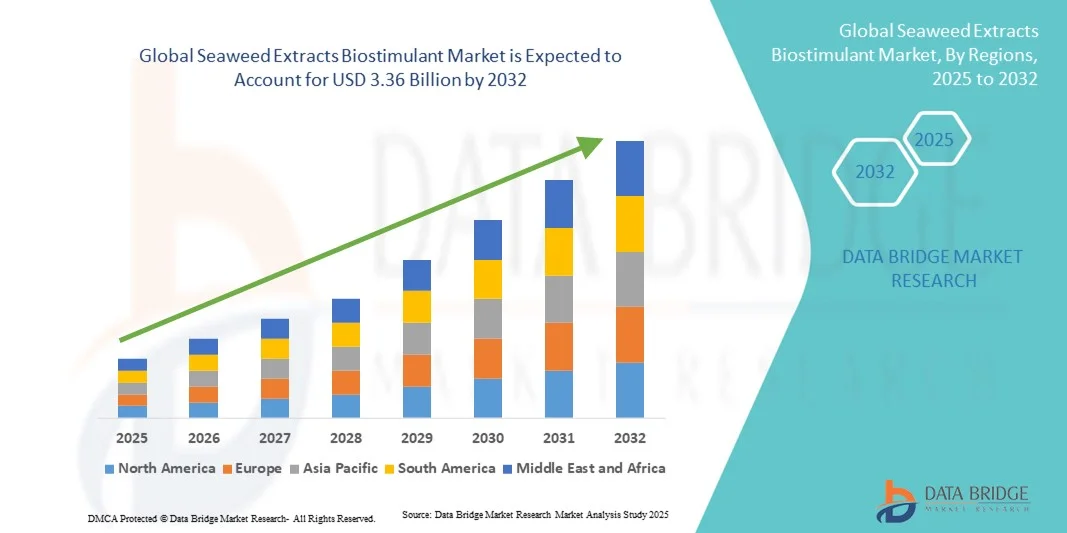
What is the Global Seaweed Extracts Biostimulant Market Size and Growth Rate?
- The global seaweed extracts biostimulant market size was valued at USD 1.25 billion in 2024 and is expected to reach USD 3.36 billion by 2032, at a CAGR of 13.10% during the forecast period
- The rising preference for organically grown food among consumers is the key factor fueling the expansion of the seaweed extracts biostimulant market. The availability of a wider range of seaweed extracts biostimulant products is driving the market's expansion. In addition, the market is further influenced by the rising need for sustainable agriculture
What are the Major Takeaways of Seaweed Extracts Biostimulant Market?
- Synthetic (man-made) insecticides, fertilizers, and herbicides are used in the production of conventional (non-organic) food. However, organically cultivated food offers the best nutritional benefits and dietary variety, leading to a larger uptake of naturally grown food by more individuals. As a result, the growing popularity of organically cultivated food ultimately increases the demand for plant inhibitors, bio-fertilizers, and bio pesticides. As it contains vitamins, fatty acids, and other macro- and micronutrients necessary for plant growth, seaweed extract offers the perfect substitute for chemical fertilizers, which are used to boost both the amount and quality of farming production
- Europe dominated the seaweed extracts biostimulant market with the largest revenue share of 42.5% in 2024, driven by widespread adoption of sustainable agriculture practices, organic farming, and stringent regulations on chemical fertilizers
- The Asia-Pacific market is poised to grow at the fastest CAGR of 6.21% from 2025 to 2032, driven by increasing adoption of modern farming practices, rapid urbanization, and government support for sustainable agriculture in countries such as China, India, and Japan
- The brown algae segment dominated the market with a revenue share of 52% in 2024, owing to its rich composition of bioactive compounds, including polysaccharides, auxins, and cytokinins, which enhance plant growth, stress tolerance, and yield
Report Scope and Seaweed Extracts Biostimulant Market Segmentation
|
Attributes |
Seaweed Extracts Biostimulant Key Market Insights |
|
Segments Covered |
|
|
Countries Covered |
North America
Europe
Asia-Pacific
Middle East and Africa
South America
|
|
Key Market Players |
|
|
Market Opportunities |
|
|
Value Added Data Infosets |
In addition to the insights on market scenarios such as market value, growth rate, segmentation, geographical coverage, and major players, the market reports curated by the Data Bridge Market Research also include in-depth expert analysis, pricing analysis, brand share analysis, consumer survey, demography analysis, supply chain analysis, value chain analysis, raw material/consumables overview, vendor selection criteria, PESTLE Analysis, Porter Analysis, and regulatory framework. |
What is the Key Trend in the Seaweed Extracts Biostimulant Market?
Rising Adoption of Sustainable and Precision Agriculture Solutions
- A significant trend in the global Seaweed Extracts Biostimulant market is the increasing integration of these biostimulants with precision agriculture technologies, including IoT-based soil sensors, drones, and automated irrigation systems. This integration enhances crop management, monitoring, and overall farm productivity
- For instance, biostimulant formulations such as liquid seaweed extracts are being used in combination with smart irrigation systems to optimize nutrient uptake, reduce fertilizer use, and improve crop quality. Similarly, foliar sprays integrated with farm monitoring apps allow farmers to track plant response in real time
- Seaweed Extracts Biostimulants improve plant resilience to abiotic stress, enhance root development, and boost nutrient efficiency, enabling more predictable yields. Advanced formulations now include bioactive compounds that stimulate plant hormones, improving flowering, fruit set, and overall plant health
- The seamless integration of biostimulants with digital farming platforms allows farmers to manage crop nutrition, pest control, and soil health holistically. This creates a more efficient, data-driven, and sustainable farming ecosystem
- The trend toward sustainable, high-yield, and environmentally friendly agriculture is reshaping farmer expectations. Companies such as Valagro, UPL, and Koppert are developing seaweed-based products with tailored formulations for different crops and climates
- Demand for Seaweed Extracts Biostimulants is rapidly increasing across both row crops and horticultural sectors, driven by the growing need for sustainable agriculture practices, yield enhancement, and soil health management
What are the Key Drivers of Seaweed Extracts Biostimulant Market?
- The growing demand for sustainable agriculture, coupled with the increasing awareness of environmental concerns, is a primary driver of market growth. Farmers are seeking eco-friendly alternatives to synthetic fertilizers and growth enhancers
- For instance, in 2024, UPL and FMC Corporation launched advanced seaweed extract products compatible with precision farming systems to optimize crop performance while minimizing chemical inputs. Such innovations are expected to fuel market expansion
- Seaweed Extracts Biostimulants provide benefits such as enhanced nutrient uptake, improved stress tolerance, stronger root systems, and higher crop yields, making them attractive over conventional fertilizers
- The rise in organic farming and government incentives promoting sustainable agriculture practices are further supporting adoption. Many biostimulants are now approved for organic cultivation, boosting market penetration
- Convenience of foliar sprays, compatibility with existing farm equipment, and tailored formulations for specific crops or soil conditions are key factors propelling adoption across horticulture, fruits, vegetables, and cereals
Which Factor is Challenging the Growth of the Seaweed Extracts Biostimulant Market?
- High cost of premium seaweed extract formulations and inconsistent quality across suppliers pose a major challenge for broader adoption. Farmers in developing regions may find it difficult to justify the upfront investment compared to conventional fertilizers
- Inconsistent regulatory frameworks across countries and limited awareness of biostimulant benefits are additional barriers. Some farmers remain skeptical about the return on investment due to variable crop response
- Addressing these challenges requires standardization, certification of product quality, and farmer education on application techniques and yield benefits. Companies such as Valagro and UPL emphasize field trials and demonstration projects to build trust
- In addition, supply chain issues, such as sourcing raw seaweed sustainably, can affect consistent availability of high-quality extracts, slowing market growth
- Overcoming these challenges through affordable formulations, better farmer outreach, and clear regulatory support will be vital to ensure sustained expansion of the Seaweed Extracts Biostimulant market
How is the Seaweed Extracts Biostimulant Market Segmented?
The market is segmented on the basis of species, crop type, application method, form, end user, and distribution channel.
- By Species
On the basis of species, the seaweed extracts biostimulant market is segmented into brown algae, red algae, and green algae. The brown algae segment dominated the market with a revenue share of 52% in 2024, owing to its rich composition of bioactive compounds, including polysaccharides, auxins, and cytokinins, which enhance plant growth, stress tolerance, and yield. Brown algae-based extracts are widely adopted across fruits, vegetables, cereals, and turf applications due to proven efficacy and ease of formulation.
The green algae segment is expected to witness the fastest CAGR of 23% from 2025 to 2032, driven by rising research on its growth-promoting properties, cost-effectiveness, and compatibility with organic and precision farming practices. Increasing interest in eco-friendly and sustainable biostimulants is further propelling demand for green algae formulations across diverse crop categories.
- By Crop Type
On the basis of crop type, the market is segmented into fruits & vegetables, cereals & grains, oilseeds & pulses, turf & ornamentals, and other crops. The fruits & vegetables segment dominated the market with a 45% revenue share in 2024, driven by the high value of horticultural crops and the need for consistent yields and quality enhancement. Seaweed extracts improve flowering, fruit set, color, and shelf life, making them highly suitable for these crops.
The cereals & grains segment is anticipated to witness the fastest CAGR of 21% from 2025 to 2032, fueled by increasing adoption of biostimulants in staple crops to improve stress resistance, nutrient uptake, and productivity. The growing integration of biostimulants with precision agriculture solutions is supporting faster growth in cereals and grains across emerging economies.
- By Application Method
On the basis of application method, the market is segmented into foliar treatment, soil treatment, and seed treatment. The foliar treatment segment dominated the market with a 50% revenue share in 2024, due to its ease of use, rapid absorption, and ability to directly deliver bioactive compounds to leaves for immediate effects. Foliar sprays are widely used in horticultural crops, turf management, and high-value vegetables.
The soil treatment segment is expected to witness the fastest CAGR of 22% from 2025 to 2032, supported by advancements in irrigation and fertigation systems that allow precise nutrient delivery. Soil application enhances root development, microbial activity, and long-term soil fertility, driving adoption across cereals, grains, and oilseeds.
- By Form
On the basis of form, the market is segmented into liquid and dry formulations. The liquid form dominated the market with a 57% revenue share in 2024, owing to superior solubility, rapid plant uptake, and versatility across foliar and soil applications. Liquid seaweed extracts are preferred by commercial farmers for high-value crops and precision farming.
The dry form is projected to register the fastest CAGR of 24% from 2025 to 2032, driven by convenience in storage, longer shelf life, and suitability for bulk crop applications. The growth of dry formulations is supported by cost-effectiveness and rising adoption in cereals, grains, and large-scale agricultural operations in emerging regions.
- By End User
On the basis of end user, the market is segmented into farmers, related industries, research institutes, and others. The farmers segment dominated the market with a 68% revenue share in 2024, reflecting widespread adoption in commercial agriculture, horticulture, and turf management. Farmers benefit from yield enhancement, improved crop resilience, and better profitability with biostimulant use.
The research institutes segment is expected to witness the fastest CAGR of 25% from 2025 to 2032, driven by increasing R&D activities, testing of new formulations, and innovations for sustainable agriculture practices. Collaborations between research institutes and commercial players are further accelerating adoption and new product development.
- By Distribution Channel
On the basis of distribution channel, the market is segmented into direct and indirect channels. The direct channel dominated the market with a 60% revenue share in 2024, as leading manufacturers supply biostimulants directly to large-scale farms, agro-industries, and institutional clients, ensuring product quality, guidance, and consistent supply.
The indirect channel is expected to witness the fastest CAGR of 22% from 2025 to 2032, supported by e-commerce platforms, distributors, and agro-retail stores, which are expanding reach to smallholder and medium-scale farmers. Increasing awareness of biostimulant benefits, coupled with convenient access through indirect channels, is driving market growth in developing regions.
Which Region Holds the Largest Share of the Seaweed Extracts Biostimulant Market?
- Europe dominated the seaweed extracts biostimulant market with the largest revenue share of 42.5% in 2024, driven by widespread adoption of sustainable agriculture practices, organic farming, and stringent regulations on chemical fertilizers
- European farmers and agribusinesses highly value the efficiency, crop yield enhancement, and eco-friendly properties offered by Seaweed Extracts Biostimulants
- The dominance is further supported by high technological adoption, government initiatives promoting sustainable agriculture, and strong R&D investment in biostimulant formulations, establishing Europe as the largest regional market for these products
Germany Seaweed Extracts Biostimulant Market Insight
The Germany market accounted for a substantial share in Europe in 2024, fueled by the emphasis on sustainable and organic farming, advanced agricultural infrastructure, and increasing awareness of soil health and crop productivity. Adoption is strong across fruits, vegetables, cereals, and horticultural crops. Farmers benefit from improved crop resilience, nutrient uptake, and yield stability, making Seaweed Extracts Biostimulants a preferred solution for both commercial and research-driven applications.
U.K. Seaweed Extracts Biostimulant Market Insight
The U.K. market is experiencing steady growth due to growing demand for organic and premium crops, coupled with increasing awareness of eco-friendly agricultural solutions. Adoption is supported by governmental incentives, agricultural advisory programs, and the expanding organic food sector. Seaweed extracts are widely used in horticulture, turf management, and commercial farming, with farmers prioritizing yield enhancement, disease resistance, and sustainable nutrient management.
France Seaweed Extracts Biostimulant Market Insight
France’s market growth is driven by strong emphasis on sustainable farming practices, extensive use of fruits and vegetable crops, and increasing adoption of precision agriculture technologies. Seaweed Extracts Biostimulants are integrated into both conventional and organic farming systems, with applications across foliar sprays and soil treatments. Consumer demand for high-quality produce and government support for eco-friendly inputs further reinforce market expansion in the country.
Which Region is the Fastest Growing Region in the Seaweed Extracts Biostimulant Market?
The Asia-Pacific market is poised to grow at the fastest CAGR of 6.21% from 2025 to 2032, driven by increasing adoption of modern farming practices, rapid urbanization, and government support for sustainable agriculture in countries such as China, India, and Japan. Rising awareness about crop productivity, soil health, and environmental sustainability is fueling demand across cereals, horticulture, and oilseed crops.
China Seaweed Extracts Biostimulant Market Insight
China accounted for the largest market revenue share in APAC in 2024, fueled by rapid urbanization, technological adoption in agriculture, and strong demand for high-quality crops. Seaweed extracts are widely applied in both smallholder and commercial farms for yield improvement and stress tolerance. Government initiatives promoting sustainable and eco-friendly farming practices further accelerate market growth.
India Seaweed Extracts Biostimulant Market Insight
India is witnessing rapid adoption of biostimulants due to the increasing need for crop yield enhancement, improved soil health, and reduced chemical fertilizer usage. Foliar and soil application methods are gaining popularity among small and large-scale farmers, supported by training programs and the growing availability of cost-effective seaweed formulations.
Japan Seaweed Extracts Biostimulant Market Insight
The Japanese market growth is driven by high-tech agriculture, integration of seaweed extracts with precision farming, and increasing adoption in horticulture and high-value crops. Aging farmer population and demand for labor-efficient, high-yield solutions are further propelling the market, with a focus on sustainable and environmentally friendly agricultural inputs.
Which are the Top Companies in Seaweed Extracts Biostimulant Market?
The seaweed extracts biostimulant industry is primarily led by well-established companies, including:
- UPL Limited (India)
- FMC Corporation (U.S.)
- Haifa Negev Technologies Ltd. (Israel)
- Valagro S.p.A. (Italy)
- BioAtlantis Ltd. (Ireland)
- ASL Aviation Holdings (Ireland)
- Biostadt India Limited (India)
- Algea (Australia)
- Koppert (Netherlands)
- ROVENSA NEXT (Portugal)
- OMEX (U.K.)
- Brandt, Inc. (U.S.)
- Qingdao Seawin Biotech Group Co. Ltd. (China)
- MPH (U.K.)
- Biolchim S.p.A. (Italy)
- Indigrow Ltd. (U.K.)
- BIOVERT S.L. (Spain)
- Ilex EnviroSciences Ltd. (U.S.)
What are the Recent Developments in Global Seaweed Extracts Biostimulant Market?
- In May 2023, Yara International announced the construction of a new global production plant for biostimulants and specialty crop nutrition products, designed to enhance crop yields and improve quality, reflecting the company’s commitment to sustainable agriculture solutions
- In January 2023, Sumitomo Chemical Co., Ltd., one of Japan’s leading chemical companies, acquired FBSciences Holdings, Inc., a U.S.-based biostimulants manufacturer, strengthening its global footprint in the biostimulant industry and expanding technological capabilities
- In January 2023, Archer Daniels Midland Company launched NeoVita 43, a biostimulant aimed at increasing corn yields through improved nutrient use efficiency, highlighting the growing focus on precision agriculture and productivity enhancement
- In March 2022, Valagro collaborated with its Indian subsidiary, Valagro Biosciences, to introduce the innovative biostimulant Talete in the Indian market, providing a solution to boost Crop Water Productivity and support sustainable farming practices
- In February 2022, LIPOFABRIK, a start-up specializing in plant protection and biostimulant solutions, developed Plant Boost, a Bacillus subtilis-based biostimulant authorized for use in Belgium, France, Spain, the Netherlands, Germany, Italy, and the U.K., demonstrating the expanding regulatory acceptance of innovative biostimulants

- Interactive Data Analysis Dashboard
- Company Analysis Dashboard for high growth potential opportunities
- Research Analyst Access for customization & queries
- Competitor Analysis with Interactive dashboard
- Latest News, Updates & Trend analysis
- Harness the Power of Benchmark Analysis for Comprehensive Competitor Tracking
Data collection and base year analysis are done using data collection modules with large sample sizes. The stage includes obtaining market information or related data through various sources and strategies. It includes examining and planning all the data acquired from the past in advance. It likewise envelops the examination of information inconsistencies seen across different information sources. The market data is analysed and estimated using market statistical and coherent models. Also, market share analysis and key trend analysis are the major success factors in the market report. To know more, please request an analyst call or drop down your inquiry.
The key research methodology used by DBMR research team is data triangulation which involves data mining, analysis of the impact of data variables on the market and primary (industry expert) validation. Data models include Vendor Positioning Grid, Market Time Line Analysis, Market Overview and Guide, Company Positioning Grid, Patent Analysis, Pricing Analysis, Company Market Share Analysis, Standards of Measurement, Global versus Regional and Vendor Share Analysis. To know more about the research methodology, drop in an inquiry to speak to our industry experts.
Data Bridge Market Research is a leader in advanced formative research. We take pride in servicing our existing and new customers with data and analysis that match and suits their goal. The report can be customized to include price trend analysis of target brands understanding the market for additional countries (ask for the list of countries), clinical trial results data, literature review, refurbished market and product base analysis. Market analysis of target competitors can be analyzed from technology-based analysis to market portfolio strategies. We can add as many competitors that you require data about in the format and data style you are looking for. Our team of analysts can also provide you data in crude raw excel files pivot tables (Fact book) or can assist you in creating presentations from the data sets available in the report.