


What is the Seaweed Extracts Market Size and Overview?
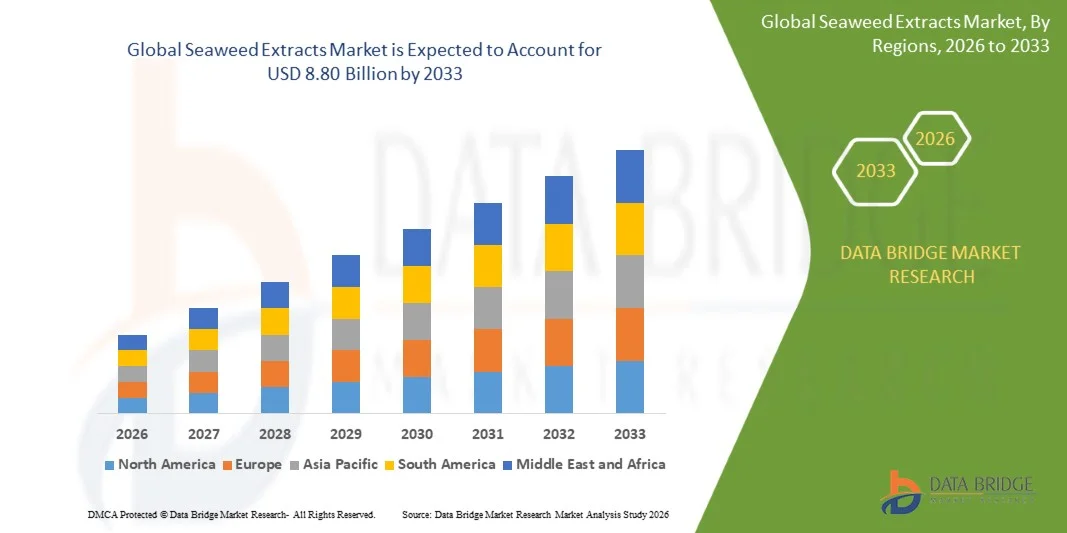
As per Data Bridge Market Research Analysis the Seaweed Extracts Market was valued at USD 4.42 billion in 2025 and is projected to reach USD 8.80 billion by 2033, growing at a CAGR of 9.00% from 2026 to 2033. The market is experiencing steady growth driven by increasing demand for natural and organic agricultural inputs, rising adoption of bio-based fertilizers, and growing awareness regarding sustainable farming practices. Seaweed extracts are widely used as biostimulants to enhance crop yield, improve soil health, and strengthen plant resistance to environmental stress.
The increasing shift toward organic agriculture, combined with stringent regulations on chemical fertilizers and pesticides, is further accelerating market adoption across both developed and emerging economies. In addition, expanding applications in horticulture, turf management, and aquaculture are supporting market expansion. Growing investments in marine biotechnology and sustainable resource utilization are also encouraging large-scale production and commercialization of seaweed-based products globally.
Key Market Trends & Insights
- North America dominated the seaweed extracts market with the largest revenue share of 34.6% in 2025, supported by strong adoption of organic farming inputs, increasing use of sustainable biostimulants, and advanced commercial farming infrastructure. Rising consumer preference for chemical-free food products and supportive regulations promoting environmentally sustainable agriculture are further accelerating market expansion across the region.
- Asia-Pacific is expected to be the fastest-growing region, recording a CAGR of 10.8% from 2026 to 2033. Growth is driven by large-scale agricultural activities, rising population-driven food demand, increasing government support for organic farming, and abundant seaweed cultivation across countries such as China, India, Japan, and South Korea. Expanding greenhouse farming and precision agriculture adoption are also strengthening regional market growth.
- The Liquid segment held the largest market revenue share of approximately 46.3% in 2025 driven by its easy application in foliar sprays, fertigation systems, and greenhouse farming practices. Liquid seaweed extracts are widely preferred in modern agriculture due to their quick absorption rate, compatibility with precision irrigation systems, and effectiveness in improving crop yield and stress resistance across fruits, vegetables, and cereal crops.
- The Powder segment accounted for approximately 34.7% market share in 2025, supported by its longer shelf life, ease of storage, and increasing use in large-scale agricultural formulations and export-oriented biofertilizer production. The Flakes segment held around 12.5% share, primarily used in coastal agriculture and organic farming applications, while the Others segment accounted for approximately 6.5% share, driven by niche applications in specialized soil conditioners and aquaculture inputs.
- The Brown Seaweed Extract segment dominated the market with approximately 58.2% share in 2025 due to its high concentration of bioactive compounds such as alginates, fucoidans, and plant growth hormones that enhance crop productivity and stress tolerance. Brown seaweed species such as Ascophyllum nodosum and Laminaria are widely used in commercial agriculture across Europe, North America, and Asia-Pacific.
- The Green Seaweed Extract segment accounted for approximately 24.6% market share in 2025, driven by increasing use in aquaculture feed additives and horticultural applications due to its rich nutrient profile and rapid decomposition properties. The Red Seaweed Extract segment held around 17.2% share, supported by its growing adoption in cosmetics, pharmaceuticals, and specialty agricultural applications, particularly in Japan and South Korea where marine biotechnology research is highly advanced.
- The Agriculture and Horticulture segment dominated the market with approximately 62.8% share in 2025 due to extensive use of seaweed-based biostimulants in crop enhancement, soil conditioning, and organic farming systems. Increasing adoption of sustainable agriculture practices and reduction in synthetic fertilizer usage are further strengthening segment growth globally.
- The Food and Beverages segment accounted for approximately 12.4% market share in 2025, driven by rising use of seaweed extracts as natural thickening agents and nutritional additives. The Cosmetics and Personal Care segment held around 11.6% share, supported by increasing demand for natural skincare ingredients with anti-aging and moisturizing properties. The Healthcare segment accounted for approximately 8.3% share due to growing use in nutraceuticals and dietary supplements, while the Others segment held around 4.9% share driven by applications in animal feed, aquaculture, and industrial formulations.
Market Size & Forecast
- Global Market Value (2025): USD 4.42 Billion
- Expected Market Value (2033): USD 8.80 Billion
- Forecast CAGR (2026–2033): 9.00%
- Leading Region in 2025: North America
- Fastest Growing Region: Asia-Pacific
Report Scope and Seaweed Extracts Market Segmentation
|
Attributes |
Seaweed Extracts Key Market Insights |
|
Segments Covered |
|
|
Countries Covered |
North America
Europe
Asia-Pacific
Middle East and Africa
South America
|
|
Key Market Players |
|
|
Market Opportunities |
|
|
Value Added Data Infosets |
In addition to the insights on market scenarios such as market value, growth rate, segmentation, geographical coverage, and major players, the market reports curated by the Data Bridge Market Research also include in-depth expert analysis, pricing analysis, brand share analysis, consumer survey, demography analysis, supply chain analysis, value chain analysis, raw material/consumables overview, vendor selection criteria, PESTLE Analysis, Porter Analysis, and regulatory framework. |
What is the Key Trend in the Seaweed Extracts Market?
Trend: Growth In Sustainable Agriculture And Bio-Based Plant Biostimulants
Increasing demand for sustainable farming practices, organic crop production, and chemical-free agricultural inputs is driving the adoption of seaweed extracts as natural biostimulants across global agriculture markets. Seaweed-based products improve nutrient uptake, enhance root development, and increase crop resilience against drought, salinity, and temperature stress, making them increasingly important in climate-resilient farming systems. Growing restrictions on synthetic fertilizers and rising soil degradation concerns are further encouraging farmers to shift toward bio-based agricultural solutions.
In modern agriculture systems, seaweed extracts are widely integrated into foliar sprays and soil treatments to improve yield quality and crop productivity. For instance in high-value crops such as fruits and vegetables, applications of Ascophyllum nodosum–based extracts have demonstrated yield improvements of around 10–25% in controlled field trials conducted across Europe and North America. In India and China, large-scale adoption of bio-stimulant seaweed formulations in horticulture farming has increased significantly, supported by government initiatives promoting organic agriculture and sustainable input usage.
The expansion of greenhouse farming and precision agriculture technologies is also increasing demand for liquid and soluble seaweed-based fertilizers that can be easily integrated into irrigation systems. In addition, aquaculture and turf management sectors are adopting seaweed extracts to improve growth performance and environmental resilience. Commercial farming trials conducted in 2025 across coastal regions of India reported improved soil microbial activity and up to 15% reduction in synthetic fertilizer usage after seaweed extract application
Seaweed Extracts Market Dynamics
Key Market Driver: Rising Demand For Organic Farming And Sustainable Crop Yield Enhancement
Global agriculture is under increasing pressure to enhance productivity while reducing environmental impact, driving strong demand for organic and bio-based agricultural inputs. Seaweed extracts serve as natural growth promoters that enhance nutrient absorption, stimulate plant hormones, and improve soil fertility without causing chemical residue buildup.
Countries such as the U.S., India, and members of the European Union are increasingly promoting organic farming practices through subsidies and regulatory frameworks that discourage excessive chemical fertilizer usage. For instance, organic farmland in Europe surpassed 17 million hectares in 2025, reflecting a steady shift toward sustainable agriculture practices. In addition, seaweed-based biostimulants are increasingly being adopted in commercial farming of cereals, fruits, and oilseeds to improve yield consistency under changing climate conditions.
Field studies in Brazil and India during 2024 demonstrated that seaweed extract applications in wheat and soybean cultivation improved crop yield by approximately 12–18%, supporting their growing role in large-scale agricultural productivity enhancement
Key Restraint/Challenge: Seasonal Raw Material Availability And Processing Cost Variability
The availability of seaweed biomass is highly dependent on seasonal harvesting cycles and coastal environmental conditions, creating supply chain variability and price fluctuations in raw materials. Overharvesting risks and regulatory restrictions in certain coastal regions further limit consistent supply for large-scale industrial production of seaweed extracts.
In addition, processing seaweed into standardized liquid or powder extracts requires advanced extraction technologies, drying systems, and quality control processes, which increase overall production costs. Limited mechanization in several developing coastal economies further contributes to supply inefficiencies and operational challenges.
Market assessments indicate that raw seaweed prices can fluctuate by 20–35% annually depending on seasonal yield variations and regional harvesting conditions, directly impacting production stability and pricing for end-use agricultural applications
Key Market Opportunity: Expansion In Organic Agriculture And Climate-Resilient Farming Solutions
The rapid expansion of organic agriculture, regenerative farming, and climate-resilient crop production systems is creating strong opportunities for seaweed extract adoption across global markets. Increasing demand for sustainable food production is encouraging farmers to adopt natural biostimulants that improve crop yield while maintaining soil health and biodiversity.
Seaweed extracts are increasingly being integrated into precision farming systems, greenhouse cultivation, and high-value crop production such as grapes, tomatoes, and berries to enhance productivity and quality. For instance, large-scale adoption of seaweed-based foliar sprays in horticultural farms across China and Spain in 2025 has shown yield improvements of up to 20% in controlled agricultural environments.
In addition, ongoing research in marine biotechnology is leading to the development of advanced seaweed-derived formulations with enhanced nutrient delivery and stress tolerance capabilities. Expanding applications in aquaculture feed additives and turf management systems are further opening new growth avenues across Asia-Pacific, Europe, and Latin America
How is the Seaweed Extracts Market Segmented?
The market is segmented on the basis of model, type, functionality, offering, and end-use application.
• By Form Type
On the basis of form type, the seaweed extracts market is segmented into Liquid, Powder, Flakes, and Others. The Liquid segment held the largest market revenue share of approximately 46.3% in 2025 driven by its easy application in foliar sprays, fertigation systems, and greenhouse farming practices. Liquid seaweed extracts are widely preferred in modern agriculture due to their quick absorption rate, compatibility with precision irrigation systems, and effectiveness in improving crop yield and stress resistance across fruits, vegetables, and cereal crops.
The Powder segment accounted for approximately 34.7% market share in 2025, supported by its longer shelf life, ease of storage, and increasing use in large-scale agricultural formulations and export-oriented biofertilizer production. The Flakes segment held around 12.5% share, primarily used in coastal agriculture and organic farming applications, while the Others segment accounted for approximately 6.5% share, driven by niche applications in specialized soil conditioners and aquaculture inputs.
• By Type
On the basis of type, the seaweed extracts market is segmented into Brown Seaweed Extract, Green Seaweed Extract, and Red Seaweed Extract. The Brown Seaweed Extract segment dominated the market with approximately 58.2% share in 2025 due to its high concentration of bioactive compounds such as alginates, fucoidans, and plant growth hormones that enhance crop productivity and stress tolerance. Brown seaweed species such as Ascophyllum nodosum and Laminaria are widely used in commercial agriculture across Europe, North America, and Asia-Pacific.
The Green Seaweed Extract segment accounted for approximately 24.6% market share in 2025, driven by increasing use in aquaculture feed additives and horticultural applications due to its rich nutrient profile and rapid decomposition properties. The Red Seaweed Extract segment held around 17.2% share, supported by its growing adoption in cosmetics, pharmaceuticals, and specialty agricultural applications, particularly in Japan and South Korea where marine biotechnology research is highly advanced.
• By Application
On the basis of application, the seaweed extracts market is segmented into Food and Beverages, Cosmetics and Personal Care, Healthcare, Agriculture and Horticulture, and Others. The Agriculture and Horticulture segment dominated the market with approximately 62.8% share in 2025 due to extensive use of seaweed-based biostimulants in crop enhancement, soil conditioning, and organic farming systems. Increasing adoption of sustainable agriculture practices and reduction in synthetic fertilizer usage are further strengthening segment growth globally.
The Food and Beverages segment accounted for approximately 12.4% market share in 2025, driven by rising use of seaweed extracts as natural thickening agents and nutritional additives. The Cosmetics and Personal Care segment held around 11.6% share, supported by increasing demand for natural skincare ingredients with anti-aging and moisturizing properties. The Healthcare segment accounted for approximately 8.3% share due to growing use in nutraceuticals and dietary supplements, while the Others segment held around 4.9% share driven by applications in animal feed, aquaculture, and industrial formulations.
Which Region Holds the Largest Share of the Seaweed Extracts Market?
North America Seaweed Extracts Market Insight
North America dominated the seaweed extracts market with the largest revenue share of 34.6% in 2025, supported by strong demand for organic farming inputs, increasing adoption of bio-based fertilizers, and rising awareness regarding sustainable agriculture practices. Farmers and agribusinesses in the region are increasingly shifting toward natural biostimulants to improve crop yield, enhance soil health, and reduce dependency on synthetic agrochemicals. The presence of advanced agricultural technologies, large-scale commercial farming operations, and supportive regulatory frameworks for organic inputs further strengthens market growth across the region.
U.S. Seaweed Extracts Market Insight
The U.S. seaweed extracts market captured the largest revenue share of 28.9% in North America in 2025, driven by strong adoption of sustainable farming practices and increasing use of organic biostimulants in row crops, fruits, and vegetable cultivation. Growing demand for residue-free food products and expansion of organic farmland are further supporting market growth. For instance, organic crop acreage in the U.S. exceeded 5 million hectares in 2025, reflecting strong momentum toward chemical-free agriculture. In addition, increasing use of seaweed-based formulations in large-scale farming operations across California, Iowa, and Texas is accelerating market expansion.
Europe Seaweed Extracts Market Insight
The Europe seaweed extracts market is expected to witness the fastest growth rate from 2026 to 2033, driven by strict regulations on chemical fertilizers, strong adoption of organic farming practices, and rising demand for sustainable agricultural inputs. The region is witnessing increasing use of seaweed-based biostimulants in horticulture, greenhouse farming, and high-value crop production. Government initiatives promoting carbon-neutral agriculture and soil regeneration are further supporting adoption across major economies such as France, Spain, and Italy.
U.K. Seaweed Extracts Market Insight
The U.K. seaweed extracts market is expected to witness steady growth from 2026 to 2033, supported by rising consumer demand for organic food products and increasing adoption of sustainable farming techniques. Farmers in the country are increasingly using seaweed-based biostimulants to improve crop yield and soil fertility while reducing chemical fertilizer dependency. For instance, organic farmland in the U.K. accounted for nearly 3% of total agricultural land in 2025, reflecting growing acceptance of sustainable agricultural inputs. In addition, expansion of greenhouse farming is further contributing to market growth.
Germany Seaweed Extracts Market Insight
The Germany seaweed extracts market is expected to witness strong growth from 2026 to 2033, driven by increasing focus on environmentally sustainable agriculture and advanced farming technologies. The country’s emphasis on soil health improvement and reduced chemical usage is encouraging adoption of bio-based fertilizers and biostimulants. For instance, Germany recorded over 1.8 million hectares of organic farmland in 2025, highlighting strong demand for natural agricultural inputs. In addition, integration of seaweed extracts into precision farming systems and horticultural production is further accelerating market expansion.
Asia-Pacific Seaweed Extracts Market Insight
The Asia-Pacific seaweed extracts market is expected to witness the fastest growth rate from 2026 to 2033, supported by rapid population growth, rising food demand, and strong agricultural activity across China, India, and Southeast Asia. The region is also a major producer of seaweed, providing cost-effective raw material availability for extract manufacturing. Government initiatives promoting organic farming and sustainable agriculture are further driving adoption. For instance, India’s organic farming area exceeded 4.5 million hectares in 2025, reflecting increasing use of bio-based agricultural inputs.
Japan Seaweed Extracts Market Insight
The Japan seaweed extracts market is expected to witness steady growth from 2026 to 2033 due to strong agricultural innovation, advanced biotechnology applications, and high demand for premium-quality crops. Japan has a long history of seaweed utilization in agriculture and continues to integrate marine-based biostimulants into modern farming systems. For instance, Japanese horticultural farms have reported yield improvements of up to 15% after adoption of seaweed-based foliar sprays in controlled cultivation environments in 2025. In addition, increasing focus on sustainable farming practices is supporting market expansion.
China Seaweed Extracts Market Insight
The China seaweed extracts market accounted for the largest market revenue share in Asia-Pacific in 2025, driven by large-scale agricultural production, strong domestic seaweed cultivation, and increasing adoption of bio-fertilizers in commercial farming. China is one of the largest producers and consumers of seaweed-based agricultural inputs, supported by government initiatives promoting sustainable agriculture and soil health improvement. For instance, China’s organic farming area surpassed 5 million hectares in 2025, reflecting strong demand for natural crop enhancement solutions. In addition, expansion of modern farming practices and greenhouse cultivation is further supporting market growth across the country.
Which are the Top Companies in Seaweed Extracts Market?
The Seaweed Extracts industry is primarily led by well-established companies, including:
- J&JCI (U.S.)
- ARIHANT BIO FERTICHEM PVT. LTD. (India)
- SUBONEYO Chemicals Pharmaceuticals P Limited (India)
- Indigrow Limited (U.K.)
- Saosis (South Africa)
- A J Products Pty Ltd (Australia)
- Ocean Harvest Technology Limited (Ireland)
- Alga-Net (France)
- Grow More Inc. (U.S.)
- Kelpak (South Africa)
- Algea (Norway)
- Unilever (U.K.)
- Mycsa AG (Switzerland)
- North American Kelp (Canada)
- Yash Chemicals (India)
- Technaflora (Canada)
- Valley Proteins, Inc. (U.S.)
- Dean Foods (U.S.)
- ADM (U.S.)
- DuPont (U.S.)
- Nutro Products Inc. (U.S.)
- Hill's Pet Nutrition (U.S.)
- Lafeber Co (U.S.)
What are Latest Developments in Seaweed Extracts Market?
- In April 2025, Bayer AG launched a new seaweed biostimulant product named AnHai Long in the China market to improve nutrient absorption, address soil degradation, and enhance crop resistance against abiotic stress conditions. The launch strengthened Bayer’s sustainable agriculture portfolio and supported the growing adoption of bio-based crop enhancement solutions across Asia-Pacific agricultural markets
- In June 2024, Hi-Q Marine Biotech introduced FucoSkin CS, a seaweed extract ingredient designed for cosmetic and personal care formulations. The product received Ecocert certification and COSMOS approval, enhancing its commercial acceptance in natural skincare applications and supporting increasing global demand for sustainable and marine-derived cosmetic ingredients
- In July 2023, Bionema Group Ltd launched a new range of seaweed extract-based biostimulant products in the U.K. market targeting agriculture, horticulture, forestry, and turf management applications. The development expanded the company’s sustainable crop enhancement solutions portfolio and supported increasing adoption of organic and environmentally friendly farming inputs across Europe
- In June 2023, Cascadia Seaweed and Refeed Canada entered into a strategic partnership and launched liquid seaweed extract biostimulant products in Canada to support regenerative agriculture practices and improve soil health management. The collaboration strengthened commercial availability of seaweed-based agricultural products and accelerated market penetration of sustainable farming technologies in North America

- Interactive Data Analysis Dashboard
- Company Analysis Dashboard for high growth potential opportunities
- Research Analyst Access for customization & queries
- Competitor Analysis with Interactive dashboard
- Latest News, Updates & Trend analysis
- Harness the Power of Benchmark Analysis for Comprehensive Competitor Tracking
Global Seaweed Extracts Market, Supply Chain Analysis and Ecosystem Framework
To support market growth and help clients navigate the impact of geopolitical shifts, DBMR has integrated in-depth supply chain analysis into its Global Seaweed Extracts Market research reports. This addition empowers clients to respond effectively to global changes affecting their industries. The supply chain analysis section includes detailed insights such as Global Seaweed Extracts Market consumption and production by country, price trend analysis, the impact of tariffs and geopolitical developments, and import and export trends by country and HSN code. It also highlights major suppliers with data on production capacity and company profiles, as well as key importers and exporters. In addition to research, DBMR offers specialized supply chain consulting services backed by over a decade of experience, providing solutions like supplier discovery, supplier risk assessment, price trend analysis, impact evaluation of inflation and trade route changes, and comprehensive market trend analysis.
Data collection and base year analysis are done using data collection modules with large sample sizes. The stage includes obtaining market information or related data through various sources and strategies. It includes examining and planning all the data acquired from the past in advance. It likewise envelops the examination of information inconsistencies seen across different information sources. The market data is analysed and estimated using market statistical and coherent models. Also, market share analysis and key trend analysis are the major success factors in the market report. To know more, please request an analyst call or drop down your inquiry.
The key research methodology used by DBMR research team is data triangulation which involves data mining, analysis of the impact of data variables on the market and primary (industry expert) validation. Data models include Vendor Positioning Grid, Market Time Line Analysis, Market Overview and Guide, Company Positioning Grid, Patent Analysis, Pricing Analysis, Company Market Share Analysis, Standards of Measurement, Global versus Regional and Vendor Share Analysis. To know more about the research methodology, drop in an inquiry to speak to our industry experts.
Data Bridge Market Research is a leader in advanced formative research. We take pride in servicing our existing and new customers with data and analysis that match and suits their goal. The report can be customized to include price trend analysis of target brands understanding the market for additional countries (ask for the list of countries), clinical trial results data, literature review, refurbished market and product base analysis. Market analysis of target competitors can be analyzed from technology-based analysis to market portfolio strategies. We can add as many competitors that you require data about in the format and data style you are looking for. Our team of analysts can also provide you data in crude raw excel files pivot tables (Fact book) or can assist you in creating presentations from the data sets available in the report.













