


What is the Security Service Edge (SSE) Market Size and Overview?
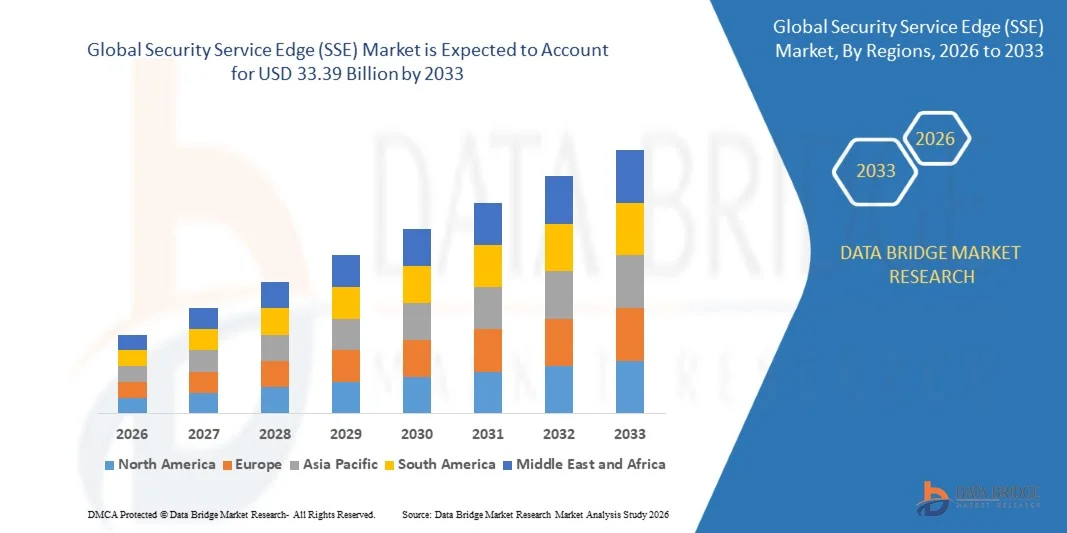
The Security Service Edge (SSE) Market was valued at USD 6.85 billion in 2025 and is projected to reach USD 33.39 billion by 2033, growing at a CAGR of 21.90% from 2026 to 2033. The market is experiencing robust growth driven by the rising adoption of cloud computing, hybrid work environments, and increasing demand for Zero Trust security architectures. Growing cybersecurity threats, rapid digital transformation, and the migration of enterprise applications to the cloud are accelerating the deployment of Security Service Edge (SSE) solutions across organizations of all sizes.
The increasing frequency of ransomware attacks, phishing campaigns, insider threats, and data breaches, combined with stringent data privacy regulations, is compelling enterprises to adopt cloud-delivered security services. Secure Web Gateway (SWG), Cloud Access Security Broker (CASB), Zero Trust Network Access (ZTNA), and Data Loss Prevention (DLP) solutions are replacing traditional perimeter-based security models by providing scalable, centralized, and real-time protection for users, applications, and data across distributed and hybrid IT environments.
Market Size & Forecast
- Global Market Value (2025): USD 6.85 Billion
- Expected Market Value (2033): USD 33.39 Billion
- Forecast CAGR (2026–2033): 21.90%
- Leading Region in 2025: North America
- Fastest Growing Region: Asia-Pacific
Key Market Trends & Insights
- North America dominated the Security Service Edge (SSE) Market with the largest revenue share of 38.21% in 2025, supported by early adoption of zero-trust security architectures, strong cloud migration initiatives, stringent cybersecurity regulations, and the presence of leading SSE solution providers.
- The secure web gateway (SWG) segment dominated the market with a 27.94% share in 2025 due to its critical role in protecting users from web-based cyber threats while enabling secure access to cloud applications and the internet.
- Asia-Pacific is expected to be the fastest-growing region at a CAGR of 18.4% from 2026 to 2033, fueled by rapid cloud adoption, accelerating digital transformation, expanding enterprise cybersecurity investments, and growing implementation of zero-trust frameworks across China, India, Japan, South Korea, and Southeast Asia.
- Zero trust network access (ZTNA) is the fastest-growing component, projected to register a CAGR of 20.2% during the forecast period, reflecting the increasing replacement of traditional VPNs with identity-based secure access solutions for distributed workforces and cloud-native applications.
Report Scope and Security Service Edge (SSE) Market Segmentation
|
Attributes |
Security Service Edge (SSE) Key Market Insights |
|
Segments Covered |
|
|
Countries Covered |
North America
Europe
Asia-Pacific
Middle East and Africa
South America
|
|
Key Market Players |
|
|
Market Opportunities |
|
|
Value Added Data Infosets |
In addition to the insights on market scenarios such as market value, growth rate, segmentation, geographical coverage, and major players, the market reports curated by the Data Bridge Market Research also include in-depth expert analysis, geographically represented company-wise production and capacity, network layouts of distributors and partners, detailed and updated price trend analysis and deficit analysis of supply chain and demand. |
What is the Key Trend in the Security Service Edge (SSE) Market?
Trend: Accelerating Adoption of Zero Trust Architecture and Cloud-Native Security
The Security Service Edge (SSE) Market is experiencing rapid growth as enterprises accelerate cloud adoption, hybrid work strategies, and digital transformation initiatives. Organizations are increasingly replacing traditional perimeter-based security with cloud-delivered, identity-centric security frameworks that provide secure access to applications regardless of user location. The growing adoption of Zero Trust Network Access (ZTNA), Secure Web Gateway (SWG), Cloud Access Security Broker (CASB), and Data Loss Prevention (DLP) solutions is transforming enterprise cybersecurity strategies. According to industry reports, global cybercrime damages are projected to exceed USD 10 trillion annually, while enterprise cloud workloads continue to expand, increasing demand for cloud-native security platforms. AI-powered threat detection, behavioral analytics, real-time policy enforcement, and automated incident response are becoming core capabilities of modern SSE platforms. Vendors are also integrating generative AI, threat intelligence, and unified security management to simplify operations and improve protection across distributed workforces, making SSE a critical pillar of modern enterprise cybersecurity.
Security Service Edge (SSE) Market Dynamics
Key Market Driver: Rising Enterprise Adoption of Cloud Computing and Zero Trust Security
The primary driver of the Security Service Edge (SSE) Market is the rapid migration of enterprise applications and workloads to public and hybrid cloud environments, coupled with the growing adoption of zero-trust security models. Organizations across BFSI, healthcare, government, manufacturing, and IT sectors are increasingly deploying SSE solutions to secure remote users, SaaS applications, and cloud infrastructure while reducing reliance on traditional VPNs. According to Gartner, Zero Trust Network Access (ZTNA) is expected to become the preferred remote access technology for the majority of new enterprise deployments over conventional VPN solutions. Increasing cyberattacks targeting cloud environments, ransomware incidents, and regulatory requirements related to data privacy are encouraging enterprises to implement integrated SWG, CASB, ZTNA, FWaaS, and DLP solutions. Growing investments in secure digital workplaces and cloud-first IT strategies continue to drive strong demand for SSE platforms worldwide.
Key Restraint/Challenge: Complexity of Integrating Legacy Infrastructure with Cloud-Native Security
A major challenge for the Security Service Edge (SSE) Market is the complexity of integrating cloud-native security services with legacy enterprise infrastructure. Many organizations continue to operate traditional firewalls, VPNs, on-premises applications, and fragmented security tools that are not designed for modern cloud environments. Migrating to an SSE architecture often requires significant changes to network architecture, identity management, policy enforcement, and security operations. Enterprises also face challenges related to interoperability, compliance, data residency requirements, and workforce training during deployment. In highly regulated industries such as banking and healthcare, ensuring seamless integration while maintaining business continuity and regulatory compliance can increase implementation costs and deployment timelines. These technical and operational complexities remain a significant barrier, particularly for small and medium-sized enterprises with limited cybersecurity resources.
Key Market Opportunity: AI-Powered Security Analytics and Unified Cloud Security Platforms
The integration of artificial intelligence and machine learning into Security Service Edge platforms presents a significant market opportunity. AI-powered SSE solutions enable continuous user behavior analysis, automated threat detection, adaptive access control, and real-time risk assessment, allowing organizations to respond to cyber threats more quickly and accurately. Increasing adoption of Security Operations Center (SOC) automation, extended detection and response (XDR), and security orchestration technologies is further enhancing the effectiveness of SSE deployments. Enterprises are also adopting unified cloud-native platforms that combine SWG, CASB, ZTNA, FWaaS, and DLP into a single management framework, reducing operational complexity and improving security visibility. The continued expansion of hybrid work, multi-cloud environments, SaaS adoption, IoT deployments, and edge computing is expected to generate substantial growth opportunities for SSE vendors across North America, Europe, Asia-Pacific, Latin America, and the Middle East during the forecast period.
How is the Security Service Edge (SSE) Market Segmented?
The security service edge (SSE) market is segmented on the basis of component and end user.
- By Component
On the basis of component, the Security Service Edge (SSE) Market is segmented into Secure Web Gateway (SWG), Cloud Access Security Broker (CASB), Zero Trust Network Access (ZTNA), Firewall as a Service (FWaaS), Data Loss Prevention (DLP), Remote Browser Isolation (RBI), and Others. The Secure Web Gateway (SWG) segment dominated the market with a 27.94% share in 2025 due to its critical role in protecting users from web-based cyber threats while enabling secure access to cloud applications and the internet. Organizations across BFSI, healthcare, manufacturing, government, and IT sectors are increasingly deploying SWG solutions to safeguard hybrid workforces against phishing, malware, ransomware, and malicious websites. The growing migration toward cloud-first environments has significantly increased demand for cloud-delivered web security solutions capable of enforcing centralized security policies. SWG platforms also provide URL filtering, SSL inspection, advanced threat protection, and application control, allowing enterprises to strengthen their cybersecurity posture. Integration with artificial intelligence, machine learning, and threat intelligence platforms is improving real-time threat detection and automated policy enforcement. Increasing regulatory compliance requirements related to data privacy and cybersecurity are further accelerating adoption. The continued expansion of SaaS applications and remote work environments reinforces the leading position of the SWG segment in the global SSE market.
The Zero Trust Network Access (ZTNA) segment is expected to witness the fastest CAGR of 20.2% from 2026 to 2033, driven by the rapid replacement of traditional VPNs with identity-centric secure access solutions. Enterprises are increasingly implementing zero-trust architectures to provide least-privilege access based on user identity, device posture, and application context. The rise of hybrid work, remote employees, third-party contractors, and cloud-native applications has significantly accelerated demand for ZTNA platforms. These solutions continuously authenticate users, reduce lateral movement across enterprise networks, and minimize cyberattack risks. Integration with identity providers, multi-factor authentication, endpoint detection and response (EDR), and AI-powered behavioral analytics is enhancing security effectiveness. Organizations are also investing in ZTNA to comply with evolving cybersecurity regulations and improve secure access management across distributed IT environments. Growing enterprise cloud adoption is expected to sustain strong growth throughout the forecast period.
- By End User
On the basis of end user, the Security Service Edge (SSE) Market is segmented into BFSI, Healthcare, IT & Telecommunications, Government & Public Sector, Retail & E-commerce, Manufacturing, Education, and Others. The BFSI segment dominated the market with a 24.83% share in 2025 due to increasing cybersecurity threats targeting financial institutions, digital banking platforms, payment systems, and cloud-based financial applications. Banks and financial service providers are rapidly implementing SSE solutions to secure remote employees, protect customer information, and ensure secure access to mission-critical applications. The increasing adoption of cloud banking, open banking APIs, digital wallets, and fintech platforms has expanded the cybersecurity attack surface, creating strong demand for integrated SWG, CASB, ZTNA, and DLP solutions. Regulatory requirements such as PCI DSS, GDPR, and regional financial cybersecurity frameworks are further encouraging investment in cloud-native security technologies. AI-driven threat detection, real-time monitoring, and data loss prevention capabilities are helping financial institutions strengthen cyber resilience while maintaining regulatory compliance. Continuous digital transformation initiatives across the BFSI sector continue to reinforce its dominant position in the global SSE market.
The Healthcare segment is expected to witness the fastest CAGR of 19.1% from 2026 to 2033, driven by the rapid digitization of healthcare services and increasing reliance on cloud-based clinical applications. Hospitals, diagnostic centers, pharmaceutical companies, and healthcare providers are increasingly adopting SSE platforms to secure electronic health records (EHRs), telemedicine platforms, connected medical devices, and remote healthcare infrastructure. The growing frequency of ransomware attacks and healthcare data breaches has accelerated investments in zero-trust security, secure web gateways, cloud access security brokers, and data loss prevention solutions. AI-powered threat analytics, identity-based access controls, and continuous security monitoring are improving protection of sensitive patient information while supporting regulatory compliance. Expansion of digital healthcare ecosystems, connected medical technologies, and cloud-hosted healthcare applications is expected to further increase demand for comprehensive SSE solutions. Rising investments in healthcare cybersecurity across both developed and emerging markets will continue to drive strong segment growth throughout the forecast period.
Which Region Holds the Largest Share of the Security Service Edge (SSE) Market?
North America dominated the Security Service Edge (SSE) Market and accounted for the largest revenue share of 38.21% in 2025, supported by early adoption of zero-trust security architectures, strong cloud migration initiatives, stringent cybersecurity regulations, and the presence of leading SSE solution providers. The region is also witnessing increasing deployment of cloud-native security platforms across enterprises to secure hybrid work environments and distributed applications. The secure web gateway (SWG) segment led the market with a 27.94% share in 2025, driven by growing demand for secure internet access, web traffic filtering, malware protection, and cloud-delivered security services.
U.S. Security Service Edge (SSE) Market Insight
The U.S. security service edge (SSE) market is witnessing strong growth due to increasing enterprise cloud adoption, widespread implementation of zero-trust security frameworks, and rising cybersecurity investments across public and private sectors. Organizations are increasingly deploying SWG, CASB, ZTNA, and DLP solutions to secure remote workforces, cloud applications, and digital assets. Furthermore, the presence of leading cybersecurity vendors and continued investments in AI-driven threat detection are accelerating market growth.
Europe Security Service Edge (SSE) Market Insight
The Europe security service edge (SSE) market remains a major contributor to global revenue, driven by stringent data protection regulations, increasing cloud migration, and growing demand for secure access to enterprise applications. Organizations across BFSI, healthcare, manufacturing, and government sectors are adopting integrated cloud security platforms to strengthen cyber resilience. Rising investments in zero-trust security and secure access technologies continue to support regional market expansion.
U.K. Security Service Edge (SSE) Market Insight
The U.K. security service edge (SSE) market is experiencing steady growth, supported by increasing adoption of cloud computing, hybrid work models, and digital transformation initiatives. Enterprises are investing in advanced SSE platforms to strengthen network security, ensure regulatory compliance, and protect cloud workloads. Additionally, rising cyber threats and strong demand for managed security services are driving the adoption of cloud-delivered security solutions across industries.
Germany Security Service Edge (SSE) Market Insight
The Germany security service edge (SSE) market is expanding steadily due to increasing enterprise digitalization, growing cloud infrastructure, and strong cybersecurity awareness. Businesses are increasingly implementing zero-trust access, secure web gateways, and cloud access security brokers to protect distributed workforces and critical business applications. Continued investments in Industry 4.0 and secure digital infrastructure are further supporting market growth.
Asia-Pacific Security Service Edge (SSE) Market Insight
The Asia-Pacific security service edge (SSE) market is expected to be the fastest-growing regional market, registering a CAGR of 18.4% from 2026 to 2033, fueled by rapid cloud adoption, accelerating digital transformation, expanding enterprise cybersecurity investments, and growing implementation of zero-trust frameworks across China, India, Japan, South Korea, and Southeast Asia. Increasing adoption of cloud-native applications and rising cybersecurity awareness are significantly boosting demand for SSE solutions across the region.
Japan Security Service Edge (SSE) Market Insight
The Japan security service edge (SSE) market is witnessing consistent growth due to increasing enterprise cloud migration, rising cybersecurity investments, and growing adoption of zero-trust network architectures. Organizations are implementing advanced SSE platforms to secure cloud applications, remote employees, and digital business operations. Government initiatives promoting cybersecurity resilience and digital transformation are further supporting market expansion.
China Security Service Edge (SSE) Market Insight
The China security service edge (SSE) market is growing rapidly, driven by expanding cloud infrastructure, rising enterprise digitalization, and increasing investments in cybersecurity technologies. Organizations are increasingly adopting secure web gateways, cloud access security brokers, and zero-trust network access solutions to protect critical data and cloud environments. In addition, strong government support for digital infrastructure, growing cybersecurity regulations, and rapid adoption of cloud-based business applications are positioning China as one of the fastest-growing markets for security service edge (SSE) globally.
Which are the Top Companies in Security Service Edge (SSE) Market?
The security service edge (SSE) industry is primarily led by well-established companies, including:
- Palo Alto Networks, Inc. (U.S.)
- Zscaler, Inc. (U.S.)
- Cisco Systems, Inc. (U.S.)
- Netskope, Inc. (U.S.)
- Broadcom Inc. (Symantec Enterprise) (U.S.)
- Fortinet, Inc. (U.S.)
- Check Point Software Technologies Ltd. (Israel)
- Microsoft Corporation (U.S.)
- IBM Corporation (U.S.)
- Akamai Technologies, Inc. (U.S.)
- Cloudflare, Inc. (U.S.)
- Forcepoint LLC (U.S.)
- Cato Networks Ltd. (Israel)
- Skyhigh Security LLC (U.S.)
- Versa Networks, Inc. (U.S.)
- Open Systems AG (Switzerland)
- Lookout, Inc. (U.S.)
- Trend Micro Incorporated (Japan)
- Sophos Ltd. (U.K.)
- Trellix (U.S.)
- Barracuda Networks, Inc. (U.S.)
- Proofpoint, Inc. (U.S.)
- Menlo Security, Inc. (U.S.)
- SonicWall Inc. (U.S.)
- Huawei Technologies Co., Ltd. (China)
- Sangfor Technologies Inc. (China)
- HCLSoftware (India)
- Tata Consultancy Services (TCS) (India)
- Wipro Limited (India)
- Orange Cyberdefense (France)
- BT Group plc (U.K.)
- AT&T Cybersecurity (U.S.)
- Kyndryl Holdings, Inc. (U.S.)
- Telstra International (Australia)
What are Latest Developments in Security Service Edge (SSE) Market?
- In September 2021, Zscaler announced the acquisition of Smokescreen Technologies to strengthen its Zero Trust Exchange platform with advanced deception technology. The acquisition enhanced threat detection, lateral movement prevention, and ransomware defense capabilities, reinforcing Zscaler’s Security Service Edge (SSE) portfolio for enterprise customers
- In April 2022, Gartner released its first-ever Magic Quadrant for Security Service Edge (SSE), recognizing Zscaler, Netskope, and McAfee Enterprise (later Skyhigh Security) as market Leaders. The report highlighted the rapid growth of cloud-delivered security driven by hybrid work, zero-trust adoption, and cloud migration, marking a significant milestone for the SSE market
- In April 2023, Palo Alto Networks announced that it had been recognized as a Leader in the Gartner Magic Quadrant for Security Service Edge (SSE). The recognition followed significant enhancements to its Prisma Access platform, including stronger Zero Trust Network Access (ZTNA), SD-WAN integration, and AI-powered security capabilities, making Palo Alto Networks the only vendor recognized as a Leader in both the Gartner Magic Quadrants for SD-WAN and SSE
- In April 2024, Gartner released its 2024 Magic Quadrant for Security Service Edge (SSE), naming Netskope, Palo Alto Networks, and Zscaler as Leaders for the second consecutive year. The report also added Fortinet and Versa Networks to the evaluation, reflecting the continued expansion and maturity of the global SSE market
- In November 2024, Palo Alto Networks expanded the capabilities of Prisma Access Browser by releasing security enhancements and vulnerability updates designed to strengthen enterprise browser security within its SSE platform. The update improved secure browsing, cloud application protection, and zero-trust access for hybrid workforces, reinforcing the company's cloud-delivered security portfolio

- Interactive Data Analysis Dashboard
- Company Analysis Dashboard for high growth potential opportunities
- Research Analyst Access for customization & queries
- Competitor Analysis with Interactive dashboard
- Latest News, Updates & Trend analysis
- Harness the Power of Benchmark Analysis for Comprehensive Competitor Tracking
Data collection and base year analysis are done using data collection modules with large sample sizes. The stage includes obtaining market information or related data through various sources and strategies. It includes examining and planning all the data acquired from the past in advance. It likewise envelops the examination of information inconsistencies seen across different information sources. The market data is analysed and estimated using market statistical and coherent models. Also, market share analysis and key trend analysis are the major success factors in the market report. To know more, please request an analyst call or drop down your inquiry.
The key research methodology used by DBMR research team is data triangulation which involves data mining, analysis of the impact of data variables on the market and primary (industry expert) validation. Data models include Vendor Positioning Grid, Market Time Line Analysis, Market Overview and Guide, Company Positioning Grid, Patent Analysis, Pricing Analysis, Company Market Share Analysis, Standards of Measurement, Global versus Regional and Vendor Share Analysis. To know more about the research methodology, drop in an inquiry to speak to our industry experts.
Data Bridge Market Research is a leader in advanced formative research. We take pride in servicing our existing and new customers with data and analysis that match and suits their goal. The report can be customized to include price trend analysis of target brands understanding the market for additional countries (ask for the list of countries), clinical trial results data, literature review, refurbished market and product base analysis. Market analysis of target competitors can be analyzed from technology-based analysis to market portfolio strategies. We can add as many competitors that you require data about in the format and data style you are looking for. Our team of analysts can also provide you data in crude raw excel files pivot tables (Fact book) or can assist you in creating presentations from the data sets available in the report.













