


What is the Semiconductor ChemicalsMarket Size and Overview?
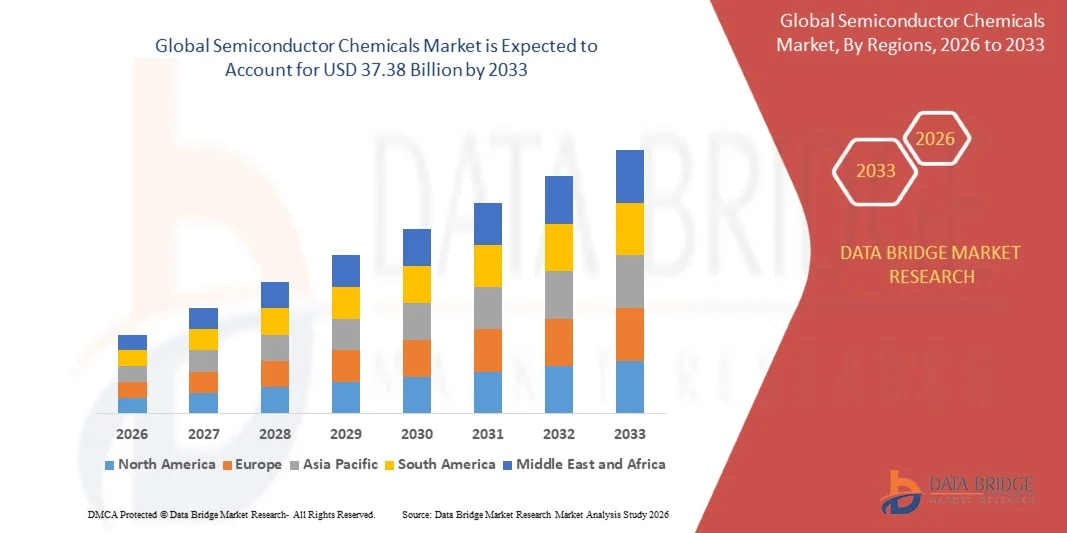
As per Data Bridge Market Research analysis the semiconductor chemicals market was valued at USD 18.90 billion in 2025 and is projected to reach USD 37.38 billion by 2033, growing at a CAGR of 8.90% from 2026 to 2033. The market is experiencing strong growth driven by increasing semiconductor manufacturing capacity, rising demand for advanced integrated circuits, and expanding applications across consumer electronics, automotive, artificial intelligence, 5G infrastructure, and data centers.
The rapid transition toward smaller semiconductor nodes, combined with growing investments in domestic chip fabrication facilities and government initiatives to strengthen semiconductor supply chains, is accelerating the demand for high-purity semiconductor chemicals. Wet chemicals, photoresists, specialty gases, CMP slurries, and cleaning chemicals are becoming increasingly essential for advanced wafer fabrication, enabling higher chip performance, improved manufacturing yields, and reliable production of next-generation semiconductor devices.
Market Size & Forecast
- Market Value (2025): USD 18.90 Billion
- Expected Market Value (2033): USD 37.38 Billion
- Forecast CAGR (2026–2033): 8.90%
- Leading Region in 2025: Asia-Pacific
- Fastest Growing Region: North America
What are the Major Takeaways of Semiconductor Chemicals Market?
- Asia-Pacific dominated the semiconductor chemicals market with the largest revenue share of approximately 50.5% in 2025, supported by the presence of major semiconductor manufacturing hubs including Taiwan, South Korea, China, and Japan.
- North America semiconductor chemicals market is expected to witness the fastest growth rate from 2026 to 2033, supported by substantial investments in semiconductor manufacturing, expanding domestic chip fabrication capacity, and strong government initiatives under the CHIPS and Science Act.
- The Front-End-of-Line (FEOL) segment held the largest market revenue share of approximately 56.8% in 2025, driven by increasing production of advanced logic and memory chips requiring extensive wafer cleaning, oxidation, etching, deposition, and lithography processes. Growing investments in advanced semiconductor fabrication facilities continue to support demand for FEOL chemicals.
- The Back-End-of-Line (BEOL) segment is projected to register the fastest growth at a CAGR of 6.4% from 2026 to 2033, driven by increasing adoption of advanced packaging technologies, heterogeneous integration, chiplet architectures, and high-bandwidth memory (HBM). Rising demand for AI and high-performance computing devices is accelerating segment expansion.
- The semiconductors segment held the largest market revenue share of approximately 62.9% in 2025, driven by growing demand for integrated circuits across consumer electronics, automotive, industrial automation, telecommunications, and artificial intelligence applications. Continuous investments in wafer fabrication capacity are further strengthening segment growth.
- The displays segment is projected to register the fastest growth at a CAGR of 6.30% from 2026 to 2033, driven by increasing demand for OLED, AMOLED, and microLED display technologies across smartphones, televisions, tablets, automotive displays, and wearable devices. Rising investments in next-generation display manufacturing facilities and the growing need for high-purity chemicals and specialty materials used in display fabrication are accelerating segment expansion.
Report Scope and Semiconductor Chemicals Market Segmentation
Attributes |
Semiconductor Chemicals Key Market Insights |
|
Segments Covered |
|
|
Countries Covered |
North America
Europe
Asia-Pacific
Middle East and Africa
South America
|
|
Key Market Players |
|
|
Market Opportunities |
|
|
Value Added Data Infosets |
In addition to the insights on market scenarios such as market value, growth rate, segmentation, geographical coverage, and major players, the market reports curated by the Data Bridge Market Research also include import export analysis, production capacity overview, production consumption analysis, price trend analysis, climate change scenario, supply chain analysis, value chain analysis, raw material/consumables overview, vendor selection criteria, PESTLE Analysis, Porter Analysis, and regulatory framework. |
What is the Key Trend in the Semiconductor Chemicals Market?
Trend: Rising Adoption Of High-Purity Chemicals For Advanced Semiconductor Manufacturing
The transition toward advanced semiconductor process nodes, heterogeneous integration, and AI-driven computing is significantly increasing demand for ultra-high-purity semiconductor chemicals used in wafer fabrication. Chip manufacturers are investing heavily in high-performance photoresists, wet chemicals, specialty gases, CMP slurries, and cleaning formulations to improve yield, reduce defects, and support production of sub-5 nm and next-generation semiconductor devices. Growing demand for AI processors, high-bandwidth memory (HBM), automotive semiconductors, and advanced packaging technologies is further accelerating chemical consumption across fabrication facilities.
For instance, in April 2024, BASF inaugurated its new Semiconductor Materials Application Center (SMAC) in Ansan, South Korea. The facility enables collaborative development and testing of advanced semiconductor materials with chip manufacturers, strengthening innovation in high-purity electronic chemicals used for next-generation semiconductor fabrication.
The continued expansion of advanced semiconductor fabrication and increasing investments in specialty electronic materials are expected to strengthen long-term demand for semiconductor chemicals, positioning suppliers to benefit from the expansion of AI, high-performance computing, and advanced chip manufacturing.
Semiconductor Chemicals Market Dynamics
Key Market Driver: Increasing Investments In Advanced Semiconductor Fabrication And AI Chip Production
Governments and semiconductor manufacturers worldwide are investing billions of dollars in new wafer fabrication facilities to strengthen domestic chip production and meet growing demand from artificial intelligence, automotive electronics, data centers, consumer electronics, and 5G infrastructure. These facilities require large volumes of ultra-high-purity acids, solvents, specialty gases, photoresists, and CMP materials to ensure high manufacturing yields and device reliability.
For instance, in April 2024, Taiwan Semiconductor Manufacturing Company (TSMC) began construction of its third fabrication facility in Phoenix, Arizona, supported by the U.S. CHIPS and Science Act. The expansion will manufacture advanced semiconductor technologies while substantially increasing demand for semiconductor-grade chemicals, specialty gases, and wafer processing materials throughout the supply chain.
As semiconductor manufacturing capacity continues to expand, rising investments in advanced fabrication technologies are expected to generate sustained demand for high-purity semiconductor chemicals across wafer processing and advanced packaging applications.
Key Restraint/Challenge: Stringent Purity Requirements And Rising Manufacturing Costs
Semiconductor chemicals require exceptionally high purity levels, as even trace contaminants can significantly affect wafer yields and device performance. Manufacturers must continuously invest in advanced purification technologies, quality control systems, and regulatory compliance while managing increasing production costs associated with energy, raw materials, and specialized manufacturing processes.
In addition, geopolitical tensions and supply chain disruptions affecting specialty chemicals and electronic materials continue to create procurement challenges for semiconductor manufacturers. According to Intel's 2024 Annual Report, maintaining resilient supply chains for specialty materials and manufacturing inputs remains a critical operational priority as semiconductor production becomes increasingly complex.
Despite robust market demand, stringent purity requirements, rising production costs, and ongoing supply chain uncertainties are expected to remain significant restraints, increasing operational pressures and limiting scalability across the semiconductor chemicals market throughout the forecast period.
Key Market Opportunity: Expansion Of Domestic Semiconductor Manufacturing And Specialty Chemical Production
Governments across North America, Europe, and Asia-Pacific are introducing major incentive programs to establish regional semiconductor manufacturing ecosystems, creating substantial opportunities for suppliers of electronic chemicals and specialty materials. The expansion of domestic fabrication facilities is increasing demand for locally produced, high-purity semiconductor chemicals that comply with stringent quality and supply chain requirements.
For instance, in March 2024, the U.S. Department of Commerce announced proposed funding for Intel under the CHIPS and Science Act to expand advanced semiconductor manufacturing and packaging facilities across the United States. These investments are expected to strengthen domestic semiconductor supply chains while creating long-term demand for semiconductor chemicals used in wafer fabrication and advanced packaging.
As governments continue strengthening semiconductor self-sufficiency and manufacturers expand fabrication capacity worldwide, increasing investments in specialty chemical production and localized supply chains are expected to create significant long-term growth opportunities for the semiconductor chemicals market.
How is the Semiconductor Chemicals Market Segmented?
The market is segmented on the basis of process, application, material type, and purity level.
- By Process
On the basis of process, the semiconductor chemicals market is segmented into Front-End-of-Line (FEOL), Back-End-of-Line (BEOL), and Epiwafers. The Front-End-of-Line (FEOL) segment held the largest market revenue share of approximately 56.8% in 2025, driven by increasing production of advanced logic and memory chips requiring extensive wafer cleaning, oxidation, etching, deposition, and lithography processes. Growing investments in advanced semiconductor fabrication facilities continue to support demand for FEOL chemicals.
The Back-End-of-Line (BEOL) segment is projected to register the fastest growth at a CAGR of 6.4% from 2026 to 2033, driven by increasing adoption of advanced packaging technologies, heterogeneous integration, chiplet architectures, and high-bandwidth memory (HBM). Rising demand for AI and high-performance computing devices is accelerating segment expansion.
- By Application
On the basis of application, the market is segmented into semiconductors, displays, photovoltaics, light emitting diodes (LEDs), and advanced packaging. The semiconductors segment held the largest market revenue share of approximately 62.9% in 2025, driven by growing demand for integrated circuits across consumer electronics, automotive, industrial automation, telecommunications, and artificial intelligence applications. Continuous investments in wafer fabrication capacity are further strengthening segment growth.
The displays segment is projected to register the fastest growth at a CAGR of 6.30% from 2026 to 2033, driven by increasing demand for OLED, AMOLED, and microLED display technologies across smartphones, televisions, tablets, automotive displays, and wearable devices. Rising investments in next-generation display manufacturing facilities and the growing need for high-purity chemicals and specialty materials used in display fabrication are accelerating segment expansion.
- By Material Type
On the basis of material type, the market is segmented into chemicals, gases, slurries, pastes, and others. The chemicals segment accounted for the largest market revenue share of approximately 45.8% in 2025, driven by extensive use of wet chemicals, solvents, developers, strippers, and cleaning agents throughout semiconductor manufacturing processes. Increasing demand for high-purity chemicals in advanced process nodes continues to support market expansion.
The gases segment is expected to witness the fastest CAGR of 6.4% from 2026 to 2033, driven by growing utilization of specialty gases such as nitrogen trifluoride, argon, helium, hydrogen, and fluorinated gases in etching, deposition, cleaning, and lithography processes. Increasing production of advanced semiconductor devices and expansion of wafer fabrication facilities worldwide are further supporting demand for high-purity semiconductor gases.
- By Purity Level
On the basis of purity level, the market is segmented into electronics grade, ultra-pure grade, and high-purity grade. The ultra-pure grade segment dominated the market with a revenue share of approximately 52.1% in 2025, driven by stringent contamination control requirements in advanced semiconductor manufacturing. Ultra-pure chemicals are essential for achieving higher wafer yields and reliable production of advanced integrated circuits at leading-edge technology nodes.
The electronics grade segment is anticipated to register the fastest CAGR of 6.1% from 2026 to 2033, driven by expanding semiconductor manufacturing capacity, increasing production of mature-node chips, and rising demand for consumer electronics, automotive semiconductors, and power devices across markets.
Semiconductor Chemicals Market Regional Analysis
Asia-Pacific Semiconductor Chemicals Market Insight
The Asia-Pacific dominated the semiconductor chemicals market with the largest revenue share of approximately 50.5% in 2025, supported by the presence of major semiconductor manufacturing hubs including Taiwan, South Korea, China, and Japan. Increasing investments in wafer fabrication plants, rapid expansion of consumer electronics manufacturing, and growing production of memory and logic chips are significantly boosting demand for semiconductor-grade chemicals. Strong government support and expanding semiconductor supply chains continue to reinforce the region's leadership in semiconductor production.
Japan Semiconductor Chemicals Market Insight
The Japan semiconductor chemicals market is expected to witness the fastest growth rate from 2026 to 2033 due to its leadership in specialty electronic materials, advanced semiconductor manufacturing technologies, and precision chemical production. Japanese manufacturers continue to invest in high-purity photoresists, specialty gases, and advanced process chemicals to support next-generation semiconductor fabrication. Growing demand from automotive electronics, industrial equipment, and AI applications is further contributing to market growth.
China Semiconductor Chemicals Market Insight
The China semiconductor chemicals market accounted for the largest market revenue share in Asia-Pacific in 2025, attributed to the country's rapid expansion of domestic semiconductor manufacturing, significant government investments, and increasing self-sufficiency initiatives. Rising construction of wafer fabrication facilities, growing production of memory and logic chips, and expanding electronics manufacturing are driving strong demand for semiconductor chemicals. Continuous investments in advanced process technologies and local semiconductor supply chains are expected to further strengthen China's position in the regional market.
North America Semiconductor Chemicals Market Insight
North America semiconductor chemicals market is expected to witness the fastest growth rate from 2026 to 2033, supported by substantial investments in semiconductor manufacturing, expanding domestic chip fabrication capacity, and strong government initiatives under the CHIPS and Science Act. The region benefits from the presence of leading semiconductor manufacturers, advanced research facilities, and specialty chemical suppliers. Increasing demand for AI processors, high-performance computing, automotive semiconductors, and data center technologies continues to drive consumption of high-purity semiconductor chemicals across wafer fabrication facilities.
U.S. Semiconductor Chemicals Market Insight
The U.S. semiconductor chemicals market captured the largest revenue share in 2025 within North America, fueled by increasing investments in advanced semiconductor fabrication plants and expanding production of logic, memory, and AI chips. Government incentives supporting domestic semiconductor manufacturing, coupled with growing demand for high-purity wet chemicals, specialty gases, and CMP slurries, are accelerating market growth. Continuous expansion of leading semiconductor manufacturers and strong R&D investments further strengthen the country's position in the regional market.
Europe Semiconductor Chemicals Market Insight
The Europe semiconductor chemicals market is expected to witness the fastest growth rate from 2026 to 2033, primarily driven by the European Chips Act, increasing investments in regional semiconductor manufacturing, and rising demand for automotive and industrial semiconductors. Growing focus on supply chain resilience and technological independence is encouraging expansion of fabrication facilities and specialty chemical production. The region is also witnessing increased collaboration between semiconductor manufacturers and chemical suppliers to support advanced chip production.
U.K. Semiconductor Chemicals Market Insight
The U.K. semiconductor chemicals market is expected to witness the fastest growth rate from 2026 to 2033, driven by increasing investments in semiconductor research, compound semiconductor technologies, and advanced electronics manufacturing. Government support for semiconductor innovation, together with expanding applications in aerospace, defense, telecommunications, and medical devices, is stimulating demand for high-purity semiconductor chemicals. Growing collaboration between universities and industry is further supporting market development.
Germany Semiconductor Chemicals Market Insight
The Germany semiconductor chemicals market is expected to witness the fastest growth rate from 2026 to 2033, fueled by the country's strong automotive electronics industry, advanced manufacturing capabilities, and increasing investments in semiconductor fabrication facilities. Rising production of power semiconductors, industrial automation components, and electric vehicle electronics is driving demand for specialty electronic chemicals. Germany's emphasis on technological innovation and sustainable manufacturing further supports market expansion.
Asia-Pacific Semiconductor Chemicals Market Insight
The Asia-Pacific semiconductor chemicals market is expected to witness the fastest growth rate from 2026 to 2033, supported by the presence of major semiconductor manufacturing hubs including Taiwan, South Korea, China, and Japan. Increasing investments in wafer fabrication plants, rapid expansion of consumer electronics manufacturing, and growing production of memory and logic chips are significantly boosting demand for semiconductor-grade chemicals. Strong government support and expanding semiconductor supply chains continue to reinforce the region's leadership in semiconductor production.
Japan Semiconductor Chemicals Market Insight
The Japan semiconductor chemicals market is expected to witness the fastest growth rate from 2026 to 2033 due to its leadership in specialty electronic materials, advanced semiconductor manufacturing technologies, and precision chemical production. Japanese manufacturers continue to invest in high-purity photoresists, specialty gases, and advanced process chemicals to support next-generation semiconductor fabrication. Growing demand from automotive electronics, industrial equipment, and AI applications is further contributing to market growth.
China Semiconductor Chemicals Market Insight
The China semiconductor chemicals market accounted for the largest market revenue share in Asia-Pacific in 2025, attributed to the country's rapid expansion of domestic semiconductor manufacturing, significant government investments, and increasing self-sufficiency initiatives. Rising construction of wafer fabrication facilities, growing production of memory and logic chips, and expanding electronics manufacturing are driving strong demand for semiconductor chemicals. Continuous investments in advanced process technologies and local semiconductor supply chains are expected to further strengthen China's position in the regional market.
Semiconductor Chemicals Market Share
The semiconductor chemicals industry is primarily led by well-established companies, including:
- BASF SE (Germany)
- FUJIFILM Holdings Corporation (Japan)
- Entegris, Inc. (U.S.)
- Linde plc (U.K.)
- Honeywell International Inc. (U.S.)
- Merck KGaA (Germany)
- Kanto Chemical Co., Inc. (Japan)
- Air Liquide S.A. (France)
- Cabot Microelectronics Corporation (CMC Materials) (U.S.)
- DuPont de Nemours, Inc. (U.S.)
- Solvay S.A. (Belgium)
- Eastman Chemical Company (U.S.)
- SK Inc. (South Korea)
- JSR Corporation (Japan)
- Avantor, Inc. (U.S.)
Latest Developments in Semiconductor Chemicals Market
- In November 2025, FUJIFILM Corporation completed a new development and evaluation building at its Shizuoka factory in Japan to accelerate the development and testing of advanced semiconductor materials, including photoresists and process chemicals for next-generation chips. The facility enhances FUJIFILM’s R&D capabilities and enables faster commercialization of high-performance materials. This expansion supports the growing demand for advanced semiconductor manufacturing and strengthens FUJIFILM’s position in the electronic materials market.
- In October 2025, BASF SE announced the expansion of its semiconductor materials production capabilities with a new electronic-grade ammonium hydroxide facility in Ludwigshafen, Germany, designed to support wafer cleaning and etching processes. The investment aims to improve the availability of high-purity chemicals for semiconductor manufacturers in Europe. This development strengthens regional supply chain resilience and supports the expansion of advanced chip fabrication capacity.
- In September 2025, Dow Inc. announced a strategic collaboration focused on advancing semiconductor chemical solutions through improved manufacturing technologies and innovation capabilities. The initiative aims to enhance production efficiency, optimize material performance, and support the evolving requirements of semiconductor manufacturers. This development highlights increasing industry focus on digital transformation and advanced material solutions for next-generation chip production.
- In August 2025, BASF SE introduced new sustainable semiconductor material solutions designed to support the growing demand for environmentally responsible electronics manufacturing. The new materials focus on improving sustainability across semiconductor production processes while maintaining high performance standards. This development supports sustainability initiatives and strengthens BASF’s competitive position in the semiconductor chemicals market.
- In July 2025, Merck KGaA expanded its semiconductor materials capabilities in Asia to address increasing demand for high-purity chemicals used in semiconductor manufacturing. The investment focuses on improving regional production capacity and enhancing supply reliability for chip manufacturers. This expansion supports the growing semiconductor ecosystem in Asia and strengthens Merck’s presence in advanced electronic materials.

- Interactive Data Analysis Dashboard
- Company Analysis Dashboard for high growth potential opportunities
- Research Analyst Access for customization & queries
- Competitor Analysis with Interactive dashboard
- Latest News, Updates & Trend analysis
- Harness the Power of Benchmark Analysis for Comprehensive Competitor Tracking
Global Semiconductor Chemicals Market, Supply Chain Analysis and Ecosystem Framework
To support market growth and help clients navigate the impact of geopolitical shifts, DBMR has integrated in-depth supply chain analysis into its Global Semiconductor Chemicals Market research reports. This addition empowers clients to respond effectively to global changes affecting their industries. The supply chain analysis section includes detailed insights such as Global Semiconductor Chemicals Market consumption and production by country, price trend analysis, the impact of tariffs and geopolitical developments, and import and export trends by country and HSN code. It also highlights major suppliers with data on production capacity and company profiles, as well as key importers and exporters. In addition to research, DBMR offers specialized supply chain consulting services backed by over a decade of experience, providing solutions like supplier discovery, supplier risk assessment, price trend analysis, impact evaluation of inflation and trade route changes, and comprehensive market trend analysis.
Data collection and base year analysis are done using data collection modules with large sample sizes. The stage includes obtaining market information or related data through various sources and strategies. It includes examining and planning all the data acquired from the past in advance. It likewise envelops the examination of information inconsistencies seen across different information sources. The market data is analysed and estimated using market statistical and coherent models. Also, market share analysis and key trend analysis are the major success factors in the market report. To know more, please request an analyst call or drop down your inquiry.
The key research methodology used by DBMR research team is data triangulation which involves data mining, analysis of the impact of data variables on the market and primary (industry expert) validation. Data models include Vendor Positioning Grid, Market Time Line Analysis, Market Overview and Guide, Company Positioning Grid, Patent Analysis, Pricing Analysis, Company Market Share Analysis, Standards of Measurement, Global versus Regional and Vendor Share Analysis. To know more about the research methodology, drop in an inquiry to speak to our industry experts.
Data Bridge Market Research is a leader in advanced formative research. We take pride in servicing our existing and new customers with data and analysis that match and suits their goal. The report can be customized to include price trend analysis of target brands understanding the market for additional countries (ask for the list of countries), clinical trial results data, literature review, refurbished market and product base analysis. Market analysis of target competitors can be analyzed from technology-based analysis to market portfolio strategies. We can add as many competitors that you require data about in the format and data style you are looking for. Our team of analysts can also provide you data in crude raw excel files pivot tables (Fact book) or can assist you in creating presentations from the data sets available in the report.













