


Sepsis Disease Treatment Market Size
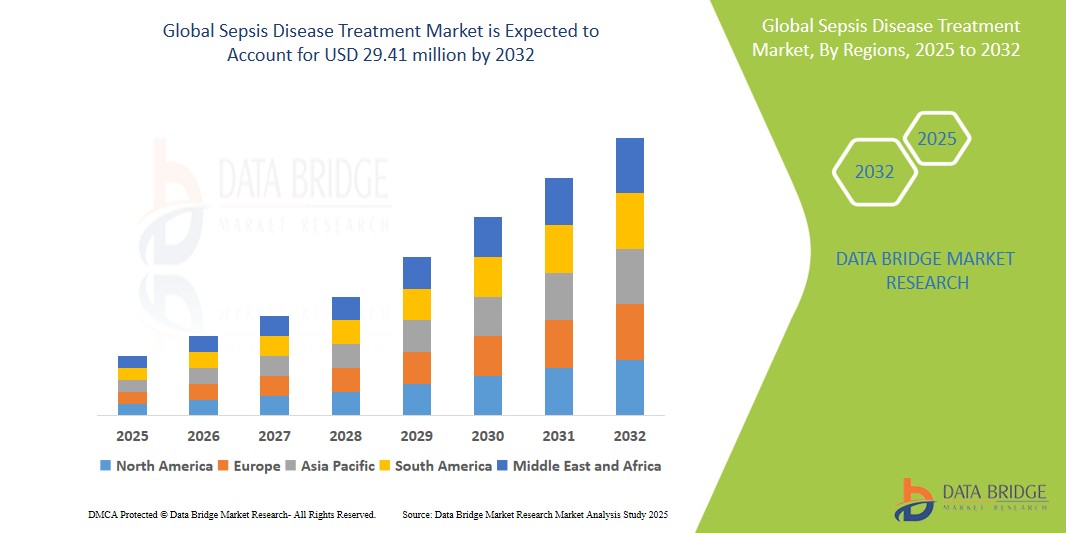
- The global sepsis treatment market size was valued at USD 17.11 million in 2024 and is expected to reach USD 29.41 million by 2032, growing at a CAGR of 7.0% during the forecast period.
- This growth is primarily driven by increasing incidences of sepsis, rising awareness about early diagnosis and intervention, and advancements in treatment modalities including novel drug therapies and supportive care technologies
Sepsis Disease Treatment Market Analysis
- Sepsis is a life-threatening condition caused by the body’s extreme response to infection, leading to tissue damage, organ failure, and potentially death. Effective treatment requires a combination of rapid diagnosis, antimicrobial therapy, hemodynamic support, and organ support measures.
- The demand for sepsis treatment is significantly fueled by the rising prevalence of hospital-acquired infections, the growing geriatric population, and the increasing number of surgeries and ICU admissions globally.
- North America is expected to dominate the global sepsis treatment market due to well-established healthcare systems, higher healthcare spending, and early adoption of advanced therapies.
- Asia-Pacific is projected to be the fastest-growing region due to improving healthcare infrastructure, growing awareness of sepsis management, and increasing government initiatives for infection control.
- The "Sepsis" stage segment currently holds 48.4% market share due to the high incidence rate and need for prompt medical intervention. Antibiotics remain the cornerstone of treatment, but the market is also witnessing innovations in immunomodulatory therapies and supportive care.
Report Scope and Sepsis Disease Treatment Market Segmentation
|
Attributes |
Sepsis Disease Treatment Key Market Insights |
|
Segments Covered |
|
|
Countries Covered |
North America
Europe
Asia-Pacific
Middle East and Africa
South America
|
|
Key Market Players |
|
|
Market Opportunities |
|
|
Value Added Data Infosets |
In addition to the insights on market scenarios such as market value, growth rate, segmentation, geographical coverage, and major players, the market reports curated by the Data Bridge Market Research also include import export analysis, production capacity overview, production consumption analysis, price trend analysis, climate change scenario, supply chain analysis, value chain analysis, raw material/consumables overview, vendor selection criteria, PESTLE Analysis, Porter Analysis, and regulatory framework. |
Sepsis Disease Treatment Market Trends
“Technological Advancements in Sepsis Diagnosis and Personalized Therapeutic Approaches”
- One of the leading trends in the global sepsis treatment market is the growing adoption of rapid molecular diagnostics and biomarker-based detection methods
- These technologies enable earlier identification of sepsis-causing pathogens and patient-specific biomarkers, facilitating more timely and precise treatment interventions
- For instance, novel platforms like multiplex PCR assays and point-of-care biomarker testing (e.g., procalcitonin levels) provide faster and more accurate diagnostics compared to traditional culture methods, improving survival rates by enabling earlier administration of targeted therapies.
- The integration of personalized medicine in sepsis management is further enhancing treatment efficacy, with research focusing on individualized therapy based on genomic and proteomic profiling of patients.
- These innovations are reshaping sepsis care, supporting better clinical decision-making and contributing to reduced mortality, thereby driving demand for advanced sepsis treatment options.
Sepsis Disease Treatment Market Dynamics
Driver
“Rising Incidence of Sepsis and Related Mortality Rates”
- The increasing global burden of sepsis, driven by factors such as hospital-acquired infections, antimicrobial resistance, and aging populations, is a primary driver of the sepsis treatment market
- Sepsis is one of the leading causes of death in intensive care units worldwide, with a high fatality rate when not diagnosed and treated promptly
- As awareness about the severity and urgency of early sepsis treatment grows, there is a rising demand for advanced drugs, supportive therapies, and diagnostic solutions
For instance,
- According to the World Health Organization (WHO), sepsis affects approximately 49 million people globally each year and contributes to 11 million deaths—about 20% of all global deaths—underscoring the urgent need for improved treatment strategies
- This growing clinical need is fueling investment in sepsis-focused drug development and hospital protocol optimization
Opportunity
“AI Integration and Predictive Analytics in Sepsis Management”
- Artificial Intelligence (AI) and machine learning are emerging as valuable tools in early sepsis detection and treatment optimization
- AI algorithms can continuously monitor patient vital signs and lab results in real-time, identifying patterns and risk factors that may indicate early onset of sepsis
- These systems assist clinicians in making timely decisions, reducing diagnostic delays, and initiating appropriate therapy before clinical deterioration
For instance,
- In February 2025, a study published in Nature Digital Medicine demonstrated that AI-based sepsis early-warning systems using EHR data significantly improved patient outcomes by detecting sepsis 4–6 hours before clinical recognition by human providers
- With healthcare systems focusing on predictive, proactive approaches, AI-powered tools present a transformative opportunity to reduce sepsis mortality and healthcare costs while improving patient care
Restraint/Challenge
“Lack of Standardized Diagnostic Protocols and Delayed Recognition”
- Despite advancements, the absence of universally accepted sepsis diagnostic criteria continues to hinder timely identification and treatment
- Sepsis symptoms often overlap with other conditions, making early diagnosis difficult without standardized biomarkers or clinical algorithms
- Delayed recognition leads to postponed treatment, contributing to high morbidity and mortality
For instance,
- According to a 2024 review by The Lancet Infectious Diseases, variability in diagnostic protocols across hospitals and regions results in inconsistent treatment initiation times, directly impacting patient survival rates
- This challenge is particularly severe in low-resource settings where limited diagnostic infrastructure and clinical expertise further exacerbate delays in care
- xThe lack of consistency in early detection strategies ultimately restricts the market's full growth potential and underscores the need for global diagnostic harmonization
Sepsis Disease Treatment Market Scope
The market is segmented on the basis stages, pathogen type, mechanism of action, treatment, route of administration, end user, and distribution channel.
|
Segmentation |
Sub-Segmentation |
|
By Stages |
|
|
By Pathogen Type |
|
|
By Mechanism of Action |
|
|
By Treatment
|
|
|
By Route of Administration |
|
|
By Route of Administration
|
|
|
By Distribution Channel |
|
In 2025, the sepsis segment is projected to dominate the market with the largest share in the stages segment
The sepsis segment is expected to dominate the global sepsis disease treatment market with the largest share of 46.78% in 2025, owing to the high incidence rate and the critical need for immediate intervention. As the initial and most commonly diagnosed stage of the condition, early detection and treatment of sepsis are crucial to preventing progression to more severe stages. Rising awareness, increased hospitalization rates, and greater use of antibiotics and supportive care for early-stage patients significantly contribute to this segment’s dominance. In addition, healthcare systems are prioritizing early sepsis recognition protocols, boosting treatment rates and market growth.
The intravenous segment is expected to account for the largest share during the forecast period in the route of administration segment
In 2025, the intravenous segment is expected to lead the market with the largest market share of 61.24%, due to its rapid and effective drug delivery method essential for treating sepsis. Intravenous administration ensures immediate therapeutic action, which is critical in managing time-sensitive conditions like sepsis, septic shock, and organ dysfunction. Hospitals and intensive care units widely prefer this route for administering antibiotics, fluids, and vasoactive agents, enhancing patient survival. The demand for fast-acting treatments and the standardization of IV therapies in emergency and critical care settings significantly bolster this segment’s prominence.
Sepsis Disease Treatment Market Regional Analysis
“North America Holds the Largest Share in the Sepsis Disease Treatment Market”
- North America dominates the global sepsis disease treatment market, primarily due to its advanced healthcare infrastructure, high rate of sepsis diagnosis, and widespread availability of intensive care units (ICUs).
- The United States holds the largest market share in the region, attributed to increasing awareness of early sepsis symptoms, robust clinical guidelines, and the rapid implementation of evidence-based treatment protocols such as early goal-directed therapy (EGDT).
- Additionally, the presence of leading pharmaceutical and biotechnology companies engaged in the development of novel sepsis therapies and diagnostic tools drives regional growth.
- Government initiatives like the CDC’s “Get Ahead of Sepsis” campaign and favorable reimbursement policies support better patient management and further boost market development.
“Asia-Pacific is Projected to Register the Highest CAGR in the Sepsis Disease Treatment Market”
- The Asia-Pacific region is expected to witness the fastest growth in the sepsis disease treatment market during the forecast period, driven by rising healthcare expenditures, growing prevalence of hospital-acquired infections, and increased awareness of sepsis-related complications.
- Countries like China, India, and Japan are emerging as high-potential markets due to their large and aging populations, rising incidence of chronic illnesses, and increasing rates of surgical procedures—all of which heighten the risk of sepsis.
- China and India are particularly witnessing significant government and private sector efforts to upgrade critical care services, which include the procurement of sepsis diagnostic tools, antibiotics, and life-saving equipment.
- Japan, with its technologically advanced healthcare system and strong emphasis on infection control, contributes notably to regional growth through the adoption of precision-based therapies and clinical sepsis protocols.
- The growing presence of multinational healthcare companies and expansion of intensive care capabilities across urban and semi-urban hospitals are also playing a vital role in propelling the market forward in Asia-Pacific.
Sepsis Disease Treatment Market Share
The market competitive landscape provides details by competitor. Details included are company overview, company financials, revenue generated, market potential, investment in research and development, new market initiatives, global presence, production sites and facilities, production capacities, company strengths and weaknesses, product launch, product width and breadth, application dominance. The above data points provided are only related to the companies' focus related to market.
The Major Market Leaders Operating in the Market Are:
- Abbott (U.S.)
- Pfizer Inc (U.S.)
- GSK plc (U.K.)
- Bristol-Myers Squibb Company (U.S.)
- AdrenoMed AG (Germany)
- AM-Pharma B.V. (Netherlands)
- Amomed Pharma GmbH (Austria)
- Asahi Kasei Corporation (Japan)
- ENDACEA, Inc (U.S.)
- InflaRx Pharmaceuticals Inc. (Germany)
- Formosa Labs Inc. (U.S.)
- Lilly (U.S.)
- Takeda Pharmaceutical Company Limited (Japan)
- Eisai Co., Ltd (Japan)
- CirrusDx, Inc. (U.S.)
- AstraZeneca (U.K.)
- Merck & Co., Inc. (U.S.)
Latest Developments in Global Sepsis Disease Treatment Market
- In June 2023, T2 Biosystems announced a collaboration with Vanderbilt University Medical Center to implement and assess the clinical application of the T2Bacteria Panel. This partnership aims to enhance the rapid identification of bacterial infections, which could lead to more timely and effective treatment strategies in clinical settings
- In May 2023, Sysmex Corporation launched a range of advanced products in Japan, including the clinical flow cytometry system Flow Cytometer XF-1600, the Sample Preparation System PS-10, and a selection of antibody reagents. This launch represents Sysmex's commitment to advancing diagnostic capabilities and providing healthcare professionals with the tools needed for accurate and efficient clinical analysis
- In April 2023, BioMérieux introduced BIOFIRE FIREWORKS, an innovative integrated software solution designed to enhance laboratory services associated with BIOFIRE Systems. This software aims to optimize operational efficiency while enabling laboratory professionals to make data-driven decisions, ultimately improving patient outcomes and service delivery
- In February 2023, Immunexpress successfully launched its SeptiCyte Rapid test in the U.S., designed to swiftly diagnose sepsis in patients within just one hour. This innovative point-of-care test enables clinicians to detect sepsis at an early stage, facilitating prompt intervention that can significantly improve patient outcomes. By providing rapid results, the SeptiCyte Rapid test enhances the efficiency of sepsis management in clinical settings
- In January 2023, Cytovale introduced its new IntelliSep sepsis diagnostics test, aimed specifically at patients in emergency departments experiencing symptoms of sepsis. This cutting-edge test addresses the urgent need for effective diagnostics in high-pressure environments, ensuring that clinicians can quickly assess and respond to potential sepsis cases. By enabling rapid identification, the IntelliSep test plays a crucial role in enhancing patient care in emergency medical situations
- In January 2023, PERSOWN Inc. unveiled its SMASH-H system, a real-time sepsis monitoring solution designed to tackle the growing burden of sepsis in healthcare settings. This advanced monitoring system aims to continuously track patient data, allowing for immediate detection of sepsis indicators and timely medical responses. By integrating real-time monitoring into patient care, SMASH-H seeks to reduce sepsis-related complications and improve overall patient safety

- Interactive Data Analysis Dashboard
- Company Analysis Dashboard for high growth potential opportunities
- Research Analyst Access for customization & queries
- Competitor Analysis with Interactive dashboard
- Latest News, Updates & Trend analysis
- Harness the Power of Benchmark Analysis for Comprehensive Competitor Tracking
Data collection and base year analysis are done using data collection modules with large sample sizes. The stage includes obtaining market information or related data through various sources and strategies. It includes examining and planning all the data acquired from the past in advance. It likewise envelops the examination of information inconsistencies seen across different information sources. The market data is analysed and estimated using market statistical and coherent models. Also, market share analysis and key trend analysis are the major success factors in the market report. To know more, please request an analyst call or drop down your inquiry.
The key research methodology used by DBMR research team is data triangulation which involves data mining, analysis of the impact of data variables on the market and primary (industry expert) validation. Data models include Vendor Positioning Grid, Market Time Line Analysis, Market Overview and Guide, Company Positioning Grid, Patent Analysis, Pricing Analysis, Company Market Share Analysis, Standards of Measurement, Global versus Regional and Vendor Share Analysis. To know more about the research methodology, drop in an inquiry to speak to our industry experts.
Data Bridge Market Research is a leader in advanced formative research. We take pride in servicing our existing and new customers with data and analysis that match and suits their goal. The report can be customized to include price trend analysis of target brands understanding the market for additional countries (ask for the list of countries), clinical trial results data, literature review, refurbished market and product base analysis. Market analysis of target competitors can be analyzed from technology-based analysis to market portfolio strategies. We can add as many competitors that you require data about in the format and data style you are looking for. Our team of analysts can also provide you data in crude raw excel files pivot tables (Fact book) or can assist you in creating presentations from the data sets available in the report.












