


Sequencing Driven Metagenomics Market Size
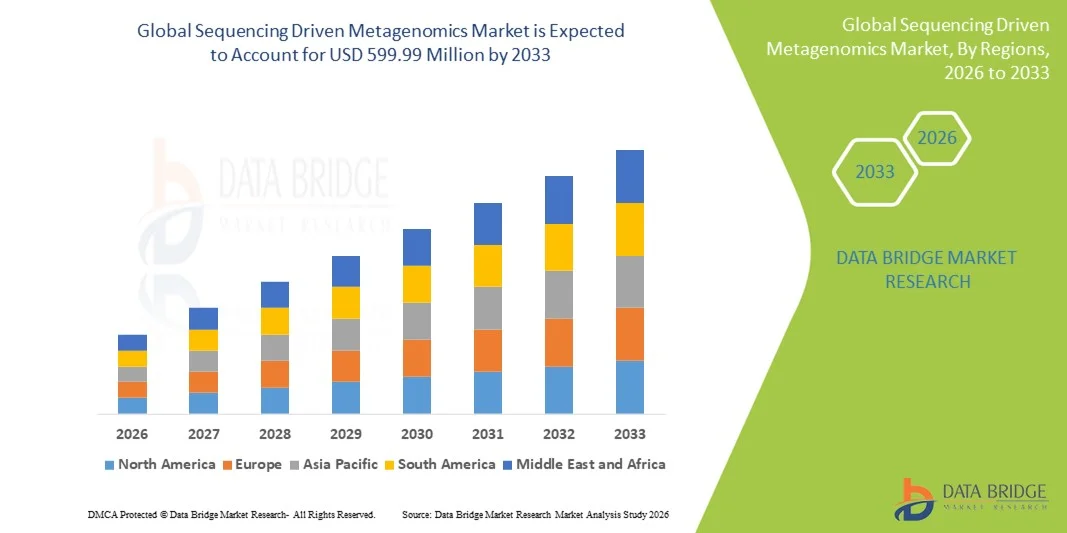
- The global sequencing driven metagenomics market size was valued at USD 346.08 million in 2025 and is expected to reach USD 599.99 million by 2033, at a CAGR of 7.12% during the forecast period
- The market growth is primarily driven by advancements in high-throughput sequencing technologies, bioinformatics tools, and decreasing costs of sequencing, which are enabling comprehensive analysis of microbial communities across diverse environments
- In addition, increasing applications in healthcare, agriculture, environmental monitoring, and biotechnology, coupled with the rising demand for personalized medicine and microbial-based solutions, are positioning sequencing driven metagenomics as a critical tool for research and industrial applications. These combined factors are accelerating market adoption, thereby significantly enhancing the industry's growth
Sequencing Driven Metagenomics Market Analysis
- Sequencing driven metagenomics, enabling comprehensive analysis of microbial communities through high-throughput sequencing and bioinformatics, is increasingly critical for applications in healthcare, agriculture, environmental monitoring, and industrial biotechnology due to its precision, scalability, and ability to uncover novel microbial functions
- The rising demand for sequencing driven metagenomics is primarily fueled by advancements in next-generation sequencing technologies, decreasing costs of sequencing, and the growing need for data-driven insights into microbiomes for personalized medicine, disease diagnostics, and microbial-based solutions
- North America dominated the sequencing driven metagenomics market with the largest revenue share of 39.8% in 2025, characterized by a strong presence of major sequencing technology providers, well-established research infrastructure, and significant government and private investments in genomics and microbiome research, particularly in the U.S., where healthcare and biotechnology sectors are driving extensive adoption
- Asia-Pacific is expected to be the fastest growing region in the sequencing driven metagenomics market during the forecast period due to increasing research investments, expanding biotechnology sector, and growing adoption of advanced sequencing technologies in countries such as China, India, and Japan
- Kits and Reagents segment dominated the sequencing-driven metagenomics market with a market share of 38.9% in 2025, supported by its essential role in sample preparation, library construction, and microbial DNA/RNA extraction, with increasing usage across research laboratories, biotechnology companies, and academic institutes due to recurring demand and rapid advancements in sequencing chemistry
Report Scope and Sequencing Driven Metagenomics Market Segmentation
|
Attributes |
Sequencing Driven Metagenomics Key Market Insights |
|
Segments Covered |
|
|
Countries Covered |
North America
Europe
Asia-Pacific
Middle East and Africa
South America
|
|
Key Market Players |
|
|
Market Opportunities |
|
|
Value Added Data Infosets |
In addition to the insights on market scenarios such as market value, growth rate, segmentation, geographical coverage, and major players, the market reports curated by the Data Bridge Market Research also include in-depth expert analysis, patient epidemiology, pipeline analysis, pricing analysis, and regulatory framework |
Sequencing Driven Metagenomics Market Trends
Integration of AI and Advanced Bioinformatics for Microbiome Insights
- A significant and accelerating trend in the global sequencing driven metagenomics market is the growing integration of artificial intelligence (AI) and advanced bioinformatics platforms to analyze complex microbial data more efficiently and accurately. This fusion of technologies is enhancing insights into microbial composition, function, and interactions
- For instance, platforms such as CosmosID and One Codex utilize AI-powered algorithms to provide rapid identification of pathogens and functional profiling of microbiomes, enabling researchers to derive actionable insights from large datasets
- AI integration allows predictive modeling of microbial community behavior and facilitates anomaly detection in clinical, environmental, and industrial samples. Some platforms can suggest microbial targets for therapeutics or bioremediation based on sequencing outputs
- The seamless integration of sequencing data with cloud-based bioinformatics solutions enables centralized management of multi-omics datasets, allowing researchers to analyze, visualize, and interpret results across multiple projects from a single interface
- This trend toward more intelligent, automated, and scalable metagenomic analysis is reshaping expectations for research and industrial applications. Companies such as QIAGEN and Illumina are developing platforms with AI-driven data interpretation, automated workflows, and real-time reporting capabilities
- The demand for sequencing driven metagenomics solutions that offer AI and advanced analytics integration is growing rapidly across healthcare, agriculture, and environmental sectors, as organizations increasingly prioritize accuracy, scalability, and actionable insights
- The growing collaboration between sequencing technology providers and cloud analytics firms is enabling real-time, collaborative research across geographies, accelerating discoveries in microbiome-based therapeutics and industrial applications
Sequencing Driven Metagenomics Market Dynamics
Driver
Rising Demand for Microbiome-Based Research and Personalized Medicine
- The increasing focus on microbiome research, coupled with the rising adoption of personalized medicine, is a significant driver for the growth of sequencing driven metagenomics solutions
- For instance, in March 2025, Diversigen launched a comprehensive microbiome profiling service targeting precision medicine applications, which is expected to accelerate market adoption
- As healthcare, agriculture, and biotechnology sectors increasingly rely on microbial insights, sequencing driven metagenomics enables the identification of disease markers, probiotic candidates, and novel enzymes, providing a compelling value proposition over traditional microbiology methods
- Furthermore, the need for rapid, high-resolution analysis of complex microbial communities is driving investments in next-generation sequencing and bioinformatics platforms capable of handling large-scale datasets efficiently
- The scalability of sequencing services, combined with decreasing sequencing costs and expanding research funding, is facilitating broader adoption in both academic and industrial settings
- Integration of sequencing data with precision medicine initiatives, agricultural optimization programs, and industrial microbiome applications is a key factor propelling the adoption of metagenomics solutions globally
- For instance, the rising trend of microbiome-based therapeutics and probiotics research in Asia-Pacific is creating new market opportunities for sequencing services
- Collaboration between pharmaceutical companies and sequencing providers to develop targeted microbiome-based treatments is driving demand for specialized metagenomics solutions
Restraint/Challenge
Data Complexity and Standardization Barriers
- The massive volume and complexity of metagenomic sequencing data pose significant challenges for data processing, interpretation, and storage, which can hinder market adoption
- For instance, inconsistencies in sample preparation, sequencing protocols, and bioinformatics pipelines across laboratories can result in variability in microbial profiling outcomes, affecting reproducibility and reliability
- High computational resource requirements, sophisticated analytical skills, and the need for robust cloud or on-premise infrastructure make it challenging for smaller research organizations or startups to adopt sequencing driven metagenomics solutions
- While platforms such as Illumina BaseSpace and MG-RAST provide standardized pipelines, the lack of universal guidelines and regulatory frameworks for clinical and industrial metagenomics analysis remains a barrier
- The relatively high cost of comprehensive sequencing and data analysis, especially for longitudinal or large-scale studies, can limit adoption in resource-constrained regions or for budget-sensitive organizations
- Overcoming these challenges through standardized protocols, user-friendly analytical platforms, and cost-effective sequencing solutions will be vital for sustained growth in the sequencing driven metagenomics market
- For instance, data privacy and compliance concerns in clinical applications can slow adoption due to regulatory and ethical considerations surrounding human microbiome data
- The lack of interoperability between different sequencing platforms and bioinformatics software can result in workflow inefficiencies and delayed analysis, posing an additional challenge for widespread implementation
Sequencing Driven Metagenomics Market Scope
The market is segmented on the basis of product, application, and end users.
- By Product
On the basis of product, the sequencing driven metagenomics market is segmented into kits and reagents, sequencing and data analytics services, instruments, consumables, and others. The Kits and Reagents segment dominated the market with the largest revenue share of 38.9% in 2025, driven by its essential role in sample preparation, microbial DNA/RNA extraction, and library construction workflows. The recurring nature of reagent consumption creates a continuous demand cycle, making it the most revenue-generating category across laboratories and research institutes. Increasing advancements in sequencing chemistries, such as improved enzymatic fragmentation and high-yield amplification kits, further strengthen this segment’s dominance. Its broad adoption across environmental, clinical, agricultural, and industrial metagenomics applications also contributes significantly to revenue stability. In addition, the rising need for standardized, high-quality kits to support multi-omics integration continues to propel the segment’s growth globally.
The Sequencing and Data Analytics Services segment is anticipated to witness the fastest growth rate from 2026 to 2033, driven by the increasing shift of laboratories toward outsourced sequencing and bioinformatics due to high instrument costs and data-analysis complexities. Growing adoption of cloud-based metagenomics pipelines and AI-enhanced microbial profiling accelerates the demand for service-based solutions. For instance, many research groups prefer service providers for shotgun sequencing, variant analysis, and functional annotation due to faster turnaround times and access to expert bioinformaticians. The expansion of microbial reference databases and machine-learning tools for pathogen identification is further stimulating service uptake. The rising use of sequencing services in clinical decision-making, environmental surveillance, and agriculture is expected to strengthen this segment’s rapid growth.
- By Application
On the basis of application, the sequencing driven metagenomics market is segmented into environmental, human health, agriculture, biotechnology, biofuel, and others. The Environmental segment dominated the market in 2025, driven by the increasing need for microbial community analysis in soil, water, wastewater, and marine ecosystems. Governments and academic institutions are increasingly integrating metagenomics for biodiversity conservation, pollution monitoring, and antimicrobial resistance (AMR) tracking. The ability of sequencing-driven metagenomics to uncover novel organisms and functional genes makes it indispensable for ecological and climate-related studies. Large-scale environmental microbiome projects and global ocean-sampling initiatives continue to enhance demand. Rising focus on bioremediation, climate resilience, and ecosystem restoration further solidifies the dominance of this segment.
The Human Health segment is expected to witness the fastest growth rate from 2026 to 2033, fueled by the expanding role of metagenomics in infectious disease diagnostics, microbiome-based therapeutics, and personalized medicine. Metagenomic sequencing is increasingly used for rapid pathogen detection in clinical settings, especially when traditional culturing methods fail. Growing investments in gut microbiome research are accelerating developments in metabolic, neurological, and immune-related disease applications. The rise of precision probiotics, microbial biomarkers, and fecal microbiota analysis is also driving adoption. Furthermore, hospitals and diagnostic labs are integrating sequencing-driven metagenomics into outbreak surveillance and antimicrobial resistance profiling, which is boosting its rapid growth trajectory.
- By End Users
On the basis of end users, the sequencing driven metagenomics market is segmented into pharmaceutical industries, biotechnology companies, research laboratories, pathology laboratories, academic and research institutes, and others. The Academic and Research Institutes segment dominated the market in 2025, supported by extensive government funding, strong university-led sequencing programs, and ongoing global microbiome initiatives. These institutes are primary users of high-throughput sequencing to study microbial ecology, human microbiomes, agricultural microbiota, and industrial microbial strains. The broad adoption of metagenomics in fundamental research—such as discovering novel enzymes, antibiotic resistance genes, and metabolic pathways—strengthens this segment’s leadership. Universities worldwide are expanding sequencing hubs and bioinformatics centers, further reinforcing their dominant market share. Their role in publishing high-impact research and advancing new methodologies continues to drive segmental growth.
The Biotechnology Companies segment is projected to grow at the fastest CAGR from 2026 to 2033, driven by rising adoption of metagenomics for microbial engineering, synthetic biology, enzyme discovery, and bioproduct development. Companies are leveraging metagenomic insights to develop probiotics, biofertilizers, bio-based chemicals, and novel therapeutics derived from microbial genomes. Increasing commercialization of microbiome-based diagnostics and therapeutics is also accelerating industry demand. Biotech firms are investing in automated sequencing workflows, AI-enabled bioinformatics, and strain optimization platforms to enhance innovation speed. The expanding use of metagenomics in industrial biotechnology, environmental bioprocessing, and precision agriculture is expected to further fuel rapid growth in this segment.
Sequencing Driven Metagenomics Market Regional Analysis
- North America dominated the sequencing driven metagenomics market with the largest revenue share of 39.8% in 2025, characterized by a strong presence of major sequencing technology providers, well-established research infrastructure, and significant government and private investments in genomics and microbiome research, particularly in the U.S., where healthcare and biotechnology sectors are driving extensive adoption
- Research institutions, pharmaceutical companies, and biotechnology firms in the region highly value the accuracy, scalability, and comprehensive insights provided by sequencing driven metagenomics solutions for healthcare, agriculture, and industrial applications
- This widespread adoption is further supported by substantial government and private funding, a well-established genomics ecosystem, and the presence of leading sequencing technology providers, establishing North America as a hub for both academic and commercial metagenomics research
U.S. Sequencing Driven Metagenomics Market Insight
The U.S. sequencing driven metagenomics market captured the largest revenue share of 42% in 2025, fueled by extensive investments in genomics research, precision medicine, and microbiome studies. Researchers and biotech firms are increasingly prioritizing high-resolution microbial analysis to advance therapeutics, diagnostics, and agricultural applications. The growing adoption of next-generation sequencing platforms, combined with advanced bioinformatics and cloud-based data analytics, further propels the market. Moreover, collaborations between pharmaceutical companies and sequencing providers to develop targeted microbiome-based treatments are significantly contributing to the market's expansion.
Europe Sequencing Driven Metagenomics Market Insight
The Europe sequencing driven metagenomics market is projected to expand at a substantial CAGR throughout the forecast period, driven by strong government funding for microbiome research, stringent regulatory frameworks, and growing demand for personalized medicine. Increasing urbanization and the adoption of advanced sequencing technologies are fostering market growth. European research institutions and biotech companies are leveraging metagenomics solutions for healthcare, agriculture, and environmental applications, with significant integration into both academic research and industrial projects.
U.K. Sequencing Driven Metagenomics Market Insight
The U.K. sequencing driven metagenomics market is anticipated to grow at a noteworthy CAGR during the forecast period, driven by the rising focus on microbiome-based therapeutics and agricultural applications. Increasing awareness of microbiome health and high adoption of digital laboratory solutions are encouraging both academic and industrial research organizations to invest in sequencing services. The U.K.’s strong research ecosystem, combined with government and private funding for genomics initiatives, is expected to continue to stimulate market growth.
Germany Sequencing Driven Metagenomics Market Insight
The Germany sequencing driven metagenomics market is expected to expand at a considerable CAGR during the forecast period, fueled by increasing investment in biotech research, precision medicine, and industrial microbiome applications. Germany’s advanced research infrastructure and focus on innovation promote the adoption of high-throughput sequencing platforms and bioinformatics solutions. The integration of sequencing driven metagenomics with laboratory automation and data analytics platforms is becoming increasingly prevalent, aligning with local industry and academic research priorities.
Asia-Pacific Sequencing Driven Metagenomics Market Insight
The Asia-Pacific sequencing driven metagenomics market is poised to grow at the fastest CAGR of 25% during the forecast period of 2026 to 2033, driven by rising R&D investments, expanding biotechnology and pharmaceutical sectors, and adoption of advanced sequencing technologies in countries such as China, Japan, and India. Government initiatives supporting precision medicine, microbiome research, and digital laboratories are driving market adoption. Furthermore, the region’s growing presence of sequencing service providers and bioinformatics platforms is increasing accessibility and affordability for both research institutions and industrial applications.
Japan Sequencing Driven Metagenomics Market Insight
The Japan sequencing driven metagenomics market is gaining momentum due to the country’s advanced research ecosystem, high-tech culture, and emphasis on precision medicine. Japanese research institutions and biotech firms prioritize comprehensive microbial analysis for healthcare, agriculture, and industrial applications. The integration of sequencing technologies with cloud-based bioinformatics and automated lab systems is fueling growth. Moreover, collaborations between pharmaceutical companies and sequencing providers are spurring demand for specialized metagenomics services in both residential and commercial research sectors.
India Sequencing Driven Metagenomics Market Insight
The India sequencing driven metagenomics market accounted for the largest market revenue share in Asia-Pacific in 2025, attributed to the country’s expanding biotechnology sector, increasing R&D investments, and high adoption of advanced sequencing technologies. India is becoming a key hub for microbiome research and industrial microbiology applications. The push towards precision medicine, affordable sequencing services, and growing collaborations between domestic and international sequencing providers are key factors propelling the market in India.
Sequencing Driven Metagenomics Market Share
The Sequencing Driven Metagenomics industry is primarily led by well-established companies, including:
- Illumina, Inc. (U.S.)
- Thermo Fisher Scientific Inc. (U.S.)
- Oxford Nanopore Technologies plc (U.K.)
- BGI Group (China)
- QIAGEN (Netherlands)
- Agilent Technologies, Inc. (U.S.)
- GENEWIZ (U.S.)
- Macrogen (South Korea)
- Novogene Corporation (China)
- Zymo Research (U.S.)
- Diversigen (U.S.)
- Microsynth AG (Switzerland)
- BaseClear (Netherlands)
- MR DNA (U.S.)
- Eurofins Scientific (Luxembourg)
- NuGEN Technologies (U.S.)
- Takara Bio (Japan)
- Swift Biosciences (U.S.)
- New England Biolabs (U.S.)
- CosmosID (U.S.)
What are the Recent Developments in Global Sequencing Driven Metagenomics Market?
- In June 2025, Phase Genomics launched its new ProxiMeta™ Starter and Elite Bundles, making genome‑resolved (Hi‑C) metagenomics much more accessible offering end‑to‑end workflows combining sequencing, bioinformatics, and turnkey support to accelerate microbial community analysis in human, environmental and public‑health research settings
- In April 2025, Metabolon, Inc. announced the launch of a comprehensive microbiome research solution combining metagenomics sequencing, a new microbiome metabolite panel, and integrated bioinformatics tools offering researchers a unified platform to link microbial genetic data with metabolic (phenotypic) outputs for deeper insight into microbial communities
- In February 2025, MGI Tech Co., Ltd. rolled out its new Microbiome Metabarcoding Sequencing Package (MMSP), based on its DNBSEQ‑G99 and DNBSEQ‑E25 platforms a streamlined solution covering nucleic acid extraction, library prep, sequencing and analysis, aimed at accelerating microbiome research across human, environmental, agricultural, and industrial samples
- In April 2024, Clinical Microbiomics (post‑merger with CosmosID) launched advanced long‑read sequencing services covering 16S, ITS, 18S rRNA, custom gene sequencing, and full metagenomics enabling unprecedented resolution and assembly quality for complex microbial communities, and supporting strain‑level genome reconstruction
- In June 2022, Illumina, Inc. completed the acquisition of IDbyDNA a company specializing in metagenomic sequencing and bioinformatics for infectious disease and pathogen surveillance strengthening Illumina’s capabilities in pathogen detection, antimicrobial‑resistance profiling, and clinical metagenomics workflows worldwide

- Interactive Data Analysis Dashboard
- Company Analysis Dashboard for high growth potential opportunities
- Research Analyst Access for customization & queries
- Competitor Analysis with Interactive dashboard
- Latest News, Updates & Trend analysis
- Harness the Power of Benchmark Analysis for Comprehensive Competitor Tracking
Data collection and base year analysis are done using data collection modules with large sample sizes. The stage includes obtaining market information or related data through various sources and strategies. It includes examining and planning all the data acquired from the past in advance. It likewise envelops the examination of information inconsistencies seen across different information sources. The market data is analysed and estimated using market statistical and coherent models. Also, market share analysis and key trend analysis are the major success factors in the market report. To know more, please request an analyst call or drop down your inquiry.
The key research methodology used by DBMR research team is data triangulation which involves data mining, analysis of the impact of data variables on the market and primary (industry expert) validation. Data models include Vendor Positioning Grid, Market Time Line Analysis, Market Overview and Guide, Company Positioning Grid, Patent Analysis, Pricing Analysis, Company Market Share Analysis, Standards of Measurement, Global versus Regional and Vendor Share Analysis. To know more about the research methodology, drop in an inquiry to speak to our industry experts.
Data Bridge Market Research is a leader in advanced formative research. We take pride in servicing our existing and new customers with data and analysis that match and suits their goal. The report can be customized to include price trend analysis of target brands understanding the market for additional countries (ask for the list of countries), clinical trial results data, literature review, refurbished market and product base analysis. Market analysis of target competitors can be analyzed from technology-based analysis to market portfolio strategies. We can add as many competitors that you require data about in the format and data style you are looking for. Our team of analysts can also provide you data in crude raw excel files pivot tables (Fact book) or can assist you in creating presentations from the data sets available in the report.













