What is the Shelf Life Testing Market Size and Growth Rate?
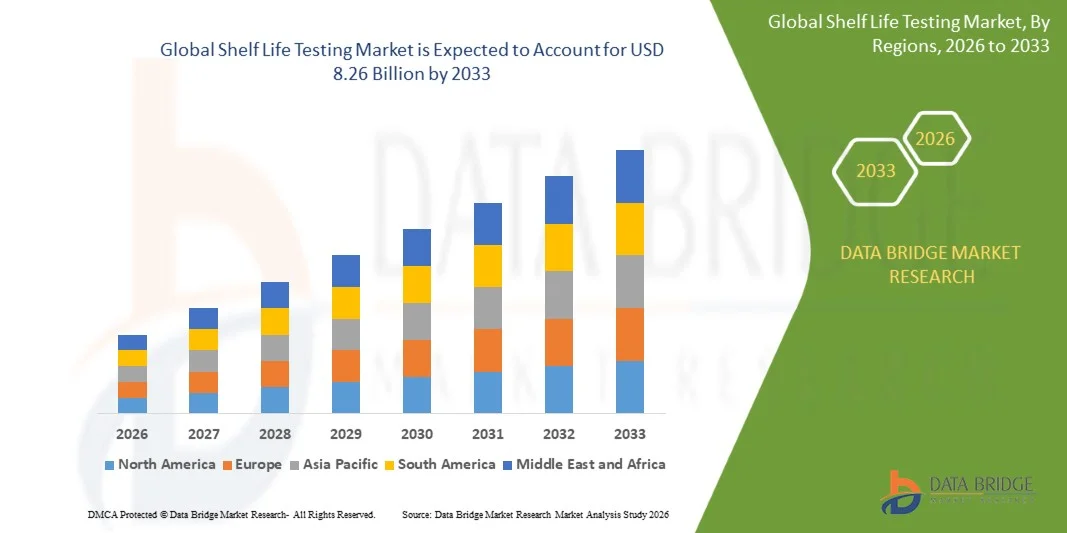
- As per Data Bridge Market Research Analysis the shelf life testing market was valued at USD 4.85 billion in 2025 and is projected to reach USD 8.26 billion by 2033, growing at a CAGR of 6.90% from 2026 to 2033.
- The market is experiencing steady growth driven by rising consumer health concerns, high demand for packaged and convenience foods, stringent food safety regulations, and the growing use of stability testing across pharmaceuticals, cosmetics, and nutraceuticals.
- Increasing global food trade, rising incidence of food-borne illnesses, and stricter enforcement of product recall and labelling regulations are compelling manufacturers, contract laboratories, and regulatory bodies to adopt advanced shelf life testing methods. Accelerated and real-time testing protocols are increasingly replacing conventional empirical approaches, offering faster, more accurate, and cost-effective assessment of product stability.
Market Size & Forecast
- Global Market Value (2025): USD 4.85 Billion
- Expected Market Value (2033): USD 8.26 Billion
- Forecast CAGR (2026–2033): 6.90%
- Leading Region in 2025: Europe
- Fastest Growing Region: Asia-Pacific
What are the Major Takeaways of the Shelf Life Testing Market?
- Europe dominated the global shelf life testing market with the largest revenue share of 34.10% in 2025, supported by stringent food safety regulations, a well-established testing laboratory network, and frequent incidents prompting rigorous quality-assurance protocols.
- Asia-Pacific is expected to be the fastest-growing region at a CAGR of 8.6% from 2026 to 2033, fueled by rising packaged food consumption, expanding pharmaceutical manufacturing, and tightening food safety regulations across China, India, and Japan.
- The microbial contamination segment led the market with a 38.60% share in 2025, driven by widespread regulatory requirements for pathogen testing and rising consumer awareness of food-borne illness risks.
- Accelerated shelf-life testing is the fastest-growing testing method, projected to register a CAGR of 8.1%, reflecting demand for faster time-to-market and reduced product development cycles.
- The packaged food segment dominated the food & product tested category with a 33.75% revenue share in 2025, led by rising global consumption of ready-to-eat and convenience foods.
- The food & beverages end-use segment accounted for 61.40% of the market share in 2025, remaining the primary driver of demand for shelf life testing services worldwide.
- The pharmaceuticals end-use segment is the fastest-growing category, with a CAGR of 8.4%, driven by rising drug stability testing requirements and expanding generic and biologic drug pipelines.
Report Scope and Shelf Life Testing Market Segmentation
|
Attributes |
Shelf Life Testing Key Market Insights |
|
Segments Covered |
|
|
Countries Covered |
North America
Europe
Asia-Pacific
Middle East and Africa
South America
|
|
Key Market Players |
|
|
Market Opportunities |
|
|
Value Added Data Infosets |
In addition to the insights on market scenarios such as market value, growth rate, segmentation, geographical coverage, and major players, the market reports curated also include in-depth expert analysis, geographically represented company-wise production and capacity, network layouts of distributors and partners, detailed and updated price trend analysis and deficit analysis of supply chain and demand. |
What is the Key Trend in the Shelf Life Testing Market?
- Testing laboratories are increasingly reorganizing around rapid, specialized microbiology capabilities to shorten turnaround times for perishable and time-sensitive product categories.
- For instance, in October 2025, Eurofins Microbiology Laboratories announced the formation of Eurofins Rapid Microbiology Laboratories, LLC, a dedicated entity focused exclusively on advancing rapid microbiological testing and turnaround for clients in critical produce-growing and meat-processing regions across the United States.
- Growing digitalization, automated data capture, and traceability solutions are enabling laboratories to deliver more transparent, auditable, and faster shelf life assessments to food, pharmaceutical, and cosmetic manufacturers.
- Contract testing organizations are expanding accredited service scopes, adding new analytes and parameters to existing ISO 17025 laboratory scopes to keep pace with evolving product formulations and regulatory demands.
- As manufacturers continue to prioritize faster product launches without compromising safety, the adoption of accelerated and rapid shelf life testing protocols is expected to accelerate, reinforcing testing as a core component of product development and quality assurance.
What are the Key Drivers of the Shelf Life Testing Market?
- Rising consumer health awareness and high demand for packaged and convenience foods are compelling manufacturers to invest in rigorous stability and quality testing to meet regulatory requirements and reduce recall risk.
- For instance, in July 2025, Mérieux NutriSciences completed its acquisition of Bureau Veritas' food testing activities in Ecuador, strengthening its microbiological and nutritional analysis, residue and pesticide testing, and molecular biology capabilities across Latin America.
- Growing pharmaceutical and diagnostics research is expanding the use of stability testing to validate product shelf life under evolving storage and usage conditions.
- For instance, in March 2023, ACON Laboratories' ongoing stability testing supported an FDA-approved extension of the Flowflex COVID-19 Antigen Home Test's shelf life from 12 to 24 months when stored at 36–86°F (2–30°C), reflecting the role of shelf life testing in supporting regulatory approvals.
- With international food trade, regulatory scrutiny, and product complexity all continuing to rise, shelf life testing will remain indispensable to quality assurance, regulatory compliance, and consumer safety across the food, pharmaceutical, and cosmetics industries.
Which Factors are Challenging the Growth of the Shelf Life Testing Market?
- Advanced shelf life testing requires accredited laboratory infrastructure, sophisticated analytical instrumentation, and skilled personnel, resulting in significant capital and operating costs.
- These high costs limit adoption among smaller food processors, regional manufacturers, and organizations in emerging economies that lack access to accredited testing facilities.
- Fragmented regulatory frameworks and inconsistent testing standards across countries add complexity and cost for manufacturers seeking to sell products in multiple international markets.
- The lack of modernized testing infrastructure and limited organization within food systems in developing regions continues to restrain broader adoption, slowing market penetration in price-sensitive geographies despite growing underlying demand.
How is the Shelf Life Testing Market Segmented?
The shelf life testing market is segmented on the basis of testing parameter, food tested, testing method, technology, AND end-use industry.
- By Testing Parameter
On the basis of testing parameter, the global shelf life testing market is segmented into microbial contamination, rancidity & oxidative stability, nutrient stability, organoleptic properties, and others. The microbial contamination segment dominated the market with a 38.60% share in 2025, owing to strict regulatory mandates for pathogen testing, including Salmonella, E. coli, Listeria, and Campylobacter, and rising consumer awareness of food-borne illness risks. This segment remains central to compliance and product recall prevention across packaged food and beverage categories.
The organoleptic properties segment is projected to register the fastest growth at a CAGR of 7.6% from 2026 to 2033, driven by rising demand for sensory-validated shelf life claims and growing use of trained sensory panels alongside instrumental analysis to support product labelling and consumer acceptance testing.
- By Food Tested
On the basis of food & product tested, the global shelf life testing market is segmented into packaged food, beverages, bakery and confectionery products, meat and meat products, dairy products and desserts, processed fruits and vegetables, and others. The packaged food segment led the market with a 33.75% share in 2025, supported by rising global consumption of ready-to-eat and convenience foods and the need for extended, verifiable shelf life claims.
The dairy products and desserts segment is expected to experience the fastest growth at a CAGR of 7.8% from 2026 to 2033, driven by the perishable nature of dairy products, rising demand for value-added dairy formats, and increasing regulatory scrutiny of cold-chain-dependent categories.
- By Testing Method
On the basis of testing method, the global shelf life testing market is segmented into real-time shelf life testing and accelerated shelf-life testing. The real-time shelf life testing segment dominated the market with a share of 57.20% in 2025 due to its higher accuracy in replicating actual storage conditions and its continued preference by regulatory bodies for label validation and regulatory submissions.
The accelerated shelf-life testing segment is expected to witness the fastest CAGR of 8.1% from 2026 to 2033, driven by increasing pressure to shorten product development timelines, reduce time-to-market, and support faster new product launches without compromising quality assurance standards.
- By Technology
On the basis of technology, the global shelf life testing market is segmented into equipment and kit-based testing and manual testing. The equipment and kit-based segment dominated the market with a share of 64.30% in 2025 due to increasing laboratory automation, higher throughput, and improved reproducibility compared with traditional manual methods.
The equipment and kit-based segment is also expected to witness the fastest CAGR of 7.7% from 2026 to 2033, this growth is driven by continued investment in chromatography, spectroscopy, PCR, and ELISA-based platforms that improve testing speed, sensitivity, and regulatory traceability across laboratories.
- By End-Use Industry
On the basis of end-use industry, the global shelf life testing market is segmented into food & beverages, pharmaceuticals, cosmetics & personal care, nutraceuticals & dietary supplements, and medical devices. The food & beverages segment dominated the market with a share of 61.40% in 2025 due to its critical role in regulatory compliance, product recall prevention, and consumer safety assurance across a wide range of perishable and packaged categories.
The pharmaceuticals segment is expected to witness the fastest CAGR of 8.4% from 2026 to 2033, driven by expanding generic and biologic drug pipelines, stringent regulatory stability-testing requirements, and rising demand for validated shelf life data to support product approvals and labelling.
- By End User
On the basis of end user, the global shelf life testing market is segmented into food & beverage manufacturers, contract & third-party testing laboratories, pharmaceutical & cosmetic companies, government & regulatory bodies, and research institutes & universities. The food & beverage manufacturers segment dominated the market with a share of 39.90% in 2025 due to their direct responsibility for product safety, labelling accuracy, and regulatory compliance across global supply chains.
The contract & third-party testing laboratories segment is expected to witness the fastest CAGR of 7.9% from 2026 to 2033, driven by manufacturers increasingly outsourcing specialized and accredited testing to independent laboratories to reduce internal infrastructure costs while maintaining regulatory compliance.
Which Region Holds the Largest Share of the Shelf Life Testing Market?
- Europe dominated the shelf life testing market and accounted for the largest revenue share of 34.10% in 2025, supported by stringent EU food safety regulations, a dense network of accredited testing laboratories, and a strong presence of established players such as SGS, Bureau Veritas, and Eurofins.
- The region also benefits from frequent regulatory audits, high consumer awareness of food quality, and growing pharmaceutical and cosmetics manufacturing activity. Continued investment in laboratory accreditation and rapid testing technologies is expected to reinforce Europe's leadership position in the global market.
U.K. Shelf Life Testing Market Insight
The U.K. shelf life testing market continues to grow steadily, supported by a well-established network of accredited food and pharmaceutical testing laboratories and strict post-Brexit food safety compliance requirements. Rising demand for extended-shelf-life packaged foods and growing investment in rapid microbiological testing capabilities are further strengthening the U.K.'s position as a key testing hub in the region.
Germany Shelf Life Testing Market Insight
The Germany shelf life testing market is expanding steadily, underpinned by the country's strong food processing and pharmaceutical manufacturing base and rigorous national and EU regulatory standards. Food producers, pharmaceutical companies, and contract laboratories are increasingly investing in accelerated testing methods and automated laboratory equipment to improve testing throughput and accuracy.
Asia-Pacific Shelf Life Testing Market Insight
The Asia-Pacific shelf life testing market is expected to witness rapid growth, driven by rising urbanization, expanding packaged food consumption, and increasing pharmaceutical and nutraceutical manufacturing across China, India, and Japan. Growing government focus on food safety regulation and rising investments by contract testing laboratories are further supporting regional market expansion.
Japan Shelf Life Testing Market Insight
The Japan shelf life testing market is witnessing consistent growth, supported by the country's stringent food labelling regulations, ageing-conscious consumer base, and strong pharmaceutical R&D activity. Increasing adoption of automated and rapid testing platforms is further contributing to improved testing efficiency and market growth.
China Shelf Life Testing Market Insight
The China shelf life testing market is growing rapidly, driven by expanding packaged food manufacturing, rising government focus on food safety enforcement, and increasing exports requiring compliance with international testing standards. Growing investment by domestic and multinational testing laboratories is significantly boosting market demand across the country.
Which are the Top Companies in Shelf Life Testing Market?
The shelf life testing industry is primarily led by well-established testing, inspection, and certification companies, including:
- SGS SA (Switzerland)
- Bureau Veritas SA (France)
- Eurofins Scientific SE (Luxembourg)
- Intertek Group plc (U.K.)
- Mérieux NutriSciences (U.S.)
- ALS Limited (Australia)
- TÜV SÜD AG (Germany)
- AsureQuality Ltd. (New Zealand)
- Neogen Corporation (U.S.)
- NSF International (U.S.)
- QIMA Limited (Hong Kong)
- Premier Analytical Services (U.K.)
- AES Laboratories (India)
- EMSL Analytical, Inc. (U.S.)
What are Latest Developments in Shelf Life Testing Market?
- In December 2025, Eurofins Consumer Product Testing completed a major laboratory expansion in Ho Chi Minh City, Vietnam, relocating to a purpose-built 7,000 sq. m facility that provides more than two and a half times the floor space of its previous site. The expansion strengthens testing capabilities across food contact materials, electrical and electronics, and textiles, supporting Vietnam's growing role as a global manufacturing and export hub.
- In October 2025, Eurofins Microbiology Laboratories announced the formation of Eurofins Rapid Microbiology Laboratories, LLC, realigning a select group of U.S. laboratories under a new entity dedicated exclusively to rapid microbiological testing. Located across key produce-growing and meat-processing regions, the new organization is designed to deliver faster turnaround for perishable-industry clients without compromising accuracy.
- In July 2025, Mérieux NutriSciences completed its acquisition of Bureau Veritas' food testing activities in Ecuador, marking its entry into the Ecuadorian market and strengthening its capabilities in microbiological and nutritional analysis, residue and pesticide testing, and molecular biology across Latin America. The transaction followed earlier closings of the same global deal in North America, Africa, Asia Pacific, and Chile.
- In March 2023, ACON Laboratories' ongoing shelf-life stability testing supported an FDA-approved extension of the Flowflex COVID-19 Antigen Home Test's shelf life from 12 to 24 months when stored at 36–86°F (2–30°C), illustrating the role of rigorous stability testing in enabling regulatory approvals for time-sensitive diagnostic products.
- Industry-wide, testing organizations including Eurofins, SGS, Bureau Veritas, Intertek, Mérieux NutriSciences, TÜV SÜD, ALS, Underwriters Laboratories, NSF International, and QIMA continue to prioritize digitalization, traceability solutions, and laboratory workflow automation to deliver faster and more transparent shelf life testing results to clients worldwide.

- Interactive Data Analysis Dashboard
- Company Analysis Dashboard for high growth potential opportunities
- Research Analyst Access for customization & queries
- Competitor Analysis with Interactive dashboard
- Latest News, Updates & Trend analysis
- Harness the Power of Benchmark Analysis for Comprehensive Competitor Tracking
Global Shelf Life Testing Market, Supply Chain Analysis and Ecosystem Framework
To support market growth and help clients navigate the impact of geopolitical shifts, DBMR has integrated in-depth supply chain analysis into its Global Shelf Life Testing Market research reports. This addition empowers clients to respond effectively to global changes affecting their industries. The supply chain analysis section includes detailed insights such as Global Shelf Life Testing Market consumption and production by country, price trend analysis, the impact of tariffs and geopolitical developments, and import and export trends by country and HSN code. It also highlights major suppliers with data on production capacity and company profiles, as well as key importers and exporters. In addition to research, DBMR offers specialized supply chain consulting services backed by over a decade of experience, providing solutions like supplier discovery, supplier risk assessment, price trend analysis, impact evaluation of inflation and trade route changes, and comprehensive market trend analysis.
Data collection and base year analysis are done using data collection modules with large sample sizes. The stage includes obtaining market information or related data through various sources and strategies. It includes examining and planning all the data acquired from the past in advance. It likewise envelops the examination of information inconsistencies seen across different information sources. The market data is analysed and estimated using market statistical and coherent models. Also, market share analysis and key trend analysis are the major success factors in the market report. To know more, please request an analyst call or drop down your inquiry.
The key research methodology used by DBMR research team is data triangulation which involves data mining, analysis of the impact of data variables on the market and primary (industry expert) validation. Data models include Vendor Positioning Grid, Market Time Line Analysis, Market Overview and Guide, Company Positioning Grid, Patent Analysis, Pricing Analysis, Company Market Share Analysis, Standards of Measurement, Global versus Regional and Vendor Share Analysis. To know more about the research methodology, drop in an inquiry to speak to our industry experts.
Data Bridge Market Research is a leader in advanced formative research. We take pride in servicing our existing and new customers with data and analysis that match and suits their goal. The report can be customized to include price trend analysis of target brands understanding the market for additional countries (ask for the list of countries), clinical trial results data, literature review, refurbished market and product base analysis. Market analysis of target competitors can be analyzed from technology-based analysis to market portfolio strategies. We can add as many competitors that you require data about in the format and data style you are looking for. Our team of analysts can also provide you data in crude raw excel files pivot tables (Fact book) or can assist you in creating presentations from the data sets available in the report.