


Shigellosis Gastroenteritis Treatment Market Size
-
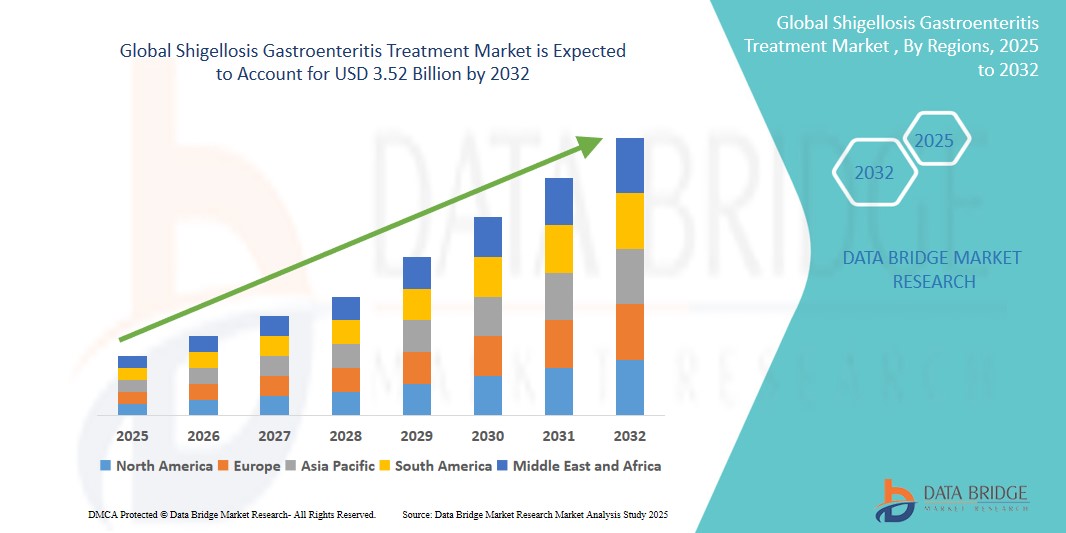
The Global Shigellosis Gastroenteritis Treatment Market size was valued at USD 2.21 billion in 2024 and is expected to reach USD 3.52 billion by 2032, at a CAGR of 6.0% during the forecast period
-
This growth is driven by factors such as the rising prevalence of Shigella infections, increasing antimicrobial resistance, expanding global awareness of waterborne diseases, and advancements in both antibiotic and supportive therapies
Shigellosis Gastroenteritis Treatment Market Analysis
-
Shigellosis gastroenteritis treatment involves a combination of antibiotic therapy and rehydration strategies, essential for managing and controlling the disease, especially in vulnerable populations such as children and the elderly. Effective treatment options reduce disease duration, prevent complications, and limit transmission
-
The market is significantly driven by the rising global burden of diarrheal diseases, especially in low- and middle-income countries, where Shigella is a leading cause of bacterial diarrhea. Improved diagnostics, increased public health efforts, and the development of novel therapeutics are further supporting market expansion
- Asia-Pacific is expected to dominate the global shigellosis gastroenteritis treatment market, accounting for a share of 41.2%, due to strong healthcare infrastructure, high awareness, and access to a broad range of antibiotics and supportive therapies
- is projected to be the fastest-growing region during the forecast period, driven by high disease prevalence, ongoing healthcare improvements, and expanding antibiotic access programs across developing nations
- The ciprofloxacin segment is expected to lead the market with a share of 33.1%, owing to its proven efficacy, broad-spectrum action, and widespread availability. Despite growing concerns over resistance, ciprofloxacin remains a frontline treatment in many clinical settings due to its established use and cost-effectiveness. Emerging alternatives like azithromycin and newer therapeutic approaches are gaining traction, especially in regions with high resistance profiles, but ciprofloxacin continues to dominate due to clinician familiarity and established treatment protocols
Report Scope and Shigellosis Gastroenteritis Treatment Market Segmentation
|
Attributes |
Shigellosis Gastroenteritis Treatment Key Market Insights |
|
Segments Covered |
|
|
Countries Covered |
North America
Europe
Asia-Pacific
Middle East and Africa
South America
|
|
Key Market Players |
|
|
Market Opportunities |
|
|
Value Added Data Infosets |
In addition to the insights on market scenarios such as market value, growth rate, segmentation, geographical coverage, and major players, the market reports curated by the Data Bridge Market Research also include import export analysis, production capacity overview, production consumption analysis, price trend analysis, climate change scenario, supply chain analysis, value chain analysis, raw material/consumables overview, vendor selection criteria, PESTLE Analysis, Porter Analysis, and regulatory framework. |
Shigellosis Gastroenteritis Treatment Market Trends
“Increasing Global Awareness of Waterborne and Diarrheal Diseases”
- One prominent trend in the shigellosis gastroenteritis treatment market is the rising global awareness of waterborne infections and diarrheal diseases, particularly among vulnerable populations such as children under five and the elderly
- As the burden of infectious gastrointestinal diseases grows—especially in low- and middle-income countries—there is increasing demand for effective antimicrobial and supportive therapies to manage and prevent outbreaks
- For instance, the World Health Organization (WHO) and global health agencies are increasingly supporting initiatives to expand access to antibiotics, oral rehydration salts (ORS), and water sanitation solutions in high-burden regions, helping to reduce mortality associated with Shigella infections
- This trend is transforming the approach to infectious disease management by emphasizing early diagnosis, timely treatment, and prevention, thereby improving public health outcomes
- The Shigellosis Gastroenteritis Treatment market is positioned for continued growth, supported by increasing public health investments, rising antibiotic access programs, and growing recognition of the economic and health burdens posed by diarrheal diseases
Shigellosis Gastroenteritis Treatment Market Dynamics
Driver
“Increasing Antimicrobial Resistance (AMR) Driving Demand for New Therapeutics”
- The growing resistance of Shigella strains to commonly used antibiotics such as ciprofloxacin and azithromycin is driving demand for newer, more effective treatment alternatives
- With Shigella increasingly becoming multidrug-resistant (MDR), there is an urgent clinical need for novel antibiotics, combination therapies, and alternative treatment strategies that can overcome resistance barriers
- This challenge has led pharmaceutical companies and public health organizations to invest in the development of next-generation drugs and more robust diagnostic tools for targeted therapy
- Newer treatment regimens are being tailored based on local resistance patterns and patient demographics, improving the effectiveness of shigellosis management and reducing disease recurrence
For instance,
- Several research institutions and biotech firms are collaborating on oral and intravenous therapies targeting MDR Shigella, while also exploring adjunct treatments such as probiotics and immunotherapy to enhance gut recovery
- The demand for resistance-busting drugs and personalized antimicrobial therapy is expected to grow as global surveillance highlights the continued spread of resistant Shigella strains.
Opportunity
“Public-Private Collaborations for Expanded Treatment Access in Endemic Regions”
- Increasing public-private partnerships present a major growth opportunity in the shigellosis gastroenteritis treatment market, particularly in resource-limited settings
- Collaborations between pharmaceutical companies, NGOs, and international health organizations are enabling wider access to antibiotics, ORS, and community-based healthcare programs in endemic regions
- These partnerships are critical for rapid treatment deployment, mass awareness, and infrastructure development to combat outbreaks and reduce hospitalizations
For instance,
- UNICEF and the Global Antibiotic Research and Development Partnership (GARDP) are working with governments to distribute low-cost, high-quality antibiotics and rehydration kits in Sub-Saharan Africa and South Asia, where shigellosis remains a major public health threat
- Strategic alliances not only accelerate innovation and drug accessibility but also strengthen surveillance and treatment compliance, helping reduce morbidity and mortality from Shigella infections
Restraint/Challenge
“Limited Access to Advanced Diagnostics and Antibiotics in Low-Income Settings”
- Limited access to reliable diagnostics and quality-assured antibiotics remains a key challenge in the global shigellosis treatment market, especially in low-income countries
- Many healthcare systems in endemic areas lack the infrastructure to accurately diagnose shigellosis, leading to delayed or inappropriate treatment, which exacerbates the disease burden and accelerates resistance
- Additionally, economic barriers prevent patients and small clinics from obtaining newer, effective antibiotics, forcing reliance on outdated drugs with declining efficacy
For instance,
- Rural healthcare centers in parts of Africa and South Asia often lack laboratory capabilities for stool culture and antibiotic susceptibility testing, resulting in empirical treatment that may not address resistant infections
- These systemic limitations create a disparity in treatment outcomes and reduce the overall effectiveness of public health initiatives aimed at controlling Shigella outbreaks. Addressing these gaps through infrastructure development, training, and affordability programs is crucial for ensuring market growth
Shigellosis Gastroenteritis Treatment Market Scope
The market is segmented on the basis of drug class, type, therapy type, mode of administration and distribution channel.
|
Segmentation |
Sub-Segmentation |
|
By Drug Class |
|
|
By Type |
|
|
By Therapy Type |
|
|
By Mode of Administration |
|
|
By Distribution Channel |
|
In 2025, the Flexneri segment is projected to dominate the market with the largest share in the type segment
The Flexneri segment is expected to dominate the global shigellosis gastroenteritis treatment market with the largest share of 39.6% in 2025 due to its high prevalence, particularly in low- and middle-income countries. Shigella flexneri is the most frequently isolated species in endemic regions across Asia, Africa, and Latin America, accounting for a significant proportion of reported cases. Its strong association with poor sanitation and water quality, combined with its increasing resistance to first-line antibiotics, drives greater demand for focused treatment options and surveillance efforts. The clinical burden and regional predominance of Flexneri continue to make it the most targeted strain for therapy development and public health interventions.
The Ciprofloxacin segment is expected to account for the largest share during the forecast period in the drug class segment
In 2025, the ciprofloxacin segment is expected to dominate the market with a share of 36.8%, due to its historical use as the first-line antibiotic in treating shigellosis and its continued prescription in many clinical settings. Ciprofloxacin, a broad-spectrum fluoroquinolone, remains widely used due to its effectiveness in reducing disease duration and transmission risk. Although emerging resistance is a growing concern, ciprofloxacin continues to be a cornerstone treatment—especially in settings where susceptibility remains high or diagnostics are limited. Its cost-effectiveness, oral administration route, and accessibility in both public and private healthcare systems support its ongoing market leadership. Furthermore, ciprofloxacin’s inclusion in several global treatment guidelines reinforces its dominant position in the drug class segment.
Shigellosis Gastroenteritis Treatment Market Regional Analysis
“Asia-Pacific Holds the Largest Share in the Shigellosis Gastroenteritis Treatment Market”
-
Asia-Pacific dominates the global shigellosis gastroenteritis treatment market with a share of 41.2%, primarily due to the high disease burden in densely populated countries, poor sanitation infrastructure, and limited access to clean water—factors that contribute significantly to the transmission of Shigella infections
- India holds a substantial share of 37.9% within the region, attributed to a high prevalence of diarrheal diseases, particularly among children, and government-led initiatives focused on infectious disease control and antibiotic distribution. Public health campaigns and the integration of antimicrobial stewardship programs have further supported treatment efforts
- The presence of regional pharmaceutical manufacturers, such as ZydusCadila and Sun Pharmaceutical Industries Ltd, facilitates the widespread availability of affordable antibiotics, boosting access to treatment in resource-limited settings
- In addition, increasing investments in healthcare infrastructure and growing awareness about the importance of early treatment and hydration therapy are accelerating the demand for effective shigellosis management solutions in Asia-Pacific. These dynamics position the region as the largest and most influential in the global market
“Africa is Projected to Register the Highest CAGR in the Shigellosis Gastroenteritis Treatment Market”
-
Africa is expected to witness the highest growth rate in the shigellosis gastroenteritis treatment market, driven by a rising incidence of diarrheal diseases, particularly among children under five, due to inadequate sanitation, unsafe drinking water, and poor hygiene conditions
- Countries such as Nigeria, Kenya, and Ethiopia are key markets showing increasing demand for antibiotics and oral rehydration therapy, supported by international public health programs and governmental disease control initiatives. Efforts by organizations like WHO, UNICEF, and GAVI to reduce child mortality rates are further supporting early diagnosis and treatment
- Nigeria, with its large and growing population, is emerging as a central hub for infectious disease treatment, bolstered by foreign aid, public-private partnerships, and expanded access to essential medicines through non-profit channels.The market is also gaining traction due to the increasing penetration of online and retail pharmacies, which enhance medicine availability in rural and remote areas. As governments and non-governmental organizations continue to focus on improving access to treatment and sanitation, Africa is poised to become the fastest-growing region for shigellosis gastroenteritis treatment solutions.
Shigellosis Gastroenteritis Treatment Market Share
The market competitive landscape provides details by competitor. Details included are company overview, company financials, revenue generated, market potential, investment in research and development, new market initiatives, global presence, production sites and facilities, production capacities, company strengths and weaknesses, product launch, product width and breadth, application dominance. The above data points provided are only related to the companies' focus related to market.
The Major Market Leaders Operating in the Market Are:
- BioSolutionsInc (U.S.)
- Pfizer Inc. (U.S.)
- LimmaTech Biologics AG (Switzerland)
- GlaxoSmithKline plc (UK)
- ZydusCadila (India)
- Bionpharma (U.S.)
- Aurobindo Pharma (India)
- Teva Pharmaceutical Industries Ltd (Israel)
- Fresenius Kabi AG (Germany)
- Novartis AG (Switzerland)
- WOCKHARDT (India)
- Mylan N.V. (U.S.)
- LUPIN (India)
- Sun Pharmaceutical Industries Ltd (India)
- Novel Laboratories Inc. (U.S.)
- Hainan Poly Co. Ltd (China)
- Amneal Pharmaceuticals LLC (U.S.)
Latest Developments in Global Shigellosis Gastroenteritis Treatment Market
- In October 2024, Valneva SE and LimmaTech Biologics announced that the FDA granted Fast Track designation to Shigella4V, the world’s most advanced tetravalent bioconjugate vaccine candidate for shigellosis, which Valneva licensed exclusively.
- In October 2023, Institut Pasteur announced a study of Phase 2 clinical trials for Injection SF2A-TT15 10 µg Adjuvanted. The aim of this research is to investigate the safety and effectiveness of a two-dose parenteral synthetic carbohydrate-based conjugate vaccine for Shigella flexneri 2a (SF2a-TT15) in infants in a Shigella-endemic country, Kenya. The study will explore the vaccine's immunogenicity and safety, comparing formulations with and without Alhydrogel as an adjuvant. The research adopts an age-descending approach, focusing on the vaccine's target population.
- In September 2023, International Centre for Diarrhoeal Disease Research, Bangladesh announced a study of Phase 2 clinical trials for Tebipenem Pivoxil, Azithromycin, and Ceftriaxon. The proposed study aims to investigate whether tebipenem-pivoxil is as effective as the currently WHO-recommended second-line therapy for Shigella (ceftriaxone).
- In June 2023, GlaxoSmithKline announced a study of Phase 1 & 2 clinical trials for altSonflex. The objective of this ongoing clinical trial is to assess, for the first time in humans, the safety and immune response elicited by the altSonflex1-2-3 candidate vaccine targeting S. sonnei and S. flexneri serotypes 1b, 2a, and 3a. The initial phase of the study involves administering the vaccine to adults aged 18 to 50 years in Europe.

- Interactive Data Analysis Dashboard
- Company Analysis Dashboard for high growth potential opportunities
- Research Analyst Access for customization & queries
- Competitor Analysis with Interactive dashboard
- Latest News, Updates & Trend analysis
- Harness the Power of Benchmark Analysis for Comprehensive Competitor Tracking
Data collection and base year analysis are done using data collection modules with large sample sizes. The stage includes obtaining market information or related data through various sources and strategies. It includes examining and planning all the data acquired from the past in advance. It likewise envelops the examination of information inconsistencies seen across different information sources. The market data is analysed and estimated using market statistical and coherent models. Also, market share analysis and key trend analysis are the major success factors in the market report. To know more, please request an analyst call or drop down your inquiry.
The key research methodology used by DBMR research team is data triangulation which involves data mining, analysis of the impact of data variables on the market and primary (industry expert) validation. Data models include Vendor Positioning Grid, Market Time Line Analysis, Market Overview and Guide, Company Positioning Grid, Patent Analysis, Pricing Analysis, Company Market Share Analysis, Standards of Measurement, Global versus Regional and Vendor Share Analysis. To know more about the research methodology, drop in an inquiry to speak to our industry experts.
Data Bridge Market Research is a leader in advanced formative research. We take pride in servicing our existing and new customers with data and analysis that match and suits their goal. The report can be customized to include price trend analysis of target brands understanding the market for additional countries (ask for the list of countries), clinical trial results data, literature review, refurbished market and product base analysis. Market analysis of target competitors can be analyzed from technology-based analysis to market portfolio strategies. We can add as many competitors that you require data about in the format and data style you are looking for. Our team of analysts can also provide you data in crude raw excel files pivot tables (Fact book) or can assist you in creating presentations from the data sets available in the report.












