What is the Shiitake Mushroom Cultivation Market Size and Growth Rate?
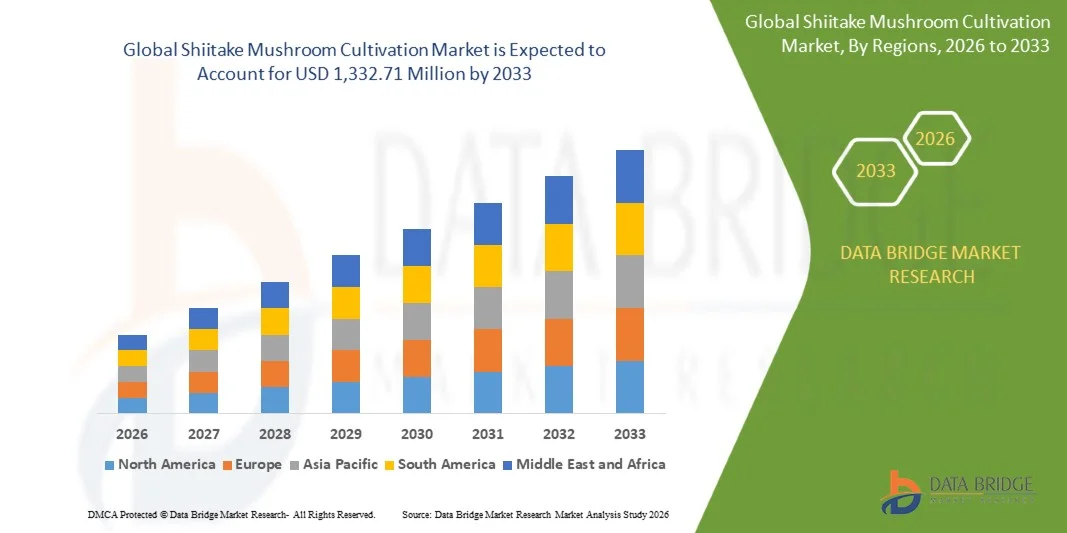
- As per Data Bridge Market Research analysis, the shiitake mushroom cultivation market was valued at USD 930.00 million in 2025 and is projected to reach USD 1,332.71 million by 2033, growing at a CAGR of 4.60% from 2026 to 2033.
- The market is experiencing steady growth driven by rising global consumer interest in functional and nutrient-dense foods, growing culinary adoption of shiitake mushrooms across Western cuisines beyond their traditional East Asian markets, and increasing use of shiitake-derived compounds in nutraceutical and dietary-supplement formulations.
- The growing consumer preference for plant-based and mushroom-based protein alternatives, combined with expanding scientific interest in shiitake's beta-glucan and lentinan content for immune-support applications, is compelling both commercial growers and food-ingredient manufacturers to scale cultivation capacity. Rising adoption of sawdust substrate-bag cultivation methods, which offer faster growing cycles and higher yield consistency than traditional log cultivation, is further reshaping global shiitake production economics.
Market Size & Forecast
- Global Market Value (2025): USD 930.00 Million
- Expected Market Value (2033): USD 1,332.71 Million
- Forecast CAGR (2026–2033): 4.60%
- Leading Region in 2025: Asia-Pacific
- Fastest Growing Region: North America
What are the Major Takeaways of the Shiitake Mushroom Cultivation Market?
- Asia-Pacific dominated the global shiitake mushroom cultivation market with the largest revenue share of 62.73% in 2025, supported by deep-rooted cultivation traditions and large-scale commercial production across China and Japan.
- North America is expected to be the fastest-growing region at a CAGR of 6.2% from 2026 to 2033, fueled by rising consumer interest in functional foods and expanding domestic specialty-mushroom farming operations.
- The sawdust/substrate bag cultivation method segment led the market with a 54.36% share in 2025, driven by its faster growing cycles, higher yield consistency, and lower land-area requirements compared to traditional log cultivation.
- The indoor/controlled environment cultivation segment is the fastest-growing cultivation method category, projected to register a CAGR of 7.1%, reflecting rising grower investment in climate-controlled facilities that enable year-round production.
- The fresh form segment dominated the form category with a 48.62% revenue share in 2025, led by strong culinary demand across retail and foodservice channels for fresh shiitake caps.
- The food & culinary application segment accounted for 61.84% of the market share in 2025, preferred for shiitake's established role as a flavor-rich ingredient across Asian and increasingly Western cuisine.
- The nutraceuticals & dietary supplements application segment is the fastest-growing category, with a CAGR of 6.8%, driven by rising consumer interest in shiitake-derived beta-glucan and lentinan compounds for immune-support products.
Report Scope and Shiitake Mushroom Cultivation Market Segmentation
|
Attributes |
Shiitake Mushroom Cultivation Key Market Insights |
|
Segments Covered |
|
|
Countries Covered |
North America
Europe
Asia-Pacific
Middle East and Africa
South America
|
|
Key Market Players |
|
|
Market Opportunities |
|
|
Value Added Data Infosets |
In addition to the insights on market scenarios such as market value, growth rate, segmentation, geographical coverage, and major players, the market reports curated by the Data Bridge Market Research also include import export analysis, production capacity overview, production consumption analysis, price trend analysis, climate change scenario, supply chain analysis, value chain analysis, raw material/consumables overview, vendor selection criteria, PESTLE Analysis, Porter Analysis, and regulatory framework. |
What is the Key Trend in the Shiitake Mushroom Cultivation Market?
- Commercial growers are increasingly transitioning from traditional log cultivation to sawdust substrate-bag methods, which offer faster growing cycles, higher yield consistency, and reduced dependence on forest-log availability.
- For instance, in April 2025, Monterey Mushrooms expanded its substrate-bag shiitake cultivation capacity in North America, offering retail and foodservice customers more consistent year-round supply compared to traditional seasonal log-grown production.
- Rising adoption of controlled-environment indoor cultivation facilities is enabling growers to produce shiitake mushrooms independent of seasonal temperature and humidity fluctuations, supporting more predictable harvest scheduling.
- Ingredient manufacturers are increasingly extracting and standardizing shiitake beta-glucan and lentinan compounds for incorporation into immune-support dietary supplements and functional-food products.
- For instance, in January 2025, Hokto Kinoko Company introduced an expanded line of shiitake extract-based nutraceutical ingredients targeting supplement manufacturers seeking standardized, traceable functional-mushroom compounds.
- As consumers and food manufacturers continue to prioritize functional nutrition, culinary versatility, and sustainable sourcing, the adoption of advanced shiitake cultivation methods and value-added product formats is expected to steadily expand, reinforcing shiitake's position as a mainstream specialty crop across global food and supplement markets.
What are the Key Drivers of the Shiitake Mushroom Cultivation Market?
- Rising global consumer interest in functional and nutrient-dense foods, combined with growing culinary adoption of shiitake mushrooms beyond traditional East Asian cuisine, has significantly increased demand for both fresh and processed shiitake products.
- For instance, in March 2025, South Mill Champs expanded its specialty-mushroom growing facilities in the United States to meet rising retail and foodservice demand for fresh shiitake mushrooms.
- Food manufacturers and nutraceutical companies are increasingly incorporating shiitake-derived ingredients into functional-food and supplement formulations to capitalize on consumer interest in immune-support and plant-based nutrition.
- For instance, in October 2024, Sylvan announced an investment in additional shiitake spawn production capacity to support rising orders from commercial growers expanding cultivation operations across North America and Europe.
- With consumers and food manufacturers increasingly prioritizing functional, traceable, and sustainably grown specialty produce, shiitake mushroom cultivation will remain an expanding segment across global fresh-produce, processed-food, and nutraceutical supply chains.
- For instance, in June 2024, Yukiguni Maitake expanded its shiitake cultivation and processing capacity in Asia to support growing export demand for dried and powdered shiitake products.
What Factors are Challenging the Growth of the Shiitake Mushroom Cultivation Market?
- Shiitake cultivation, particularly traditional log-based methods, requires extended growing cycles of up to several years before initial fruiting, creating a substantial capital lock-up period that limits the pace of new commercial operation establishment.
- These long production cycles and the specialized substrate and climate-control requirements limit adoption among smaller growers and constrain the speed at which supply can respond to rising demand.
- For instance, in 2024, Swallowtail Forest Farm, a U.S.-based farm specializing in forest-grown mushrooms, transitioned out of actively growing and marketing log-grown shiitake mushrooms. The farm continues to use shiitake production as part of its woodlot management but no longer commercially markets its log-grown shiitake crop. This example highlights the practical challenges associated with maintaining commercial log-based shiitake production and supports the need for growers to evaluate production methods, operating requirements, and market economics carefully.
- The extended cultivation cycles and specialized growing infrastructure requirements associated with shiitake production continue to restrict rapid capacity expansion, particularly among smaller and newer growers. This production-cycle barrier slows the market's ability to respond quickly to demand surges, limiting near-term supply growth despite strong underlying consumer interest.
How is the Shiitake Mushroom Cultivation Market Segmented?
The shiitake mushroom cultivation market is segmented on the basis of cultivation method, substrate type, form, scale of operation, application, distribution channel, farming technique, end user, spawn type and growing environment.
- By Cultivation Method
On the basis of cultivation method, the global shiitake mushroom cultivation market is segmented into log-based cultivation, sawdust/substrate bag cultivation, and indoor/controlled environment cultivation. The sawdust/substrate bag cultivation segment dominated the market with a 54.36% share in 2025, owing to its faster growing cycles, higher yield consistency, and lower land-area requirements compared to traditional log cultivation. This method delivers predictable, scalable production, making it the preferred choice for commercial growers seeking to meet growing retail demand.
The indoor/controlled environment cultivation segment is projected to register the fastest growth at a CAGR of 7.1% from 2026 to 2033, driven by rising grower investment in climate-controlled facilities that enable year-round production independent of seasonal conditions. Advances in automated humidity and temperature management, combined with growing demand for supply consistency, are accelerating segment expansion.
- By Substrate Type
On the basis of substrate type, the global shiitake mushroom cultivation market is segmented into hardwood logs, sawdust blocks, agricultural residues, and others. The sawdust blocks segment led the market with a 51.72% share in 2025, supported by its compatibility with faster-cycle substrate-bag cultivation and consistent nutrient composition across production batches.
The agricultural residues segment is expected to experience the fastest growth at a CAGR of 6.4% from 2026 to 2033, driven by increasing grower interest in using regionally available crop byproducts as a cost-effective, sustainable substrate alternative to hardwood.
- By Form
On the basis of form, the global shiitake mushroom cultivation market is segmented into fresh, dried, powder/extract, and frozen. The fresh segment dominated the market with a share of 48.62% in 2025 due to its strong culinary demand across retail and foodservice channels for shiitake caps used in fresh cooking applications. The widespread availability of fresh shiitake through supermarket produce sections is driving strong demand for this form category.
The powder/extract segment is expected to witness the fastest CAGR of 7.3% from 2026 to 2033, driven by the rising incorporation of standardized shiitake extract into nutraceutical, dietary-supplement, and functional-food formulations. Manufacturers are increasingly developing concentrated powder and extract products optimized for beta-glucan and lentinan content. Additionally, the growing emphasis on shelf-stable, easily dosed functional ingredients is further accelerating adoption of this form category.
- By Scale of Operation
On the basis of scale of operation, the global shiitake mushroom cultivation market is segmented into commercial/large-scale farms, small & medium farms, and home/hobbyist cultivation. The commercial/large-scale farms segment dominated the market with a share of 62.84% in 2025 due to its critical role in supplying high volumes of consistent-quality shiitake mushrooms to retail chains and food-processing customers. High adoption is driven by the increasing need for scalable, standardized production, integration with retail supply-chain requirements, and enhanced production-cost efficiency. Additionally, growing investment by commercial growers to expand substrate-bag and indoor cultivation capacity is reinforcing the leading position of this segment in the market.
The small & medium farms segment is expected to witness the fastest CAGR of 5.9% from 2026 to 2033, driven by the increasing number of specialty growers entering the market to supply farmers markets, restaurants, and regional health-food retailers seeking locally grown, traceable produce. Growing consumer interest in local and artisanal specialty foods is further accelerating market expansion in this segment.
- By Application
On the basis of application, the global shiitake mushroom cultivation market is segmented into food & culinary, nutraceuticals & dietary supplements, pharmaceuticals, and cosmetics. The food & culinary segment dominated the market with a share of 61.84% in 2025 due to shiitake's established role as a flavor-rich ingredient across Asian cuisine and its growing incorporation into Western culinary applications. additionally, rising consumer interest in umami-rich, nutrient-dense vegetables further supports the strong adoption of shiitake in food and culinary applications.
The nutraceuticals & dietary supplements segment is anticipated to witness the fastest CAGR of 6.8% from 2026 to 2033, driven by this growth is fueled by the increasing consumer interest in shiitake-derived beta-glucan and lentinan compounds recognized for immune-support properties. manufacturers are adopting standardized extraction processes to conduct cost-effective, scalable, and consistent supplement-ingredient production. additionally, the integration of shiitake extracts into mainstream functional-food and supplement product lines is enhancing category visibility, further driving segment growth.
- By Distribution Channel
On the basis of distribution channel, the global shiitake mushroom cultivation market is segmented into supermarkets/hypermarkets, specialty/health food stores, online retail, direct/farmers markets, and foodservice/HoReCa. The supermarkets/hypermarkets segment dominated the market with a share of 44.72% in 2025 due to its widespread adoption as the primary retail channel for both fresh and dried shiitake products, offering broad consumer accessibility and consistent supply-chain integration. the widespread availability of shiitake in mainstream grocery produce and specialty sections is driving strong demand for this distribution-channel category.
The online retail segment is expected to witness the fastest CAGR of 7.6% from 2026 to 2033, driven by the growth is primarily driven by the increasing consumer preference for direct-to-door delivery of fresh and dried specialty mushrooms and mushroom-based supplement products. by offering accessible, cost-effective direct-to-consumer sourcing, this channel enhances product discovery and repeat-purchase convenience, making it highly attractive for both mainstream and specialty shiitake product brands.
- By Farming Technique
On the basis of farming technique, the global shiitake mushroom cultivation market is segmented into organic and conventional. The conventional segment dominated the market with a share of 73.64% in 2025 due to its widespread adoption across large-scale commercial cultivation operations prioritizing production efficiency and cost-effective scaling. additionally, established growing infrastructure and extensive commercial-scale production history are facilitating continued adoption of conventional cultivation across mainstream shiitake supply chains.
The organic segment is expected to witness the fastest CAGR of 6.9% from 2026 to 2033, driven by this growth is primarily driven by the increasing consumer demand for certified-organic, traceable specialty produce free from synthetic inputs. growers are increasingly certifying organic substrate sourcing and cultivation processes to enhance product positioning and support premium retail pricing.
- By End User
On the basis of end user, the global shiitake mushroom cultivation market is segmented into households, restaurants & foodservice, food processing companies, and nutraceutical manufacturers. The households segment dominated the market with a share of 42.36% in 2025 due to its widespread consumption of fresh and dried shiitake mushrooms as a household culinary ingredient purchased through retail grocery channels. additionally, established retail distribution networks and broad consumer familiarity are facilitating continued adoption of shiitake among household consumers.
The nutraceutical manufacturers segment is expected to witness the fastest CAGR of 7.1% from 2026 to 2033, driven by this growth is primarily driven by the increasing incorporation of standardized shiitake extract into immune-support and functional-nutrition supplement product lines. manufacturers are leveraging shiitake's recognized beta-glucan content to enhance product differentiation and support growing consumer demand for mushroom-based functional ingredients.
- By Spawn Type
On the basis of spawn type, the global shiitake mushroom cultivation market is segmented into grain spawn, sawdust spawn, and plug spawn. The sawdust spawn segment dominated the market with a share of 49.83% in 2025 due to its widespread compatibility with substrate-bag cultivation methods requiring uniform mycelial colonization across bagged growing media. additionally, established spawn-production infrastructure and broad grower familiarity are facilitating continued adoption of sawdust spawn across commercial cultivation operations.
The grain spawn segment is expected to witness the fastest CAGR of 6.3% from 2026 to 2033, driven by this growth is primarily driven by its faster colonization rates and growing use in large-scale indoor cultivation facilities seeking to optimize production-cycle efficiency.
- By Growing Environment
On the basis of growing environment, the global shiitake mushroom cultivation market is segmented into outdoor and greenhouse/indoor climate-controlled. The outdoor segment dominated the market with a share of 58.72% in 2025 due to its widespread use in traditional log-based cultivation practiced across established growing regions with favorable natural climate conditions. additionally, established outdoor-cultivation traditions and lower infrastructure investment requirements are facilitating continued adoption of outdoor growing methods among smaller and traditional producers.
The greenhouse/indoor climate-controlled segment is expected to witness the fastest CAGR of 6.7% from 2026 to 2033, driven by this growth is primarily driven by the increasing grower investment in year-round production capability independent of seasonal and regional climate constraints. manufacturers of growing infrastructure are leveraging automated climate-control technology to enhance yield predictability and support consistent supply-chain commitments.
Which Region Holds the Largest Share of the Shiitake Mushroom Cultivation Market?
- Asia-Pacific dominated the shiitake mushroom cultivation market and accounted for the largest revenue share of 62.73% in 2025, supported by deep-rooted cultivation traditions, large-scale commercial production infrastructure, and strong domestic and export demand across China and Japan.
- The region also benefits from established log and sawdust-bag cultivation expertise, extensive drying and processing infrastructure, and growing use of shiitake across both fresh culinary and processed nutraceutical applications. Increasing focus on export-oriented production and rising domestic functional-food consumption continues to strengthen Asia-Pacific's leadership position in the global market.
China Shiitake Mushroom Cultivation Market Insight
The China shiitake mushroom cultivation market is growing steadily, driven by the country's position as the world's largest shiitake producer, extensive substrate-bag cultivation infrastructure, and strong export orientation toward global fresh and dried mushroom markets. Growing adoption of standardized cultivation practices across major producing provinces is significantly boosting market demand. In addition, rising investments in processing and drying infrastructure, increasing export-oriented production, and rapid technological advancement in spawn development are positioning China as the leading global market for shiitake mushroom cultivation.
Japan Shiitake Mushroom Cultivation Market Insight
The Japan shiitake mushroom cultivation market is witnessing consistent growth due to the country's long cultivation heritage, strong domestic culinary demand, and continued investment in high-quality log and indoor cultivation techniques. Growers, food processors, and research institutes are increasingly adopting precision climate-control technology for premium shiitake production. Moreover, the country's focus on quality and traceability is further contributing to steady market growth in Japan.
North America Shiitake Mushroom Cultivation Market Insight
North America’s shiitake mushroom cultivation market is expanding with increasing consumer demand for specialty mushrooms, functional foods, and plant-based nutrition. The United States and Canada have established specialty mushroom industries, supported by growing retail, foodservice, and direct-to-consumer channels. Advances in indoor and controlled-environment cultivation are enabling year-round production and improved yield consistency. Rising interest in locally produced food, sustainable farming, and the culinary use of shiitake mushrooms is further creating opportunities for growers, while demand for premium and value-added mushroom products supports market development.
U.S. Shiitake Mushroom Cultivation Market Insight
The U.S. shiitake mushroom cultivation market is expected to witness steady growth, driven by rising consumer interest in functional foods, expanding domestic specialty-mushroom farming operations, and growing culinary adoption of shiitake across mainstream retail and foodservice channels. Growing awareness regarding immune-supportive nutrition, rising adoption of substrate-bag and indoor cultivation methods, and increasing demand for locally grown specialty produce are supporting regional market expansion. Additionally, the growing presence of nutraceutical manufacturers incorporating shiitake extracts is accelerating adoption across the functional-food sector.
Canada Shiitake Mushroom Cultivation Market Insight
Canada’s shiitake mushroom cultivation market is supported by growing consumer interest in specialty mushrooms, plant-based foods, and functional nutrition. Demand from retail, foodservice, and Asian cuisine continues to create opportunities for domestic growers. Controlled-environment cultivation and improved substrate technologies are helping producers achieve more consistent yields and year-round production. Increasing interest in locally grown produce and sustainable agricultural practices is also supporting market development, while premium pricing for specialty mushrooms provides opportunities for commercial cultivators.
Which are the Top Companies in Shiitake Mushroom Cultivation Market?
The shiitake mushroom cultivation industry is primarily led by well-established companies, including:
- Monterey Mushrooms, Inc. (U.S.)
- South Mill Champs, LLC (U.S.)
- Hokto Kinoko Company (Japan)
- Yukiguni Maitake Co., Ltd. (Japan)
- Hokuto Corporation (Japan)
- Sylvan Inc. (U.S.)
- Phillips Mushroom Farms, Inc. (U.S.)
- Highline Mushrooms (Canada)
- Okechamp S.A. (Poland)
- Costa Group Holdings Limited (Australia)
- Gourmet Mushrooms, Inc. (U.S.)
- Far West Fungi (U.S.)
- Mycelia bvba (Belgium)
- Italspawn S.r.l. (Italy)
- Banken Champignons B.V. (Netherlands)
- Fujian Sanming Yasheng Industry Co., Ltd. (China)
- Shandong Qihe Biotechnology Co., Ltd. (China)
- Fujian Shengda Biological Engineering Co., Ltd. (China)
- Gutian Fumin Edible Fungi Co., Ltd. (China)
- Guan's Mushroom Co. (Canada)
What are Latest Developments in Shiitake Mushroom Cultivation Market?
- In September 2025, Monterey Mushrooms launched an expanded indoor climate-controlled shiitake cultivation facility in North America, increasing year-round production capacity to meet growing retail and foodservice demand.
- In February 2025, Hokto Kinoko Company expanded its shiitake cultivation and processing capacity in Japan to support growing domestic and export demand for both fresh and value-added shiitake products.
- In November 2025, Sylvan introduced an upgraded sawdust spawn product line optimized for faster colonization and improved yield consistency, strengthening its position in the global spawn-supply market. This development supports commercial growers seeking to reduce production-cycle time and improve harvest predictability.
- In October 2024, South Mill Champs expanded its specialty-mushroom growing operations in the United States to include additional substrate-bag shiitake production lines, improving supply continuity for retail and foodservice customers.
- In June 2023, Yukiguni Maitake partnered with a regional food-ingredient manufacturer to co-develop standardized shiitake extract products for the nutraceutical market, combining its cultivation expertise with the partner's ingredient-formulation capabilities to support broader functional-food access.
- In March 2023, Okechamp received certification for an expanded organic shiitake cultivation program in Europe, enabling the company to serve growing demand from health-food retailers seeking certified-organic specialty mushroom products.

- Interactive Data Analysis Dashboard
- Company Analysis Dashboard for high growth potential opportunities
- Research Analyst Access for customization & queries
- Competitor Analysis with Interactive dashboard
- Latest News, Updates & Trend analysis
- Harness the Power of Benchmark Analysis for Comprehensive Competitor Tracking
Data collection and base year analysis are done using data collection modules with large sample sizes. The stage includes obtaining market information or related data through various sources and strategies. It includes examining and planning all the data acquired from the past in advance. It likewise envelops the examination of information inconsistencies seen across different information sources. The market data is analysed and estimated using market statistical and coherent models. Also, market share analysis and key trend analysis are the major success factors in the market report. To know more, please request an analyst call or drop down your inquiry.
The key research methodology used by DBMR research team is data triangulation which involves data mining, analysis of the impact of data variables on the market and primary (industry expert) validation. Data models include Vendor Positioning Grid, Market Time Line Analysis, Market Overview and Guide, Company Positioning Grid, Patent Analysis, Pricing Analysis, Company Market Share Analysis, Standards of Measurement, Global versus Regional and Vendor Share Analysis. To know more about the research methodology, drop in an inquiry to speak to our industry experts.
Data Bridge Market Research is a leader in advanced formative research. We take pride in servicing our existing and new customers with data and analysis that match and suits their goal. The report can be customized to include price trend analysis of target brands understanding the market for additional countries (ask for the list of countries), clinical trial results data, literature review, refurbished market and product base analysis. Market analysis of target competitors can be analyzed from technology-based analysis to market portfolio strategies. We can add as many competitors that you require data about in the format and data style you are looking for. Our team of analysts can also provide you data in crude raw excel files pivot tables (Fact book) or can assist you in creating presentations from the data sets available in the report.