


What is the Single Mode Vertical Cavity Surface Emitting Laser (VCSEL) Market Size and Growth Rate?
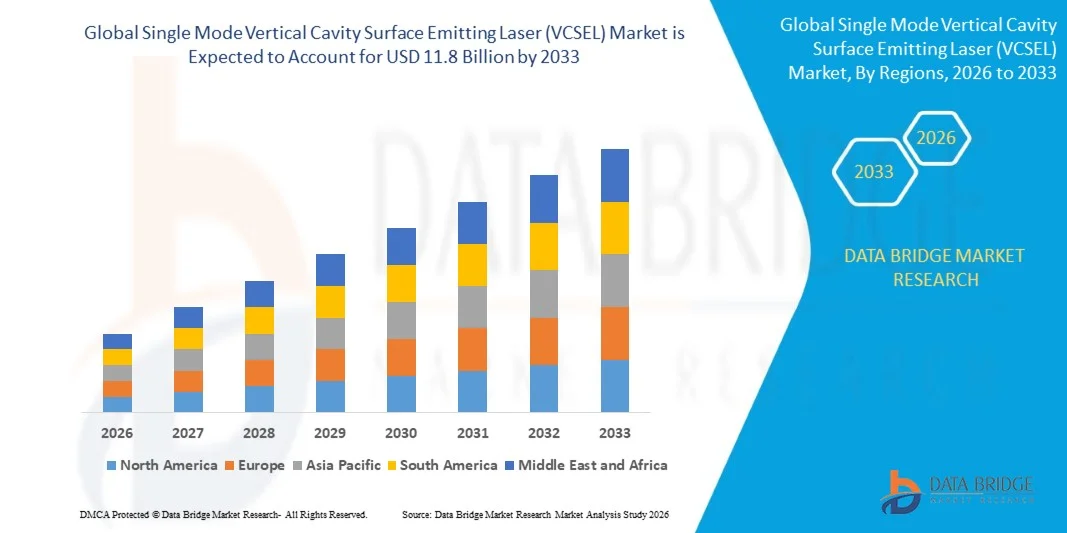
- As per market analysis, the Global Single Mode Vertical Cavity Surface Emitting Laser (VCSEL) Market was valued at USD 4.4 Billion in 2025 and is projected to reach USD 11.8 Billion by 2033, growing at a CAGR of 15.2% from 2026 to 2033.
- The market is witnessing steady growth driven by the increasing adoption of VCSEL technology in data communication, optical sensing, 3D sensing, LiDAR systems, and consumer electronics, along with rising demand for high-speed data transmission and compact optical components.
- Increasing deployment of data centers, growing adoption of 3D sensing technologies in smartphones and consumer devices, rising demand for autonomous and advanced driver assistance systems, and advancements in optical communication technologies are encouraging manufacturers to invest in high-performance VCSEL solutions, advanced semiconductor designs, improved sensing capabilities, and broader application development.
Market Size & Forecast
- Market Value (2025): USD 4.4 Billion
- Expected Market Value (2033): USD 11.8 Billion
- Forecast CAGR (2026–2033): 15.2%
- Leading Region in 2025: North America
- Fastest Growing Region: Asia-Pacific
What are the Major Takeaways of the Single Mode Vertical Cavity Surface Emitting Laser (VCSEL) Market?
- Asia-Pacific dominated the Single Mode Vertical Cavity Surface Emitting Laser (VCSEL) Market with a revenue share of 38.2% in 2025, supported by strong semiconductor manufacturing capabilities, expanding telecommunications infrastructure, increasing data center investments, growing automotive electronics production, and the presence of major electronics manufacturing hubs across China, South Korea, and Japan.
- North America represented a significant market for Single Mode VCSELs with a revenue share of 29.0% in 2025, supported by strong demand for high-speed optical communication, advanced data center infrastructure, 5G connectivity, automotive sensing, and increasing investments in photonics and semiconductor technologies.
- The 850 nm wavelength segment dominated the Single Mode VCSEL Market, accounting for a 42.5% revenue share in 2025, supported by its widespread application in data center interconnects, optical communication, and high-speed short-reach data transmission systems. The segment is projected to grow at a CAGR of 11.8% from 2026 to 2034, driven by continued expansion of high-speed data center connectivity.
- Data Communication represented a major application segment in the Single Mode VCSEL Market with a 49.2% share in 2025, driven by increasing bandwidth requirements, expansion of hyperscale and cloud data centers, deployment of high-speed optical interconnects, and growing demand for efficient optical transmission solutions.
- Automotive applications are gaining traction in the Single Mode VCSEL Market, driven by increasing integration of optical sensing technologies across ADAS, autonomous driving, LiDAR, driver monitoring, and vehicle perception systems. The automotive vertical is also projected to register strong growth as demand for compact, precise, and energy-efficient optical sensing technologies increases.
- The global Single Mode VCSEL Market is projected to grow at a CAGR of 12.5% from 2026 to 2034, supported by increasing deployment of data centers, 5G telecommunications infrastructure, automotive sensing technologies, and high-speed optical communication systems.
Report Scope and Single Mode Vertical Cavity Surface Emitting Laser (VCSEL) Market Segmentation
|
Attributes |
Single Mode Vertical Cavity Surface Emitting Laser (VCSEL) Key Market Insights |
|
Segments Covered |
|
|
Countries Covered |
North America
Europe
Asia-Pacific
Middle East and Africa
South America
|
|
Key Market Players |
|
|
Market Opportunities |
|
|
Value Added Data Infosets |
In addition to the insights on market scenarios such as market value, growth rate, segmentation, geographical coverage, and major players, the market reports curated by the Data Bridge Market Research also include in-depth expert analysis, geographically represented company-wise production and capacity, network layouts of distributors and partners, detailed and updated price trend analysis and deficit analysis of supply chain and demand. |
What is the Key Trend in the Single Mode Vertical Cavity Surface Emitting Laser (VCSEL) Market?
- Single Mode Vertical Cavity Surface Emitting Laser (VCSEL) manufacturers are increasingly focusing on high-speed and high-bandwidth VCSEL technologies to support growing requirements for faster optical data transmission, particularly across AI-driven data centers, cloud computing infrastructure, and high-performance computing environments.
- Advanced VCSEL designs with improved power efficiency, thermal performance, reliability, and transmission speeds are gaining traction as data center operators and telecommunications companies seek compact optical components capable of supporting increasing data traffic and next-generation communication networks.
- For instance, in March 2026, Coherent demonstrated next-generation VCSEL-based optical technologies at OFC 2026, including 200G VCSEL technology and VCSEL-based solutions for 1.6T transceivers, highlighting the increasing focus on higher-speed optical connectivity for AI-driven data center infrastructure. Coherent also reported that its VCSEL solutions support data rates of up to 200 Gb/s and single-mode solutions for extended-reach applications.
- Manufacturers are also developing VCSEL arrays, higher-power laser architectures, and integrated optical solutions, including technologies designed for automotive LiDAR, 3D sensing, industrial sensing, facial recognition, and augmented and virtual reality applications. Coherent, for instance, introduced next-generation 2D VCSEL and photodiode arrays in September 2025, including an 850 nm, 1.6T array architecture designed for AI/ML data center interconnects.
- As AI workloads, high-performance computing, autonomous vehicles, and advanced sensing applications increasingly prioritize higher transmission speeds, lower power consumption, compact form factors, and improved optical performance, advanced Single Mode VCSEL technologies, high-speed architectures, VCSEL arrays, and application-specific solutions are expected to become increasingly important across the global photonics and optical semiconductor market.
What are the Key Drivers of the Single Mode Vertical Cavity Surface Emitting Laser (VCSEL) Market?
- Single Mode Vertical Cavity Surface Emitting Laser (VCSEL) manufacturers are increasingly focusing on high-speed and high-bandwidth optical solutions, particularly for data centers and optical interconnects, to support growing data traffic, cloud computing, artificial intelligence workloads, and next-generation communication infrastructure.
- Single Mode VCSELs are gaining traction in advanced sensing applications, as automotive manufacturers and technology companies increasingly adopt VCSEL-based solutions for LiDAR, autonomous driving, advanced driver-assistance systems (ADAS), facial recognition, 3D sensing, and other precision sensing applications.
- For instance, in April 2025, Coherent Corp. demonstrated a 1.6T-SR8 optical transceiver incorporating advanced 200G VCSELs and photodiodes at OFC 2025. The company highlighted the technology's relevance to high-speed, low-power optical connectivity for data center environments, where demand is being driven by artificial intelligence and machine learning workloads.
- Manufacturers are also developing advanced VCSEL architectures and differentiated products, including high-power VCSEL arrays, wavelength-specific solutions, improved modulation capabilities, and compact optical modules designed for data communication, telecommunications, consumer electronics, automotive sensing, and industrial applications.
- As data traffic, AI computing, high-speed connectivity, 3D sensing, and autonomous vehicle technologies increasingly require compact, energy-efficient, reliable, and high-performance optical sources, advanced Single Mode VCSELs, high-speed optical modules, and next-generation sensing solutions are expected to become increasingly important across the global photonics and semiconductor markets.
Which Factors are Challenging the Growth of the Single Mode Vertical Cavity Surface Emitting Laser (VCSEL) Market?
- Thermal management and heat dissipation remain significant challenges for Single Mode VCSEL manufacturers, particularly as higher optical output power and faster modulation rates increase heat generation. Excessive junction temperature can affect optical performance, reliability, wavelength stability, and device lifetime, creating additional design and cooling requirements.
- Limited transmission range compared with alternative laser technologies can constrain the adoption of Single Mode VCSELs in long-distance optical communication applications. The technology is particularly suited to short-reach optical links, while applications requiring extended transmission distances may favor alternative laser sources with stronger long-range performance.
- Increasing technical requirements for higher bandwidth and data rates are creating challenges for VCSEL manufacturers, as next-generation AI and high-performance computing infrastructure requires higher-speed optical interconnects, improved reliability, and lower power consumption.
- For instance, in April 2025, Coherent Corp. demonstrated a 1.6T-SR8 optical transceiver incorporating advanced 200G VCSELs and photodiodes at OFC 2025. The company highlighted the increasing demand for VCSEL-based short-reach optical connectivity from artificial intelligence and machine learning workloads, while the development of 200G-per-lane technology demonstrates the need for continued improvements in VCSEL bandwidth and performance.
- High capital requirements and manufacturing complexity associated with advanced VCSEL fabrication can also challenge market expansion. The development of high-performance VCSELs requires specialized semiconductor processing, epitaxial growth, wafer fabrication, testing, and photonic integration capabilities, increasing investment requirements for manufacturers and new market entrants.
- Competition from alternative laser and photonic technologies can further restrict Single Mode VCSEL adoption in applications requiring higher output power, longer transmission distances, or specific wavelength characteristics. Edge-emitting lasers and other semiconductor laser technologies can provide advantages in selected long-range and high-power applications
How is the Single Mode Vertical Cavity Surface Emitting Laser (VCSEL) Market Segmented?
The market is segmented on the basis of Mode, Wavelength, and Application.
- By Mode
On the basis of wavelength, the Single Mode Vertical Cavity Surface Emitting Laser (VCSEL) Market is segmented into 850 nm, 1310 nm, 1550 nm, and Others. The 850 nm segment held the largest market revenue share of 42.5% in 2025, supported by its extensive use in data center optical interconnects and short-reach high-speed communication applications.
The 1310 nm segment accounted for the market and is projected to grow at a CAGR of 13.2% from 2026 to 2033, supported by increasing deployment in telecommunications metro networks, intermediate-reach data center interconnects, and fiber-optic sensing applications.
- By Wavelength
On the basis of wavelength, the Single Mode Vertical Cavity Surface Emitting Laser (VCSEL) Market is segmented into 850 nm, 1310 nm, 1550 nm, and Others. The 850 nm segment held the largest market revenue share of 42.5% in 2025, supported by its extensive use in data center optical interconnects and short-reach high-speed communication applications.
The 1310 nm segment accounted for the market in 2025 and is projected to grow at a CAGR of 13.2% from 2026 to 2033, supported by increasing deployment in telecommunications metro networks, intermediate-reach data center interconnects, and fiber-optic sensing applications.
- By Application
On the basis of application, the Single Mode Vertical Cavity Surface Emitting Laser (VCSEL) Market is segmented into Data Communication, Sensing, Industrial Heating, and Others. The Data Communication segment held the largest market revenue share of 49.2% in 2025 and is projected to grow at a CAGR of 13.8% from 2026 to 2033, driven by increasing demand for optical transceivers, data center connectivity, telecommunications infrastructure, and high-speed network capacity.
The Sensing segment accounted for the market in 2025 and is projected to grow at a CAGR of 14.2% from 2026 to 2033, supported by increasing adoption of fiber-optic sensing, automotive LiDAR, structural health monitoring, environmental monitoring, and industrial sensing applications.
Which Region Holds the Largest Share of the Single Mode Vertical Cavity Surface Emitting Laser (VCSEL) Market?
- North America dominated the Single Mode Vertical Cavity Surface Emitting Laser (VCSEL) Market with the largest revenue share of 38.2% in 2025, supported by strong semiconductor manufacturing capabilities, expanding fiber-optic and telecommunications infrastructure, increasing data center investments, growing automotive electronics production, and the presence of major electronics manufacturing hubs across China, Japan, and South Korea.
- Asia-Pacific is expected to witness significant growth during the forecast period, supported by rapid deployment of fiber-optic networks, expansion of cloud computing and data center infrastructure, increasing adoption of high-speed optical interconnects, and growing demand for automotive sensing technologies. China, South Korea, and Japan remain key contributors to regional Single Mode VCSEL demand due to their established semiconductor, telecommunications, consumer electronics, and automotive ecosystems.
U.S. Single Mode Vertical Cavity Surface Emitting Laser (VCSEL) Market Insight
The U.S. Single Mode Vertical Cavity Surface Emitting Laser (VCSEL) Market is witnessing strong growth, supported by increasing demand for high-speed optical communication, advanced 3D sensing, automotive LiDAR, and data center connectivity. The growing deployment of AI infrastructure and hyperscale data centers is creating demand for high-bandwidth, low-power optical interconnects, while automotive manufacturers are increasingly adopting VCSELs for LiDAR, driver monitoring, and ADAS applications. The U.S. also benefits from established semiconductor capabilities and the presence of leading players such as Lumentum and Coherent, supporting technological innovation and product development.
Europe Single Mode Vertical Cavity Surface Emitting Laser (VCSEL) Market Insight
The Europe Single Mode Vertical Cavity Surface Emitting Laser (VCSEL) Market is witnessing strong growth, supported by increasing adoption in high-speed data communication, optical networks, automotive sensing, industrial automation, and advanced sensing applications. The region benefits from a well-established automotive and industrial ecosystem, which is accelerating the integration of VCSEL technology into LiDAR, ADAS, driver monitoring, and precision sensing systems. Germany, the U.K., and France remain key markets, supported by semiconductor development and investments in advanced optical technologies. Europe is also expected to experience rapid growth as demand for high-performance and energy-efficient optical solutions increases.
U.K. Single Mode Vertical Cavity Surface Emitting Laser (VCSEL) Market Insight
The U.K. Single Mode Vertical Cavity Surface Emitting Laser (VCSEL) Market is witnessing steady growth, driven by increasing demand for high-speed data communication, advanced sensing, and next-generation optical technologies. Strong photonics research capabilities and investments in telecommunications, data centers, automotive sensing, healthcare, and aerospace applications are supporting market expansion. The adoption of VCSELs in LiDAR, ADAS, in-cabin sensing, and high-performance optical communication is further creating growth opportunities. The U.K.’s established technology ecosystem, research institutions, and focus on advanced semiconductor and photonics innovation are expected to strengthen the adoption of single-mode VCSELs across emerging applications.
Germany Single Mode Vertical Cavity Surface Emitting Laser (VCSEL) Market Insight
The Germany Single Mode Vertical Cavity Surface Emitting Laser (VCSEL) Market is witnessing steady growth, driven by increasing demand for high-speed data communication, advanced sensing technologies, and automotive applications. The expansion of data centers and telecommunications infrastructure is supporting the adoption of VCSELs for high-speed optical connectivity. In addition, Germany’s strong automotive industry is encouraging the integration of VCSEL technology into advanced driver-assistance systems, LiDAR, and sensing applications. Growing investments in industrial automation, healthcare technologies, and energy-efficient optical solutions are further creating opportunities for single-mode VCSEL adoption across diverse end-use sectors.
Asia-Pacific Single Mode Vertical Cavity Surface Emitting Laser (VCSEL) Market Insight
The Asia-Pacific Single Mode Vertical Cavity Surface Emitting Laser (VCSEL) Market is witnessing strong growth, supported by expanding data center infrastructure, increasing adoption of high-speed optical communication, rapid 5G deployment, and rising demand for advanced sensing technologies. Asia-Pacific accounted for 38.2% of the global Single Mode VCSEL market revenue in 2025, reflecting the region’s strong semiconductor manufacturing ecosystem and growing electronics industry. China, Japan, South Korea, and India are key contributors, supported by investments in telecommunications, automotive electronics, consumer devices, and data centers.
Japan Single Mode Vertical Cavity Surface Emitting Laser (VCSEL) Market Insight
The Japan Single Mode Vertical Cavity Surface Emitting Laser (VCSEL) Market is witnessing steady growth, supported by increasing demand for high-speed data communication, advanced sensing, automotive LiDAR, and consumer electronics applications. The country’s strong semiconductor and photonics ecosystem, along with continued research and development activities, is supporting technological advancements in VCSEL performance, efficiency, and reliability. Growing investments in data centers, cloud infrastructure, industrial automation, and next-generation sensing technologies are further creating opportunities for single-mode VCSEL adoption. In addition, Japan’s focus on precision manufacturing and advanced optoelectronic technologies is expected to strengthen the market’s development during the forecast period.
China Single Mode Vertical Cavity Surface Emitting Laser (VCSEL) Market Insight
China’s Single Mode Vertical Cavity Surface Emitting Laser (VCSEL) market is witnessing strong growth, supported by expanding data communication infrastructure, 5G deployment, semiconductor manufacturing, and increasing adoption of advanced sensing technologies. Rising demand for high-speed optical connectivity in data centers and telecommunications is creating opportunities for single-mode VCSELs, while automotive LiDAR, ADAS, facial recognition, and 3D sensing are further broadening applications. Government support for domestic semiconductor and photonics development is encouraging local production and research activities. China’s growing electronics ecosystem and increasing focus on self-sufficient optoelectronic supply chains are expected to strengthen market expansion.
Which are the Top Companies in Single Mode Vertical Cavity Surface Emitting Laser (VCSEL) Market?
The Single Mode Vertical Cavity Surface Emitting Laser (VCSEL) industry is primarily led by well-established companies, including:
- Lumentum Holdings Inc. (U.S.)
- Coherent Corp. (U.S.)
- ams-OSRAM AG (Austria)
- Broadcom Inc. (U.S.)
- TRUMPF GmbH + Co. KG (Germany)
- Santec Holdings Corporation (Japan)
- IQE PLC (U.K.)
- VERTILAS GmbH (Germany)
- Vertilite Co., Ltd. (China)
- Teledyne FLIR LLC (U.S.)
- Thorlabs, Inc. (U.S.)
- Leonardo S.p.A. (Italy)
- TT Electronics plc (U.K.)
- Agiltron Inc. (U.S.)
- Inneos LLC (U.S.)
What are Latest Developments in Single Mode Vertical Cavity Surface Emitting Laser (VCSEL) Market?
- In March 2026, Lumentum announced a strategic partnership with NVIDIA to develop advanced optical technologies for next-generation AI infrastructure. The collaboration includes a planned USD 2 billion investment by NVIDIA in Lumentum to expand manufacturing capacity, strengthen U.S.-based production, and advance optical technologies for AI data centers. Lumentum also demonstrated a VCSEL-based optical scale-up architecture at OFC 2026, highlighting the increasing role of VCSEL technology in high-bandwidth AI interconnects.
- In January 2025, Thorlabs acquired Praevium Research, a company specializing in advanced VCSEL technologies. The acquisition followed a long-standing strategic partnership between the companies and strengthened Thorlabs’ capabilities in high-speed tunable MEMS-VCSELs, swept-source optical coherence tomography, and other advanced photonics applications.
- In August 2025, Coherent expanded its strategic partnership with Apple through a new multiyear VCSEL supply agreement. Coherent will continue manufacturing VCSELs at its Sherman, Texas facility for applications including Face ID in Apple’s iPhone and iPad products, reinforcing demand for VCSEL technology in consumer electronics and 3D sensing.
- In September 2025, Coherent introduced next-generation 2D VCSEL and photodiode arrays designed for AI-driven optical interconnects. The company demonstrated a 1.6T, 850 nm architecture for short-reach scale-up networks and announced plans for 1060 nm backside-emitting VCSEL/photodiode array variants in 2026.
- In 2026, ams OSRAM intensified its strategic focus on digital photonics, including AI photonics and optical interconnects for AI data centers. In May 2026, the company also announced the sale of its CMOS image sensor business to indie Semiconductor for EUR 40 million, allowing greater concentration of investment on digital photonics growth areas, including AI photonics and AR smart glasses.
- In 2026, Coherent continued advancing high-speed VCSEL technology, with its OFC 2026 materials highlighting single-mode solutions for extended-reach applications, 200G VCSEL technology, and high-density VCSEL arrays for AI data-center interconnects.

- Interactive Data Analysis Dashboard
- Company Analysis Dashboard for high growth potential opportunities
- Research Analyst Access for customization & queries
- Competitor Analysis with Interactive dashboard
- Latest News, Updates & Trend analysis
- Harness the Power of Benchmark Analysis for Comprehensive Competitor Tracking
Global Single Mode Vcsel Market, Supply Chain Analysis and Ecosystem Framework
To support market growth and help clients navigate the impact of geopolitical shifts, DBMR has integrated in-depth supply chain analysis into its Global Single Mode Vcsel Market research reports. This addition empowers clients to respond effectively to global changes affecting their industries. The supply chain analysis section includes detailed insights such as Global Single Mode Vcsel Market consumption and production by country, price trend analysis, the impact of tariffs and geopolitical developments, and import and export trends by country and HSN code. It also highlights major suppliers with data on production capacity and company profiles, as well as key importers and exporters. In addition to research, DBMR offers specialized supply chain consulting services backed by over a decade of experience, providing solutions like supplier discovery, supplier risk assessment, price trend analysis, impact evaluation of inflation and trade route changes, and comprehensive market trend analysis.
Data collection and base year analysis are done using data collection modules with large sample sizes. The stage includes obtaining market information or related data through various sources and strategies. It includes examining and planning all the data acquired from the past in advance. It likewise envelops the examination of information inconsistencies seen across different information sources. The market data is analysed and estimated using market statistical and coherent models. Also, market share analysis and key trend analysis are the major success factors in the market report. To know more, please request an analyst call or drop down your inquiry.
The key research methodology used by DBMR research team is data triangulation which involves data mining, analysis of the impact of data variables on the market and primary (industry expert) validation. Data models include Vendor Positioning Grid, Market Time Line Analysis, Market Overview and Guide, Company Positioning Grid, Patent Analysis, Pricing Analysis, Company Market Share Analysis, Standards of Measurement, Global versus Regional and Vendor Share Analysis. To know more about the research methodology, drop in an inquiry to speak to our industry experts.
Data Bridge Market Research is a leader in advanced formative research. We take pride in servicing our existing and new customers with data and analysis that match and suits their goal. The report can be customized to include price trend analysis of target brands understanding the market for additional countries (ask for the list of countries), clinical trial results data, literature review, refurbished market and product base analysis. Market analysis of target competitors can be analyzed from technology-based analysis to market portfolio strategies. We can add as many competitors that you require data about in the format and data style you are looking for. Our team of analysts can also provide you data in crude raw excel files pivot tables (Fact book) or can assist you in creating presentations from the data sets available in the report.













