


What is the Global Skilled Nursing Services Market Size and Growth Rate?
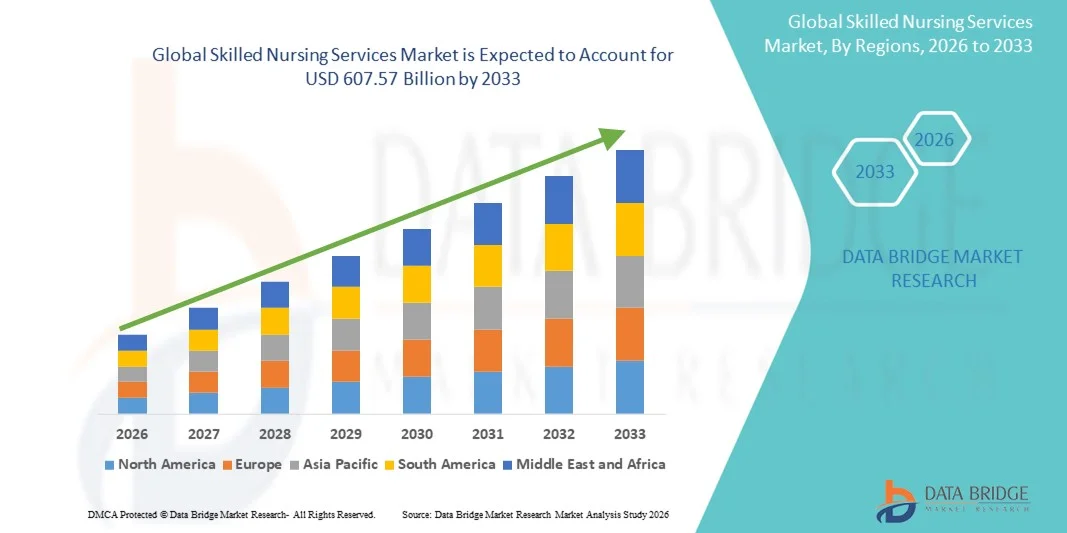
- As per Data Bridge Market Research analysis, the global skilled nursing services market size was valued at USD 308.30 billion in 2025 and is expected to reach USD 607.57 billion by 2033, at a CAGR of 8.85% during the forecast period
- The market growth is largely driven by the rising aging population, increasing prevalence of chronic diseases, and growing demand for post-acute care and long-term healthcare services. Expansion of healthcare infrastructure and improved insurance coverage are further facilitating access to skilled nursing care
- In addition, increasing focus on patient-centric care, technological advancements in healthcare monitoring, and home-based nursing services are reinforcing skilled nursing services as a preferred care model. These factors collectively are driving market adoption and propelling industry growth
Market Size & Forecast
- Market Value (2025): USD 308.30 Billion
- Expected Market Value (2033): USD 607.57 Billion
- Forecast CAGR: 8.85%
What are the Major Takeaways of Skilled Nursing Services Market?
- Skilled nursing services, providing professional medical care and rehabilitation for patients recovering from illness, injury, or surgery, are becoming increasingly critical in post-acute and long-term care settings due to their comprehensive healthcare support, personalized care plans, and integration with broader healthcare systems
- The growing demand for skilled nursing services is primarily driven by the aging global population, rising prevalence of chronic and lifestyle-related diseases, and increasing focus on quality post-hospitalization care
- North America dominated the skilled nursing services market with the largest revenue share of 38.9% in 2025, supported by well-established healthcare infrastructure, high healthcare spending, and a strong presence of key service providers. The U.S. is witnessing substantial growth in skilled nursing facilities and home-based care services, driven by technological advancements in patient monitoring and integrated care solutions
- Asia-Pacific is expected to be the fastest-growing region in the skilled nursing services market during the forecast period due to increasing elderly population, rising healthcare awareness, and expanding healthcare infrastructure
- Connected to Hospital segment dominated the skilled nursing services market with a market share of 42.8% in 2025, driven by the benefits of seamless patient data integration, improved care coordination, and enhanced monitoring for better clinical outcomes
Report Scope and Skilled Nursing Services Market Segmentation
|
Attributes |
Skilled Nursing Services Key Market Insights |
|
Segments Covered |
|
|
Countries Covered |
North America
Europe
Asia-Pacific
Middle East and Africa
South America
|
|
Key Market Players |
|
|
Market Opportunities |
|
|
Value Added Data Infosets |
In addition to the insights on market scenarios such as market value, growth rate, segmentation, geographical coverage, and major players, the market reports curated by the Data Bridge Market Research also include in-depth expert analysis, patient epidemiology, pipeline analysis, pricing analysis, and regulatory framework |
What is the Key Trend in the Skilled Nursing Services Market?
Integration of Telehealth and Remote Monitoring
- A significant and accelerating trend in the global skilled nursing services market is the growing integration of telehealth platforms and remote patient monitoring technologies, enhancing care delivery and patient engagement
- For instance, telehealth-enabled skilled nursing facilities allow nurses and physicians to conduct virtual consultations, monitor vital signs remotely, and adjust care plans in real time, improving clinical outcomes
- Remote monitoring systems in skilled nursing services facilitate early detection of health deterioration, medication adherence tracking, and personalized care interventions, reducing hospital readmissions and enhancing patient safety
- The seamless integration of telehealth tools with electronic health records (EHRs) and care management platforms allows centralized patient data access, enabling coordinated care across hospitals, assisted living communities, and home healthcare providers
- This trend towards more connected, technology-driven care is reshaping expectations for patient management and outcomes. Consequently, companies such as Amedisys and LHC Group are deploying remote monitoring-enabled skilled nursing programs to improve quality of care and operational efficiency
- The demand for telehealth-integrated skilled nursing services is growing rapidly across both post-acute and long-term care settings, as healthcare providers prioritize convenience, continuous monitoring, and better patient outcomes
- Increasing adoption of AI-powered analytics in skilled nursing services is enabling predictive care, early risk detection, and optimization of staffing schedules to improve efficiency and patient satisfaction
- Collaborative care models linking skilled nursing facilities with hospitals and primary care providers are becoming more prevalent, improving continuity of care and reducing hospital readmissions for chronic disease patients
Skilled Nursing Services Market Dynamics
Driver
Increasing Demand Due to Aging Population and Chronic Disease Prevalence
- The rising global elderly population, coupled with increasing incidence of chronic diseases, is a major driver fueling the demand for skilled nursing services across both residential and hospital-linked settings
- For instance, in March 2025, Genesis Healthcare expanded its post-acute skilled nursing programs in response to growing needs for elderly care and chronic disease management in U.S. communities
- As older adults require more specialized care for conditions such as cardiovascular disease, diabetes, and dementia, skilled nursing services provide professional medical support, rehabilitation, and continuous monitoring
- Furthermore, increasing patient awareness of post-hospitalization care benefits and the desire for high-quality, personalized care are making skilled nursing services an essential part of the healthcare continuum
- The ability to provide integrated care plans, coordination with primary healthcare providers, and home-based nursing support are key factors propelling the adoption of skilled nursing services in both North America and emerging markets
- Expanding insurance coverage and government initiatives supporting long-term care are enabling more patients to access skilled nursing services, driving market growth
- Rising investment in technology-driven skilled nursing solutions, including wearable health devices and remote monitoring platforms, is enhancing care quality and operational efficiency, further boosting market demand
Restraint/Challenge
Staff Shortages and Regulatory Compliance Hurdles
- Shortages of trained nursing staff and high turnover rates pose a significant challenge to the scalability and quality of skilled nursing services, limiting service availability in certain regions
- For instance, reports of staffing deficits in U.S. skilled nursing facilities have delayed patient admissions and impacted quality-of-care metrics, making recruitment and retention a critical concern for operators
- Meeting stringent regulatory requirements, licensing standards, and quality certifications adds operational complexity and increases costs for skilled nursing providers, particularly in highly regulated markets
- In addition, reimbursement challenges from insurance providers and public healthcare programs can constrain investment in technology, facility upgrades, and workforce expansion
- While initiatives to improve workforce training and compliance are ongoing, addressing staffing gaps and regulatory hurdles remains vital for ensuring sustainable market growth
- Overcoming these challenges through enhanced workforce planning, regulatory support, and adoption of technology-driven care solutions will be key for long-term expansion of skilled nursing services globally
- Variability in patient needs and care complexity requires flexible service models, making standardization difficult and increasing operational challenges for providers
- High operational costs in upgrading facilities, implementing advanced care technologies, and maintaining compliance can limit market expansion, particularly in developing regions
How is the Skilled Nursing Services Market Segmented?
The market is segmented on the basis of connectivity and application.
- By Connectivity
On the basis of connectivity, the skilled nursing services market is segmented into connected to hospital, connected to assisted living community, connected to both, and freestanding. The Connected to Hospital segment dominated the market with the largest revenue share of 42.8% in 2025, driven by the seamless integration of skilled nursing facilities with hospital systems. Hospitals benefit from improved patient data sharing, coordinated care plans, and faster response to clinical needs, which enhances care quality and reduces hospital readmissions. Patients transitioning from acute care to skilled nursing facilities prefer hospital-connected services for continuity of care, particularly for chronic disease management and post-surgical rehabilitation. This connectivity allows physicians to monitor patient progress remotely and adjust treatment plans efficiently. In addition, hospital-linked skilled nursing facilities often have access to advanced medical equipment and specialist support, making them a preferred choice for higher-acuity patients. The strong presence of established healthcare networks in North America and Europe further reinforces the dominance of this segment.
The Connected to Both segment is expected to witness the fastest growth from 2026 to 2033, fueled by the increasing demand for integrated care models linking hospitals and assisted living communities. This connectivity ensures continuity of care across multiple care settings, allowing patients to benefit from coordinated monitoring, personalized rehabilitation programs, and shared electronic health records. Providers can optimize resource utilization, improve staff allocation, and enhance patient outcomes through data-driven decision-making. Patients and families increasingly prefer facilities that offer flexibility and integrated services, supporting growth in this segment. Emerging technologies, including telehealth and remote monitoring, further accelerate adoption, as they facilitate real-time communication between hospital systems and assisted living facilities.
- By Application
On the basis of application, the skilled nursing services market is segmented into man and woman. The Woman segment dominated the market with a revenue share of 51.2% in 2025, largely due to the longer life expectancy of women and higher prevalence of age-related chronic conditions such as osteoporosis, cardiovascular disorders, and arthritis. Women are also more such asly to require long-term care and post-acute rehabilitation services, boosting demand for skilled nursing facilities. Gender-specific healthcare programs, wellness initiatives, and personalized care plans contribute to the strong adoption of services tailored for women. In addition, increasing awareness among women about preventive care, rehabilitation, and chronic disease management is reinforcing this segment’s dominance. Skilled nursing providers are expanding women-focused programs, including specialized physical therapy and geriatric care, to address these growing needs.
The Man segment is expected to witness the fastest growth from 2026 to 2033, driven by rising awareness of men’s health, increasing incidence of lifestyle-related chronic conditions, and expanding insurance coverage. Men are showing higher utilization of skilled nursing services post-hospitalization and for long-term care as they age, particularly for cardiac rehabilitation and mobility support. The adoption of digital health monitoring and remote care solutions further encourages male patients to access skilled nursing services. Healthcare providers are increasingly designing male-focused rehabilitation programs, exercise regimens, and chronic disease management services, fueling growth in this application segment.
Which Region Holds the Largest Share of the Skilled Nursing Services Market?
- North America dominated the skilled nursing services market with the largest revenue share of 38.9% in 2025, supported by well-established healthcare infrastructure, high healthcare spending, and a strong presence of key service providers
- Patients and caregivers in the region highly value the availability of professional medical care, post-acute rehabilitation, and coordinated services offered by skilled nursing facilities, ensuring continuity of care after hospitalization
- This widespread adoption is further supported by high healthcare spending, advanced technological integration in patient monitoring, and government initiatives promoting long-term care, establishing skilled nursing services as a preferred care solution across both residential and hospital-linked settings
U.S. Skilled Nursing Services Market Insight
The U.S. skilled nursing services market captured the largest revenue share of 79% in 2025 within North America, driven by the increasing elderly population, rising prevalence of chronic diseases, and robust healthcare infrastructure. Patients and caregivers increasingly prioritize access to post-acute care, rehabilitation services, and long-term nursing support. The growing adoption of telehealth and remote monitoring technologies, combined with integrated care programs linking hospitals and skilled nursing facilities, further propels the market. Moreover, government initiatives and insurance coverage supporting long-term and post-hospitalization care are significantly contributing to the market’s expansion.
Europe Skilled Nursing Services Market Insight
The Europe skilled nursing services market is projected to expand at a substantial CAGR throughout the forecast period, primarily driven by aging populations, increasing chronic disease incidence, and the growing demand for professional long-term care. Healthcare regulations promoting quality and safety in skilled nursing facilities are further encouraging adoption. European patients and families are drawn to the continuity of care, comprehensive rehabilitation programs, and integrated care models provided by skilled nursing services. The region is experiencing significant growth across hospital-connected and assisted living community-linked facilities, catering to both post-acute and long-term care needs.
U.K. Skilled Nursing Services Market Insight
The U.K. skilled nursing services market is anticipated to grow at a noteworthy CAGR during the forecast period, fueled by rising elderly demographics, increased awareness of post-hospitalization care, and growing demand for personalized rehabilitation services. Concerns about chronic disease management and the need for continuous monitoring are encouraging both hospitals and assisted living communities to expand skilled nursing programs. The U.K.’s well-established healthcare system, alongside strong public and private insurance frameworks, is expected to continue to stimulate market growth.
Germany Skilled Nursing Services Market Insight
The Germany skilled nursing services market is expected to expand at a considerable CAGR during the forecast period, driven by rising elderly populations, increasing chronic disease prevalence, and high-quality healthcare infrastructure. Germany’s emphasis on patient safety, quality rehabilitation, and technological adoption promotes the utilization of skilled nursing facilities. Integration of skilled nursing services with hospitals and home-based care programs is also becoming increasingly prevalent, with a strong preference for specialized, continuous care for post-acute and chronic conditions aligning with local patient expectations.
Asia-Pacific Skilled Nursing Services Market Insight
The Asia-Pacific skilled nursing services market is poised to grow at the fastest CAGR of 23% during the forecast period of 2026 to 2033, driven by increasing aging populations, urbanization, and rising healthcare awareness in countries such as China, Japan, and India. The region’s growing inclination towards professional long-term care, supported by government initiatives promoting elderly care and chronic disease management, is driving adoption. Furthermore, expanding healthcare infrastructure and rising affordability of skilled nursing services are increasing accessibility for a wider patient base across residential and assisted living settings.
Japan Skilled Nursing Services Market Insight
The Japan skilled nursing services market is gaining momentum due to the country’s rapidly aging population, increasing life expectancy, and growing demand for post-acute and long-term care services. Japanese patients and caregivers prioritize professional nursing support, rehabilitation programs, and integration with hospital care. The adoption of telehealth and remote patient monitoring is further enhancing service delivery. Moreover, Japan’s emphasis on technology-enabled healthcare and home-based nursing programs is fueling growth across both residential and commercial care facilities.
India Skilled Nursing Services Market Insight
The India skilled nursing services market accounted for the largest market revenue share in Asia Pacific in 2025, attributed to the country’s expanding elderly population, rapid urbanization, and increasing awareness of long-term care needs. India is witnessing a growing preference for professional nursing services in hospitals, assisted living communities, and home-based care. Government initiatives supporting elderly care, the rise of private healthcare providers, and improving insurance coverage are key factors propelling market growth. In addition, increasing availability of technology-enabled care solutions is enhancing the quality and accessibility of skilled nursing services across the country.
Which are the Top Companies in Skilled Nursing Services Market?
The Skilled Nursing Services industry is primarily led by well-established companies, including:
- Ensign Group, Inc. (U.S.)
- Life Care Centers of America (U.S.)
- Genesis HealthCare (U.S.)
- Brookdale Senior Living (U.S.)
- Consulate Health Care (U.S.)
- SavaSeniorCare Administrative Services (U.S.)
- Diversicare Healthcare Services (U.S.)
- Signature HealthCARE LLC (U.S.)
- National HealthCare Corporation (U.S.)
- Trilogy Health Services LLC (U.S.)
- ProMedica Senior Care (U.S.)
- Atria Senior Living (U.S.)
- Sunrise Senior Living, LLC (U.S.)
- Five Star Senior Living Inc. (U.S.)
- Kindred Healthcare (U.S.)
- HCR ManorCare (U.S.)
- Golden LivingCenters (U.S.)
- CareOne LLC (U.S.)
- PruittHealth (U.S.)
- Avamere Family of Companies (U.S.)
What are the Recent Developments in Global Skilled Nursing Services Market?
- In November 2025, Brookdale Senior Living announced that eight of its skilled nursing communities were recognized as “Best Nursing Homes 2026” by U.S. News & World Report, reflecting outstanding performance in quality care, staffing, and resident satisfaction across short‑term rehabilitation and long‑term care services
- In August 2025, Optum (UnitedHealth Group’s care services unit) completed its USD 3.3 billion acquisition of Amedisys, a major provider of home health, hospice, and high‑acuity care including in‑home skilled nursing services—following DOJ settlement conditions. This deal significantly expands Optum’s footprint in post‑acute care delivery
- In March 2025, Brookdale Senior Living completed the acquisition of multiple senior living communities, including 94 skilled nursing units, as part of a USD 310 million portfolio expansion. This transaction strengthens Brookdale’s real estate position and signals ongoing consolidation in senior care services
- In November 2023, MOBOTIX AG and Kepler Vision Technologies launched an intelligent sensor solution for hospital and care facilities, including skilled nursing homes, to improve patient safety through advanced monitoring and fall detection indicating increasing adoption of tech innovations in skilled nursing environments
- In June 2023, UnitedHealth Group’s Optum reached an agreement to acquire Amedisys in an all‑cash USD 3.3 billion deal, aiming to advance value‑based care across home health and related services that support skilled nursing and post‑acute care patients. This proposed combination highlighted strategic consolidation in the broader skilled nursing and post‑acute care market

- Interactive Data Analysis Dashboard
- Company Analysis Dashboard for high growth potential opportunities
- Research Analyst Access for customization & queries
- Competitor Analysis with Interactive dashboard
- Latest News, Updates & Trend analysis
- Harness the Power of Benchmark Analysis for Comprehensive Competitor Tracking
Data collection and base year analysis are done using data collection modules with large sample sizes. The stage includes obtaining market information or related data through various sources and strategies. It includes examining and planning all the data acquired from the past in advance. It likewise envelops the examination of information inconsistencies seen across different information sources. The market data is analysed and estimated using market statistical and coherent models. Also, market share analysis and key trend analysis are the major success factors in the market report. To know more, please request an analyst call or drop down your inquiry.
The key research methodology used by DBMR research team is data triangulation which involves data mining, analysis of the impact of data variables on the market and primary (industry expert) validation. Data models include Vendor Positioning Grid, Market Time Line Analysis, Market Overview and Guide, Company Positioning Grid, Patent Analysis, Pricing Analysis, Company Market Share Analysis, Standards of Measurement, Global versus Regional and Vendor Share Analysis. To know more about the research methodology, drop in an inquiry to speak to our industry experts.
Data Bridge Market Research is a leader in advanced formative research. We take pride in servicing our existing and new customers with data and analysis that match and suits their goal. The report can be customized to include price trend analysis of target brands understanding the market for additional countries (ask for the list of countries), clinical trial results data, literature review, refurbished market and product base analysis. Market analysis of target competitors can be analyzed from technology-based analysis to market portfolio strategies. We can add as many competitors that you require data about in the format and data style you are looking for. Our team of analysts can also provide you data in crude raw excel files pivot tables (Fact book) or can assist you in creating presentations from the data sets available in the report.













