


Sleep Bruxism Market Size
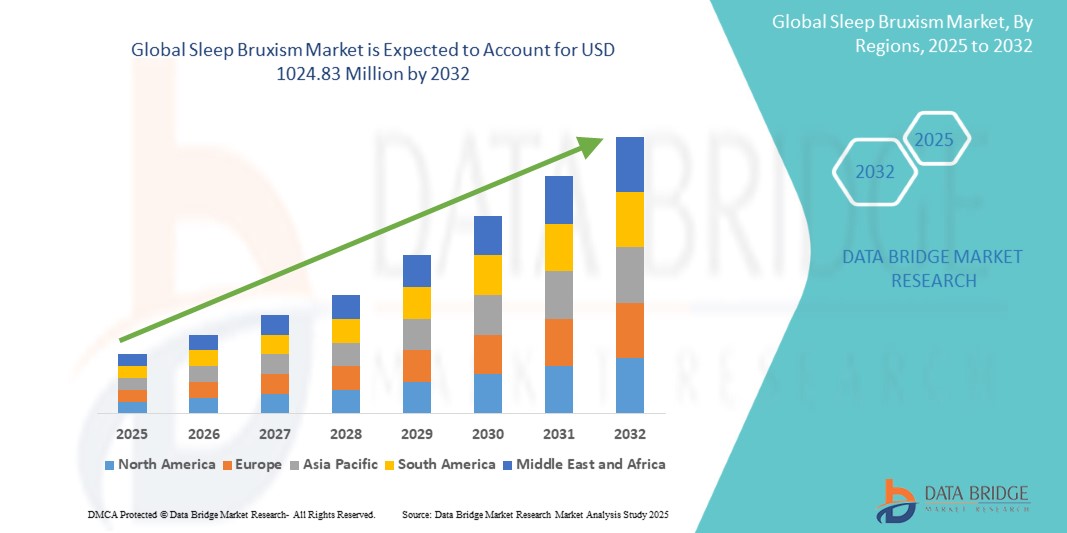
- The Global Sleep Bruxism Market size was valued at USD 610.01 Million in 2024 and is expected to reach USD 1024.83 Million by 2032, at a CAGR of 6.7% during the forecast period
The market growth is largely driven by increasing awareness and diagnosis of sleep-related disorders such as obstructive sleep apnea, gastroesophageal reflux disease (GERD), malocclusion, and sleep paralysis, which are recognized as leading causes of bruxism.
Furthermore, the rising demand for effective and non-invasive treatment options—such as mouth guards, NTI-TSS devices, splints, and pharmacological solutions like sedatives, muscle relaxants, and antidepressants—is contributing to a broader acceptance and adoption of bruxism therapies.
Advancements in diagnostic tools including polysomnography, X-rays, and electromyography methods, along with the growing availability of treatments through hospitals, dental clinics, and online pharmacies, are further boosting market expansion.
Sleep Bruxism Market Analysis
- Sleep bruxism, characterized by involuntary grinding or clenching of teeth during sleep, is increasingly recognized as a significant sleep-related movement disorder. It is gaining clinical attention due to its association with tooth damage, jaw disorders, headaches, and sleep disturbances, impacting both dental health and overall well-being.
- The growing demand for diagnostic accuracy and personalized treatment is primarily driven by the increasing incidence of stress-related disorders, sleep apnea, and gastroesophageal reflux disease (GERD)—conditions strongly linked with the onset of sleep bruxism.
- North America dominates the sleep bruxism market with the largest revenue share of 37.5% in 2025, supported by high awareness levels, widespread access to sleep diagnostic facilities, strong healthcare infrastructure, and a growing focus on oral health. The U.S. in particular is witnessing an uptick in dental clinic consultations and custom mouthguard prescriptions, further accelerated by technological advancements in diagnostic methods such as polysomnography and EMG.
- Asia-Pacific is projected to be the fastest-growing region during the forecast period, fueled by increased stress levels in urban populations, rising healthcare expenditure, and growing access to non-invasive bruxism treatments and dental care services.
- The mouth guard segment is expected to dominate the implants category with a market share of 45.8% in 2025, driven by its widespread use as a first-line intervention, ease of customization, affordability, and strong adoption by both general dentists and sleep specialists.
Report Scope and Sleep Bruxism Market Segmentation
|
Attributes |
Sleep Bruxism Key Market Insights |
|
Segments Covered |
|
|
Countries Covered |
North America
Europe
Asia-Pacific
Middle East and Africa
South America
|
|
Key Market Players |
|
|
Market Opportunities |
|
|
Value Added Data Infosets |
In addition to the insights on market scenarios such as market value, growth rate, segmentation, geographical coverage, and major players, the market reports curated by the Data Bridge Market Research also include in-depth expert analysis, pricing analysis, brand share analysis, consumer survey, demography analysis, supply chain analysis, value chain analysis, raw material/consumables overview, vendor selection criteria, PESTLE Analysis, Porter Analysis, and regulatory framework. |
Sleep Bruxism Market Trends
“Technological Advancements in Diagnostics and Personalized Treatment”
- A significant and accelerating trend in the global sleep bruxism market is the integration of advanced diagnostic technologies and personalized therapeutic approaches, which is reshaping how sleep bruxism is identified, monitored, and managed.
- Digital polysomnography systems, portable EMG devices, and AI-powered wearables are increasingly used to monitor nocturnal muscle activity and provide objective assessments of bruxism episodes in both clinical and at-home settings.
- For instance, BruxApp, a mobile application connected to wearable EMG devices, allows users to log jaw activity and receive real-time feedback, improving patient engagement and aiding clinicians in tailoring treatment plans. Similarly, emerging smart dental splints with embedded sensors are being developed to track bite force and frequency, enabling clinicians to measure treatment effectiveness over time.
- These innovations support a shift toward data-driven and personalized bruxism management, especially when combined with telemedicine platforms and cloud-based analytics. They not only help differentiate between awake and sleep bruxism but also assist in identifying underlying causes such as stress, obstructive sleep apnea (OSA), or GERD.
- As patients and practitioners increasingly seek minimally invasive, cost-effective, and evidence-based solutions, the adoption of custom-fit mouthguards, cognitive behavioral therapy (CBT), biofeedback, and medication is expanding.
- This trend towards digitally enabled, patient-centric, and multidisciplinary care models is enhancing treatment outcomes and expanding access to bruxism care—particularly in urban and high-tech markets.
Sleep Bruxism Market Dynamics
Driver
“Rising Stress Levels and Increased Awareness of Sleep-Related Disorders”
- The growing global burden of stress and anxiety-related conditions, especially in urbanized and high-paced environments, is a major driver fueling the demand for sleep bruxism diagnosis and treatment.
- As lifestyle-related psychological disorders increase, more individuals are experiencing bruxism as a secondary symptom—triggering demand for both dental and behavioral interventions.
- Additionally, increasing awareness of the link between sleep bruxism and serious conditions like obstructive sleep apnea, GERD, and temporomandibular joint disorders (TMJD) is encouraging patients to seek early diagnosis and appropriate care.
- For instance, many dental and sleep clinics have introduced routine screening for bruxism during dental check-ups and sleep evaluations, leading to higher diagnostic rates and better treatment penetration.
- Educational campaigns, particularly in North America and parts of Europe, are raising awareness of the long-term impact of untreated bruxism, including chronic pain, tooth damage, and sleep disruption—prompting both healthcare providers and patients to take proactive steps.
- The trend is supported by advancements in diagnostic tools and personalized therapy options, making it easier to provide targeted treatment based on the patient’s condition, lifestyle, and comorbidities.
Restraint/Challenge
“Limited Access to Diagnosis and High Cost of Custom Treatments”
- Despite the growing recognition of sleep bruxism, limited access to specialized diagnostic tools and treatment options in low- and middle-income regions remains a significant challenge.
- Traditional diagnostic methods such as polysomnography and EMG are often expensive, time-consuming, and typically confined to urban healthcare centers, restricting reach in underserved markets.
- Furthermore, custom-fabricated mouthguards and dental splints, which are among the most commonly recommended treatments, may be cost-prohibitive for many patients, especially without dental insurance coverage.
- In emerging markets, the lack of insurance reimbursement for dental sleep treatments further hinders adoption, leading many to rely on over-the-counter or DIY solutions that may not be clinically effective.
- Additionally, the overlap of symptoms with other disorders like TMJD or sleep apnea can complicate diagnosis, requiring multidisciplinary evaluations which may not be readily accessible in all regions.
- Bridging these gaps requires cost reduction strategies, expanded tele-dentistry platforms, insurance reforms, and the development of low-cost, yet clinically validated diagnostic and treatment alternatives to ensure widespread adoption and improved outcomes globally.
Sleep Bruxism Market Scope
The market is segmented on the basis of diagnostics, implants, medications, cause, end user, and distribution channel.
• By Diagnostics
On the basis of diagnostics, the sleep bruxism market is segmented into polysomnography, X-rays, electromyography (EMG) methods, Botox injections, and others. The polysomnography segment dominates the market with the largest revenue share of 38.4% in 2025, owing to its status as the gold standard in diagnosing sleep-related disorders, including bruxism. Polysomnography provides comprehensive data on sleep stages, muscle movements, and respiratory patterns, enabling accurate differentiation between sleep bruxism and other conditions like obstructive sleep apnea. Its widespread use in sleep clinics, especially across North America and Europe, contributes to its strong market presence.
The electromyography (EMG) methods segment is projected to witness the fastest CAGR of 7.9% from 2025 to 2032, driven by the increasing adoption of portable EMG devices for home monitoring and early bruxism detection. These devices offer a cost-effective alternative to lab-based testing and are gaining popularity among dental clinics and telemedicine providers for real-time muscle activity analysis. EMG-based diagnostics also support continuous monitoring, aiding in personalized treatment adjustments over time.
• By Implants
On the basis of implants, the market is segmented into mouth guards, NTI-TSS devices, and splints. The mouth guards segment dominates the market with the largest revenue share of 45.8% in 2025, driven by their wide acceptance as a non-invasive, affordable, and first-line treatment option for sleep bruxism. Custom-fit guards are increasingly prescribed by dental professionals for protection against enamel wear and jaw strain.
The NTI-TSS device segment is projected to experience the fastest CAGR from 2025 to 2032, due to growing adoption in patients with severe temporomandibular joint (TMJ) disorders and tension-type headaches. These devices are favored for their targeted muscle relaxation benefits and effectiveness in severe bruxism cases.
• By Medications
On the basis of medications, the market is segmented into sedatives, muscle relaxants, and antidepressants. The muscle relaxants segment accounted for the largest revenue share in 2025, attributed to their ability to relieve nocturnal muscle tension and reduce clenching intensity. These are commonly prescribed in conjunction with behavioral therapy or dental devices for short-term management.
The antidepressants segment is expected to record the fastest CAGR from 2025 to 2032, driven by the rising prevalence of bruxism associated with psychological stress, anxiety, and depression. Selective serotonin reuptake inhibitors (SSRIs) and tricyclic antidepressants are being explored for dual-purpose therapy.
• By Cause
On the basis of cause, the market is segmented into obstructive sleep apnea (OSA), gastroesophageal reflux disease (GERD), malocclusion, sleep paralysis, and others. Obstructive sleep apnea is projected to dominate with the largest market share in 2025, due to a growing understanding of its strong association with sleep bruxism. Many clinicians are now routinely screening for bruxism in OSA patients as part of holistic sleep assessments.
The malocclusion segment is anticipated to witness the fastest growth during the forecast period, driven by rising dental awareness, orthodontic diagnoses, and growing demand for corrective dental procedures globally.
• By End User
On the basis of end user, the market is segmented into hospitals, dental clinics, and others. Dental clinics held the largest revenue share in 2025, owing to their role as the primary point of diagnosis and treatment for bruxism. With increasing awareness about dental damage caused by bruxism, more patients are seeking professional evaluation and custom treatment plans at dental practices.
Hospitals are expected to register the fastest CAGR from 2025 to 2032, supported by the rise in integrated care models where multidisciplinary teams address bruxism as part of broader sleep disorder management.
• By Distribution Channel
On the basis of distribution channel, the market is segmented into direct tender, hospital pharmacy, dental clinics, retail pharmacy, online pharmacy, and others. Dental clinics dominate the market in 2025 with the largest revenue share, as most custom mouthguards and NTI-TSS devices are prescribed and dispensed directly by dental professionals.
The online pharmacy segment is projected to experience the fastest CAGR from 2025 to 2032, driven by increasing consumer preference for convenience, rising e-commerce penetration, and the availability of over-the-counter night guards and bruxism aids via digital platforms.
Sleep Bruxism Market Regional Analysis
- North America dominates the global sleep bruxism market with the largest revenue share of 37.5% in 2024, driven by heightened awareness of sleep-related disorders, well-established dental and sleep diagnostic infrastructure, and the high prevalence of stress and lifestyle-related conditions.
- Consumers in the region are increasingly seeking effective and early intervention for bruxism, with a strong emphasis on non-invasive treatments, custom dental appliances, and integrated behavioral therapy.
- This widespread adoption is further supported by greater access to specialized care, high healthcare expenditure, and a rising focus on preventive oral health, establishing sleep bruxism diagnosis and treatment as a standard component of both dental and sleep medicine practices across residential and clinical settings.
U.S. Sleep Bruxism Market Insight
The U.S. sleep bruxism market captured the largest revenue share of 80.3% within North America in 2025, driven by a high prevalence of stress-related disorders and sleep disturbances. The country’s advanced healthcare infrastructure, widespread dental coverage, and strong presence of sleep clinics contribute to early diagnosis and comprehensive treatment of bruxism. The adoption of custom dental appliances, EMG-based diagnostics, and behavioral therapy is accelerating, while increasing public awareness campaigns continue to educate patients on the long-term effects of untreated bruxism. Integration of sleep bruxism screening into routine dental and sleep evaluations further supports market growth.
Europe Sleep Bruxism Market Insight
The European sleep bruxism market is projected to expand at a substantial CAGR during the forecast period, primarily driven by rising dental health awareness, a growing geriatric population, and increasing access to advanced diagnostic tools. Regulatory support for dental care, coupled with government-sponsored sleep disorder programs in countries like Germany and France, is promoting early detection and intervention. The region also sees expanding adoption of mouthguards and splints in both public and private dental settings, with notable demand in urban and aging populations.
U.K. Sleep Bruxism Market Insight
The U.K. sleep bruxism market is expected to grow at a noteworthy CAGR over the forecast period, fueled by rising public concern over stress-induced dental issues and disrupted sleep patterns. NHS-supported dental care, a robust network of sleep specialists, and increasing media coverage around the health risks of bruxism are driving demand for customized mouthguards and EMG-based screening. Additionally, consumer preference for non-invasive and holistic treatment options is stimulating interest in behavioral therapies and cognitive stress management programs.
Germany Sleep Bruxism Market Insight
The German sleep bruxism market is expected to expand at a considerable CAGR, supported by a well-established healthcare system, strong dental care access, and rising public investments in sleep medicine. German consumers are increasingly opting for digitally enabled diagnostic tools and eco-conscious treatment solutions such as biocompatible dental appliances. The country’s focus on preventive dental health and integration of digital health platforms into routine care are further boosting the adoption of innovative sleep bruxism interventions.
Asia-Pacific Sleep Bruxism Market Insight
The Asia-Pacific sleep bruxism market is poised to grow at the fastest CAGR of over 8.5% in 2025, driven by increasing stress levels, urban lifestyle shifts, and a growing middle class in countries like China, India, and Japan. Rising healthcare awareness and improvements in dental infrastructure are enabling more timely diagnosis and treatment. Government initiatives promoting oral health and digital health tools are further expanding access to cost-effective diagnostic solutions and over-the-counter night guards, making bruxism care more accessible to wider demographics.
Japan Sleep Bruxism Market Insight
The Japan sleep bruxism market is gaining momentum due to the country’s high stress culture, aging population, and strong affinity for advanced technology in healthcare. Japanese consumers are actively adopting AI-powered dental solutions, portable EMG devices, and custom dental appliances to manage bruxism symptoms. The integration of bruxism treatment into broader sleep wellness programs, along with the country's high standard for dental care and hygiene, is accelerating the market’s expansion.
China Sleep Bruxism Market Insight
The China sleep bruxism market accounted for the largest revenue share in Asia-Pacific in 2025, driven by rapid urbanization, increasing dental awareness, and strong domestic manufacturing of dental products. The expanding middle class, combined with the rising prevalence of workplace stress and sleep disorders, is contributing to higher demand for diagnostic screenings and mouthguard solutions. Government health initiatives and widespread access to affordable, tech-enabled dental care are also driving consumer adoption of bruxism management tools across both urban and rural areas.
Sleep Bruxism Market Share
The Sleep Bruxism industry is primarily led by well-established companies, including:
- Pfizer Inc. (U.S.)
- Randmark Dental Products (U.S.)
- Akervall Technologies (U.S.)
- Patterson Dental Supply (U.S.)
- Henry Schein (U.S.)
- Carestream Dental (U.S.)
- S4S Dental Laboratory (UK)
- Merz Pharma GmbH & Co. (Germany)
- PLANMECA OY (Finland)
- Ipsen Biopharmaceuticals (France)
- Dental Lab India (India)
- Bupa (UK)
- American Dental Craft (U.S.)
- Polpharma (Poland)
- Covis Pharma (Switzerland)
- Norwich Pharma Services (U.S.)
- Teva Pharmaceutical Industries Ltd. (Israel)
- Oventus (Australia)
- Energy Resources International Co., Ltd. (South Korea)
- Implants Broadcast International (U.S.)
- Bio 3 Implants GMBH (Germany)
- BioMedical Industry Group Inc. (Taiwan)

- Interactive Data Analysis Dashboard
- Company Analysis Dashboard for high growth potential opportunities
- Research Analyst Access for customization & queries
- Competitor Analysis with Interactive dashboard
- Latest News, Updates & Trend analysis
- Harness the Power of Benchmark Analysis for Comprehensive Competitor Tracking
Data collection and base year analysis are done using data collection modules with large sample sizes. The stage includes obtaining market information or related data through various sources and strategies. It includes examining and planning all the data acquired from the past in advance. It likewise envelops the examination of information inconsistencies seen across different information sources. The market data is analysed and estimated using market statistical and coherent models. Also, market share analysis and key trend analysis are the major success factors in the market report. To know more, please request an analyst call or drop down your inquiry.
The key research methodology used by DBMR research team is data triangulation which involves data mining, analysis of the impact of data variables on the market and primary (industry expert) validation. Data models include Vendor Positioning Grid, Market Time Line Analysis, Market Overview and Guide, Company Positioning Grid, Patent Analysis, Pricing Analysis, Company Market Share Analysis, Standards of Measurement, Global versus Regional and Vendor Share Analysis. To know more about the research methodology, drop in an inquiry to speak to our industry experts.
Data Bridge Market Research is a leader in advanced formative research. We take pride in servicing our existing and new customers with data and analysis that match and suits their goal. The report can be customized to include price trend analysis of target brands understanding the market for additional countries (ask for the list of countries), clinical trial results data, literature review, refurbished market and product base analysis. Market analysis of target competitors can be analyzed from technology-based analysis to market portfolio strategies. We can add as many competitors that you require data about in the format and data style you are looking for. Our team of analysts can also provide you data in crude raw excel files pivot tables (Fact book) or can assist you in creating presentations from the data sets available in the report.












