


What is the Slicing Equipment Market Size and Growth Rate?
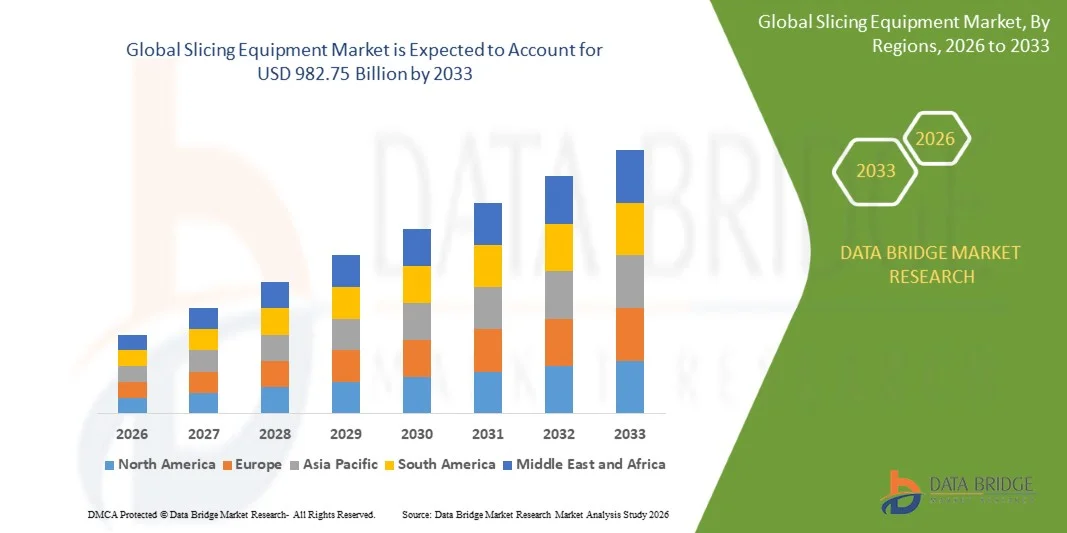
- As per Data Bridge Market Research analysis, the Slicing Equipment market was valued at USD 706.78 Million in 2025 and is projected to reach USD 982.75 Million by 2033, growing at a CAGR of 4.20% from 2026 to 2033.
- The market is experiencing consistent growth driven by rising demand for efficient and precise food preparation, increasing adoption of automated and semi-automatic slicing equipment, and expanding applications across food processing plants, restaurants, supermarkets, and other foodservice establishments. The growing consumption of ready-to-eat, pre-sliced, and convenience food products is further supporting the adoption of advanced slicing solutions that improve productivity, consistency, and operational efficiency.
- The increasing emphasis on food safety, hygiene, labor efficiency, and consistent product quality, combined with technological advancements in automated slicing systems, is encouraging food processors and commercial kitchens to upgrade their equipment. Automatic and semi-automatic slicers are increasingly being adopted to reduce manual intervention, improve slicing precision, minimize product waste, and support high-volume processing requirements.
Market Size & Forecast
- Global Market Value (2025): USD 706.78 Million
- Expected Market Value (2033): USD 982.75 Million
- Forecast CAGR (2026–2033): 4.20%
- Leading Region in 2025: North America
- Fastest Growing Region: Asia Pacific
What are the Major Takeaways of the Slicing Equipment Market?
- North America dominated the Slicing Equipment market with the largest revenue share of 32.6% in 2025, supported by a well-established foodservice industry, high adoption of commercial kitchen technologies, strong demand for efficient food preparation solutions, and increasing use of automated slicing equipment.
- Asia-Pacific is expected to be the fastest-growing region at a CAGR of approximately 6.0% from 2026 to 2033, fueled by rapid urbanization, expansion of food processing industries, rising consumption of processed and convenience foods, and increasing adoption of automated slicing technologies across China, India, Japan, and Southeast Asia.
- The automatic slicing equipment segment led the market with a 61.9% share in 2025, driven by its ability to provide consistent slicing thickness, higher processing throughput, reduced manual intervention, and improved operational efficiency in high-volume food processing applications.
- Semi-automatic slicing equipment is expected to witness significant growth during the forecast period, supported by increasing demand from commercial kitchens, restaurants, and medium-scale food processors seeking a balance between automation, operational flexibility, and investment efficiency.
- The heavy-duty segment dominated the category segment in 2025, supported by its extensive use in high-volume food processing operations where continuous operation, durability, higher throughput, and consistent slicing performance are required.
- Medium-duty slicing equipment is expected to register steady growth during the forecast period, driven by increasing adoption among restaurants, commercial kitchens, and small- and medium-sized food processing businesses requiring reliable slicing performance and greater operational flexibility.
- Food processing plants accounted for the largest application share in 2025, with approximately 54.8%, driven by the extensive use of slicing equipment in high-throughput processing operations, increasing demand for processed and convenience foods, and the need for consistent product quality and reduced processing time.
- Important: I have retained percentages only where supporting market-research data is available. I have not invented percentages or CAGRs for the heavy-duty, medium-duty, or semi-automatic segments. The exact DBMR market itself reports the overall CAGR of 4.20%, while newer sources with the same segmentation provide additional segment/region shares.
Report Scope and Slicing Equipment Market Segmentation
|
Attributes |
Slicing Equipment Key Market Insights |
|
Segments Covered |
|
|
Countries Covered |
North America
Europe
Asia-Pacific
Middle East and Africa
South America
|
|
Key Market Players |
|
|
Market Opportunities |
|
|
Value Added Data Infosets |
In addition to the insights on market scenarios such as market value, growth rate, segmentation, geographical coverage, and major players, the market reports curated by the Data Bridge Market Research also include in-depth expert analysis, geographically represented company-wise production and capacity, network layouts of distributors and partners, detailed and updated price trend analysis and deficit analysis of supply chain and demand. |
What is the Key Trend in the Slicing Equipment Market?
- Manufacturers of slicing equipment are increasingly focusing on automated, high-throughput systems that improve slicing precision, reduce product waste, and minimize manual intervention across food processing operations.
- For instance, in May 2025, GEA introduced innovations to its automated One-Line-Concept at IFFA, including the OptiSlicer 7000, which can process calibrated products at capacities of up to 2,000 kg/h in its single-drive configuration, supporting high-volume slicing with improved portion control and efficiency.
- Advances in automated slicing technologies are enabling food processors to integrate scanning, slicing, portion control, weighing, and packaging into connected production lines, improving throughput while supporting more consistent product quality.
- Food equipment manufacturers are increasingly combining slicing technology with robotics and automated handling to address labor shortages, improve hygiene, and support continuous production in food processing, retail, and foodservice operations.
- For instance, in June 2025, Bizerba, in collaboration with FANUC and other technology partners, presented a fully automated robotic sandwich station integrating precise slicing, robotic handling, vacuum gripping, and high-precision dosing for hygienic, contact-free food preparation.
- As food manufacturers continue prioritizing automation, production efficiency, hygiene, portion accuracy, and waste reduction, the adoption of advanced automatic and semi-automatic slicing equipment is expected to accelerate, strengthening the role of integrated slicing solutions across high-volume food processing applications.
What are the Key Drivers of the Slicing Equipment Market?
- The increasing demand for processed, ready-to-eat, and convenience food products is driving the adoption of slicing equipment that enables consistent cutting, improved productivity, and higher processing efficiency across commercial food operations.
- For instance, in May 2025, GEA showcased its automated slicing solutions at IFFA 2025, including the OptiSlicer 7000, which supports processing capacities of up to 2,000 kg/h, demonstrating the growing emphasis on high-throughput and automated slicing operations.
- Food processors, restaurants, and commercial kitchens are increasingly adopting automatic and semi-automatic slicing equipment to reduce manual labor, improve portion consistency, enhance hygiene, and minimize product handling during high-volume operations.
- For instance, in June 2025, Bizerba, together with technology partners, presented an automated robotic food preparation solution integrating precision slicing and robotic handling, highlighting the increasing integration of slicing technologies with automated food-processing systems.
- With food manufacturers increasingly prioritizing automation, operational efficiency, hygiene, portion accuracy, and waste reduction, advanced slicing equipment is expected to remain an important solution across food processing plants, restaurants, and other commercial foodservice applications.
Which Factors are Challenging the Growth of the Slicing Equipment Market?
- Advanced automatic and semi-automatic slicing equipment requires higher initial investment compared with conventional manual slicing machines, which can limit adoption among small-scale food processors, restaurants, and other cost-sensitive end users.
- For instance, in May 2025, GEA highlighted advanced automated slicing solutions at IFFA 2025, including the OptiSlicer 7000, designed for high-throughput processing of up to 2,000 kg/h, demonstrating the higher level of automation and technology incorporated into modern slicing systems.
- The increasing technical complexity of slicing equipment, including automated controls, precision blades, sensors, conveyors, and integrated portioning systems, can increase maintenance requirements and require trained personnel for operation and servicing.
- Product variability remains another challenge, as differences in product size, shape, texture, temperature, and moisture content can affect slicing precision, throughput, blade performance, and overall equipment efficiency.
- The need to balance equipment cost, automation, maintenance, slicing precision, hygiene, throughput, and compatibility with existing food-processing lines continues to challenge end users, potentially slowing the replacement of conventional slicing equipment with advanced automated solutions.
How is the Slicing Equipment Market Segmented?
The Slicing Equipment market is segmented on the basis of type, category, application, and end user
- By Type
On the basis of type, the Slicing Equipment market is segmented into automatic slicing equipment, semi-automatic slicing equipment, and manual slicing equipment. The automatic slicing equipment segment dominated the market with 42.3% share in 2025, driven by increasing automation across food processing operations, the need for consistent slicing quality, higher processing throughput, and reduced dependence on manual labor. Automatic slicers are particularly suitable for large-scale food processing plants and commercial operations requiring continuous and standardized production. The integration of automated controls, precision cutting, and portioning technologies is further supporting adoption.
The automatic slicing equipment segment is projected to register the fastest growth at 6.2% CAGR during the forecast period, supported by increasing investments in industrial automation, food safety requirements, labor efficiency, and the growing production of processed and convenience foods. Automated systems enable higher throughput while maintaining consistent slice thickness and reducing product handling.
- By Category
On the basis of category, the Slicing Equipment market is segmented into heavy duty, medium duty, and light duty. The heavy-duty segment dominated the market with 45.0% share in 2025, driven by increasing demand for high-capacity slicing solutions across large-scale food processing plants and industrial production facilities. Heavy-duty slicing equipment is particularly suitable for continuous operations requiring high throughput, durability, and consistent slicing performance. The increasing adoption of automated processing lines is further supporting demand for heavy-duty equipment.
The heavy-duty segment is projected to register the fastest growth at 4.8% CAGR during the forecast period, supported by increasing food production volumes, automation of processing operations, rising labor costs, and the need for reliable high-throughput equipment. Heavy-duty systems enable processors to handle larger product volumes while maintaining consistent slicing quality and operational efficiency.
- By Application
On the basis of application, the Slicing Equipment market is segmented into food processing plants, restaurants, and others. The food processing plants segment dominated the market with 55.0% share in 2025, driven by increasing demand for high-throughput slicing equipment across meat and poultry, fruits and vegetables, bakery, dairy, and other processed food applications. Slicing equipment is widely used in food processing plants to maintain consistent product dimensions, improve production efficiency, reduce product waste, and support standardized portion sizes. The increasing consumption of processed and convenience foods is further supporting adoption.
The food processing plants segment is projected to register the fastest growth at 5.0% CAGR during the forecast period, supported by increasing investments in automated food processing lines, rising production volumes, labor efficiency requirements, and growing emphasis on food safety and hygiene. Automated slicing systems enable higher processing capacity while maintaining consistent slicing precision and reducing manual handling.
- By End User
On the basis of end user, the Slicing Equipment market is segmented into food processing industry, foodservice industry, retail and deli sector, institutional kitchens, and others. The food processing industry dominated the market with 52.0% share in 2025, driven by extensive demand for automated and high-capacity slicing equipment across industrial food production facilities. Food processors increasingly adopt slicing systems to improve production throughput, maintain consistent product dimensions, reduce manual intervention, and support food hygiene requirements. The growing demand for processed, ready-to-eat, and pre-sliced food products is further supporting adoption.
The food processing industry segment is projected to register the fastest growth at 5.1% CAGR during the forecast period, supported by increasing food production, automation initiatives, labor shortages, stringent hygiene requirements, and the need for consistent product quality. Advanced slicing systems enable food processors to improve operational efficiency, reduce product waste, and meet the requirements of high-volume production environments.
Which Region Holds the Largest Share of the Slicing Equipment Market?
- North America dominated the Slicing Equipment market with the largest revenue share of 35.0% in 2025, supported by the strong presence of food processing industries, increasing adoption of automated food preparation equipment, and growing demand for high-capacity slicing solutions across commercial and industrial applications.
- The region also benefits from increasing investments in food processing automation, rising labor costs, stringent food safety and hygiene requirements, and strong demand for consistent and high-quality food preparation. Growing adoption of automatic and semi-automatic slicing equipment across meat processing, bakery, dairy, fruits and vegetables, restaurants, and foodservice operations continues to strengthen North America’s leadership position in the global market.
U.S. Slicing Equipment Market Insight
The U.S. Slicing Equipment market is witnessing strong growth due to rising demand for automated food processing equipment, increasing adoption of high-throughput slicing solutions, and growing investments in modern food processing infrastructure. The country’s mature meat, poultry, bakery, dairy, and foodservice industries, along with increasing labor costs and the need for consistent product quality, are driving demand for automatic and semi-automatic slicing equipment. In addition, growing emphasis on food safety, hygiene, portion control, and operational efficiency is accelerating the adoption of advanced slicing technologies across food processing plants and commercial kitchens.
Asia-Pacific Slicing Equipment Market Insight
The Asia-Pacific Slicing Equipment market is expected to witness rapid growth, driven by expanding food processing industries, rising consumption of processed and convenience foods, and increasing investments in automated food manufacturing infrastructure across countries such as China, India, and Japan. Growing demand for ready-to-eat and pre-sliced food products, rising labor costs, and increasing adoption of automatic and semi-automatic equipment are supporting regional market expansion. In addition, the growing presence of food processing manufacturers and increasing focus on production efficiency, food hygiene, and standardized slicing are accelerating the adoption of advanced slicing equipment across the region.
Japan Slicing Equipment Market Insight
The Japan Slicing Equipment market is witnessing consistent growth due to rising investments in advanced food processing technologies, automation, and high-precision slicing equipment. Food manufacturers, restaurants, supermarkets, and commercial kitchens are increasingly adopting automated slicing solutions to improve productivity, maintain consistent slice thickness, reduce manual handling, and enhance food hygiene. Moreover, Japan’s focus on labor-saving technologies, operational efficiency, and advanced manufacturing systems is further contributing to the adoption of automatic and semi-automatic slicing equipment.
China Slicing Equipment Market Insight
The China Slicing Equipment market is growing rapidly, driven by expanding food processing production, rising consumption of packaged and convenience foods, and increasing demand for automated food preparation solutions. Growing adoption of automatic and semi-automatic slicing equipment across meat and poultry, bakery, fruits and vegetables, dairy, and other processed food applications is significantly boosting market demand. In addition, rising investments in modern food processing facilities, increasing labor costs, and growing emphasis on production efficiency and food safety are positioning China as one of the fastest-growing markets for Slicing Equipment globally.
U.K. Slicing Equipment Market Insight
The U.K. Slicing Equipment market is experiencing steady growth, supported by rising adoption of automated food processing technologies, increasing demand for convenience and ready-to-eat foods, and growing investments in efficient food preparation equipment. Food manufacturers, supermarkets, restaurants, and foodservice operators are increasingly utilizing automatic and semi-automatic slicing equipment to improve productivity, maintain consistent portion sizes, and reduce manual intervention. Furthermore, increasing emphasis on food hygiene, labor efficiency, and advanced processing technologies is contributing to the continued adoption of modern slicing solutions across the U.K. market.
Germany Slicing Equipment Market Insight
The Germany Slicing Equipment market is expanding steadily due to the country’s strong food processing manufacturing base, advanced industrial automation capabilities, and increasing adoption of high-performance food processing equipment. Food manufacturers, meat processors, bakeries, supermarkets, and commercial kitchens are increasingly utilizing automated slicing systems to enhance processing efficiency, improve slicing precision, and maintain consistent product quality. Continuous advancements in automation, robotics, precision cutting, and integrated food processing systems, along with growing demand for labor-saving and hygienic solutions, are further driving market growth in Germany.
Which are the Top Companies in Slicing Equipment Market?
The Slicing Equipment industry is primarily led by well-established companies, including:
- Messermeister (Germany)
- Victorinox AG (Switzerland)
- Dexter-Russell, Inc. (U.S.)
- Kai Corporation (Japan)
- Samuel Staniforth (U.K.)
- TOJIRO Co Ltd (Japan)
- ZWILLING J.A. Henckels AG (Germany)
- Friedr. Dick GmbH & Co. KG (Germany)
- KAI USA LTD (U.S.)
- Minerva Omega Group S.r.l. (Italy)
- Kaltra (Germany)
- MAGURIT Gefrierschneider GmbH (Germany)
What are Latest Developments in Slicing Equipment Market?
- In May 2025, GEA introduced new innovations for its automated One-Line-Concept at IFFA 2025, including the OptiSlicer 7000, OptiScanner 5000, and the newly developed R505 slicing blade. The OptiSlicer 7000 was designed for high-volume slicing of calibrated products at capacities of up to 2,000 kg/h, while its dual-drive configuration supports high-yield processing of natural products. The integration of advanced scanning and slicing technologies was developed to improve portion control, reduce product giveaway, increase throughput, and optimize raw material utilization. This development highlights the growing adoption of automated, high-precision slicing equipment across large-scale food processing operations.·
- In June 2025, Bizerba, in collaboration with FANUC, KILIVATIONS, J. Schmalz, and ViscoTec, introduced a fully automated robotic sandwich station at automatica 2025. The solution combines Bizerba’s precision slicing technology with industrial robotics, vacuum gripping, and high-precision dosing systems to enable hygienic and contact-free preparation of fresh food. The system was designed for applications across supermarkets, large-scale kitchens, hospitals, and other food retail environments, while precise slicing and demand-driven production help improve consistency and reduce food waste. This development demonstrates the increasing integration of slicing equipment with robotics and automated food preparation systems.
- In June 2025, Bizerba, FANUC, KILIVATIONS, and J. Schmalz announced a strategic alliance focused on developing and implementing advanced automation solutions for the food industry. Bizerba contributes slicing, weighing, labeling, and inspection technologies, while FANUC provides robotics and control technologies and J. Schmalz contributes vacuum gripping solutions for food handling. The partnership is aimed at supporting continuous and scalable automation across food processing lines, including product handling, slicing, case loading, and palletizing. This collaboration reflects the increasing shift toward integrated slicing and automation solutions designed to address labor shortages and improve operational efficiency.
- In March 2025, MULTIVAC announced new slicing solutions for IFFA 2025, including a high-output slicing line for raw ham products and a flexible slicing line developed for standard-diameter products. The solutions were designed to address rising production costs, personnel shortages, and the growing need for efficient and sustainable food processing operations. MULTIVAC also highlighted highly automated line concepts that combine slicing, portioning, loading, packaging, labeling, inspection, and other processing functions within integrated production systems. This development demonstrates the increasing demand for flexible, connected, and high-throughput slicing equipment in industrial food processing.
- In May 2025, Provisur and MULTIVAC entered into a cooperation agreement to provide integrated high-output slicing lines for bacon and raw ham products. The collaboration was designed to combine slicing, loading, packaging, labeling, and quality control within coordinated line solutions, with particular emphasis on weight accuracy and yield. The agreement was introduced in response to increasing customer requirements for high-output slicing solutions for natural food products. This development highlights the growing industry focus on integrated slicing systems that improve production efficiency, product yield, and process consistency.

- Interactive Data Analysis Dashboard
- Company Analysis Dashboard for high growth potential opportunities
- Research Analyst Access for customization & queries
- Competitor Analysis with Interactive dashboard
- Latest News, Updates & Trend analysis
- Harness the Power of Benchmark Analysis for Comprehensive Competitor Tracking
Global Slicing Equipment Market, Supply Chain Analysis and Ecosystem Framework
To support market growth and help clients navigate the impact of geopolitical shifts, DBMR has integrated in-depth supply chain analysis into its Global Slicing Equipment Market research reports. This addition empowers clients to respond effectively to global changes affecting their industries. The supply chain analysis section includes detailed insights such as Global Slicing Equipment Market consumption and production by country, price trend analysis, the impact of tariffs and geopolitical developments, and import and export trends by country and HSN code. It also highlights major suppliers with data on production capacity and company profiles, as well as key importers and exporters. In addition to research, DBMR offers specialized supply chain consulting services backed by over a decade of experience, providing solutions like supplier discovery, supplier risk assessment, price trend analysis, impact evaluation of inflation and trade route changes, and comprehensive market trend analysis.
Data collection and base year analysis are done using data collection modules with large sample sizes. The stage includes obtaining market information or related data through various sources and strategies. It includes examining and planning all the data acquired from the past in advance. It likewise envelops the examination of information inconsistencies seen across different information sources. The market data is analysed and estimated using market statistical and coherent models. Also, market share analysis and key trend analysis are the major success factors in the market report. To know more, please request an analyst call or drop down your inquiry.
The key research methodology used by DBMR research team is data triangulation which involves data mining, analysis of the impact of data variables on the market and primary (industry expert) validation. Data models include Vendor Positioning Grid, Market Time Line Analysis, Market Overview and Guide, Company Positioning Grid, Patent Analysis, Pricing Analysis, Company Market Share Analysis, Standards of Measurement, Global versus Regional and Vendor Share Analysis. To know more about the research methodology, drop in an inquiry to speak to our industry experts.
Data Bridge Market Research is a leader in advanced formative research. We take pride in servicing our existing and new customers with data and analysis that match and suits their goal. The report can be customized to include price trend analysis of target brands understanding the market for additional countries (ask for the list of countries), clinical trial results data, literature review, refurbished market and product base analysis. Market analysis of target competitors can be analyzed from technology-based analysis to market portfolio strategies. We can add as many competitors that you require data about in the format and data style you are looking for. Our team of analysts can also provide you data in crude raw excel files pivot tables (Fact book) or can assist you in creating presentations from the data sets available in the report.













