


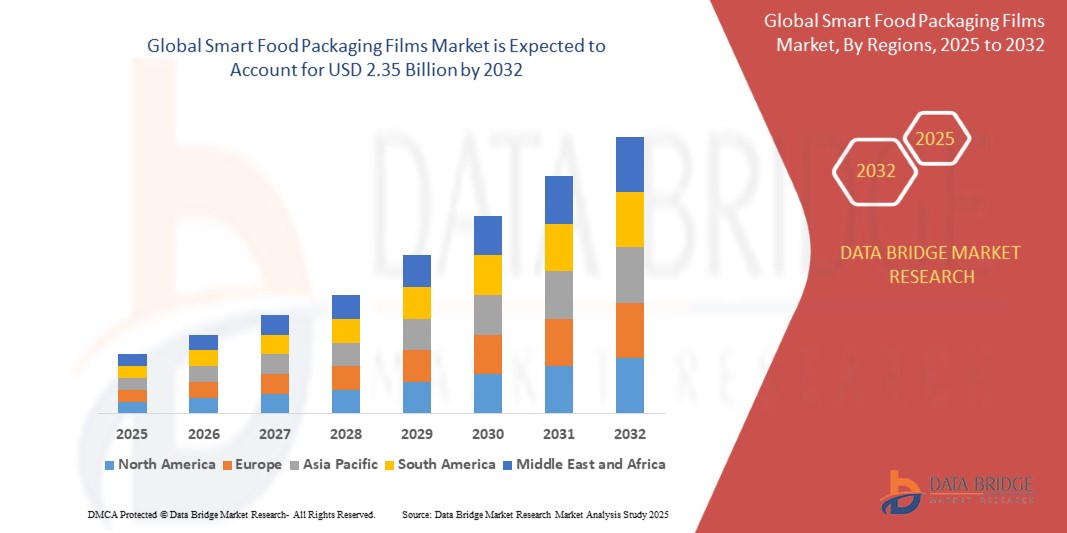
What is the Global Smart Food Packaging Films Market Size and Growth Rate?
- The global smart food packaging films market size was valued at USD 1.13 billion in 2024 and is expected to reach USD 2.35 billion by 2032, at a CAGR of 8.40% during the forecast period
- The market growth is primarily driven by the rising demand for sustainable, intelligent, and innovative packaging solutions that enhance food safety, extend shelf life, and support eco-friendly practices
- In addition, the increasing adoption of nanotechnology, sensors, and active packaging materials in the food sector is boosting demand, with consumer preference shifting toward convenient and safe packaged food products globally
What are the Major Takeaways of Smart Food Packaging Films Market?
- Smart food packaging films, equipped with barrier properties, antimicrobial features, and freshness indicators, are becoming essential in modern food supply chains to ensure product safety, quality, and extended usability
- The rising demand is fueled by growing consumer awareness about food safety, stringent regulatory standards, and the global push for sustainable packaging solutions
- Increasing adoption across fresh produce, meat, dairy, and beverage packaging segments highlights the expanding role of smart films in reducing food waste and enhancing supply chain efficiency
- North America dominated the smart food packaging films market with the largest revenue share of 42.14% in 2024, driven by increasing demand for convenience foods, extended shelf life solutions, and sustainable packaging technologies
- Asia-Pacific market is poised to grow at the fastest CAGR of 5.78% during 2025–2032, driven by rapid urbanization, rising disposable incomes, and growing packaged food consumption in China, Japan, and India
- The flexible packaging films segment dominated the market in 2024, accounting for 62.7% of the revenue share, driven by their versatility, lightweight nature, and ability to extend the shelf life of perishable food products
Report Scope and Smart Food Packaging Films Market Segmentation
|
Attributes |
Smart Food Packaging Films Key Market Insights |
|
Segments Covered |
|
|
Countries Covered |
North America
Europe
Asia-Pacific
Middle East and Africa
South America
|
|
Key Market Players |
|
|
Market Opportunities |
|
|
Value Added Data Infosets |
In addition to the insights on market scenarios such as market value, growth rate, segmentation, geographical coverage, and major players, the market reports curated by the Data Bridge Market Research also include in-depth expert analysis, pricing analysis, brand share analysis, consumer survey, demography analysis, supply chain analysis, value chain analysis, raw material/consumables overview, vendor selection criteria, PESTLE Analysis, Porter Analysis, and regulatory framework. |
What is the Key Trend in the Smart Food Packaging Films Market?
Integration of Intelligent Indicators and IoT for Food Safety
- A major trend shaping the smart food packaging films market is the integration of intelligent freshness indicators, RFID tags, and IoT connectivity to enhance food safety and shelf-life monitoring. These technologies provide real-time insights into product quality and storage conditions
- For instance, Timestrip UK Ltd has developed smart indicator labels that can be integrated into packaging films to track temperature and freshness, helping retailers and consumers make informed decisions
- IoT-enabled smart films are increasingly being used to monitor gas exchange, humidity, and microbial growth, thereby reducing food waste and ensuring regulatory compliance. Advanced nanomaterials are also being explored to improve barrier properties and enable active preservation
- Smart food films provide transparency for consumers and create value for food manufacturers by offering supply chain visibility, traceability, and compliance with food safety standards
- This integration of intelligent packaging with digital ecosystems is setting new benchmarks for safety, sustainability, and consumer trust in packaged foods
What are the Key Drivers of Smart Food Packaging Films Market?
- The rising global focus on food safety, shelf-life extension, and reduced food wastage is a significant driver fueling demand for smart food packaging films
- For instance, in March 2024, Mondi Plc (U.K.) announced the development of recyclable high-barrier films integrated with smart freshness indicators to improve shelf-life monitoring in perishable goods
- Increasing consumer preference for transparency in food labeling and freshness assurance is accelerating the adoption of smart packaging technologies. These films allow consumers to monitor food conditions, reducing health risks
- The expansion of e-commerce and cold-chain logistics is creating demand for intelligent packaging that ensures product integrity throughout transit
- In addition, government initiatives and regulatory pressure on food waste reduction and sustainability are propelling manufacturers to adopt smart packaging solutions
Which Factor is Challenging the Growth of the Smart Food Packaging Films Market?
- One of the key challenges facing the Smart Food Packaging Films market is the high production cost of intelligent films embedded with sensors, nanomaterials, or IoT features, limiting adoption in price-sensitive markets
- For instance, RFID and printed sensor technologies add significant cost compared to conventional food packaging, making it difficult for small-scale food processors to implement
- Another challenge is data privacy and consumer acceptance. Since some smart packaging solutions involve tracking and data collection, concerns about misuse of consumer information persist
- Technical challenges such as material compatibility, recyclability, and large-scale manufacturing feasibility also restrict widespread commercialization
- Overcoming these hurdles through cost optimization, eco-friendly smart film development, and scalable production will be crucial for enabling mass adoption in global markets.
How is the Smart Food Packaging Films Market Segmented?
The market is segmented on the basis of type, material, and application.
• By Type
On the basis of type, the smart food packaging films market is segmented into flexible packaging films and rigid packaging films. The flexible packaging films segment dominated the market in 2024, accounting for 62.7% of the revenue share, driven by their versatility, lightweight nature, and ability to extend the shelf life of perishable food products. These films are increasingly preferred for fresh produce, snacks, and dairy products due to their superior barrier properties and convenience in storage and transportation. Moreover, the rising trend of single-serve and on-the-go food packaging continues to support flexible film adoption across global markets.
The rigid packaging films segment is projected to register the fastest growth at a CAGR of 7.8% from 2025 to 2032, fueled by increasing demand in beverage and meat packaging applications where durability and structural integrity are essential. Rigid films are also gaining popularity in premium food categories for their aesthetic appeal and enhanced protection.
• By Material
On the basis of material, the smart food packaging films market is segmented into Polyethylene (PE), Polypropylene (PP), Polyethylene Terephthalate (PET), Nylon, Polyvinyl Chloride (PVC), and Others. Polyethylene (PE) dominated the market in 2024, capturing 39.4% of the revenue share, owing to its cost-effectiveness, flexibility, and excellent moisture barrier properties. PE films are widely used across fresh produce, snacks, and frozen food packaging due to their durability and adaptability to various sealing technologies. In addition, recyclability advancements in PE materials have further reinforced their market leadership.
Polyethylene Terephthalate (PET) is anticipated to witness the fastest CAGR of 9.2% from 2025 to 2032, driven by its superior clarity, strength, and oxygen barrier properties, making it ideal for beverages, dairy products, and high-value food categories. The growing shift towards sustainable and recyclable materials further supports PET’s rapid adoption in global markets, particularly in Europe and Asia-Pacific.
• By Application
On the basis of application, the smart food packaging films market is segmented into fresh produce packaging, meat, poultry & seafood packaging, snack & confectionery packaging, beverage packaging films, dairy products packaging, and others. The fresh produce packaging segment dominated the market in 2024 with a 28.6% share, supported by rising global demand for fruits and vegetables with extended shelf life. High clear films provide excellent transparency, allowing consumers to assess freshness while ensuring moisture and oxygen control, which reduces food waste. The growing popularity of healthy diets and organic produce is further boosting this segment.
The snack & confectionery packaging segment is expected to record the fastest CAGR of 8.5% from 2025 to 2032, driven by increasing consumption of packaged snacks, chocolates, and confectionery products, especially among younger demographics. Innovations in packaging designs, portion packs, and resealable films are adding momentum to this segment’s growth worldwide.
Which Region Holds the Largest Share of the Smart Food Packaging Films Market?
- North America dominated the smart food packaging films market with the largest revenue share of 42.14% in 2024, driven by increasing demand for convenience foods, extended shelf life solutions, and sustainable packaging technologies
- Consumers in the region highly value active and intelligent packaging features such as freshness indicators, oxygen scavengers, and antimicrobial films, which enhance food safety and reduce waste
- The market is further supported by stringent food safety regulations, advanced R&D in packaging materials, and the growing preference for ready-to-eat meals, making smart films a vital choice for both food manufacturers and retailers
U.S. Smart Food Packaging Films Market Insight
U.S. captured the largest revenue share of 81% in 2024 within North America, fueled by high packaged food consumption, strong investments in smart packaging R&D, and rising awareness of food waste reduction. Demand is particularly strong in frozen foods, dairy, and meat products, where oxygen- and moisture-control films play a critical role. In addition, the shift toward recyclable and biodegradable films further accelerates market expansion.
Europe Smart Food Packaging Films Market Insight
European market is projected to expand at a substantial CAGR, primarily driven by strict food safety regulations (EFSA standards), consumer demand for sustainable solutions, and high adoption in meat, seafood, and dairy packaging. Urbanization and innovation in bio-based and compostable films are strengthening adoption. European food producers are also focusing on minimizing supply chain losses through advanced shelf-life extension films, contributing to steady growth.
U.K. Smart Food Packaging Films Market Insight
U.K. market is anticipated to grow at a noteworthy CAGR, driven by consumer concerns about food freshness, waste reduction, and sustainability. Adoption is further fueled by government initiatives promoting eco-friendly packaging and strong demand in the ready-to-eat and online grocery retail segments. Retailers are increasingly integrating time–temperature indicator labels and antimicrobial films, boosting adoption in both domestic and export-oriented food industries.
Germany Smart Food Packaging Films Market Insight
Germany’s market is expected to expand significantly, supported by its innovation-driven packaging industry, strong processed food consumption, and regulatory focus on circular economy practices. The demand for smart, eco-conscious solutions such as recyclable barrier films and biodegradable multilayer films is rising. The country’s well-developed logistics and retail sectors are also driving adoption of temperature- and freshness-indicator packaging films, particularly in meat, bakery, and beverage applications.
Which Region is the Fastest Growing Region in the Smart Food Packaging Films Market?
Asia-Pacific market is poised to grow at the fastest CAGR of 5.78% during 2025–2032, driven by rapid urbanization, rising disposable incomes, and growing packaged food consumption in China, Japan, and India. Government initiatives promoting food safety, digitalization of supply chains, and domestic manufacturing of smart packaging films are making APAC a global hub for adoption. Increasing awareness of shelf-life extension, reduced food waste, and affordable active packaging solutions is expanding accessibility to wider consumer groups.
Japan Smart Food Packaging Films Market Insight
Japan is gaining momentum due to its tech-driven food industry, demand for convenience foods, and preference for high-quality, long-lasting packaging. Adoption is strong in seafood, fresh produce, and premium ready-to-eat meals, where oxygen scavenger films and freshness indicators are in high demand. An aging population is also driving the need for user-friendly, secure, and health-focused packaging solutions.
China Smart Food Packaging Films Market Insight
China accounted for the largest market revenue share in APAC in 2024, supported by its growing middle class, rapid retail expansion, and government-backed food safety initiatives. The smart city agenda and expansion of e-commerce grocery platforms are accelerating demand for smart food packaging films. Local manufacturers are focusing on cost-effective oxygen- and moisture-barrier films, making solutions widely accessible in both domestic and export food supply chains.
Which are the Top Companies in Smart Food Packaging Films Market?
The smart food packaging films industry is primarily led by well-established companies, including:
- Amcor plc (Switzerland)
- Toyo Seikan Group Holdings, Ltd. (Japan)
- Multisorb (U.S.)
- Sealed Air (U.S.)
- Crown (U.S.)
- Huhtamäki Oyj (Finland)
- Berry Global Inc. (U.S.)
- 3M (U.S.)
- Stepac (Israel)
- THE TETRA LAVAL GROUP (Switzerland)
- Timestrip UK LTD (U.K.)
- Checkpoint Systems, Inc. (U.S.)
- Mondi (U.K.)
- MITSUBISHI GAS CHEMICAL COMPANY, INC. (Japan)
- Novipax Buyer, LLC (U.S.)
What are the Recent Developments in Global Smart Food Packaging Films Market?
- In August 2024, Amcor introduced AmFiber Performance Paper packaging in North America, a curbside-recyclable, high-barrier paper solution that combines sustainability with functionality. By delivering enhanced barrier properties and easy recyclability, AmFiber aligns with consumer demand for eco-friendly packaging while ensuring performance efficiency. This innovation reinforces Amcor’s commitment to sustainability and strengthens its competitive edge in the smart food packaging market
- In March 2024, Berry Global collaborated with Mitsubishi Gas Chemical to develop MXD6, a recyclable barrier resin compatible with polypropylene recycling streams. This solution extends food shelf life without EVOH while reducing both food and plastic waste, thereby advancing sustainability in food packaging. The partnership highlights the industry’s shift toward sustainable innovations that balance performance and recyclability, positioning both companies as leaders in eco-conscious packaging
- In January 2024, SEE launched its CRYOVAC compostable overwrap tray made from biobased, USDA-certified resin that is industrially compostable. Designed as an alternative to EPS foam trays, the solution ensures durability while minimizing environmental impact and maintaining compatibility with existing production lines. This development reflects SEE’s dedication to innovation and sustainability, empowering customers to achieve their green packaging goals
- In October 2023, Mitsubishi Gas Chemical unveiled PFAS-free AGELESS, the first oxygen absorber designed to meet tightening regulatory demands in the smart food packaging industry. The product replaces PFAS with a proprietary formula that ensures food quality, extends shelf life, and addresses environmental concerns. This launch establishes MGC as a leader in safe and sustainable packaging solutions, aligning with global priorities around health and environmental safety
- In November 2021, Amcor, in collaboration with MGJ, launched IMPRESSIONS, a technology enabling closure liners to carry QR codes or logos for consumer engagement. This innovation allows brands to provide interactive experiences where customers can access promotions or product details directly via their mobile devices. By integrating personalization with digital connectivity, this solution enhances brand loyalty and sets Amcor apart in the smart food packaging market

- Interactive Data Analysis Dashboard
- Company Analysis Dashboard for high growth potential opportunities
- Research Analyst Access for customization & queries
- Competitor Analysis with Interactive dashboard
- Latest News, Updates & Trend analysis
- Harness the Power of Benchmark Analysis for Comprehensive Competitor Tracking
Global Smart Food Packaging Films Market, Supply Chain Analysis and Ecosystem Framework
To support market growth and help clients navigate the impact of geopolitical shifts, DBMR has integrated in-depth supply chain analysis into its Global Smart Food Packaging Films Market research reports. This addition empowers clients to respond effectively to global changes affecting their industries. The supply chain analysis section includes detailed insights such as Global Smart Food Packaging Films Market consumption and production by country, price trend analysis, the impact of tariffs and geopolitical developments, and import and export trends by country and HSN code. It also highlights major suppliers with data on production capacity and company profiles, as well as key importers and exporters. In addition to research, DBMR offers specialized supply chain consulting services backed by over a decade of experience, providing solutions like supplier discovery, supplier risk assessment, price trend analysis, impact evaluation of inflation and trade route changes, and comprehensive market trend analysis.
Data collection and base year analysis are done using data collection modules with large sample sizes. The stage includes obtaining market information or related data through various sources and strategies. It includes examining and planning all the data acquired from the past in advance. It likewise envelops the examination of information inconsistencies seen across different information sources. The market data is analysed and estimated using market statistical and coherent models. Also, market share analysis and key trend analysis are the major success factors in the market report. To know more, please request an analyst call or drop down your inquiry.
The key research methodology used by DBMR research team is data triangulation which involves data mining, analysis of the impact of data variables on the market and primary (industry expert) validation. Data models include Vendor Positioning Grid, Market Time Line Analysis, Market Overview and Guide, Company Positioning Grid, Patent Analysis, Pricing Analysis, Company Market Share Analysis, Standards of Measurement, Global versus Regional and Vendor Share Analysis. To know more about the research methodology, drop in an inquiry to speak to our industry experts.
Data Bridge Market Research is a leader in advanced formative research. We take pride in servicing our existing and new customers with data and analysis that match and suits their goal. The report can be customized to include price trend analysis of target brands understanding the market for additional countries (ask for the list of countries), clinical trial results data, literature review, refurbished market and product base analysis. Market analysis of target competitors can be analyzed from technology-based analysis to market portfolio strategies. We can add as many competitors that you require data about in the format and data style you are looking for. Our team of analysts can also provide you data in crude raw excel files pivot tables (Fact book) or can assist you in creating presentations from the data sets available in the report.













