


Smart ICU Monitoring Platforms Market Overview
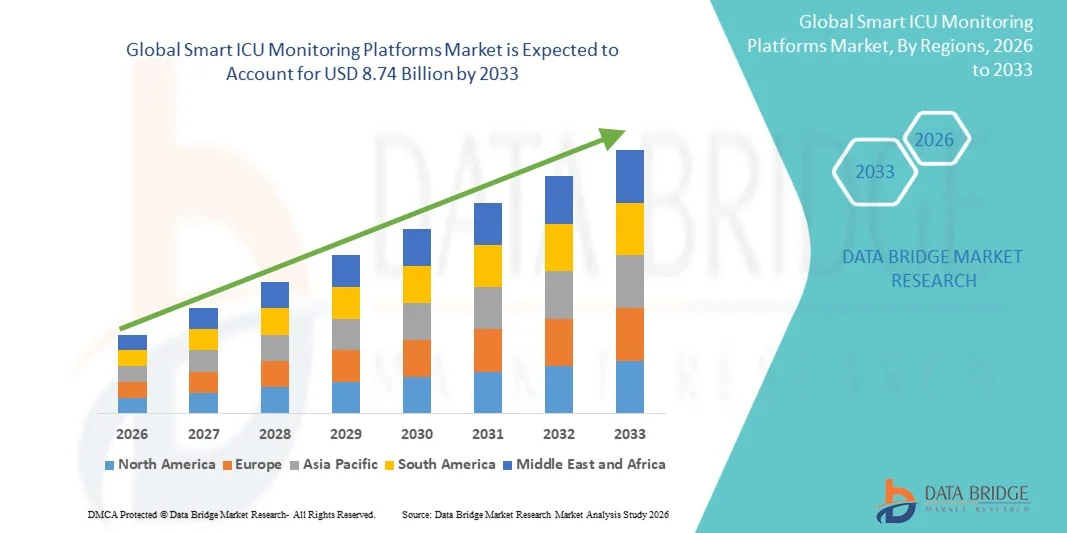
The Smart ICU Monitoring Platforms Market was valued at USD 2.86 billion in 2025 and is projected to reach USD 8.74 billion by 2033, growing at a CAGR of 15.00% from 2026 to 2033. The market is witnessing strong expansion driven by the rising demand for real-time critical care monitoring, increasing ICU admissions due to chronic and acute diseases, and rapid adoption of AI-enabled healthcare infrastructure across hospitals and intensive care units.
The growing burden of cardiovascular disorders, respiratory failures, sepsis, and post-surgical complications is accelerating the need for continuous, data-driven patient monitoring in ICUs. In parallel, healthcare systems are increasingly shifting toward digital and connected care environments, where Smart ICU platforms integrate patient data from multiple devices to enable predictive alerts, early diagnosis, and clinical decision support. In addition, advancements in IoT-enabled medical devices, cloud-based healthcare systems, and AI-powered analytics are transforming ICU workflows by reducing manual intervention and improving response times.
Key Market Trends & Insights
- North America dominated the Smart ICU Monitoring Platforms Market with the largest revenue share of 36.42% in 2025, supported by advanced hospital digital infrastructure, high ICU bed capacity, and strong adoption of AI-enabled critical care systems.
- The Central Monitoring Platforms segment led the market with a 38.90% share in 2025, driven by their widespread deployment in hospital ICUs for real-time aggregation of multi-parameter patient data across multiple beds and devices
- Asia-Pacific is expected to be the fastest-growing region at a CAGR of 8.1% from 2026 to 2033, fueled by rising healthcare investments, expanding ICU infrastructure, and increasing adoption of smart hospital technologies in China, India, and Southeast Asia.
- AI-based Smart ICU Monitoring System are the fastest-growing product type, projected to register a CAGR of 8.5%, reflecting the surge in demand for predictive analytics and early warning systems in critical care.
- The IoT-enabled Systems segment dominated the technology category with a 34.62% revenue share in 2025, led by the increasing connectivity of ICU medical devices such as patient monitors, ventilators, infusion pumps, and imaging systems.
- Cardiac Monitoring accounted for 34.18% of the market, preferred by the high global prevalence of cardiovascular diseases and the need for continuous ECG, heart rate, and blood pressure monitoring in ICUs.
- The Multi-parameter Monitoring segment is the fastest-growing application category, with a CAGR of 8.2%, driven by increasing demand for comprehensive patient monitoring solutions that integrate multiple physiological parameters into a single platform.
Market Size & Forecast
- Global Market Value (2025): USD 2.86 Billion
- Expected Market Value (2033): USD 8.74 Billion
- Forecast CAGR (2026–2033): 15.00%
- Leading Region in 2025: North America
- Fastest Growing Region: Asia Pacific
Report Scope and Smart ICU Monitoring Platforms Market Segmentation
|
Attributes |
Smart ICU Monitoring Platforms Key Market Insights |
|
Segments Covered |
|
|
Countries Covered |
North America · U.S. · Canada · Mexico Europe · Germany · France · U.K. · Netherlands · Switzerland · Belgium · Russia · Italy · Spain · Turkey · Rest of Europe Asia-Pacific · China · Japan · India · South Korea · Singapore · Malaysia · Australia · Thailand · Indonesia · Philippines · Rest of Asia-Pacific Middle East and Africa · Saudi Arabia · U.A.E. · South Africa · Egypt · Israel · Rest of Middle East and Africa South America · Brazil · Argentina · Rest of South America |
|
Key Market Players |
· Philips (Netherlands) · GE HealthCare (U.S.) · Siemens Healthineers AG (Germany) · Drägerwerk AG & Co. KGaA (Germany) · Masimo Corporation (U.S.) · Mindray Medical International Limited (China) · NIHON KOHDEN CORPORATION (Japan) · Baxter (U.S.) · Spacelabs Healthcare (U.S.) · Getinge AB (Sweden) · B. Braun SE (Germany) · Schiller AG (Switzerland) · Edan Instruments, Inc. (China) · iMDsoft (Israel) · Medtronic (Ireland) · Honeywell Life Sciences (U.S.) · Ascom Holding AG (Switzerland) · Cerner Corporation (U.S.) |
|
Market Opportunities |
· Expansion of AI-driven early warning systems in ICUs to predict patient deterioration in real time · Growth of tele-ICU and remote critical care models in emerging economies · Integration of smart ICU platforms with hospital-wide digital ecosystems (EHR, IoT devices, and cloud systems) |
|
Value Added Data Infosets |
In addition to the insights on market scenarios such as market value, growth rate, segmentation, geographical coverage, and major players, the market reports curated by the Data Bridge Market Research also include in-depth expert analysis, patient epidemiology, pipeline analysis, pricing analysis, and regulatory framework. |
Smart ICU Monitoring Platforms Market Trends
Trend: Expansion of AI-powered Predictive Critical Care Monitoring
The Smart ICU Monitoring Platforms market is increasingly shifting toward AI-driven predictive monitoring systems that continuously analyze large volumes of real-time patient data such as heart rate, oxygen saturation, blood pressure, respiratory patterns, and lab results. These platforms are designed to identify early signs of clinical deterioration before visible symptoms appear, enabling clinicians to intervene proactively rather than reactively. The integration of IoT-enabled medical devices, centralized command dashboards, and machine learning algorithms is transforming ICUs into fully connected, intelligent care environments where decision-making is faster, more accurate, and highly data-driven.
For instance, leading hospital systems in the United States have implemented AI-based ICU monitoring solutions that generate automated early warning scores for sepsis, cardiac arrest risk, and respiratory failure, significantly improving response times and reducing ICU mortality rates through continuous predictive surveillance and real-time alerts.
Smart ICU Monitoring Platforms Market Dynamics
Key Market Driver: Rising Demand for Connected and Real-Time ICU Monitoring Systems
A major growth driver for the Smart ICU Monitoring Platforms market is the increasing demand for integrated, real-time monitoring systems that consolidate patient data from multiple critical care devices into a single unified interface. With rising ICU admissions driven by cardiovascular diseases, respiratory disorders, and post-operative complications, hospitals are under pressure to improve operational efficiency and patient outcomes while managing limited ICU staff resources. Smart ICU platforms address this challenge by enabling continuous monitoring, automated data aggregation, and real-time visualization of patient conditions across multiple parameters.
For instance, large hospital networks in countries such as Germany and India have adopted centralized ICU command centers that monitor multiple ICU beds simultaneously, allowing critical care specialists to intervene quickly through digital alerts and remote consultation tools, improving coordination and reducing treatment delays.
Key Restraint/Challenge: High Implementation and Integration Costs of Smart ICU Infrastructure
Despite strong adoption potential, the market faces a significant barrier due to the high cost and complexity of implementing Smart ICU systems. These platforms require substantial investment in advanced hardware such as patient monitoring devices, network infrastructure, servers, and cloud systems, along with sophisticated AI software and cybersecurity frameworks to ensure data protection and system reliability. Furthermore, integrating Smart ICU platforms with existing hospital IT systems, including Electronic Health Records (EHR), laboratory systems, and legacy monitoring equipment, often requires customization, interoperability upgrades, and long deployment cycles.
For instance, several government and mid-sized hospitals in developing regions have delayed full-scale ICU digitization projects due to high upfront costs and the ongoing expense of system maintenance, software licensing, and continuous technology upgrades required to keep pace with evolving AI-driven healthcare standards.
Key Market Opportunity: Expansion of Tele-ICU and Cloud-Based Critical Care Networks
One of the most significant growth opportunities in the Smart ICU Monitoring Platforms market lies in the expansion of tele-ICU and cloud-based critical care ecosystems that enable remote monitoring and centralized ICU management. These systems allow critical care specialists to monitor patients across multiple hospitals in real time, regardless of geographic location, improving access to expert care in underserved and rural regions where ICU specialists are often limited. Cloud-based platforms also support seamless data sharing between devices, hospitals, and care teams, enabling continuous collaboration and faster clinical decision-making.
For instance, healthcare providers in countries such as the United Kingdom and Australia are actively deploying cloud-enabled tele-ICU networks that connect regional hospitals to centralized intensive care hubs, allowing specialists to remotely manage critically ill patients, optimize resource allocation, and improve survival outcomes across geographically dispersed healthcare facilities.
Smart ICU Monitoring Platforms Market Scope
The Smart ICU Monitoring Platforms market is segmented on the basis of product type, technology, application, and end user.
- By Product Type
On the basis of product type, the Smart ICU Monitoring Platforms Market is segmented into central monitoring platforms, remote patient monitoring systems, telemedicine/tele-ICU platforms, AI-based smart ICU monitoring systems, cloud-based ICU monitoring solutions, and wearable ICU monitoring devices. The Central Monitoring Platforms segment dominated the market with a 38.90% share in 2025, owing to their widespread deployment in hospital ICUs for real-time aggregation of multi-parameter patient data across multiple beds and devices. These platforms serve as the primary command hub in intensive care units, enabling clinicians to continuously track vitals, alarms, and device outputs in a unified interface. Their strong adoption is driven by integration with ventilators, cardiac monitors, and infusion pumps, which improves workflow efficiency and reduces manual monitoring errors. Hospitals prefer these systems due to their reliability, established infrastructure compatibility, and ability to support high-acuity care environments. Increasing digitization of ICU workflows and rising ICU bed expansion projects further reinforce demand. However, dependency on on-premise infrastructure limits flexibility in smaller healthcare settings.
The AI-based Smart ICU Monitoring Systems segment is projected to register the fastest growth at a CAGR of 8.5% from 2026 to 2033, driven by rising demand for predictive analytics and early warning systems in critical care. These systems continuously analyze patient data using machine learning models to detect deterioration risks such as sepsis, cardiac arrest, and respiratory failure before they become clinically evident. Integration of AI with real-time monitoring devices significantly improves clinical decision-making speed and accuracy. Growing adoption of automated alert systems reduces ICU workload and enhances patient survival outcomes. Continuous improvements in deep learning algorithms and healthcare data availability are accelerating system accuracy and scalability. Increasing investments in intelligent hospital infrastructure is further boosting adoption across both developed and emerging markets.
- By Technology
On the basis of technology, the market is segmented into artificial intelligence (AI) & machine learning, Internet of Things (IoT)-enabled systems, wireless monitoring technologies, predictive analytics, and cloud computing. The IoT-enabled Systems segment dominated the market with a 34.62% share in 2025, driven by the increasing connectivity of ICU medical devices such as patient monitors, ventilators, infusion pumps, and imaging systems. IoT integration enables seamless real-time data exchange between devices and centralized monitoring dashboards, improving visibility across critical care environments. Hospitals are rapidly adopting connected ICU ecosystems to enhance patient tracking accuracy and reduce manual intervention errors. These systems also support interoperability between multiple devices and hospital IT systems, strengthening workflow efficiency. Rising investments in smart hospital infrastructure and connected healthcare ecosystems further support dominance. However, concerns related to cybersecurity and data privacy remain key challenges.
The Artificial Intelligence (AI) & Machine Learning segment is expected to grow at the fastest CAGR of 9.0% from 2026 to 2033, driven by increasing use of predictive models for ICU patient monitoring and decision support. AI algorithms analyze large-scale physiological data in real time to identify risk patterns and recommend early interventions. These technologies significantly improve diagnostic accuracy and reduce response time in emergency situations. Continuous advancements in deep learning and clinical data integration are enhancing model reliability and scalability. Hospitals are increasingly deploying AI tools to optimize ICU resource allocation and reduce mortality rates. Rising adoption of intelligent healthcare systems is further accelerating segment expansion globally.
- By Application
On the basis of application, the market is segmented into cardiac monitoring, respiratory monitoring, neurological monitoring, multi-parameter monitoring, hemodynamic monitoring, and other critical care applications. The Cardiac Monitoring segment dominated the market with a 34.18% share in 2025, driven by the high global prevalence of cardiovascular diseases and the need for continuous ECG, heart rate, and blood pressure monitoring in ICUs. Cardiac patients require constant surveillance due to the risk of sudden deterioration, making real-time monitoring systems essential in critical care environments. Hospitals extensively use integrated cardiac monitoring solutions to detect arrhythmias, ischemia, and cardiac arrest events early. Integration with alarm systems and predictive analytics enhances clinical response efficiency. Rising ICU admissions due to heart-related emergencies further strengthen demand. Expanding geriatric population also contributes significantly to segment dominance.
The Multi-parameter Monitoring segment is projected to grow at the fastest CAGR of 8.2% from 2026 to 2033, driven by increasing demand for comprehensive patient monitoring solutions that integrate multiple physiological parameters into a single platform. These systems provide holistic visibility into patient health, reducing fragmentation of data across devices. Growing adoption of integrated ICU ecosystems enables real-time tracking of oxygen saturation, blood pressure, respiration, and temperature simultaneously. Enhanced clinical decision-making and reduced diagnostic delays are key advantages driving adoption. Advances in sensor technology and interoperability standards are improving system efficiency. Increasing focus on precision medicine and personalized critical care is further accelerating growth.
- By End User
On the basis of end user, the market is segmented into hospitals, clinics & specialty care centers, tele-ICU centers, long-term care facilities, and emergency & trauma centers. The Hospitals segment dominated the market with a 62.15% share in 2025, owing to the highest concentration of ICU beds, advanced critical care infrastructure, and strong adoption of digital health technologies. Hospitals serve as the primary deployment centers for Smart ICU Monitoring Platforms due to their need for continuous patient surveillance, multi-specialty care coordination, and integration with hospital-wide electronic health records. Large tertiary care hospitals and academic medical centers are leading adopters of AI-enabled ICU systems. Increasing investments in smart hospital transformation programs further support dominance. Rising patient inflow in ICUs due to chronic and acute conditions continues to drive demand. However, high infrastructure costs limit adoption in smaller hospitals.
The Tele-ICU Centers segment is expected to grow at the fastest CAGR of 8.7% from 2026 to 2033, driven by increasing demand for remote critical care services and shortage of ICU specialists in rural and semi-urban regions. Tele-ICU platforms enable centralized monitoring of multiple ICU units across different locations, improving access to expert care. These systems support real-time video consultation, remote patient tracking, and AI-driven alert systems. Growing adoption of cloud-based healthcare infrastructure is making tele-ICU models more scalable and cost-effective. Governments and healthcare providers are investing in remote care programs to improve healthcare accessibility. Expansion of digital health ecosystems is further accelerating this segment’s rapid growth.
Smart ICU Monitoring Platforms Market Regional Analysis
North America dominated the Smart ICU Monitoring Platforms Market with the largest revenue share of 36.42% in 2025, supported by advanced hospital digital infrastructure, high ICU bed capacity, and strong adoption of AI-enabled critical care systems. The region benefits from strong integration of electronic health records (EHR), widespread deployment of centralized ICU monitoring systems, and significant investments in tele-ICU networks across major hospital systems. Increasing prevalence of chronic diseases, high healthcare expenditure, and rapid adoption of predictive analytics in critical care further strengthen regional dominance. Continuous expansion of smart hospital initiatives and strong presence of leading medical technology providers continue to drive market leadership in the region.
U.S. Smart ICU Monitoring Platforms Market Insight
The U.S. Smart ICU Monitoring Platforms market is witnessing strong growth due to rising investments in digital hospital infrastructure, AI-powered critical care systems, and advanced patient monitoring solutions. The country’s highly developed healthcare ecosystem, along with widespread adoption of electronic health records (EHR) and connected ICU devices, is driving demand across hospitals, trauma centers, and tele-ICU networks. In addition, increasing ICU admissions due to chronic diseases and growing emphasis on early disease detection are accelerating adoption of predictive ICU monitoring platforms. Strong presence of leading MedTech companies and continuous innovation in AI-based clinical decision support systems further reinforce market expansion in the U.S.
Europe Smart ICU Monitoring Platforms Market Insight
The Europe Smart ICU Monitoring Platforms market remains a major contributor to global revenue, driven by strong government healthcare funding, advanced hospital infrastructure, and high adoption of digital health technologies. The widespread use of centralized ICU monitoring systems, tele-ICU models, and cloud-based patient management platforms is supporting market expansion across the region. Increasing investments in AI-enabled clinical analytics and interoperability standards are improving ICU efficiency and patient outcomes. In addition, stringent healthcare regulations and strong focus on patient safety continue to enhance adoption of advanced critical care monitoring solutions throughout Europe.
U.K. Smart ICU Monitoring Platforms Market Insight
The U.K. Smart ICU Monitoring Platforms market is experiencing steady growth, supported by rising adoption of tele-ICU services, NHS digital transformation programs, and increasing demand for real-time patient monitoring solutions. Hospitals are increasingly deploying AI-powered ICU platforms to improve clinical decision-making, optimize resource allocation, and enhance critical care efficiency. Integration of cloud-based monitoring systems and predictive analytics tools is further improving ICU workflow management. In addition, growing investments in smart hospital initiatives and remote care technologies are positioning the U.K. as a key innovation hub in digital critical care systems.
Germany Smart ICU Monitoring Platforms Market Insight
The Germany Smart ICU Monitoring Platforms market is expanding steadily due to the country’s strong healthcare infrastructure, advanced medical research capabilities, and increasing adoption of hospital digitalization technologies. Hospitals and academic medical centers are increasingly utilizing AI-enabled ICU monitoring systems for patient tracking, early warning detection, and workflow optimization. Continuous advancements in IoT-enabled medical devices and interoperable healthcare systems are strengthening ICU connectivity and efficiency. Moreover, strong government support for healthcare innovation and patient safety initiatives is further driving adoption of smart ICU technologies in Germany.
Asia-Pacific Smart ICU Monitoring Platforms Market Insight
The Asia-Pacific Smart ICU Monitoring Platforms market is expected to witness rapid growth, driven by rising healthcare investments, expanding ICU infrastructure, and increasing adoption of digital health technologies across countries such as China, India, and Japan. Growing burden of chronic diseases, increasing hospital admissions, and rising awareness of critical care monitoring are supporting regional market expansion. In addition, growing deployment of AI-based healthcare systems and cloud-enabled hospital networks is improving ICU efficiency and accessibility. Rapid digital transformation in healthcare systems is positioning Asia-Pacific as one of the fastest-growing regions globally.
Japan Smart ICU Monitoring Platforms Market Insight
The Japan Smart ICU Monitoring Platforms market is witnessing consistent growth due to rising investments in advanced healthcare technologies, aging population-driven ICU demand, and strong focus on precision medicine. Hospitals and research institutes are increasingly adopting AI-powered ICU monitoring systems for early risk detection, continuous patient surveillance, and clinical decision support. Integration of robotics, IoT-based monitoring devices, and cloud healthcare platforms is further enhancing ICU efficiency. In addition, Japan’s emphasis on high-quality healthcare delivery and technological innovation is supporting steady market expansion.
China Smart ICU Monitoring Platforms Market Insight
The China Smart ICU Monitoring Platforms market is growing rapidly, driven by expanding hospital infrastructure, increasing ICU capacity, and strong government focus on healthcare modernization. Rising adoption of AI-enabled patient monitoring systems, tele-ICU platforms, and cloud-based hospital networks is significantly boosting market demand. Growing prevalence of chronic diseases and increasing need for advanced critical care management are further accelerating adoption. In addition, large-scale investments in smart hospital projects and rapid digital transformation in healthcare are positioning China as one of the fastest-growing markets for Smart ICU Monitoring Platforms globally.
Smart ICU Monitoring Platforms Market Share
The Smart ICU Monitoring Platforms industry is primarily led by well-established companies, including:
- Philips (Netherlands)
- GE HealthCare (U.S.)
- Siemens Healthineers AG (Germany)
- Drägerwerk AG & Co. KGaA (Germany)
- Masimo Corporation (U.S.)
- Mindray Medical International Limited (China)
- NIHON KOHDEN CORPORATION (Japan)
- Baxter (U.S.)
- Spacelabs Healthcare (U.S.)
- Getinge AB (Sweden)
- Braun SE (Germany)
- Schiller AG (Switzerland)
- Edan Instruments, Inc. (China)
- iMDsoft (Israel)
- Medtronic (Ireland)
- Honeywell Life Sciences (U.S.)
- Ascom Holding AG (Switzerland)
- Cerner Corporation (U.S.)
Latest Developments in Smart ICU Monitoring Platforms Market
- In February 2024, Masimo expanded its SafetyNet remote patient monitoring platform, enhancing hospital-to-home and hospital-wide connectivity for continuous patient surveillance, including high-acuity and post-ICU care environments. The solution integrates advanced pulse oximetry, wearable sensors, and cloud-based analytics to enable early detection of patient deterioration and improve continuity of care beyond traditional ICU boundaries
- In March 2023, Philips enhanced its IntelliVue patient monitoring ecosystem by expanding AI-enabled early warning and clinical decision support capabilities, designed to help clinicians detect patient deterioration earlier in ICU and acute care settings. These enhancements improve real-time monitoring accuracy and support hospital efforts to reduce response times for critical events such as sepsis and cardiac instability
- In May 2022, GE HealthCare expanded its Edison Digital Health Platform capabilities to enhance AI-driven clinical decision support and interoperability across hospital systems, including intensive care monitoring environments. The platform enables integration of patient data from multiple ICU devices, supporting predictive analytics, workflow automation, and improved clinical insights for critical care teams managing high-acuity patients
- In December 2021, Baxter International completed its acquisition of Hillrom, significantly strengthening its portfolio in connected care technologies, including ICU communication systems, smart monitoring integration, and hospital workflow solutions. The acquisition expanded Baxter’s capabilities in critical care environments by integrating Hillrom’s Voalte digital care communications and patient monitoring ecosystem into its broader hospital solutions portfolio, supporting more connected and efficient ICU operations
- In April 2021, Philips announced expansion of its strategic collaboration with Amazon Web Services (AWS) to strengthen its HealthSuite digital health platform, enabling scalable cloud-based healthcare data management and advanced analytics for hospital systems, including ICU and acute care environments. This partnership aims to improve real-time patient monitoring, interoperability, and AI-driven clinical insights across connected care settings, supporting the shift toward cloud-native smart hospital ecosystems

- Interactive Data Analysis Dashboard
- Company Analysis Dashboard for high growth potential opportunities
- Research Analyst Access for customization & queries
- Competitor Analysis with Interactive dashboard
- Latest News, Updates & Trend analysis
- Harness the Power of Benchmark Analysis for Comprehensive Competitor Tracking
Data collection and base year analysis are done using data collection modules with large sample sizes. The stage includes obtaining market information or related data through various sources and strategies. It includes examining and planning all the data acquired from the past in advance. It likewise envelops the examination of information inconsistencies seen across different information sources. The market data is analysed and estimated using market statistical and coherent models. Also, market share analysis and key trend analysis are the major success factors in the market report. To know more, please request an analyst call or drop down your inquiry.
The key research methodology used by DBMR research team is data triangulation which involves data mining, analysis of the impact of data variables on the market and primary (industry expert) validation. Data models include Vendor Positioning Grid, Market Time Line Analysis, Market Overview and Guide, Company Positioning Grid, Patent Analysis, Pricing Analysis, Company Market Share Analysis, Standards of Measurement, Global versus Regional and Vendor Share Analysis. To know more about the research methodology, drop in an inquiry to speak to our industry experts.
Data Bridge Market Research is a leader in advanced formative research. We take pride in servicing our existing and new customers with data and analysis that match and suits their goal. The report can be customized to include price trend analysis of target brands understanding the market for additional countries (ask for the list of countries), clinical trial results data, literature review, refurbished market and product base analysis. Market analysis of target competitors can be analyzed from technology-based analysis to market portfolio strategies. We can add as many competitors that you require data about in the format and data style you are looking for. Our team of analysts can also provide you data in crude raw excel files pivot tables (Fact book) or can assist you in creating presentations from the data sets available in the report.













