


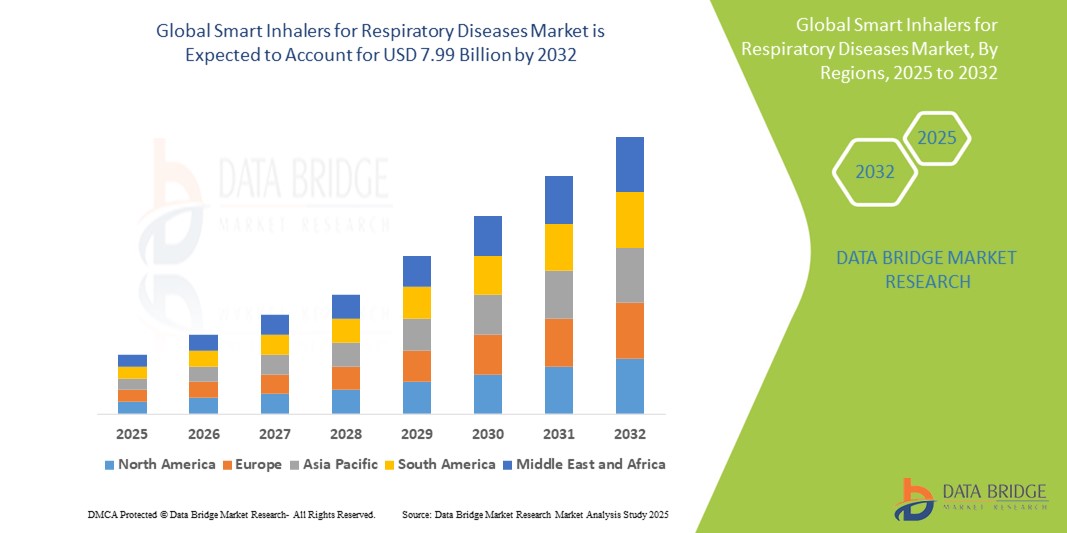
Smart Inhalers for Respiratory Diseases Market Size
- The global smart inhalers for respiratory diseases market size was valued at USD 1.09 billion in 2024 and is expected to reach USD 7.99 billion by 2032, at a CAGR of 28.30% during the forecast period
- This growth is driven by factors such as the rising prevalence of respiratory diseases like asthma and COPD, and increasing adoption of digital health technologies for better medication adherence and disease management
Smart Inhalers for Respiratory Diseases Market Analysis
- Smart inhalers are advanced drug delivery devices integrated with digital technology to monitor inhaler usage, improve medication adherence, and provide real-time data to patients and healthcare providers. They are primarily used in the management of asthma and chronic obstructive pulmonary disease (COPD)
- The demand for smart inhalers is significantly driven by the increasing global burden of respiratory diseases and growing adoption of digital health solutions to enhance treatment outcomes
- North America is expected to dominate the smart inhalers for respiratory diseases market with a market share of 39.5%, due to high prevalence of asthma and COPD, advanced digital healthcare infrastructure, and strong presence of leading market players
- Asia-Pacific is expected to be the fastest growing region in the smart inhalers for respiratory diseases market with a market share of 24.5%, during the forecast period due to growing healthcare digitization, rising respiratory disease burden, and increasing awareness about connected health solutions
- Inhalers segment is expected to dominate the market with a market share of 83.5% due to its widespread use in managing chronic respiratory conditions like asthma and COPD
Report Scope and Smart Inhalers for Respiratory Diseases Market Segmentation
|
Attributes |
Smart Inhalers for Respiratory Diseases Key Market Insights |
|
Segments Covered |
|
|
Countries Covered |
North America
Europe
Asia-Pacific
Middle East and Africa
South America
|
|
Key Market Players |
|
|
Market Opportunities |
|
|
Value Added Data Infosets |
In addition to the insights on market scenarios such as market value, growth rate, segmentation, geographical coverage, and major players, the market reports curated by the Data Bridge Market Research also include import export analysis, production capacity overview, production consumption analysis, price trend analysis, climate change scenario, supply chain analysis, value chain analysis, raw material/consumables overview, vendor selection criteria, PESTLE Analysis, Porter Analysis, and regulatory framework. |
Smart Inhalers for Respiratory Diseases Market Trends
“Integration of IoT and AI for Personalized Respiratory Disease Management”
- One prominent trend in the smart inhalers market is the growing integration of Internet of Things (IoT) and Artificial Intelligence (AI) technologies to deliver personalized respiratory care and real-time monitoring
- These innovations enhance patient adherence and disease management by collecting usage data, detecting patterns, and providing alerts or treatment recommendations through connected mobile applications
- For instance, AI-powered smart inhalers can predict potential asthma attacks based on historical usage data and environmental factors, allowing for timely intervention and reducing emergency visits
- These advancements are reshaping respiratory disease management, improving patient engagement, and driving the adoption of smart, data-driven inhaler technologies across global healthcare systems
Smart Inhalers for Respiratory Diseases Market Dynamics
Driver
“Rising Burden of Chronic Respiratory Diseases and Demand for Medication Adherence”
- The increasing global prevalence of chronic respiratory diseases such as asthma and chronic obstructive pulmonary disease (COPD) is a major driver for the demand for smart inhalers
- These conditions require long-term management, and smart inhalers help improve treatment adherence and monitoring through integrated sensors and mobile connectivity
- With enhanced features such as dosage tracking, reminders, and data sharing with healthcare providers, smart inhalers enable better disease control and reduce hospital admissions
For instance,
- In According to the Global Burden of Disease Study 2019, asthma affected an estimated 262 million people worldwide and caused 461,000 deaths, highlighting the urgent need for better disease management tools such as smart inhalers
- Consequently, the rising burden of chronic respiratory conditions and the growing emphasis on patient adherence and outcome monitoring are significantly driving the adoption of smart inhalers globally
Opportunity
“Leveraging AI and Big Data for Predictive Respiratory Health Management”
- AI- Integrating Artificial Intelligence (AI) and Big Data analytics into smart inhalers presents a significant opportunity to transform respiratory disease management through predictive and personalized care
- AI can analyze inhaler usage patterns, environmental factors (e.g., air quality, allergens), and patient health data to predict exacerbations and provide early warnings, enabling timely interventions
- These insights help physicians tailor treatment plans, improve medication adherence, and reduce emergency hospital visits, thus enhancing both patient outcomes and healthcare efficiency
For instance,
- In February 2024, Propeller Health expanded its digital platform with AI-based predictive analytics to forecast asthma attacks based on user data and environmental triggers. This innovation significantly improved users' ability to avoid flare-ups and manage symptoms proactively
- The fusion of AI and big data with smart inhalers offers a powerful tool for advancing proactive respiratory care, minimizing disease progression, and optimizing long-term patient management across global health systems
Restraint/Challenge
“High Device Costs and Limited Reimbursement Slowing Adoption”
- The high cost of smart inhalers compared to traditional inhalers poses a significant barrier to widespread adoption, particularly in low- and middle-income countries where healthcare budgets are constrained
- These devices often include integrated sensors, Bluetooth connectivity, and software platforms, leading to higher production and retail prices that can deter both patients and healthcare providers
- In addition, limited reimbursement policies in many regions further restrict patient access, as insurance coverage for digital health solutions remains inconsistent and underdeveloped
For instance,
- In October 2023, a report by the European Respiratory Society noted that the higher price points of digital inhaler devices and inadequate reimbursement frameworks across several European nations were key challenges in the expansion of smart respiratory care
- As a result, the combination of high upfront costs and uncertain reimbursement limits market penetration, especially in cost-sensitive settings, slowing the pace of adoption despite the clinical benefits of smart inhalers
Smart Inhalers for Respiratory Diseases Market Scope
The market is segmented on the basis of product, device type, application, and end users
|
Segmentation |
Sub-Segmentation |
|
By Product |
|
|
By Device Type |
|
|
By Application |
|
|
By End User
|
|
In 2025, the inhalers is projected to dominate the market with a largest share in product segment
The inhalers segment is expected to dominate the smart inhalers for respiratory diseases market with the largest share of 83.5% in 2025 due to its widespread use in managing chronic respiratory conditions such as asthma and COPD. Their ease of use, portability, and ability to deliver medication directly to the lungs make them the preferred choice. In addition, the integration of smart features enhances adherence tracking and real-time monitoring, further driving their adoption
The chronic obstructive pulmonary disease is expected to account for the largest share during the forecast period in application market
In 2025, the chronic obstructive pulmonary disease segment is expected to dominate the market with the largest market share of 59.5% due to its high global prevalence and the chronic nature of the disease requiring long-term management. Smart inhalers play a crucial role in improving medication adherence and monitoring in COPD patients. The growing aging population and rising exposure to risk factors such as smoking and air pollution further contribute to the segment’s dominance
Smart Inhalers for Respiratory Diseases Market Regional Analysis
“North America Holds the Largest Share in the Smart Inhalers for Respiratory Diseases Market”
- North America dominates the smart inhalers for respiratory diseases market with a market share of estimated 39.5%, driven, by high prevalence of asthma and COPD, advanced digital healthcare infrastructure, and strong presence of leading market players
- U.S. holds a market share of 46.7%, due to widespread adoption of connected medical devices, growing emphasis on personalized medicine, and substantial investment in respiratory health technologies
- The favorable reimbursement policies and regulatory support for digital therapeutics further enhance market growth, along with strong consumer awareness and access to healthcare services
- In addition, the strategic partnerships among healthcare providers, payers, and technology developers are accelerating the integration of smart inhalers into routine respiratory care
“Asia-Pacific is Projected to Register the Highest CAGR in the Smart Inhalers for Respiratory Diseases Market”
- Asia-Pacific is expected to witness the highest growth rate in the smart inhalers for respiratory diseases market with a market share of 24.5%, driven by growing healthcare digitization, rising respiratory disease burden, and increasing awareness about connected health solutions
- Countries such as China, India, and Japan are key growth drivers due to rapid urbanization, increasing pollution levels, and a growing middle-class population seeking advanced treatment options
- Japan continues to lead in early adoption of healthcare technology, including smart inhalers, supported by its aging population and high standards of care
- India is projected to register the highest CAGR in the smart inhalers for respiratory diseases market, driven by its expanding healthcare infrastructure, government-led digital health initiatives, and growing prevalence of asthma and COPD
Smart Inhalers for Respiratory Diseases Market Share
The market competitive landscape provides details by competitor. Details included are company overview, company financials, revenue generated, market potential, investment in research and development, new market initiatives, global presence, production sites and facilities, production capacities, company strengths and weaknesses, product launch, product width and breadth, application dominance. The above data points provided are only related to the companies' focus related to market.
The Major Market Leaders Operating in the Market Are:
- Teva Pharmaceutical Industries Ltd. (Israel)
- AstraZeneca (U.K.)
- GSK plc. (U.K.)
- Boehringer Ingelheim International GmbH (Germany)
- Novartis AG (Switzerland)
- Koninklijke Philips N.V. (Netherlands)
- Propeller Health Inc. (U.S.)
- Adherium Limited (New Zealand)
- Medtronic (Ireland)
- OMRON Healthcare, Inc. (Japan)
- Sanofi (France)
- ResMed (U.S.)
- Vectura Group plc (U.K.)
- Sony Corporation (Japan)
- CANON MEDICAL SYSTEMS CORPORATION (Japan)
- Samsung Electronics Co., Ltd. (South Korea)
- Sandoz Group AG (Switzerland)
- Baxter. (U.S.)
- 3M (U.S.)
Latest Developments in Global ophthalmic Market
- In April 2025, Teva Pharmaceuticals received FDA approval for its digital inhaler integrated with sensors and a mobile app to monitor asthma and COPD symptoms, enhancing real-time adherence tracking and management
- In April 2025, AstraZeneca, in collaboration with Honeywell, announced the development of next-generation inhalers using near-zero global warming potential (GWP) propellants, aiming to reduce the environmental impact of inhalers while maintaining effectiveness
- In February 2025, Propeller Health, a leading digital respiratory company, launched an AI-enhanced smart inhaler platform that uses predictive analytics to forecast asthma and COPD exacerbations, enabling patients and clinicians to intervene proactively and reduce hospitalizations

- Interactive Data Analysis Dashboard
- Company Analysis Dashboard for high growth potential opportunities
- Research Analyst Access for customization & queries
- Competitor Analysis with Interactive dashboard
- Latest News, Updates & Trend analysis
- Harness the Power of Benchmark Analysis for Comprehensive Competitor Tracking
Data collection and base year analysis are done using data collection modules with large sample sizes. The stage includes obtaining market information or related data through various sources and strategies. It includes examining and planning all the data acquired from the past in advance. It likewise envelops the examination of information inconsistencies seen across different information sources. The market data is analysed and estimated using market statistical and coherent models. Also, market share analysis and key trend analysis are the major success factors in the market report. To know more, please request an analyst call or drop down your inquiry.
The key research methodology used by DBMR research team is data triangulation which involves data mining, analysis of the impact of data variables on the market and primary (industry expert) validation. Data models include Vendor Positioning Grid, Market Time Line Analysis, Market Overview and Guide, Company Positioning Grid, Patent Analysis, Pricing Analysis, Company Market Share Analysis, Standards of Measurement, Global versus Regional and Vendor Share Analysis. To know more about the research methodology, drop in an inquiry to speak to our industry experts.
Data Bridge Market Research is a leader in advanced formative research. We take pride in servicing our existing and new customers with data and analysis that match and suits their goal. The report can be customized to include price trend analysis of target brands understanding the market for additional countries (ask for the list of countries), clinical trial results data, literature review, refurbished market and product base analysis. Market analysis of target competitors can be analyzed from technology-based analysis to market portfolio strategies. We can add as many competitors that you require data about in the format and data style you are looking for. Our team of analysts can also provide you data in crude raw excel files pivot tables (Fact book) or can assist you in creating presentations from the data sets available in the report.













