


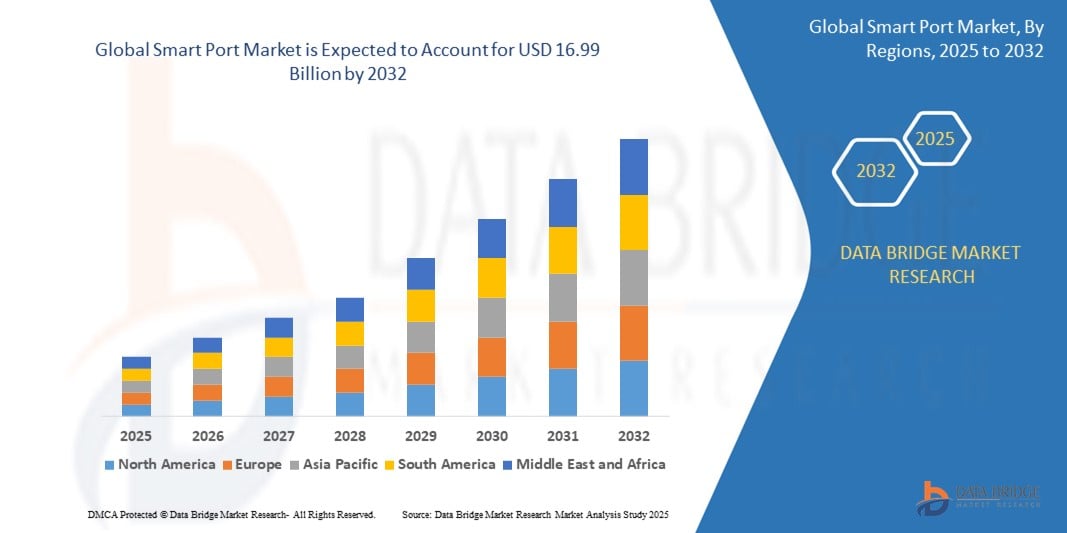
Smart Port Market Size
- The global smart port market size was valued at USD 3.09 billion in 2024 and is expected to reach USD 16.99 billion by 2032, at a CAGR of 23.75% during the forecast period
- The market growth is largely fueled by the increasing adoption of digital technologies such as IoT, AI, blockchain, and automation in maritime operations, leading to enhanced efficiency, real-time monitoring, and predictive maintenance across port ecosystems
- Furthermore, rising pressure to improve port throughput, reduce carbon emissions, and optimize logistics performance is prompting governments and operators to invest in smart port infrastructure. These converging factors are accelerating the transformation of traditional ports into intelligent, connected hubs, thereby significantly boosting the industry's growth
Smart Port Market Analysis
- Smart ports leverage advanced technologies to automate cargo handling, track vessels, manage energy usage, and streamline customs procedures, resulting in faster turnaround times, lower operational costs, and improved sustainability
- The increasing global trade volumes, rising demand for efficient supply chain operations, and supportive government initiatives for digital port transformation are key factors propelling the adoption of smart port solutions across major seaports and inland terminals
- Asia-Pacific dominated the smart port market with a share of 39.6% in 2024, due to large-scale port infrastructure upgrades, robust maritime trade growth, and increasing government investments in digital port modernization
- North America is expected to be the fastest growing region in the smart port market during the forecast period due to increasing emphasis on port security, real-time cargo visibility, and climate-resilient infrastructure
- Process automation segment dominated the market with a market share of 33.6% in 2024, due to its pivotal role in streamlining port operations by minimizing manual intervention, reducing human error, and increasing overall efficiency. Automated systems enhance cargo handling, berth scheduling, and customs clearance, resulting in faster turnaround times and improved resource utilization. As ports face growing pressure to manage increasing trade volumes while maintaining cost-effectiveness, process automation offers scalable solutions that support real-time data processing, integration with existing infrastructure, and compliance with global standards, making it the preferred technology for modernizing port ecosystems
Report Scope and Smart Port Market Segmentation
|
Attributes |
Smart Port Key Market Insights |
|
Segments Covered |
|
|
Countries Covered |
North America
Europe
Asia-Pacific
Middle East and Africa
South America
|
|
Key Market Players |
|
|
Market Opportunities |
|
|
Value Added Data Infosets |
In addition to the market insights such as market value, growth rate, market segments, geographical coverage, market players, and market scenario, the market report curated by the Data Bridge Market Research team includes in-depth expert analysis, import/export analysis, pricing analysis, production consumption analysis, and pestle analysis. |
Smart Port Market Trends
“Increasing Integration of Automation and Digital Technologies”
- The smart port market is experiencing rapid growth as ports worldwide adopt automation, IoT, AI, and data analytics to streamline operations, reduce costs, and improve cargo throughput, responding to the surge in global trade and containerized goods movement
- For instance, the Port of Hamburg in Germany has implemented IoT-enabled smart port technologies, allowing real-time tracking of cargo, predictive maintenance of equipment, and enhanced logistics efficiency, setting a benchmark for digital transformation in maritime logistics
- Governments and port authorities are actively encouraging the adoption of smart technologies through policy support, subsidies, and public-private partnerships, recognizing the role of digitalization in boosting competitiveness and sustainability
- The integration of digital twin technology is enabling ports to simulate, monitor, and optimize port operations, leading to better resource allocation, faster decision-making, and improved safety outcomes
- Sustainability is a growing focus, with ports investing in renewable energy, on-shore power supply, and emissions monitoring systems to comply with regulatory mandates and reduce their environmental footprint
- Heightened maritime security threats, including cyberattacks and smuggling, are prompting ports to deploy advanced digital surveillance, AI-powered threat detection, and robust cybersecurity frameworks to safeguard critical infrastructure
Smart Port Market Dynamics
Driver
“Escalating Demand for Efficient Cargo and Trade Management”
- The global increase in maritime trade volume and the need to handle growing cargo flows efficiently are primary drivers accelerating the adoption of smart port solutions, as traditional port operations struggle to keep up with demand
- For instance, major ports in Asia Pacific, such as Shanghai and Singapore, are investing heavily in automated container handling systems, robotics, and AI-driven traffic management to enhance throughput and minimize turnaround times, positioning themselves as global logistics hubs
- Regulatory pushes for decarbonization, such as the IMO 2030/2050 targets, are motivating ports to implement green technologies and digital tools to monitor and reduce emissions
- The rise of e-commerce, just-in-time inventory models, and increased consumer expectations for fast delivery are compelling ports to embrace digitalization and automation for improved reliability and transparency in supply chains
- Collaboration between shipping companies and technology providers is leading to the development of blockchain-based shipping systems, which streamline documentation, enhance traceability, and reduce administrative bottlenecks in port operations
Restraint/Challenge
“High Capital Expenditure and Integration Complexity”
- The high initial investment required for deploying smart port infrastructure—including automation systems, IoT networks, and advanced analytics platforms—remains a significant barrier, particularly for ports in developing regions with limited budgets
- For instance, smaller and mid-sized ports often struggle to justify the cost of upgrading legacy systems or integrating new technologies, especially when anticipated returns are long-term and dependent on broader ecosystem adoption
- The complexity of integrating diverse digital solutions with existing port operations can lead to operational disruptions, requiring extensive change management, staff training, and phased implementation strategies
- Concerns around data privacy, cybersecurity, and the risk of cyberattacks are increasing as ports become more interconnected and reliant on digital platforms, necessitating robust security investments and protocols
- Variability in regulatory standards, interoperability challenges among different technology providers, and the need for industry-wide collaboration can slow down the pace of digital transformation and limit the scalability of smart port initiatives
Smart Port Market Scope
The market is segmented on the basis of technology, throughput capacity, and type.
- By Technology
On the basis of technology, the smart port market is segmented into process automation, blockchain, Internet of Things (IoT), and artificial intelligence (AI). The process automation segment dominated the largest market revenue share of 33.6% in 2024 due to its pivotal role in streamlining port operations by minimizing manual intervention, reducing human error, and increasing overall efficiency. Automated systems enhance cargo handling, berth scheduling, and customs clearance, resulting in faster turnaround times and improved resource utilization. As ports face growing pressure to manage increasing trade volumes while maintaining cost-effectiveness, process automation offers scalable solutions that support real-time data processing, integration with existing infrastructure, and compliance with global standards, making it the preferred technology for modernizing port ecosystems.
The artificial intelligence (AI) segment is expected to witness the fastest growth rate from 2025 to 2032, driven by rising demand for intelligent decision-making systems and automation in complex logistics environments. AI enables dynamic scheduling, automated crane operations, traffic flow optimization, and predictive analytics to improve cargo handling and turnaround times. With increasing pressure to optimize costs and throughput, AI adoption is accelerating in smart ports seeking scalable, autonomous solutions to boost productivity and resilience.
- By Throughput Capacity
On the basis of throughput capacity, the smart port market is segmented into extensively busy, moderately busy, and scarcely busy ports. The extensively busy segment held the largest revenue share in 2024, attributed to the high-volume operations of major global trade hubs that necessitate advanced digital infrastructure for efficient management. These ports often face significant challenges in congestion, cargo handling, and security, making them prime adopters of smart port technologies to enhance throughput, reduce turnaround time, and ensure regulatory compliance.
The moderately busy segment is projected to grow at the fastest rate from 2025 to 2032, as regional and mid-tier ports increasingly invest in digital upgrades to remain competitive and attract more shipping lines. These ports are strategically adopting scalable smart solutions such as IoT sensors, port community systems, and AI-based traffic control to improve service efficiency, expand operational capacity, and establish themselves as reliable alternatives to overburdened mega-ports.
- By Type
On the basis of type, the smart port market is segmented into seaport and inland port. The seaport segment dominated the largest market share in 2024, owing to its critical role in international trade and high dependency on maritime logistics. Seaports are heavily investing in smart technologies to optimize vessel traffic management, container handling, and energy consumption, supported by government-led smart infrastructure initiatives and sustainability mandates.
The inland port segment is anticipated to experience the fastest growth from 2025 to 2032, driven by the rising importance of hinterland connectivity and the integration of intermodal transport systems. Inland ports serve as vital logistics hubs that reduce congestion at coastal ports and improve cargo flow across inland regions. The adoption of smart technologies in inland ports enhances visibility, streamlines customs processes, and fosters seamless coordination between rail, road, and waterborne logistics, thereby strengthening their strategic relevance in global supply chains.
Smart Port Market Regional Analysis
- Asia-Pacific dominated the smart port market with the largest revenue share of 39.6% in 2024, driven by large-scale port infrastructure upgrades, robust maritime trade growth, and increasing government investments in digital port modernization
- The region’s emphasis on logistics automation, smart container tracking, and real-time data systems—coupled with rising export-import volumes—is accelerating adoption of AI, IoT, and blockchain in port operations
- In addition, regional initiatives such as China’s Belt and Road and the Maritime Silk Road are promoting widespread implementation of smart technologies to boost port competitiveness and sustainability
Japan Smart Port Market Insight
The Japan smart port market is growing steadily, supported by strong governmental focus on automation and eco-efficiency in line with national smart logistics strategies. Ports such as Yokohama and Kobe are deploying AI-based scheduling, robotics, and autonomous cargo handling systems to enhance port productivity and reduce operational emissions. The country’s aging workforce also fuels demand for unmanned operations and advanced monitoring systems.
China Smart Port Market Insight
China held the largest market share in Asia-Pacific in 2024, bolstered by its aggressive port digitalization agenda and dominance in global trade. Major ports such as Shanghai and Shenzhen are implementing AI, 5G, and blockchain for smart customs, automated cranes, and predictive logistics. State-backed investments and strategic public-private partnerships are driving large-scale deployment of smart port ecosystems aligned with national infrastructure goals.
Europe Smart Port Market Insight
The Europe smart port market is projected to grow at a significant CAGR during the forecast period, driven by stringent environmental regulations, EU decarbonization targets, and advanced digital infrastructure across Western Europe. Leading ports in the Netherlands, Germany, and Spain are focusing on AI-enabled emissions monitoring, green port electrification, and IoT-based logistics optimization to meet climate and efficiency targets.
U.K. Smart Port Market Insight
The U.K. smart port market is anticipated to grow steadily, driven by post-Brexit trade realignment, government-backed maritime innovation strategies, and investments in port automation. Smart systems for customs digitization, contactless cargo handling, and AI-led traffic flow management are being integrated at key terminals such as London Gateway and Felixstowe to enhance throughput and reduce delays.
Germany Smart Port Market Insight
Germany’s smart port market is expanding rapidly, with ports such as Hamburg leading in digital twin technology, AI-based vessel tracking, and carbon-neutral port operations. Germany’s strong engineering base and environmental policies are fostering smart port innovations that align with Industry 4.0 principles. Cross-border logistics integration with EU neighbors also boosts demand for interoperable smart infrastructure.
North America Smart Port Market Insight
North America is projected to grow at the fastest CAGR from 2025 to 2032, driven by increasing emphasis on port security, real-time cargo visibility, and climate-resilient infrastructure. Major ports in the U.S. and Canada are adopting AI and IoT for smart yard management, digital customs processing, and predictive analytics. Rising e-commerce trade, supply chain digitalization, and infrastructure modernization funding are key growth catalysts.
U.S. Smart Port Market Insight
The U.S. smart port market captured the largest revenue share in North America in 2024, supported by high-tech investments in West and Gulf Coast ports. The implementation of 5G connectivity, drone-based surveillance, and AI-led vessel berthing systems is improving operational efficiency and security. Federal grants under maritime innovation and green port programs are further accelerating adoption of integrated smart solutions.
Smart Port Market Share
The smart port industry is primarily led by well-established companies, including:
- Royal HaskoningDHV (Netherlands)
- ABB (Switzerland)
- Trelleborg Group (Sweden)
- Accenture (Ireland)
- Ramboll Group A/S (Denmark)
- Port Solutions Limited (U.K.)
- Awake.AI (Finland)
- IBM (U.S.)
- Siemens (Germany)
- General Electric Company (U.S.)
- Navis (U.S.)
- Kalmar (Finland)
- Konecranes (Finland)
- Wärtsilä (Finland)
- PSA International (Singapore)
- DP World (UAE)
Latest Developments in Global Smart Port Market
- In June 2025, the Maritime and Port Authority of Singapore (MPA) and NUS Enterprise jointly launched the 9th edition of the PIER71 Smart Port Challenge (SPC) 2025, boosting innovation in the maritime sector. By fostering startup-driven solutions to address real-world port challenges, the initiative is expected to accelerate digital transformation across smart port ecosystems globally, reinforcing Singapore’s strategic influence in maritime innovation
- In May 2025, the Port of Ningbo-Zhoushan launched green corridor partnerships with Hamburg, Wilhelmshaven, and Valencia to advance zero-emission shipping. The initiative focuses on implementing shore power systems, clean fuel bunkering, and intelligent logistics, underscoring China’s leadership in sustainable port innovation. Despite financial and regulatory hurdles, the project strengthens momentum for global adoption of green maritime routes
- In May 2025, Fastweb and Vodafone deployed a private 5G network at Italy’s Port of Ravenna, covering a 15km canal. This development marks a significant step in enabling autonomous vehicles, IoT infrastructure, and real-time monitoring. It enhances operational efficiency, safety, and sustainability, representing a transformative milestone in Italy’s €10 million smart port modernization plan
- In February 2025, SANY Marine launched its 2025 electric intelligent product series in Zhuhai, featuring 5G-enabled remote-controlled forklifts and energy-efficient reach stackers. The delivery of 60 electric units demonstrates growing market traction for electrified port equipment and reflects increasing investment in automation and decarbonization technologies in port logistics
- In May 2022, Awake.AI introduced its “Smart Port as a Service” platform, leveraging AI, edge computing, and 5G to optimize port operations. By offering real-time cargo flow insights and emission reduction capabilities, the platform significantly improves port efficiency. Its adoption by Finnish ports positions it as a leading solution in the shift toward intelligent, data-driven maritime infrastructure

- Interactive Data Analysis Dashboard
- Company Analysis Dashboard for high growth potential opportunities
- Research Analyst Access for customization & queries
- Competitor Analysis with Interactive dashboard
- Latest News, Updates & Trend analysis
- Harness the Power of Benchmark Analysis for Comprehensive Competitor Tracking
Data collection and base year analysis are done using data collection modules with large sample sizes. The stage includes obtaining market information or related data through various sources and strategies. It includes examining and planning all the data acquired from the past in advance. It likewise envelops the examination of information inconsistencies seen across different information sources. The market data is analysed and estimated using market statistical and coherent models. Also, market share analysis and key trend analysis are the major success factors in the market report. To know more, please request an analyst call or drop down your inquiry.
The key research methodology used by DBMR research team is data triangulation which involves data mining, analysis of the impact of data variables on the market and primary (industry expert) validation. Data models include Vendor Positioning Grid, Market Time Line Analysis, Market Overview and Guide, Company Positioning Grid, Patent Analysis, Pricing Analysis, Company Market Share Analysis, Standards of Measurement, Global versus Regional and Vendor Share Analysis. To know more about the research methodology, drop in an inquiry to speak to our industry experts.
Data Bridge Market Research is a leader in advanced formative research. We take pride in servicing our existing and new customers with data and analysis that match and suits their goal. The report can be customized to include price trend analysis of target brands understanding the market for additional countries (ask for the list of countries), clinical trial results data, literature review, refurbished market and product base analysis. Market analysis of target competitors can be analyzed from technology-based analysis to market portfolio strategies. We can add as many competitors that you require data about in the format and data style you are looking for. Our team of analysts can also provide you data in crude raw excel files pivot tables (Fact book) or can assist you in creating presentations from the data sets available in the report.













