


Smart Stadium Market Size
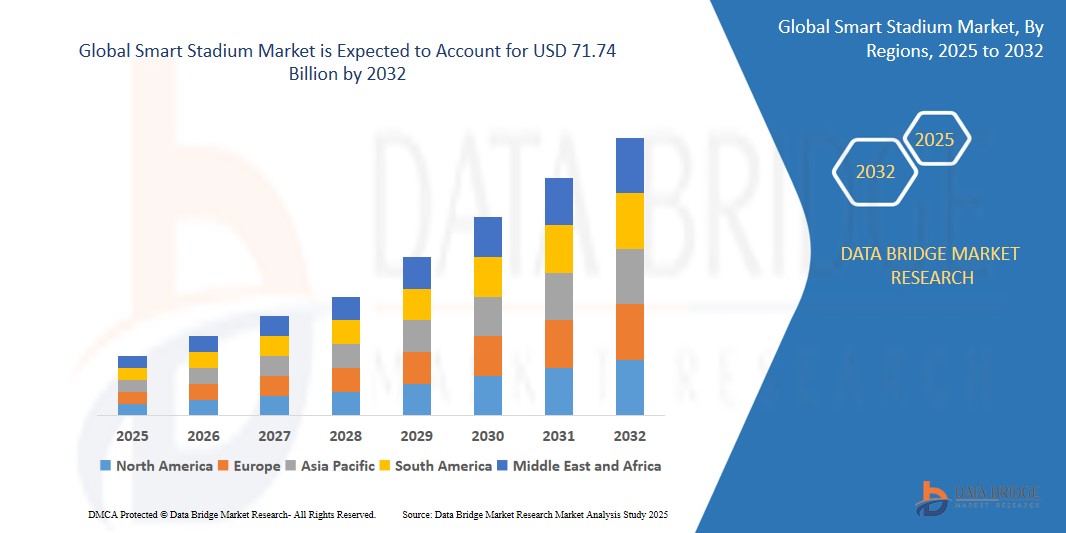
- The Global Smart Stadium Market size was valued at USD 15.17 billion in 2024 and is expected to reach USD 71.74 billion by 2032, at a CAGR of 21.43% during the forecast period
- This growth is driven by upcoming national and international sports events
Smart Stadium Market Analysis
- Smart stadiums play a crucial role in enhancing the fan experience, improving operational efficiency, and integrating advanced technologies such as IoT, AI, and data analytics in sports venues
- The demand for smart stadiums is driven by the growing need for fan engagement, data-driven insights, energy efficiency, and smart technologies that enable seamless connectivity, crowd management, and real-time information sharing during events
- Europe is expected to dominate the smart stadium market with the largest market share of 31.24% due to established sports infrastructure, increased investments in stadium upgrades, and the adoption of innovative technologies across key countries such as the U.K., Germany, and France
- Asia-Pacific is projected to be the fastest-growing region in the smart stadium market during the forecast period, driven by rapid urbanization, increasing sports events, and growing adoption of smart technologies in countries such as China, India, and Japan
- The software segment is expected to dominate the market with the market share of 61.27% owing to its integration of multiple technologies, including parking space optimization, ticketing systems, seat upgrade options, and crowd flow management. It also features services such as food ordering, restroom queue tracking, social media engagement, and real-time emergency and incident response coordination
Report Scope and Smart Stadium Market Segmentation
|
Attributes |
Smart Stadium Key Market Insights |
|
Segments Covered |
|
|
Countries Covered |
North America
Europe
Asia-Pacific
Middle East and Africa
South America
|
|
Key Market Players |
|
|
Market Opportunities |
|
|
Value Added Data Infosets |
In addition to the insights on market scenarios such as market value, growth rate, segmentation, geographical coverage, and major players, the market reports curated by the Data Bridge Market Research also include in-depth expert analysis, pricing analysis, brand share analysis, consumer survey, demography analysis, supply chain analysis, value chain analysis, raw material/consumables overview, vendor selection criteria, PESTLE Analysis, Porter Analysis, and regulatory framework. |
Smart Stadium Market Trends
“Enhanced Fan Experience through AI and Data Analytics”
- A major trend reshaping the smart stadium market is the increasing use of AI, big data, and analytics to offer personalized and interactive fan experiences
- AI-driven solutions are used for crowd management, personalized marketing, and real-time event tracking, enabling stadiums to deliver seamless and customized experiences for fans
- The demand for enhanced fan engagement through technologies such as facial recognition, crowd analytics, and virtual assistants is driving the adoption of these technologies in smart stadiums
- For instance, in August 2024, Allianz Arena in Munich implemented an AI-powered system for crowd flow management, reducing waiting times for food and merchandise during events
- This trend is expected to enhance fan satisfaction and engagement, propelling further investments in AI and data analytics technologies across stadiums globally
Smart Stadium Market Dynamics
Driver
“Growing Demand for Energy Efficiency and Sustainability”
- The growing focus on sustainability and energy efficiency is driving the smart stadium market, with venue owners and operators prioritizing green technologies
- Smart stadiums incorporate energy-efficient systems such as LED lighting, renewable energy sources, and advanced HVAC systems to reduce operational costs and environmental impact
- The implementation of smart grids, energy storage, and energy management systems further boosts stadiums' energy efficiency and reduces carbon footprints
- For instance, in March 2024, Tottenham Hotspur Stadium integrated solar panels and energy storage systems, achieving a 20% reduction in energy consumption
- This growing focus on sustainability is expected to accelerate the adoption of green technologies in smart stadiums worldwide
Restraint/Challenge
“High Initial Investment and Infrastructure Costs”
- A key challenge in the smart stadium market is the high initial investment required for upgrading to smart technologies and infrastructure
- The cost of installing advanced systems such as IoT devices, sensors, and AI-powered solutions can be prohibitive, especially for smaller or older stadiums that lack modern infrastructure
- Ongoing maintenance and software updates for smart systems can further increase operational costs
- For instance, in 2023, several U.S.-based stadiums delayed smart technology upgrades due to high capital expenditure concerns and lack of funding
- These financial barriers can hinder the widespread adoption of smart technologies in older or smaller venues, limiting market expansion in certain regions
Smart Stadium Market Scope
The market is segmented on the basis of component, deployment mode, and platform.
- By Component
On the basis of component, the Smart Stadium Market is segmented into software and services. The software segment is expected to dominate the market with the market share of 61.27% owing to its integration of multiple technologies, including parking space optimization, ticketing systems, seat upgrade options, and crowd flow management. It also features services such as food ordering, restroom queue tracking, social media engagement, and real-time emergency and incident response coordination
The services segment is expected to witness the fastest growth from 2025 to 2032. This growth is attributed to the rising need for consulting, system integration, and support & maintenance services. As more stadiums modernize their infrastructure, service providers play a critical role in ensuring seamless deployment, customization, and training of stadium staff for smart technology applications.
- By Deployment Mode
On the basis of deployment mode, the Smart Stadium Market is segmented into on-premises and cloud. The on-premises segment dominated the market in terms of revenue share in 2024. This is due to heightened concerns over data privacy and latency-sensitive operations, particularly for stadiums handling large-scale live events. On-premises systems offer better control over data storage and management, which is critical for real-time applications like surveillance and emergency response.
The cloud segment is anticipated to register the fastest CAGR during the forecast period. Cloud-based deployment enables remote monitoring, scalability, and cost efficiency. Cloud platforms are particularly beneficial for smaller and mid-size stadiums that require flexible access to advanced technologies without heavy infrastructure investments.
- By Platform
On the basis of platform, the Smart Stadium Market is segmented into application management platform, device management platform, and network management platform. The application management platform held the largest share in 2024 due to its central role in managing multiple stadium operations—such as ticketing, crowd analytics, and fan engagement—in one interface. These platforms enhance the fan experience through personalized services, while also helping stadium operators optimize workflows.
The network management platform is projected to grow at the highest rate from 2025 to 2032. The increasing demand for seamless connectivity, especially during live events, drives investments in robust network infrastructures. These platforms ensure stable Wi-Fi, support IoT devices, and manage bandwidth dynamically to accommodate fluctuating demands.
Smart Stadium Market Regional Analysis
- Europe dominates the Smart Stadium Market with the largest revenue share of 31.24% in 2024, driven by early adoption of digital transformation in sports infrastructure and the widespread deployment of smart technologies such as IoT, AI, and 5G.
- Countries like Germany, the U.K., and France are leading the charge by investing heavily in intelligent surveillance, crowd analytics, and smart ticketing solutions aimed at enhancing the fan experience and boosting operational efficiency.
- The region's leadership is further strengthened by supportive government policies, advanced IT infrastructure, and the presence of global tech leaders like Cisco, Ericsson, and NTT DATA collaborating with major sports clubs.
- Europe's commitment to sustainable construction and energy-efficient systems, combined with rising interest in digital fan engagement platforms, cements its position as a trailblazer in next-generation smart stadium development.
Germany Smart Stadium Market Insight
The Germany Smart Stadium Market is expected to register steady growth during the forecast period, driven by significant investments in energy-efficient infrastructure, smart surveillance, and data-driven venue management. Germany’s focus on sustainability, coupled with its strong sports culture, supports the integration of smart systems in stadiums. Moreover, partnerships between technology providers and Bundesliga football clubs are fueling innovation, making Germany a key contributor to Europe’s overall market dominance.
U.K. Smart Stadium Market Insight
The U.K. Smart Stadium Market is projected to grow at a notable CAGR due to rising investments in sports digitization and government-backed smart city initiatives. Premier League clubs are adopting advanced crowd monitoring, digital ticketing, and fan engagement technologies, leading to widespread deployment of smart platforms. The U.K.’s early embrace of contactless services post-COVID-19 also contributes to the popularity of automated access and mobile-based services across stadiums.
France Smart Stadium Market Insight
The France Smart Stadium Market is witnessing growth fueled by preparations for international events like the 2024 Paris Olympics, which are prompting large-scale upgrades in stadium technologies. Emphasis on digital experience, security, and environmental sustainability is leading to the adoption of smart lighting, AI-powered surveillance, and green energy systems. France's strong policy support and focus on long-term smart infrastructure further strengthen its position within the European market.
Asia-Pacific Smart Stadium Market Insight
The Asia-Pacific Smart Stadium Market is poised to grow at the fastest CAGR of 24% during 2025 to 2032, driven by rapid urbanization, rising sports enthusiasm, and significant government investments in smart infrastructure. Countries like China, India, Japan, and Australia are leading smart stadium deployments, encouraged by ongoing smart city projects and increasing fan demand for immersive digital experiences. The rise in major sporting events, including the Asian Games, IPL, and Olympic bids, is further boosting the construction of next-gen stadiums equipped with advanced crowd control, AI analytics, and IoT integration.
China Smart Stadium Market Insight
The China Smart Stadium Market accounted for the largest revenue share within Asia-Pacific in 2024, due to robust government support, rapid tech adoption, and a thriving middle class. The country’s smart city strategy has accelerated the development of high-tech stadiums featuring smart lighting, facial recognition, and cloud-based analytics. Additionally, domestic tech giants and manufacturers provide cost-effective smart solutions, further boosting local market penetration.
India Smart Stadium Market Insight
The India Smart Stadium Market is anticipated to grow significantly, supported by increased spending on sports infrastructure and smart urban development. The popularity of sports leagues like the IPL has driven the need for technologically advanced venues. Government initiatives like "Smart Cities Mission" and growing partnerships between stadiums and tech firms are encouraging the deployment of digital ticketing, real-time monitoring, and energy management systems.
Japan Smart Stadium Market Insight
The Japan Smart Stadium Market is witnessing notable momentum due to its tech-savvy population and focus on convenience and safety. With an aging population and a high level of urbanization, Japan’s smart stadiums prioritize accessibility, automation, and user-friendly interfaces. Integration with smart city ecosystems, alongside features like mobile entry, automated crowd flow, and AI-based safety systems, makes Japan a leading innovator in the APAC region.
Smart Stadium Market Share
The Smart Stadium industry is primarily led by well-established companies, including:
- IBM (U.S.)
- Tech Mahindra Limited (India)
- NEC Corporation India Private Limited (India)
- Cisco Systems, Inc. (U.S.)
- Huawei Technologies Co., Ltd. (China)
- Intel Corporation (U.S.)
- FUJITSU (Japan)
- Johnson Controls (U.S.)
- Telefonaktiebolaget LM Ericsson (Sweden)
- GP Smart Stadium (U.K.)
- CenturyLink (U.S.)
- NXP Semiconductors (Netherlands)
- Vix Technology (Australia)
- Hawk-Eye Innovations Ltd (U.K.)
- Honeywell International Inc (U.S.)
- UCOPIA (France)
- Schneider Electric (France)
- Infosys Limited (India)
- Atos SE (France)
- Volteo Group LLC (U.S.)
Latest Developments in Global Smart Stadium Market
- In September 2024, Arsenal teamed up with NTT DATA in a multi-year alliance to drive the club’s digital transformation, focusing on smart stadium development using data analytics, machine learning, and personalized fan engagement strategies. This partnership aims to elevate fan experience while strengthening Arsenal’s position as a technology-forward football club
- In June 2024, Johnson Controls partnered with Middle Eastern sustainability firm IGCC to advance smart stadium capabilities by implementing cutting-edge energy solutions aimed at boosting sustainability and operational efficiency. This collaboration underscores a growing industry emphasis on green and smart infrastructure for sports venues
- In February 2024, Orange Business joined forces with Cisco to deploy an energy-efficient solution at the Orange Vélodrome in Marseille, shifting the venue’s Wi-Fi infrastructure to an on-demand system that significantly reduces power consumption. The initiative reflects a strong commitment to sustainability and digital innovation in stadium operations
- In March 2023, Cisco entered into a global, multi-year collaboration with Real Madrid CF to modernize the Santiago Bernabéu Stadium into a top-tier, technology-integrated sports facility using advanced networking solutions. This move reinforces Real Madrid’s ambitions to lead in stadium innovation and digital connectivity
- In November 2021, Ericsson collaborated with Ooredoo Qatar to deliver enhanced 5G connectivity across stadiums and national infrastructure during Qatar’s hosting of a major global football tournament between November and December 2022.This initiative aimed to provide an unparalleled digital experience for international fans and set a benchmark for future smart stadium deployments

- Interactive Data Analysis Dashboard
- Company Analysis Dashboard for high growth potential opportunities
- Research Analyst Access for customization & queries
- Competitor Analysis with Interactive dashboard
- Latest News, Updates & Trend analysis
- Harness the Power of Benchmark Analysis for Comprehensive Competitor Tracking
Data collection and base year analysis are done using data collection modules with large sample sizes. The stage includes obtaining market information or related data through various sources and strategies. It includes examining and planning all the data acquired from the past in advance. It likewise envelops the examination of information inconsistencies seen across different information sources. The market data is analysed and estimated using market statistical and coherent models. Also, market share analysis and key trend analysis are the major success factors in the market report. To know more, please request an analyst call or drop down your inquiry.
The key research methodology used by DBMR research team is data triangulation which involves data mining, analysis of the impact of data variables on the market and primary (industry expert) validation. Data models include Vendor Positioning Grid, Market Time Line Analysis, Market Overview and Guide, Company Positioning Grid, Patent Analysis, Pricing Analysis, Company Market Share Analysis, Standards of Measurement, Global versus Regional and Vendor Share Analysis. To know more about the research methodology, drop in an inquiry to speak to our industry experts.
Data Bridge Market Research is a leader in advanced formative research. We take pride in servicing our existing and new customers with data and analysis that match and suits their goal. The report can be customized to include price trend analysis of target brands understanding the market for additional countries (ask for the list of countries), clinical trial results data, literature review, refurbished market and product base analysis. Market analysis of target competitors can be analyzed from technology-based analysis to market portfolio strategies. We can add as many competitors that you require data about in the format and data style you are looking for. Our team of analysts can also provide you data in crude raw excel files pivot tables (Fact book) or can assist you in creating presentations from the data sets available in the report.













