


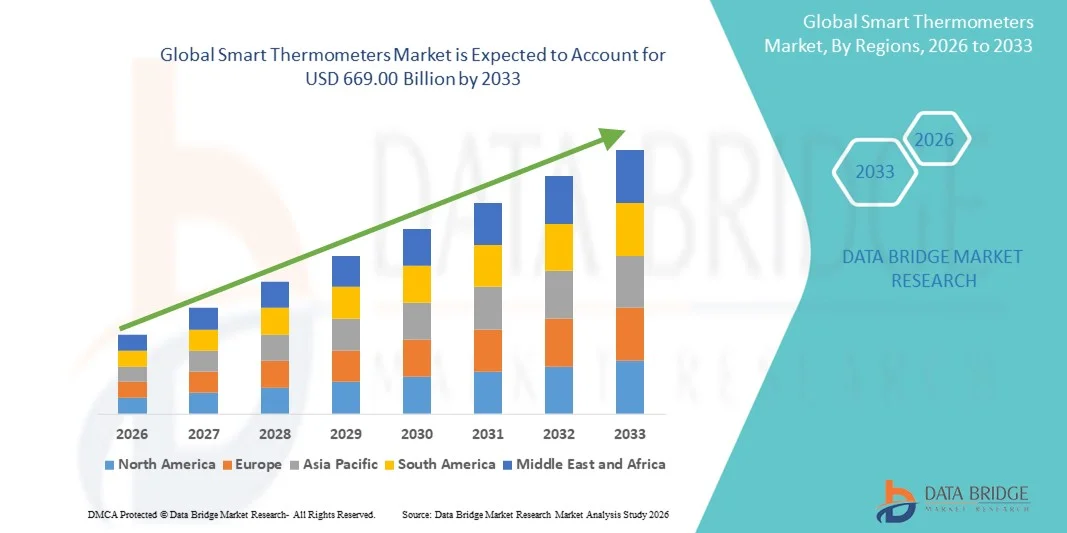
Smart Thermometers Market Size
- The global smart thermometers market size was valued at USD 366.84 billion in 2025 and is expected to reach USD 669.00 billion by 2033, at a CAGR of 7.80% during the forecast period
- The market growth is largely fueled by the increasing adoption of digital healthcare devices and advancements in sensor technology, connectivity, and mobile health platforms, leading to improved accuracy, real-time monitoring, and seamless data sharing in both home-based and clinical settings
- Furthermore, rising consumer demand for convenient, non-invasive, and user-friendly temperature monitoring solutions is establishing smart thermometers as essential tools for personal health management and remote patient monitoring. These converging factors are accelerating the uptake of Smart Thermometers solutions, thereby significantly boosting the overall growth of the market
Smart Thermometers Market Analysis
- Smart thermometers, which enable digital and connected body temperature measurement through mobile apps and cloud platforms, are increasingly vital in modern healthcare due to their ability to provide accurate, real-time readings, data tracking, and remote health monitoring in both home-care and clinical environments. These devices support early disease detection and improved personal health management
- The escalating demand for smart thermometers is primarily driven by rising health awareness, growing adoption of telehealth and remote patient monitoring solutions, and increased preference for contactless and user-friendly medical devices. Technological advancements such as Bluetooth/Wi-Fi connectivity, AI-enabled analytics, and smartphone integration are further accelerating market adoption
- North America dominated the smart thermometers market with the largest revenue share of approximately 36.8% in 2025, supported by high penetration of digital health devices, strong healthcare infrastructure, and widespread adoption of home-based monitoring solutions. The U.S. led regional growth due to strong consumer awareness and integration of smart thermometers with telemedicine platforms
- Asia-Pacific is expected to be the fastest-growing region in the smart thermometers market during the forecast period, driven by increasing healthcare digitization, rising disposable incomes, expanding middle-class populations, and growing adoption of mobile health technologies in countries such as China, India, and Japan
- The Mercury-Free Thermometers segment dominated the largest market revenue share of 62.4% in 2025, driven by rising awareness about mercury toxicity and global regulations restricting mercury use in medical devices
Report Scope and Smart Thermometers Market Segmentation
|
Attributes |
Smart Thermometers Key Market Insights |
|
Segments Covered |
|
|
Countries Covered |
North America
Europe
Asia-Pacific
Middle East and Africa
South America
|
|
Key Market Players |
• Braun GmbH (Germany) |
|
Market Opportunities |
|
|
Value Added Data Infosets |
In addition to the insights on market scenarios such as market value, growth rate, segmentation, geographical coverage, and major players, the market reports curated by the Data Bridge Market Research also include in-depth expert analysis, patient epidemiology, pipeline analysis, pricing analysis, and regulatory framework. |
Smart Thermometers Market Trends
Rising Adoption of Digital and Connected Thermometers
- A significant and accelerating trend in the global smart thermometers market is the increasing use of digital and connected thermometers that provide accurate, real-time temperature monitoring for both clinical and home settings. These devices are increasingly preferred over traditional mercury or analog thermometers due to their precision, ease of use, and rapid readings
- For instance, in 2024, Omron Healthcare launched its Next-Generation Digital Thermometer series with rapid read and memory tracking features for home use, reflecting growing consumer preference for reliable, convenient temperature monitoring solutions
- The adoption of infrared and non-contact thermometers is rising due to hygiene concerns and the need for quick, contactless measurement, particularly in public health monitoring and pediatric care
- Healthcare providers are also integrating digital thermometers into patient monitoring workflows for improved efficiency and timely detection of fever or infection
- Overall, the trend toward accuracy, speed, and convenience is driving the replacement of conventional thermometers with advanced digital and smart alternatives
Smart Thermometers Market Dynamics
Driver
Increasing Focus on Health Monitoring and Early Disease Detection
- Rising awareness of personal health management and the importance of early detection of fever and infections are major drivers for the Smart Thermometers market. Consumers and healthcare providers are increasingly adopting these devices to monitor health proactively
- For instance, in 2023, a major U.S. pediatric clinic integrated digital thermometers with patient records, enabling continuous monitoring and timely interventions for children with recurring fevers
- The COVID-19 pandemic further accelerated the adoption of contactless and rapid-read thermometers for infection control in clinics, workplaces, and homes
- Growing availability of portable, easy-to-use, and affordable thermometers is also expanding adoption in emerging markets
- Increasing focus on remote patient monitoring and home healthcare is further driving the demand for digital and connected thermometers
Restraint/Challenge
High Device Cost and Calibration Accuracy Concerns
- Despite the advantages, the high cost of advanced thermometers and occasional concerns about accuracy and calibration remain significant challenges, particularly for low-income households and small clinics
- For instance, some rural clinics in Asia reported difficulties in maintaining calibration of infrared thermometers, impacting measurement reliability and adoption rates
- Limited standardization across different devices and brands can lead to inconsistent readings, affecting trust among users and healthcare professionals
- In addition, battery dependency, device maintenance, and replacement costs can act as barriers to adoption in certain regions
- Addressing these issues through cost-effective, reliable, and standardized thermometers will be critical for sustained growth in the smart thermometers market
Smart Thermometers Market Scope
The market is segmented on the basis of product type, application, and connectivity.
- By Product Type
On the basis of product type, the Smart Thermometers market is segmented into Mercury-Free Thermometers and Mercury-Based Thermometers. The Mercury-Free Thermometers segment dominated the largest market revenue share of 62.4% in 2025, driven by rising awareness about mercury toxicity and global regulations restricting mercury use in medical devices. Mercury-free smart thermometers are widely preferred in hospitals, clinics, and households for their safety, accuracy, and ease of use. They provide fast readings and integrate seamlessly with mobile apps and telehealth platforms, enhancing patient monitoring and health data tracking. Growing adoption of digital health technologies, along with government campaigns promoting mercury-free products, supports the segment’s dominance. Additionally, the rising preference for eco-friendly devices in developed markets and stringent compliance requirements for clinical safety further boost demand. Mercury-free thermometers also benefit from compatibility with wireless and Bluetooth connectivity, enabling seamless integration with home health ecosystems and remote patient monitoring systems.
The Mercury-Based Thermometers segment is expected to witness the fastest CAGR of 19.3% from 2026 to 2033, mainly driven by niche applications in industrial and laboratory settings where high-precision temperature measurement is critical. Despite regulatory restrictions in several regions, mercury-based devices continue to find demand due to their reliability and long-term stability. Emerging markets with slower transitions to digital solutions are also contributing to growth. Advanced hybrid designs combining traditional mercury thermometers with digital readouts are being developed, which improves user experience while maintaining high accuracy. The segment’s growth is further supported by rising awareness of quality control standards and the ongoing need for precise temperature monitoring in industrial processes and specialized healthcare facilities.
- By Application
On the basis of application, the Smart Thermometers market is segmented into Medical, Industrial, and Food. The Medical segment held the largest market revenue share of 54.7% in 2025, fueled by the increasing adoption of remote patient monitoring, telemedicine, and home healthcare solutions. Hospitals, clinics, and households are increasingly using smart thermometers to track body temperature trends, detect fevers, and manage chronic illnesses. Integration with mobile apps, cloud platforms, and health portals enables data-driven decision-making and proactive care. Rising awareness of preventive healthcare, coupled with digital health adoption in developed regions such as North America and Europe, reinforces dominance. The COVID-19 pandemic accelerated demand for contactless and smart temperature monitoring devices in healthcare settings. Features such as automatic recording, notifications, and data sharing with healthcare providers further enhance adoption.
The Food segment is expected to witness the fastest CAGR of 20.5% from 2026 to 2033, driven by increasing industrialization and strict food safety regulations across regions like Asia-Pacific and Europe. Smart thermometers are used extensively in food processing, storage, and distribution to monitor temperature-sensitive products. Rising awareness of foodborne illnesses, growing consumer demand for fresh and safe food, and the integration of IoT-enabled thermometers in food supply chains fuel market growth. The segment is particularly expanding in restaurants, catering, and cold-chain logistics, where real-time monitoring improves compliance with hygiene and safety standards.
- By Connectivity
On the basis of connectivity, the Smart Thermometers market is segmented into Wireless and Bluetooth. The Wireless segment dominated the largest market revenue share of 58.1% in 2025, due to its ability to support remote health monitoring over Wi-Fi networks. Wireless thermometers allow automatic uploading of readings to cloud-based systems, enabling healthcare providers to monitor patients in real time. High-speed connectivity, integration with mobile applications, and compatibility with telehealth platforms make wireless thermometers ideal for hospitals, home care, and telemedicine. The segment benefits from increasing adoption in smart homes, remote patient monitoring programs, and large healthcare institutions.
The Bluetooth segment is expected to witness the fastest CAGR of 21.8% from 2026 to 2033, driven by the growing use of smartphone-based health monitoring and wearable integration. Bluetooth-enabled thermometers are convenient for home users and small clinics due to low power consumption, ease of pairing, and offline data synchronization. Rising awareness of personal health tracking and the popularity of connected health ecosystems, including wearable devices and health apps, is driving segment growth. The availability of cost-effective Bluetooth-enabled thermometers in Asia-Pacific is also accelerating adoption in emerging markets.
Smart Thermometers Market Regional Analysis
- North America dominated the smart thermometers market with the largest revenue share of approximately 36.8% in 2025, supported by high penetration of digital health devices, strong healthcare infrastructure, and widespread adoption of home-based monitoring solutions
- The region’s growth is driven by strong consumer awareness, increasing preference for remote health monitoring, and integration of smart thermometers with telemedicine platforms and mobile health applications
- High disposable incomes, advanced healthcare IT systems, and the growing trend of home-based care further reinforce North America’s leading position
U.S. Smart Thermometers Market Insight
The U.S. smart thermometers market accounted for the majority of regional demand in 2025, fueled by the increasing adoption of connected health devices and integration with telemedicine platforms. Consumers are leveraging smart thermometers for real-time health monitoring, early detection of fevers, and remote consultation with healthcare providers. The strong adoption of mobile apps and cloud-based monitoring systems in home healthcare is further accelerating market growth.
Europe Smart Thermometers Market Insight
The Europe smart thermometers market is projected to grow steadily during the forecast period, driven by rising health awareness, digital health initiatives, and increased adoption of home-based monitoring solutions. Countries such as Germany, France, and the U.K. are witnessing demand for connected thermometers that integrate with mobile health applications and electronic health records to improve preventive care and remote patient monitoring.
U.K. Smart Thermometers Market Insight
The U.K. smart thermometers market is anticipated to register notable growth, supported by increasing use of home health monitoring devices and government initiatives promoting digital health. The integration of smart thermometers with telehealth services and mobile applications is enabling timely health tracking and improved patient outcomes across households.
Germany Smart Thermometers Market Insight
The Germany smart thermometers market is expected to expand at a considerable CAGR, fueled by the country’s strong healthcare infrastructure, high digital health adoption, and growing consumer interest in self-monitoring health devices. German consumers and healthcare providers are increasingly using smart thermometers to track temperature trends and facilitate remote health monitoring.
Asia-Pacific Smart Thermometers Market Insight
The Asia-Pacific smart thermometers market is expected to be the fastest-growing region during the forecast period, driven by increasing healthcare digitization, rising disposable incomes, expanding middle-class populations, and growing adoption of mobile health technologies in countries such as China, India, and Japan. The rising trend of home healthcare, telemedicine, and digital wellness apps is accelerating demand for connected smart thermometers.
Japan Smart Thermometers Market Insight
The Japan smart thermometers market is gaining momentum due to high consumer awareness, advanced digital health infrastructure, and growing adoption of mobile health and telemedicine platforms. Smart thermometers are widely used in households, elderly care centers, and clinics to monitor temperature trends and support preventive healthcare initiatives.
China Smart Thermometers Market Insight
The China smart thermometers market accounted for the largest revenue share in the Asia-Pacific region in 2025, driven by rapid urbanization, expanding middle-class populations, and high adoption of mobile health technologies. The integration of smart thermometers with telehealth and mobile applications is facilitating remote monitoring and early detection of health issues, further boosting market growth.
Smart Thermometers Market Share
The Smart Thermometers industry is primarily led by well-established companies, including:
• Braun GmbH (Germany)
• iHealth Labs, Inc. (U.S.)
• Exergen Corporation (U.S.)
• Withings (France)
• A&D Medical, Inc. (Japan)
• Microlife Corporation (Switzerland)
• Ci Health, Inc. (U.S.)
• Beurer GmbH (Germany)
• DrTrust Medical (U.S.)
• Contec Medical Systems Co., Ltd. (China)
• Kinsa, Inc. (U.S.)
• Welch Allyn, Inc. (U.S.)
• Nipro Corporation (Japan)
Latest Developments in Global Smart Thermometers Market
- In May 2025, Kinsa announced the launch of the Kinsa Smart Thermometer X, a next‑generation connected smart thermometer featuring enhanced accuracy and a redesigned mobile application that offers real‑time fever tracking and pediatric health insights. This launch reflects the rising demand for app‑integrated health monitoring devices that enable users to monitor body temperature trends, share data with healthcare providers, and empower proactive care at home
- In March 2025, Omron Healthcare announced a strategic partnership with Philips to jointly develop an interoperable connected thermometer ecosystem, combining Omron’s infrared sensing expertise with Philips’ digital health platform for enhanced consumer fever‑management solutions. This collaborative initiative aims to strengthen growth in the smart thermometers segment by improving connectivity and interoperability with telehealth and remote monitoring system
- In February 2025, Microlife disclosed the launch of a cloud‑enabled smart thermometer with AI‑based fever analytics, targeted at the consumer health market. The new device is designed to integrate with mobile health applications, providing predictive insights and personalized health recommendations, demonstrating how AI is increasingly embedded into smart thermometer technology to enhance remote health monitoring
- In February 2024, BodyCap S.A.S. introduced the eCelsius Performance Connect System, a smart monitoring solution intended for sports and occupational health research. Featuring continuous temperature monitoring with real‑time data transmission, the system is helping expand the scope of advanced digital thermometry beyond clinical to research and workplace health monitoring

- Interactive Data Analysis Dashboard
- Company Analysis Dashboard for high growth potential opportunities
- Research Analyst Access for customization & queries
- Competitor Analysis with Interactive dashboard
- Latest News, Updates & Trend analysis
- Harness the Power of Benchmark Analysis for Comprehensive Competitor Tracking
Data collection and base year analysis are done using data collection modules with large sample sizes. The stage includes obtaining market information or related data through various sources and strategies. It includes examining and planning all the data acquired from the past in advance. It likewise envelops the examination of information inconsistencies seen across different information sources. The market data is analysed and estimated using market statistical and coherent models. Also, market share analysis and key trend analysis are the major success factors in the market report. To know more, please request an analyst call or drop down your inquiry.
The key research methodology used by DBMR research team is data triangulation which involves data mining, analysis of the impact of data variables on the market and primary (industry expert) validation. Data models include Vendor Positioning Grid, Market Time Line Analysis, Market Overview and Guide, Company Positioning Grid, Patent Analysis, Pricing Analysis, Company Market Share Analysis, Standards of Measurement, Global versus Regional and Vendor Share Analysis. To know more about the research methodology, drop in an inquiry to speak to our industry experts.
Data Bridge Market Research is a leader in advanced formative research. We take pride in servicing our existing and new customers with data and analysis that match and suits their goal. The report can be customized to include price trend analysis of target brands understanding the market for additional countries (ask for the list of countries), clinical trial results data, literature review, refurbished market and product base analysis. Market analysis of target competitors can be analyzed from technology-based analysis to market portfolio strategies. We can add as many competitors that you require data about in the format and data style you are looking for. Our team of analysts can also provide you data in crude raw excel files pivot tables (Fact book) or can assist you in creating presentations from the data sets available in the report.













