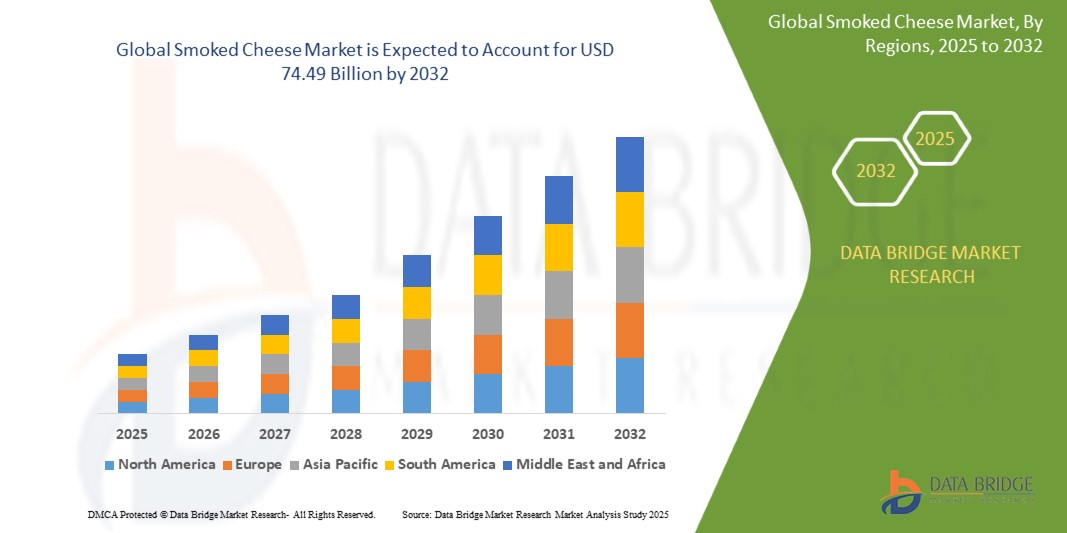
What is the Global Smoked Cheese Market Size and Growth Rate?
- The global smoked cheese market size was valued at USD 50.03 billion in 2024 and is expected to reach USD 74.49 billion by 2032, at a CAGR of 5.10% during the forecast period
- The smoked cheese market offers both original and flavored varieties to cater to diverse consumer preferences. Original smoked cheese maintains the traditional smoky flavor, appealing to purists. Meanwhile, flavored options, such as smoked gouda with herbs or smoked cheddar with jalapeno, provide unique taste experiences, attracting adventurous consumers seeking innovative flavors. This variety ensures a wide range of options to suit different tastes and culinary applications
What are the Major Takeaways of Smoked Cheese Market?
- Innovations in smoking methods and flavors are reshaping the smoked cheese market. Advancements in smoking techniques and the introduction of new flavors offer consumers a wider array of choices, enticing them with unique taste experiences. This drives market growth as manufacturers respond to evolving preferences, expanding product offerings. These innovations meet consumer demand and fuel competition, stimulating further market expansion and development
- North America dominated the smoked cheese market with the largest revenue share of 39.6% in 2024, supported by a strong presence of premium cheese producers, high per capita cheese consumption, and a growing affinity for artisanal and gourmet cheese varieties
- Asia-Pacific is expected to register the fastest CAGR of 12.7% from 2025 to 2032, driven by growing westernization of diets, increased exposure to international cuisines, and rising disposable incomes
- The Naturally Smoked Cheese segment dominated the market with the largest revenue share of 62.1% in 2024, owing to growing consumer preference for authentic and artisanal flavor experiences
Report Scope and Smoked Cheese Market Segmentation
|
Attributes |
Smoked Cheese Key Market Insights |
|
Segments Covered |
|
|
Countries Covered |
North America
Europe
Asia-Pacific
Middle East and Africa
South America
|
|
Key Market Players |
|
|
Market Opportunities |
|
|
Value Added Data Infosets |
In addition to the insights on market scenarios such as market value, growth rate, segmentation, geographical coverage, and major players, the market reports curated by the Data Bridge Market Research also include in-depth expert analysis, pricing analysis, brand share analysis, consumer survey, demography analysis, supply chain analysis, value chain analysis, raw material/consumables overview, vendor selection criteria, PESTLE Analysis, Porter Analysis, and regulatory framework. |
What is the Key Trend in the Smoked Cheese Market?
“Rising Consumer Preference for Artisanal and Authentic Flavors”
- A significant and growing trend in the global smoked cheese market is the increasing consumer inclination toward premium, artisanal, and naturally smoked cheeses. With a shift from mass-produced products to handcrafted, small-batch cheese offerings, consumers are seeking deeper flavor profiles and traceability in their dairy purchases
- Producers are responding by incorporating traditional smoking techniques, wood-type labeling (e.g., hickory, applewood), and origin-specific branding to differentiate their offerings. Brands such as Carr Valley Cheese and Grafton Village Cheese are known for artisanal smoked varieties that emphasize heritage and flavor authenticity
- Technological advancements, such as humidity-controlled smoke chambers and improved aging techniques, are being used to enhance consistency while maintaining a handcrafted appeal. Some brands also leverage QR codes to share stories of farms, milk sources, and smoking methods to build transparency
- The foodservice industry is embracing smoked cheese for gourmet applications including charcuterie boards, upscale sandwiches, and wood-fired pizzas. Increasing visibility in premium grocery sections and online platforms is expanding consumer exposure
- This trend is reshaping product innovation in the cheese segment, leading to more flavor experimentation, organic certifications, and clean-label claims, ultimately boosting brand trust and price justification
What are the Key Drivers of Smoked Cheese Market?
- The rising demand for bold, distinctive dairy flavors and natural preservation methods is a major growth driver in the smoked cheese market. Smoked cheeses are viewed as both indulgent and gourmet, aligning with the trend toward experiential eating
- For instance, in January 2024, Saputo Inc. (Canada) launched a new smoked mozzarella under its premium portfolio, focusing on natural wood-smoking and sustainable sourcing to appeal to environmentally conscious consumers
- Increasing popularity of cheese-based snacking and demand for ethnic and fusion cuisines in North America and Europe is accelerating the consumption of smoked cheese in retail and foodservice formats
- The growth of e-commerce and specialty food platforms has also enabled small and mid-sized producers to reach global audiences, offering niche smoked varieties that would otherwise be limited to local markets
- In addition, a strong rise in home cooking and gourmet experimentation, driven by social media and cooking shows, is encouraging consumers to incorporate smoked cheese into recipes for pizzas, pastas, and cheese platters
Which Factor is challenging the Growth of the Smoked Cheese Market?
- One of the primary challenges in the smoked cheese market is the high production cost and price point associated with traditional smoking processes, quality milk sourcing, and artisanal labor. These factors often result in premium pricing, limiting mass-market appeal
- For instance, brands such as Sargento and Arla Foods report increased operational costs for naturally smoked cheese lines compared to standard processed cheese due to the extended aging and real wood smoking time
- In addition, growing consumer scrutiny of additives has led to backlash against liquid smoke-flavored cheeses, which are often more affordable but perceived as less authentic. This has created trust issues in labeling, especially when terms such as "smoked" are loosely regulated
- Import/export regulations around raw milk cheeses and aging requirements in countries such as the U.S. and European Union can pose logistical barriers, limiting global scalability for smaller artisanal producers
- To overcome these challenges, producers must invest in transparent labeling, sustainable sourcing, and education about flavor authenticity. Striking a balance between cost-efficiency and craftsmanship will be critical to unlocking broader consumer adoption
How is the Smoked Cheese Market Segmented?
The market is segmented on the basis of type, product type, form, flavors, category, source, application, sales channel, and distribution channel.
• By Type
On the basis of type, the smoked cheese market is segmented into Naturally Smoked Cheese and Processed Smoked Cheese. The Naturally Smoked Cheese segment dominated the market with the largest revenue share of 62.1% in 2024, owing to growing consumer preference for authentic and artisanal flavor experiences. Naturally smoked cheeses are perceived as healthier and more flavorful due to real wood-smoking techniques and clean-label positioning.
The Processed Smoked Cheese segment is expected to witness steady growth due to its extended shelf life, affordability, and mass-market appeal in the foodservice industry.
• By Product Type
On the basis of product type, the market is segmented into Mozzarella, Parmesan, Cheddar, Cream Cheese, Ricotta, Fresh Cheese Brie, and Others. Cheddar emerged as the dominant segment with a market share of 27.8% in 2024, driven by its widespread usage in burgers, sandwiches, and cheese platters.
Mozzarella is expected to register the fastest CAGR from 2025 to 2032, supported by its growing application in pizza chains and its adaptability to both natural and flavored smoking techniques.
• By Form
On the basis of form, the market is segmented into Blocks, Cubes, Slice, Spread, and Others. The Slice segment held the largest revenue share of 34.5% in 2024, due to its convenience in usage across foodservice and household applications such as sandwiches and burgers.
The Spread segment is projected to grow rapidly, particularly in urban markets, owing to increasing snacking trends and innovative flavored cream cheese varieties.
• By Flavors
On the basis of flavor, the market is categorized into Original and Flavored. The Original flavor segment dominated with the highest market share of 66.9% in 2024, as consumers still prefer traditional, naturally smoked varieties without added ingredients.
The Flavored segment, including herbs, pepper, and garlic-infused variants, is projected to expand at a strong pace driven by younger consumers' interest in bold and experimental taste profiles.
• By Category
On the basis of category, the market is segmented into Hard Cheese and Soft Cheese. The Hard Cheese segment led the market with a share of 59.3% in 2024, driven by its durability, versatility in culinary applications, and popularity in smoked cheddar and gouda forms.
Soft Cheese is such asly to witness growth due to increasing interest in creamy smoked brie and camembert types for charcuterie and fine dining.
• By Source
On the basis of source, the market is segmented into Cattle Milk, Goat Milk, Sheep Milk, and Others. Cattle Milk-based smoked cheese dominated with a market share of 72.6% in 2024, attributed to its broad availability, neutral taste profile, and compatibility with both hard and soft cheese types.
Goat Milk cheese is gaining traction in gourmet markets due to its digestibility and unique flavor profile.
• By Application
On the basis of application, the market is segmented into Food and Beverage Industries, Food Service Sector, and Households. The Food Service Sector segment dominated with a market share of 48.7% in 2024, owing to consistent demand from restaurants, hotels, and quick-service chains.
The Household segment is projected to grow steadily, supported by increased at-home gourmet cooking and availability of smoked cheese in convenient packs.
• By Sales Channel
On the basis of sales channel, the market is segmented into Convenience Shops, Wholesalers, Local Cheese Makers, Dairy Fixtures, Cheese Counters, Supermarkets, and Specialty Retail Stores. Supermarkets held the largest market share of 35.4% in 2024, due to wide product availability and high footfall.
Specialty Retail Stores are witnessing increasing foot traffic among premium consumers seeking artisanal or imported smoked cheese.
• By Distribution Channel
On the basis of distribution channel, the market is segmented into Direct and Indirect. The Indirect segment dominated with a market share of 69.1% in 2024, driven by strong reliance on wholesalers, retail chains, and third-party sellers for global reach.
Direct distribution via online platforms and brand-owned stores is expected to expand quickly, thanks to increased e-commerce adoption and consumer interest in traceable, farm-to-table cheese offerings.
Which Region Holds the Largest Share of the Smoked Cheese Market?
- North America dominated the smoked cheese market with the largest revenue share of 39.6% in 2024, supported by a strong presence of premium cheese producers, high per capita cheese consumption, and a growing affinity for artisanal and gourmet cheese varieties
- Consumers in the U.S. and Canada are showing increasing preference for smoked cheeses made from natural ingredients and traditional techniques, particularly in snacking, cooking, and fine dining contexts
- The region benefits from a robust retail infrastructure, advanced dairy processing capabilities, and strong demand in foodservice and quick-service restaurants. This established ecosystem positions North America as the global leader in smoked cheese consumption and innovation
U.S. Smoked Cheese Market Insight
The U.S. smoked cheese market held the dominant share within North America in 2024, led by key players such as Sargento, Hilmar Cheese, and Leprino Foods. Demand for smoked cheddar, gouda, and mozzarella has surged across supermarkets, delis, and restaurant menus. The growth of specialty cheese counters, private label offerings, and e-commerce distribution are also fueling market expansion. The rise in plant-based smoked cheese alternatives is another emerging trend catering to health-conscious and flexitarian consumers.
Canada Smoked Cheese Market Insight
The Canada smoked cheese market is growing steadily, driven by rising interest in gourmet and locally-sourced cheeses. Canadian artisanal producers are gaining visibility for their naturally smoked cheeses, often made from hormone-free and grass-fed dairy sources. Supportive government policies for small-scale dairy businesses and a strong cheese culture in provinces such as Quebec are contributing to the region’s upward trajectory in both domestic and export markets.
Which Region is the Fastest Growing in the Smoked Cheese Market?
Asia-Pacific is expected to register the fastest CAGR of 12.7% from 2025 to 2032, driven by growing westernization of diets, increased exposure to international cuisines, and rising disposable incomes. Countries such as Japan, South Korea, and China are embracing premium cheese products, including smoked variants, in both traditional and fusion recipes. Expanding urban retail networks, increasing imports of European and North American smoked cheeses, and the rise of domestic production are accelerating adoption across foodservice and household segments.
China Smoked Cheese Market Insight
The China smoked cheese market is experiencing rapid expansion due to urbanization, increased cheese acceptance among younger consumers, and rising imports through cross-border e-commerce. Smoked mozzarella and smoked cream cheese are gaining popularity in bakery applications, western fast food, and home cooking. Domestic brands are beginning to innovate in smoked cheese categories, while global players are also scaling their presence to meet growing demand.
Japan Smoked Cheese Market Insight
The Japan smoked cheese market is growing steadily, supported by a mature cheese consumer base and strong demand for unique, mild-flavored cheeses. Naturally smoked varieties such as smoked brie and smoked camembert are favored in premium retail and gourmet dining. Japan’s culinary culture of precision and innovation is also influencing new product developments, particularly in convenient, ready-to-eat cheese forms.
India Smoked Cheese Market Insight
The India smoked cheese market is emerging, fueled by increased interest in global cuisines, a growing middle class, and rising availability in premium supermarket chains and online platforms. The popularity of smoked cheese in western-style dishes such as pasta, burgers, and sandwiches is encouraging both domestic producers and importers to expand offerings. Growing demand in metro cities and tier-1 regions is expected to support future market penetration.
Which are the Top Companies in Smoked Cheese Market?
The smoked cheese industry is primarily led by well-established companies, including:
- Arla Foods amba (Denmark)
- Gilman Cheese Corporation (U.S.)
- Crowley Cheese, LLC (U.S.)
- SAPUTO INC. (Canada)
- Carr Valley Cheese (U.S.)
- Hilmar Cheese Company, Inc. (U.S.)
- SWALEDALE CHEESE COMPANY (U.K.)
- Lioni Latticini, Inc. (U.S.)
- SARGENTO (U.S.)
- Leprino Foods Company (U.S.)
- Dewlay Cheesemakers (U.K.)
- Norseland Inc. (U.S.)
- Flanders Dairy Products (Belgium)
- DMK GROUP (Germany)
- Glanbia plc (Ireland)
- MURANDA CHEESE COMPANY (Australia)
- GRAFTON VILLAGE CHEESE (U.S.)
- Cabot Creamery (U.S.)
- Dairygold Co-Operative Society Ltd. (Ireland)
What are the Recent Developments in Global Smoked Cheese Market?
- In May 2025, The Laughing Cow, a brand under Bel Brands USA, expanded its spreadable cheese wedge lineup by introducing Creamy Smoked Gouda. The product features a bold, smoky profile and contains 2 grams of protein per wedge, formulated using slow-smoked cheese aged for 10 to 12 weeks. This launch reflects the brand’s response to consumer demand for richer and more adventurous cheese flavors
- In February 2025, Tillamook unveiled a new cheese product designed to revolutionize the grilled cheese experience, highlighting innovation in smoked cheese formats tailored for comfort food applications. This launch positions the company to appeal to mainstream consumers seeking elevated everyday meals
- In October 2024, Kellanova introduced its first smoked cracker series under the Cheez-It brand, titled Cheez-It Smoked. The product line features two distinct flavors—Smoked Cheddar and Smoked Gouda—infused with hickory and oak smoke, aged cheese, and onion notes, inspired by homemade snack trends. This initiative taps into the crossover appeal of smoked cheese in snack innovation and consumer nostalgia
- In September 2023, Cathedral City launched new flavor variants including Red Leicester and Smoked Cheese, extending its offerings to cater to changing consumer palates. This move underlines the brand’s commitment to flavor diversification in the premium cheese category
- In March 2022, Arla Foods amba supported the expansion of Branderup Dairy in Denmark to meet rising demand for smoked cheese. The partnership aimed to increase capacity and improve supply chain efficiency amid growing consumer interest. This strategic investment highlights the scaling potential of smoked cheese within European dairy operations

- Interactive Data Analysis Dashboard
- Company Analysis Dashboard for high growth potential opportunities
- Research Analyst Access for customization & queries
- Competitor Analysis with Interactive dashboard
- Latest News, Updates & Trend analysis
- Harness the Power of Benchmark Analysis for Comprehensive Competitor Tracking
Global Smoked Cheese Market, Supply Chain Analysis and Ecosystem Framework
To support market growth and help clients navigate the impact of geopolitical shifts, DBMR has integrated in-depth supply chain analysis into its Global Smoked Cheese Market research reports. This addition empowers clients to respond effectively to global changes affecting their industries. The supply chain analysis section includes detailed insights such as Global Smoked Cheese Market consumption and production by country, price trend analysis, the impact of tariffs and geopolitical developments, and import and export trends by country and HSN code. It also highlights major suppliers with data on production capacity and company profiles, as well as key importers and exporters. In addition to research, DBMR offers specialized supply chain consulting services backed by over a decade of experience, providing solutions like supplier discovery, supplier risk assessment, price trend analysis, impact evaluation of inflation and trade route changes, and comprehensive market trend analysis.
Data collection and base year analysis are done using data collection modules with large sample sizes. The stage includes obtaining market information or related data through various sources and strategies. It includes examining and planning all the data acquired from the past in advance. It likewise envelops the examination of information inconsistencies seen across different information sources. The market data is analysed and estimated using market statistical and coherent models. Also, market share analysis and key trend analysis are the major success factors in the market report. To know more, please request an analyst call or drop down your inquiry.
The key research methodology used by DBMR research team is data triangulation which involves data mining, analysis of the impact of data variables on the market and primary (industry expert) validation. Data models include Vendor Positioning Grid, Market Time Line Analysis, Market Overview and Guide, Company Positioning Grid, Patent Analysis, Pricing Analysis, Company Market Share Analysis, Standards of Measurement, Global versus Regional and Vendor Share Analysis. To know more about the research methodology, drop in an inquiry to speak to our industry experts.
Data Bridge Market Research is a leader in advanced formative research. We take pride in servicing our existing and new customers with data and analysis that match and suits their goal. The report can be customized to include price trend analysis of target brands understanding the market for additional countries (ask for the list of countries), clinical trial results data, literature review, refurbished market and product base analysis. Market analysis of target competitors can be analyzed from technology-based analysis to market portfolio strategies. We can add as many competitors that you require data about in the format and data style you are looking for. Our team of analysts can also provide you data in crude raw excel files pivot tables (Fact book) or can assist you in creating presentations from the data sets available in the report.