


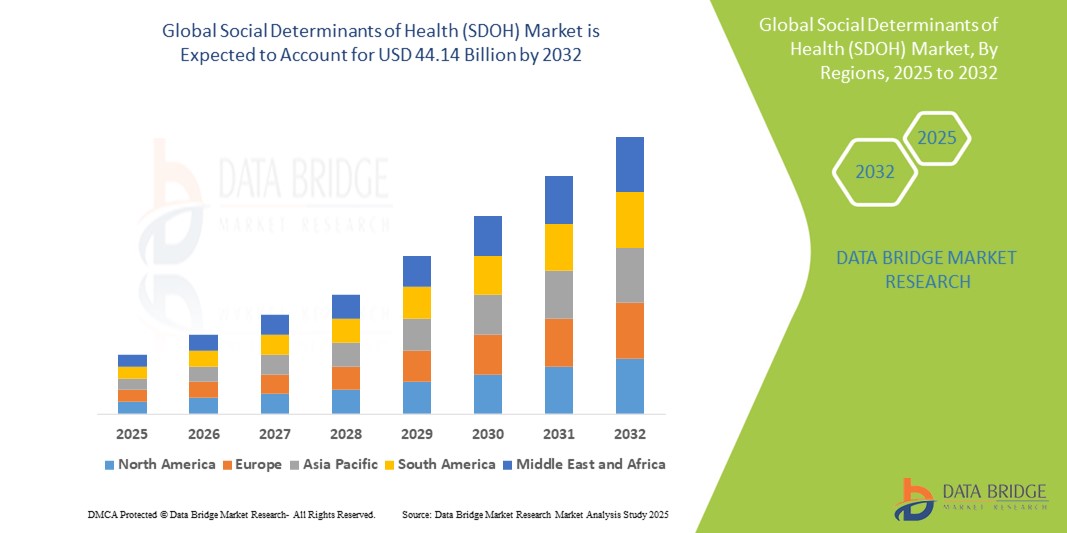
Social Determinants of Health (SDOH) Market Size
- The global Social Determinants of Health (SDOH) market was valued at USD 8.42 Billion in 2024 and is expected to reach USD 44.14 Billion by 2032
- During the forecast period of 2025 to 2032 the market is likely to grow at a CAGR of 23.00%, primarily driven by the increasing adoption of value-based care models and the growing emphasis on population health management
- This growth is driven by factors such as the rising healthcare disparities, increased government initiatives, and the integration of advanced data analytics to address social and economic factors impacting health outcomes
Social Determinants of Health (SDOH) Market Analysis
- Social Determinants of Health (SDOH) refer to the non-medical factors that influence health outcomes, including socioeconomic status, education, neighborhood and physical environment, employment, and access to healthcare. These determinants are increasingly recognized as critical components in achieving equitable healthcare delivery
- The demand for SDOH solutions is significantly driven by the shift towards value-based care models, growing awareness of health disparities, and the need to improve population health outcomes. Government mandates, policy reforms, and funding for health equity initiatives are also fueling market growth
- North America stands out as one of the dominant regions in the SDOH market, attributed to strong federal support, widespread adoption of healthcare IT, and proactive efforts by healthcare providers to integrate SDOH data into patient care strategies
- For instance, the major U.S. healthcare systems are increasingly partnering with data analytics firms and community organizations to implement SDOH-informed care models, aiming to reduce hospital readmissions and improve chronic disease management
- Globally, SDOH analytics platforms are emerging as a crucial tool in public health and clinical decision-making, second only to Electronic Health Records (EHRs), helping healthcare providers deliver more personalized, preventive, and effective care
Report Scope and Social Determinants of Health (SDOH) Market Segmentation
|
Attributes |
Social Determinants of Health (SDOH) Key Market Insights |
|
Segments Covered |
|
|
Countries Covered |
North America
Europe
Asia-Pacific
Middle East and Africa
South America
|
|
Key Market Players |
|
|
Market Opportunities |
|
|
Value Added Data Infosets |
In addition to the insights on market scenarios such as market value, growth rate, segmentation, geographical coverage, and major players, the market reports curated by the Data Bridge Market Research also include import export analysis, production capacity overview, production consumption analysis, price trend analysis, climate change scenario, supply chain analysis, value chain analysis, raw material/consumables overview, vendor selection criteria, PESTLE Analysis, Porter Analysis, and regulatory framework. |
Social Determinants of Health (SDOH) Market Trends
“Rising Integration of AI and Predictive Analytics in SDOH Solutions”
- One prominent trend in the global SDOH market is the increasing integration of artificial intelligence (AI) and predictive analytics into SDOH platforms
- These technologies enable healthcare providers to identify at-risk populations, forecast health outcomes, and design targeted interventions by analyzing complex datasets related to housing, income, education, and other social factors
- For instance, AI-driven models can predict hospital readmissions or chronic disease risks by correlating patient data with external social determinants, allowing for early and more effective preventive care strategies
- Predictive analytics also supports real-time decision-making, helping care teams allocate resources more efficiently and prioritize high-need communities
- This trend is transforming how healthcare systems address social and environmental influences on health, making care more proactive, equitable, and data-driven, thereby fueling demand for advanced SDOH solutions
Social Determinants of Health (SDOH) Market Dynamics
Driver
“Increasing Focus on Health Equity and Value-Based Care Models”
- The growing emphasis on health equity and the transition toward value-based care are key drivers accelerating the adoption of SDOH solutions across the healthcare ecosystem
- Healthcare providers, payers, and governments are recognizing the impact of social, economic, and environmental factors on individual and population health outcomes, prompting strategic investments in SDOH data integration and intervention programs
- Addressing SDOH helps reduce health disparities, lower overall healthcare costs, and improve chronic disease management—making it a cornerstone of modern, patient-centered care models
- The Advanced analytics tools and health IT platforms are being deployed to collect, analyze, and act on SDOH data, helping care teams proactively identify at-risk individuals and coordinate appropriate social support services
- Policy support and funding, particularly in developed regions, are further driving the adoption of SDOH strategies as a means to improve community health and meet performance metrics under value-based reimbursement systems
For instance,
- In March 2022, the U.S. Department of Health and Human Services launched new initiatives under Healthy People 2030, emphasizing the importance of addressing SDOH to promote health equity, reduce health disparities, and improve quality of life across diverse populations
- In November 2021, the Centers for Medicare & Medicaid Services (CMS) announced plans to expand the Accountable Health Communities Model, which focuses on linking Medicare and Medicaid beneficiaries with community-based services that address key SDOH such as housing instability, food insecurity, and transportation barriers
- As health systems increasingly prioritize upstream social interventions to enhance outcomes and reduce preventable healthcare utilization, the demand for robust SDOH solutions continues to rise globally
Opportunity
“Leveraging AI and Big Data to Drive Personalized, Preventive Care”
- The integration of artificial intelligence (AI) and big data analytics presents a significant opportunity in the SDOH market, enabling healthcare systems to deliver more personalized, proactive, and equitable care
- AI-powered tools can process vast volumes of SDOH-related data—such as income, housing, education, transportation, and food security—to identify at-risk populations and predict adverse health outcomes with greater accuracy
- These technologies allow healthcare providers to tailor interventions, allocate resources efficiently, and close care gaps in underserved communities by identifying patterns and correlations that may not be apparent through traditional analysis
For instance,
- In February 2024, a study published by the Journal of Biomedical Informatics demonstrated that AI algorithms could analyze multi-dimensional SDOH data to predict hospital readmissions with over 85% accuracy, allowing care teams to intervene early and reduce costly acute care episodes
- In August 2023, according to an article from the Health Affairs Journal, several U.S. health systems began piloting AI-driven dashboards that integrate clinical and social data to guide case management and improve chronic disease outcomes, particularly among Medicaid and uninsured populations
- By harnessing the power of AI and big data, stakeholders can better understand the social drivers of health, leading to improved population health outcomes, reduced disparities, and enhanced care delivery efficiency across diverse communities
Restraint/Challenge
“Data Privacy Concerns and Integration Barriers Limiting Adoption”
- One of the major challenges in the SDOH market is the concern over data privacy and the complexities associated with integrating SDOH data into existing healthcare systems and workflows
- Collecting and sharing sensitive social data—such as housing status, income, or employment history—raises ethical and regulatory concerns, particularly regarding patient consent, data ownership, and compliance with privacy laws such as HIPAA and GDPR
- In Addition, healthcare providers often face difficulties in standardizing and operationalizing SDOH data from disparate sources, including electronic health records (EHRs), public databases, and community organizations
For instance,
- In September 2023, according to a policy brief by the Office of the National Coordinator for Health Information Technology (ONC), despite the recognized value of SDOH data, many healthcare organizations reported challenges in accessing and integrating external social data due to a lack of interoperability and unclear data-sharing agreements
- In April 2024, a survey by the American Hospital Association (AHA) revealed that over 60% of hospitals cited patient trust and data sensitivity as significant barriers to implementing robust SDOH screening and data collection practices
- Consequently, these issues can slow the adoption of SDOH solutions, limit the effectiveness of data-driven interventions, and restrict the market's full potential, particularly in regions with limited health IT infrastructure or stringent data regulations
Social Determinants of Health (SDOH) Market Scope
The market is segmented on the basis of type, end user and application.
|
Segmentation |
Sub-Segmentation |
|
By Type |
|
|
By End User |
|
|
By Application |
|
Social Determinants of Health (SDOH) Market Regional Analysis
“North America is the Dominant Region in the Social Determinants of Health (SDOH) Market”
- North America dominates the global SDOH market, fueled by strong government initiatives, widespread adoption of health IT infrastructure, and the presence of major healthcare and technology companies
- U.S. plays a leading role, driven by federal programs such as Healthy People 2030, CMS value-based care initiatives, and growing investments in health equity and population health management
- The Advanced analytics platforms, interoperability standards, and increased collaboration between healthcare systems and community-based organizations further reinforce the region’s leadership in leveraging SDOH data to improve health outcome
- In addition, the growing use of AI and machine learning to assess and act on SDOH-related risks, along with established reimbursement frameworks and policy incentives, accelerates the adoption of SDOH solutions across the country
“Asia-Pacific is Projected to Register the Highest Growth Rate”
- Asia-Pacific is expected to experience the highest growth rate in the SDOH market due to rapid digital health transformation, increasing government focus on public health, and rising health disparities
- Countries such as India, China, and Australia are actively investing in population health programs, with a growing emphasis on addressing the social and environmental determinants of health, particularly in rural and underserved communities
- India and China, with their large and diverse populations, face significant health equity challenges—spurring initiatives aimed at improving access to healthcare, education, and housing through data-driven policymaking
- Australia is advancing the integration of SDOH into national health strategies, supported by government-funded digital health programs and partnerships with indigenous and remote community organizations to reduce disparities
- The increasing use of mobile health technologies and community-based digital platforms across the region is enabling better collection and utilization of SDOH data, fostering growth and innovation in the market
Social Determinants of Health (SDOH) Market Share
The market competitive landscape provides details by competitor. Details included are company overview, company financials, revenue generated, market potential, investment in research and development, new market initiatives, global presence, production sites and facilities, production capacities, company strengths and weaknesses, product launch, product width and breadth, application dominance. The above data points provided are only related to the companies' focus related to market.
The Major Market Leaders Operating in the Market Are:
- Optum, Inc. (U.S.)
- IQVIA (U.S.)
- Maximus (U.S.)
- Dimagi (U.S.)
- Health Leads. (U.S.)
- Uber Technologies Inc. (U.S.)
- reach52 (Singapore)
- Oracle (U.S.)
- Epic Systems Corporation (U.S.)
- Veradigm LLC (U.S.)
- Salesforce, Inc. (U.S.)
- IBM Corporation (U.S.)
- SAS Institute Inc. (U.S.)
- Health Catalyst (U.S.)
- WellSky (U.S.)
- Socially Determined, Inc. (U.S.)
- Unite Us (U.S.)
Latest Developments in Global Social Determinants of Health (SDOH) Market
- In May 2024, Clarivate Plc partnered with HealthWise Data to incorporate social determinants of health (SDOH) attributes into its Real-World Data offerings. This move aims to help healthcare professionals generate deeper insights into patient populations, advancing precision medicine and health equity
- In March 2024, Oracle Health introduced a new analytics platform designed to integrate and analyze social determinants of health (SDOH) data across healthcare systems. The platform helps providers identify at-risk populations, uncover care disparities, and improve community health outcomes through AI-driven insights and predictive modeling
- In February 2024, The World Health Organization launched a comprehensive framework to help countries monitor and evaluate progress in addressing social determinants of health. This tool aims to support better policy decisions and reduce global health disparities
- In October 2023, Market trends show increasing adoption of predictive analytics and digital platforms to monitor and address SDOH-related risks, enabling early interventions and more personalized population health strategies
- In August 2023, Boston University researchers, with support from The Rockefeller Foundation, launched the “Data for Global Health Equity” platform, offering centralized access to over 70 international SDOH datasets to promote equitable, data-driven healthcare decision

- Interactive Data Analysis Dashboard
- Company Analysis Dashboard for high growth potential opportunities
- Research Analyst Access for customization & queries
- Competitor Analysis with Interactive dashboard
- Latest News, Updates & Trend analysis
- Harness the Power of Benchmark Analysis for Comprehensive Competitor Tracking
Data collection and base year analysis are done using data collection modules with large sample sizes. The stage includes obtaining market information or related data through various sources and strategies. It includes examining and planning all the data acquired from the past in advance. It likewise envelops the examination of information inconsistencies seen across different information sources. The market data is analysed and estimated using market statistical and coherent models. Also, market share analysis and key trend analysis are the major success factors in the market report. To know more, please request an analyst call or drop down your inquiry.
The key research methodology used by DBMR research team is data triangulation which involves data mining, analysis of the impact of data variables on the market and primary (industry expert) validation. Data models include Vendor Positioning Grid, Market Time Line Analysis, Market Overview and Guide, Company Positioning Grid, Patent Analysis, Pricing Analysis, Company Market Share Analysis, Standards of Measurement, Global versus Regional and Vendor Share Analysis. To know more about the research methodology, drop in an inquiry to speak to our industry experts.
Data Bridge Market Research is a leader in advanced formative research. We take pride in servicing our existing and new customers with data and analysis that match and suits their goal. The report can be customized to include price trend analysis of target brands understanding the market for additional countries (ask for the list of countries), clinical trial results data, literature review, refurbished market and product base analysis. Market analysis of target competitors can be analyzed from technology-based analysis to market portfolio strategies. We can add as many competitors that you require data about in the format and data style you are looking for. Our team of analysts can also provide you data in crude raw excel files pivot tables (Fact book) or can assist you in creating presentations from the data sets available in the report.













