What is the Soil Carbon Measurement and Monitoring Market Size and Growth Rate?
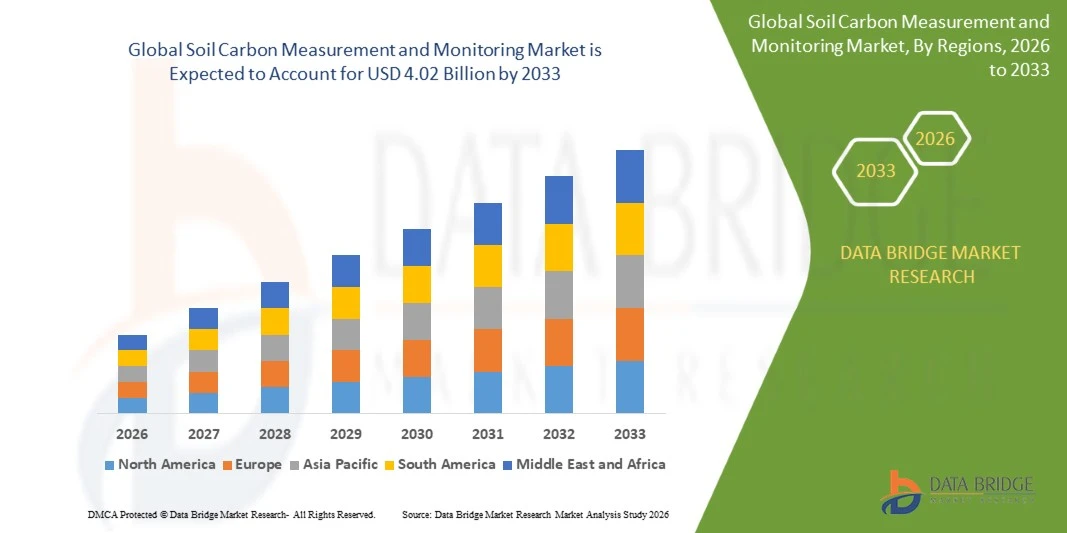
- As per Data Bridge Market Research analysis, the soil carbon measurement and monitoring market was valued at USD 2.30 billion in 2025 and is projected to reach USD 4.02 billion by 2033, growing at a CAGR of 11.6% from 2026 to 2033.
- The market is experiencing consistent growth driven by rising demand for verifiable carbon removals, expanding regenerative agriculture programs, and increasing need for low-cost, accurate methods to quantify soil organic carbon across farms, ranches, and supply chains.
- The increasing shift toward measurement-based carbon accounting, digital monitoring, reporting, and verification, and sustainable sourcing commitments, combined with growing integration of field sensors, satellite data, and modeling tools, is supporting market adoption. Soil carbon measurement is being applied across carbon credit programs, regenerative agriculture, and soil testing, offering stakeholders reliable baselines and results that connect with precision agriculture and carbon credit workflows.
Market Size & Forecast
- Global Market Value (2025): USD 2.30 Billion
- Expected Market Value (2033): USD 4.02 Billion
- Forecast CAGR (2026–2033): 11.6%
- Leading Region in 2025: North America
- Fastest Growing Region: Europe
What are the Major Takeaways of the Soil Carbon Measurement and Monitoring Market?
- North America dominated the soil carbon measurement and monitoring market with the largest revenue share of 39.62% in 2025, supported by active voluntary carbon markets, a strong base of measurement and MRV technology providers, and widespread corporate sustainability programs in agriculture.
- Europe is expected to be the fastest-growing region at a CAGR of 13.90% from 2026 to 2033, fueled by the EU carbon farming certification framework, supportive agricultural policies, and growing investment in digital MRV.
- The direct measurement segment led the market with a 58.14% share in 2025, driven by registry requirements for field sampling, laboratory analysis, and ground-truth data in credible carbon accounting.
- Model-based & remote sensing is the fastest-growing approach, projected to register a CAGR of 14.35%, reflecting demand for lower-cost and scalable estimation of soil organic carbon across large land areas.
- The services segment dominated the offering category with a 52.46% revenue share in 2025, led by demand for sampling, laboratory analysis, project design, and verification support.
- Carbon credit programs accounted for 46.83% of the market share in 2025, preferred by the need for measured baselines, repeat verification, and uncertainty estimates in registry-issued soil carbon credits.
- The regenerative agriculture programs segment is the fastest-growing application category, with a CAGR of 13.60%, driven by food companies investing in practice change and outcome reporting across supply chains.
Report Scope and Soil Carbon Measurement and Monitoring Market Segmentation
|
Attributes |
Soil Carbon Measurement and Monitoring Key Market Insights |
|
Segments Covered |
|
|
Countries Covered |
North America
Europe
Asia-Pacific
Middle East and Africa
South America
|
|
Key Market Players |
|
|
Market Opportunities |
|
|
Value Added Data Infosets |
In addition to the insights on market scenarios such as market value, growth rate, segmentation, geographical coverage, and major players, the market reports curated by the Data Bridge Market Research also include import export analysis, production capacity overview, production consumption analysis, price trend analysis, climate change scenario, supply chain analysis, value chain analysis, raw material/consumables overview, vendor selection criteria, PESTLE Analysis, Porter Analysis, and regulatory framework. |
What is the Key Trend in the Soil Carbon Measurement and Monitoring Market?
- Soil carbon measurement and monitoring is increasingly shifting from labor-intensive sampling and laboratory analysis toward hybrid systems that combine targeted field sampling, spectroscopy, proximal sensors, satellite data, and machine-learning models to reduce cost while maintaining the accuracy required for credible carbon accounting.
- For instance, in June 2021, according to Remote Sensing (MDPI), researchers using the USDA-NRCS Kellogg Soil Survey Laboratory mid-infrared spectral library across seven long-term U.S. trial sites reported soil organic carbon estimates with root mean square errors of 0.10-0.33%, indicating that existing spectral libraries can support low-cost carbon monitoring.
- Digital MRV platforms are improving transparency by linking field data, satellite imagery, and modeling outputs to methodology-compliant reports that registries, buyers, and farmers can audit.
- Measurement is also broadening beyond total soil carbon to include bulk density, carbon fractions, and other soil health indicators, giving project developers a fuller picture of carbon stability and ecosystem outcomes.
- For instance, in March 2026, according to Grassroots Carbon, the company launched GroundOwl, developed with EarthOptics, which uses electromagnetic sensors to scan soils up to one meter deep without disturbing the land and produces high-resolution maps of soil organic carbon across ranches and rangelands, demonstrating the move toward non-invasive, landscape-scale measurement.
- As sensing costs fall, models improve, and certification frameworks mature, soil carbon measurement and monitoring is expected to expand beyond carbon credit projects into corporate supply chain programs, farm management, and policy reporting.
What are the Key Drivers of the Soil Carbon Measurement and Monitoring Market?
- Growing corporate and regulatory focus on verifiable carbon removals and agricultural emissions reductions is increasing demand for credible methods to quantify soil organic carbon stocks and their changes over time.
- For instance, in July 2026, according to the European Commission, a delegated act established certification methodologies for carbon farming covering agriculture and agroforestry on mineral soils, peatland rewetting, and afforestation, including an uncertainty deduction of at least 10%, creating clear measurement and verification requirements for farmers and certification schemes.
- Farmers, food companies, and project developers are adopting measurement-based approaches to monetize regenerative practices, support supply chain emission targets, and demonstrate outcomes to buyers and registries.
- For instance, in October 2023, according to AgFunderNews, the Australian Government's National Soil Carbon Innovation Challenge offered AUD 20 million in grants to develop technologies for measuring soil organic carbon stocks, with a collective goal of lowering measurement costs by 90% to AUD 3 per hectare per year.
- Public and private investment in sensors, spectral libraries, remote sensing, and digital MRV software is steadily lowering the unit cost of measurement, making soil carbon programs viable for a wider range of farms and regions.
What Factors Are Challenging the Growth of the Soil Carbon Measurement and Monitoring Market?
- Soil carbon changes slowly and varies widely across fields and depths, so detecting real change requires intensive sampling, accurate bulk density measurements, and consistent analytical methods, all of which increase measurement costs.
- For instance, in June 2022, according to Wallaces Farmer, reliable soil carbon measurement for tradable credits requires at least 25 to 30 samples per acre to capture spatial variability, along with separate bulk density sampling to calculate carbon stocks rather than relying on concentration alone, adding to project costs.
- Remote sensing and model-based estimates can lower costs but still require ground calibration and validation, and their accuracy at the individual farm level remains a concern when used as the sole basis for credit issuance.
- Differences between registries, methodologies, and national schemes create uncertainty for project developers, as measurement protocols, uncertainty deductions, and permanence requirements vary and are still evolving.
- For instance, in March 2023, according to ImpactAlpha, Agreena, which had worked with European farmers to transition more than 600,000 hectares, noted that soil carbon credits face scrutiny over permanence because stored carbon can be released once soil is tilled, and that prices for soil carbon credits remained low, highlighting commercial and credibility pressures on measurement-based programs.
- The combination of high sampling intensity, methodological uncertainty, and permanence concerns can constrain adoption among small farms and cost-sensitive buyers, particularly where payments are low relative to measurement and verification costs.
How is the Soil Carbon Measurement and Monitoring Market Segmented?
The soil carbon measurement and monitoring market is segmented on the basis of approach, offering, application, and end user.
- By Approach
On the basis of approach, the soil carbon measurement and monitoring market is segmented into direct measurement and model-based & remote sensing. The direct measurement segment dominated the market with 58.14% share in 2025, supported by registry requirements for field sampling, laboratory analysis, and ground-truth data in credible carbon accounting. Direct methods include core sampling, dry combustion analysis, spectroscopy, and proximal sensing, which provide measured values for baselines and subsequent verification rounds. Their results are widely accepted by auditors and buyers. Standardized sampling designs and growing laboratory capacity are strengthening the segment, although cost and labor intensity remain important considerations for large-scale deployment.
The model-based & remote sensing segment is projected to register the fastest growth at a CAGR of 14.35% from 2026 to 2033, driven by demand for lower-cost, scalable measurement across large land areas. Satellite imagery, machine learning, and biogeochemical models can estimate soil organic carbon and track management practices over many farms at once. These tools reduce the number of physical samples required, although ground calibration remains necessary. Digital MRV platforms that combine sampling, remote sensing, and modeling are gaining acceptance among registries. Continued improvement in spectral libraries, satellite resolution, and uncertainty quantification is expanding their role in credit issuance and supply chain programs.
- By Offering
On the basis of offering, the soil carbon measurement and monitoring market is segmented into services, hardware, and software. The services segment dominated the market with 52.46% share in 2025, supported by demand for field sampling, laboratory analysis, project design, verification support, and MRV-as-a-service offerings. Most farmers and project developers lack in-house capacity for statistically sound sampling and registry-compliant reporting, creating reliance on specialist providers. Services also include baseline assessments, repeat sampling rounds, and data management across multiple years. Established laboratories and measurement companies benefit from recurring project cycles and the need for consistent analytical methods.
The software segment is projected to register the fastest growth at a CAGR of 15.12% from 2026 to 2033, supported by increasing adoption of digital MRV platforms that integrate field data, satellite imagery, and soil carbon models. Software reduces administrative workload by automating sampling design, data validation, and methodology-compliant reporting. Platforms also help farmers track practices, enrollment, and payments, and give buyers transparent access to project data. Interoperability with registries, farm management systems, and corporate sustainability reporting is becoming more important. Continued investment in machine learning and uncertainty estimation is improving the credibility of software-based estimates.
- By Application
On the basis of application, the soil carbon measurement and monitoring market is segmented into carbon credit programs, regenerative agriculture programs, soil health & fertility management, and others. The carbon credit programs segment dominated the application category with 46.83% share in 2025, supported by the need for measured baselines, repeat verification, and uncertainty estimates in registry-issued soil carbon credits. Credit projects require rigorous documentation of practices, stocks, and changes over crediting periods. Project developers invest in measurement to improve credit quality and buyer confidence. Developing standards in major jurisdictions are also creating clearer rules for measurement-based certification.
The regenerative agriculture programs segment is projected to register the fastest growth at a CAGR of 13.60% from 2026 to 2033, driven by food and beverage companies investing in practice change across their supply chains. These programs use soil carbon data to demonstrate outcomes, prioritize interventions, and report progress against climate commitments. Farmers receive agronomic insights alongside payments, which supports participation. Measurement is increasingly paired with other soil health indicators such as bulk density, organic matter fractions, and biology. Scalable and affordable measurement is therefore essential for programs that must enroll thousands of farms.
- By End User
On the basis of end user, the soil carbon measurement and monitoring market is segmented into carbon project developers, farmers & ranchers, agribusiness & food companies, government & regulatory bodies, research & academic institutions, and others. The carbon project developers segment dominated the end-user category with 29.74% share in 2025, supported by their central role in designing projects, commissioning sampling, and managing registry verification. Developers aggregate land across many farms and ranches, creating large and recurring measurement requirements. They adopt new sensors and modeling tools to reduce unit costs. Partnerships with laboratories, technology providers, and universities are common.
The agribusiness & food companies segment is projected to register the fastest growth at a CAGR of 14.20% from 2026 to 2033, driven by corporate commitments to reduce supply chain emissions and demonstrate regenerative sourcing. Food manufacturers, retailers, and input suppliers are funding farmer programs that require consistent measurement and reporting. Companies need data that can be audited and aggregated across regions and crops. Integration with sustainability reporting frameworks and traceability systems is increasingly important. Concerns about data ownership, farmer privacy, and the credibility of claims remain key considerations in program design.
Which Region Holds the Largest Share of the Soil Carbon Measurement and Monitoring Market?
- North America dominated the soil carbon measurement and monitoring market with the largest revenue share of 39.62% in 2025, supported by active voluntary carbon markets, a strong base of measurement and MRV technology providers, and widespread corporate sustainability programs in agriculture.
- The region also benefits from established soil survey and spectral library resources, extensive row-crop and rangeland acreage, and strong investment in agtech and climate technology. Increasing use of soil carbon data by project developers, food companies, and research institutions continues to strengthen North America's position in the global market.
U.S. Soil Carbon Measurement and Monitoring Market Insight
The U.S. soil carbon measurement and monitoring market is witnessing strong growth due to rising participation of farmers and ranchers in carbon credit and regenerative agriculture programs, supported by a mature ecosystem of laboratories, sensor developers, and MRV software providers. Corporate sustainability commitments, public soil survey data, and active registry methodologies are driving demand. In addition, innovation in non-invasive sensing and spectroscopy is lowering measurement costs and expanding the scale of soil carbon projects across croplands and rangelands.
Europe Soil Carbon Measurement and Monitoring Market Insight
The Europe soil carbon measurement and monitoring market is expected to witness rapid growth, driven by the EU carbon farming certification framework, supportive agricultural policies, and rising investment in digital MRV. Farmers, food companies, and project developers are increasingly seeking harmonized methods to measure and certify soil carbon gains. In addition, a strong research community, satellite data availability, and growing interest in peatland and agroforestry projects are accelerating demand for measurement and monitoring solutions across the region.
Germany Soil Carbon Measurement and Monitoring Market Insight
The Germany soil carbon measurement and monitoring market is expanding steadily due to the country's strong agricultural research base, advanced laboratory infrastructure, and growing interest in humus and carbon farming programs. Farmers, agribusinesses, and technology startups are using satellite data and machine learning to estimate soil organic carbon and reduce sampling costs. Furthermore, a strong focus on data quality, environmental regulation, and sustainable farming practices is supporting the adoption of measurement-based soil carbon solutions.
France Soil Carbon Measurement and Monitoring Market Insight
The France soil carbon measurement and monitoring market is experiencing steady growth, supported by extensive arable and vineyard land, national low-carbon label initiatives, and food company programs encouraging regenerative practices. Cooperatives and agronomy service providers are increasingly offering sampling and soil analysis services to farmers. Moreover, growing attention to soil health, carbon storage, and certification frameworks is encouraging investment in laboratory capacity, sensors, and digital tools for monitoring soil carbon.
Australia Soil Carbon Measurement and Monitoring Market Insight
The Australia soil carbon measurement and monitoring market is growing rapidly, supported by a national carbon crediting scheme for soil carbon, government grants for lower-cost measurement, and strong research expertise in soil spectroscopy. Farmers and project developers are testing combinations of deep soil coring, spectroscopy, and satellite data to reduce costs. In addition, large grazing and cropping areas and active agtech startups are positioning Australia as a key market for innovative soil carbon measurement.
Brazil Soil Carbon Measurement and Monitoring Market Insight
The Brazil soil carbon measurement and monitoring market is witnessing consistent growth due to large-scale adoption of no-till, integrated crop-livestock systems, and pasture restoration practices that can build soil carbon. Local technology companies and agribusinesses are developing MRV tools for carbon crediting in agriculture. In addition, increasing interest from food companies, growing private investment, and expanding use of remote sensing across large farms are supporting demand for soil carbon measurement and monitoring.
Which are the Top Companies in Soil Carbon Measurement and Monitoring Market?
The soil carbon measurement and monitoring industry is primarily led by well-established companies, including:
- Regrow Ag Inc. (U.S.)
- Indigo Ag, Inc. (U.S.)
- Agreena ApS (Denmark)
- Soil Capital (Belgium)
- Seqana (Germany)
- Perennial (U.S.)
- Yard Stick PBC (U.S.)
- EarthOptics, Inc. (U.S.)
- Grassroots Carbon (U.S.)
- Boomitra (U.S.)
- Cquester Analytics (U.S.)
- FarmLab (Australia)
- AgriProve (Australia)
- Loam Bio (Australia)
- Trace Genomics, Inc. (U.S.)
- CIBO Technologies (U.S.)
- Truterra, LLC (U.S.)
- Bayer AG (Germany)
- Cargill, Incorporated (U.S.)
- Nutrien Ltd. (Canada)
What are Latest Developments in Soil Carbon Measurement and Monitoring Market?
- In August 2026, EarthOptics and Cquester Analytics announced a strategic partnership to combine field-scale soil carbon measurement with laboratory-grade carbon fractionation. Cquester specializes in separating particulate organic matter from mineral-associated organic matter, allowing carbon programs to distinguish shorter-term carbon pools from longer-term stabilized carbon when evaluating soil carbon outcomes on farms.
- In June 2026, Berlin-based Seqana announced the close of a EUR 3.2 million funding round led by Pymwymic, with existing investors HTGF and Counteract participating. The funding, which includes a startup loan from Landwirtschaftliche Rentenbank, will accelerate its satellite and machine-learning soil carbon MRV tooling and extend measurement to additional soil health indicators and carbon pools.
- In April 2026, a Brazilian agtech startup developing monitoring, reporting, and verification technology for carbon crediting in agriculture raised R$10.8 million, equivalent to about USD 2.15 million, to expand its business, according to Carbon Pulse, reflecting growing investor interest in soil carbon measurement tools across Latin American farmland.
- In February 2026, Verra issued roughly 3 million credits from the Northern Mexico Grassland Restoration Project, developed by Boomitra, in what was reported as the first approval of soil carbon credits using AI-enabled MRV. The issuance marked a milestone for digital measurement approaches in the voluntary carbon market.
- In October 2025, U.S.-based project developer CoolPath selected compatriot dMRV provider Perennial for its novel VM0042 soil carbon project in California, according to QCI. The selection highlights growing use of specialized digital MRV platforms by project developers applying the Verra methodology for improved agricultural land management.

- Interactive Data Analysis Dashboard
- Company Analysis Dashboard for high growth potential opportunities
- Research Analyst Access for customization & queries
- Competitor Analysis with Interactive dashboard
- Latest News, Updates & Trend analysis
- Harness the Power of Benchmark Analysis for Comprehensive Competitor Tracking
Data collection and base year analysis are done using data collection modules with large sample sizes. The stage includes obtaining market information or related data through various sources and strategies. It includes examining and planning all the data acquired from the past in advance. It likewise envelops the examination of information inconsistencies seen across different information sources. The market data is analysed and estimated using market statistical and coherent models. Also, market share analysis and key trend analysis are the major success factors in the market report. To know more, please request an analyst call or drop down your inquiry.
The key research methodology used by DBMR research team is data triangulation which involves data mining, analysis of the impact of data variables on the market and primary (industry expert) validation. Data models include Vendor Positioning Grid, Market Time Line Analysis, Market Overview and Guide, Company Positioning Grid, Patent Analysis, Pricing Analysis, Company Market Share Analysis, Standards of Measurement, Global versus Regional and Vendor Share Analysis. To know more about the research methodology, drop in an inquiry to speak to our industry experts.
Data Bridge Market Research is a leader in advanced formative research. We take pride in servicing our existing and new customers with data and analysis that match and suits their goal. The report can be customized to include price trend analysis of target brands understanding the market for additional countries (ask for the list of countries), clinical trial results data, literature review, refurbished market and product base analysis. Market analysis of target competitors can be analyzed from technology-based analysis to market portfolio strategies. We can add as many competitors that you require data about in the format and data style you are looking for. Our team of analysts can also provide you data in crude raw excel files pivot tables (Fact book) or can assist you in creating presentations from the data sets available in the report.