What is the Soil Microbiome Solutions Market Size and Overview?
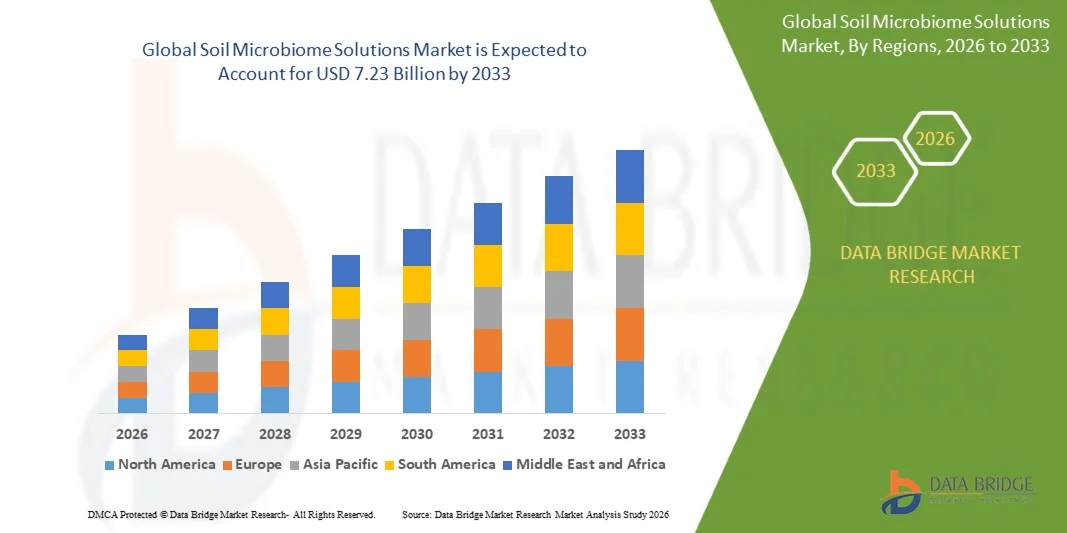
As per Data Bridge Market Research Analysis the soil microbiome solutions market was valued at USD 2.50 billion in 2025 and is projected to reach USD 7.23 billion by 2033, growing at a remarkable CAGR of 14.20% from 2026 to 2033.The global soil microbiome solutions market is gaining strong commercial importance as agriculture shifts from input-intensive production toward regenerative, climate-resilient and biology-driven farming systems.. The market is experiencing consistent growth driven by rising demand for sustainable agriculture, improved soil fertility and crop resilience, and wider adoption of microbiome-based solutions such as biofertilizers, biostimulants, microbial crop protection, and biological soil testing. Rapid advancements in DNA sequencing, microbiome analytics, and machine-learning-based soil intelligence are improving the identification of microbial communities and helping growers better assess nutrient cycling, disease risks, and overall soil health.
Declining soil fertility, growing pressure to reduce dependence on synthetic fertilizers and pesticides, and the need to maintain crop productivity under increasing climate and food-security challenges are encouraging farmers, agribusinesses, and agricultural input companies to adopt soil microbiome solutions. Biofertilizers, beneficial microbial products, and microbiome diagnostics are increasingly being used to improve nutrient availability, strengthen crop resilience, and support more targeted input use, while digital and precision agriculture tools are helping expand the adoption of these solutions across different crops and regions.
Market Size & Forecast
- Global Market Value (2025): USD 2.50 Billion
- Expected Market Value (2033): USD 7.23 Billion
- Forecast CAGR (2026-2033): 14.20%
What are the Major Takeaways of Soil Microbiome Solutions Market?
- North America led the agricultural microbials market with around 33.5% revenue share in 2025, supported by advanced farm input distribution, high adoption of biological seed treatments and strong investment in regenerative agriculture programs.
- Asia-Pacific is expected to be the fastest-growing regional opportunity, expanding at a CAGR of 16.5% from 2026 to 2035, driven by large cultivated land areas, rising food demand, soil fertility concerns, government support for biofertilizers, and increasing adoption of residue-free production practices across India, China, and Southeast Asia.
- Microbial inoculants and biofertilizers remain the core revenue-generating product groups because they are directly linked with nitrogen fixation, phosphorus solubilization, root development and nutrient-use efficiency.
- Bacteria-based solutions, especially Bacillus, Rhizobium, Azospirillum and Pseudomonas strains, dominate many commercial applications due to scalability, formulation stability and compatibility with seed/soil application systems.
- Fungal solutions, including mycorrhizae and Trichoderma, are gaining momentum for soil structure improvement, disease suppression, drought tolerance and improved phosphorus/water uptake.
- Soil microbiome testing and AI-powered soil intelligence are emerging as high-value services, with platforms such as Biome Makers BeCrop translating biological data into agronomic decisions.
- Large agri-input companies are expanding biological portfolios through acquisitions, partnerships and dedicated manufacturing facilities, showing that biologicals are now a strategic growth category rather than a niche input.
- Regenerative agriculture and carbon farming are creating new demand for soil biological measurement, microbial health verification, and integrated packages combining crop inputs with data-driven soil health monitoring.
Report Scope and Soil Microbiome Solutions Market Segmentation
|
Attributes |
Soil Microbiome Solutions Key Market Insights |
|
Segments Covered |
|
|
Countries Covered |
North America
Europe
Asia-Pacific
Middle East and Africa
South America
|
|
Key Market Players |
|
|
Market Opportunities |
|
|
Value Added Data |
In addition to the insights on market scenarios such as market value, growth rate, segmentation, geographical coverage, and major players, the market reports curated by the Data Bridge Market Research also include import export analysis, production capacity overview, production consumption analysis, price trend analysis, climate change scenario, supply chain analysis, value chain analysis, raw material/consumables overview, vendor selection criteria, PESTLE Analysis, Porter Analysis, and regulatory framework. |
What is the Key Trend in the Soil Microbiome Solutions Market?
Key Market Driver: Soil Degradation and Need for Sustainable Input Efficiency
Soil degradation, nutrient depletion and climate stress are major drivers for microbiome-based agricultural inputs. Soil microbes support nutrient cycling, organic matter decomposition, root development and plant stress tolerance. Microbial inoculants, biofertilizers and biostimulants help reduce dependence on synthetic fertilizers and pesticides while improving crop productivity under water stress, salinity and nutrient-limited conditions. Scientific reviews show that microbial-based bio-inoculants can improve plant growth, disease resistance and soil health, making them central to sustainable intensification strategies.
Key Market Restraint/Challenge: Variable Field Performance and Farmer Adoption Barriers
The biggest commercial challenge is inconsistent field performance across soil types, climates, crop varieties and farm-management practices. Unlike chemical inputs, microbial products are living systems and their performance depends on viability, shelf life, formulation stability, storage conditions, application method and compatibility with chemical seed treatments or pesticides. Farmers may also hesitate because biologicals can take longer to show visible benefits, and many markets still lack standardized soil biological testing protocols and clear product-performance claims.
Key Market Opportunity: AI-Based Soil Intelligence and Regenerative Agriculture Verification
The integration of DNA-based soil testing, artificial intelligence and precision agriculture platforms is creating a new service-led opportunity. Biome Makers launched BeCrop 4.0 in 2026 as an AI-powered soil intelligence platform to translate biological data into agricultural decision-making, while partnerships with soil laboratories are expanding access to microbiome testing. These tools can help growers select microbial inputs, monitor soil recovery, verify regenerative practices and support carbon or sustainability claims. [5][7]
How is the Soil Microbiome Solutions Market Segmented?
The Soil Microbiome Solutions Market is segmented on the basis of solution type, microbe type, by application, by crop type.
- By Solution Type
On the basis of solution type, the soil microbiome solutions market is segmented into based on solution type, the soil microbiome solutions market is segmented into microbial inoculants & biofertilizers, biostimulants, biocontrol microbials, and soil microbiome testing & intelligence platforms .Microbial inoculants and biofertilizers account for the most established share of the market because they directly improve nitrogen fixation, phosphorus solubilization, potassium mobilization and root development. Biostimulants are growing quickly as growers seek stress-tolerance products that support plant vigor under drought, heat and salinity. Biocontrol microbials are also expanding as integrated pest management systems shift toward residue reduction and resistance management. Soil microbiome testing and intelligence platforms represent a smaller but high-growth segment because they convert microbial diversity and function into farm-level decisions.
- By Microbe Type
On the basis of microbe type, the soil microbiome solutions market is segmented into bacteria, fungi, and mixed microbial consortia. Bacteria-based solutions dominate due to formulation scalability and use in seed coating, soil drench and in-furrow applications. Rhizobium-based inoculants remain highly relevant for legumes, while Bacillus and Pseudomonas strains are widely used for nutrient cycling, disease suppression and abiotic stress mitigation. Fungal products, especially mycorrhizae and Trichoderma, are gaining adoption because they improve root-zone activity, soil structure, water uptake and protection against soil-borne pathogens. Mixed microbial consortia are expected to grow as companies design products that mimic natural soil communities rather than relying on single-strain performance.
- By Application
On the basis of application type, the soil microbiome solutions market is segmented into nutrient-use efficiency, soil health improvement, disease suppression, and stress tolerance. Nutrient-use efficiency is the dominant application because rising fertilizer costs and environmental concerns are pushing farmers to improve uptake rather than simply increase input volume. Soil health improvement is the fastest-growing application as regenerative agriculture programs, food companies and carbon markets require biological indicators of land restoration. Disease suppression and stress tolerance remain important because soil-borne pathogens, heat stress, drought and salinity reduce yield potential across major cropping regions.
- By Crop Type
On the basis of crop type, the soil microbiome solutions market is segmented into cereals & grains, oilseeds & pulses, fruits & vegetables. Cereals and grains represent the largest crop segment because corn, wheat and rice cover large cultivated areas and offer high-volume opportunities for seed-applied and soil-applied microbial products. Oilseeds and pulses are important due to rhizobial inoculants and nitrogen-fixation benefits. Fruits and vegetables are a high-value segment because growers are more willing to invest in biologicals that improve quality, shelf life, root health and residue compliance.
Which Region Holds the Largest Share of the Soil Microbiome Solutions Market?
North America Soil Microbiome Solutions Market Insight
North America leads the market because the U.S. and Canada have mature agri-input channels, strong biological seed-treatment adoption, advanced soil testing infrastructure and active regenerative agriculture programs. Companies such as Indigo Ag, Biome Makers, BASF, Bayer, Corteva, Syngenta and Novonesis are active in biological inputs, soil intelligence, seed treatments and regenerative agriculture solutions. GROWMARK and Indigo Ag announced a multi-year partnership in 2024 to expand access to biological products and sustainability programming for member companies and farmers, strengthening North American distribution.
Europe Soil Microbiome Solutions Market Insight
Europe is growing steadily due to strict pesticide-residue expectations, the Farm to Fork policy direction, organic farming adoption and demand for lower-input crop protection. Biologicals are increasingly used as part of integrated pest management and soil health programs. Companies such as BASF, Syngenta, Koppert, Andermatt and Biome Makers are expanding biological and soil intelligence offerings in the region.
Asia-Pacific Soil Microbiome Solutions Market Insight
Asia-Pacific is expected to be the fastest-growing regional market due to high food demand, declining soil organic matter, government support for biofertilizers, and the need to improve farm productivity without increasing chemical residues. India and China have large-scale opportunities for biofertilizers, microbial consortia and soil health testing, while Japan and Australia are important for advanced biologicals and sustainable farming systems.
South America Soil Microbiome Solutions Market Insight
South America is a strong opportunity region because Brazil and Argentina have large soybean, corn and sugarcane acreage, high inoculant use and strong interest in climate-resilient farming. BASF’s 2026 acquisition of AgBiTech strengthens its biological portfolio with a focus on Brazil, reflecting the strategic importance of biological crop solutions in this region.
Middle East & Africa Soil Microbiome Solutions Market Insight
The Middle East and Africa represent an emerging market for soil microbiome solutions, particularly for drought tolerance, salinity management and soil restoration. Novonesis and Andermatt announced a 2024 partnership to launch Cell-Tech soybean inoculant access across Southern and Eastern Africa for the 2024-2025 planting season, demonstrating increasing commercialization of microbial solutions in the region.
Which are the Top Companies in Soil Microbiome Solutions Market?
The soil microbiome solution industry is primarily led by well-established companies, including:
- BASF SE (Germany)
- Bayer AG (Germany)
- Syngenta Group (Switzerland/China)
- Corteva Agriscience (U.S.)
- Novonesis / former Novozymes (Denmark)
- UPL Ltd. (India)
- FMC Corporation (U.S.)
- Koppert (Netherlands)
- Certis Biologicals (U.S.)
- Valent BioSciences (U.S.)
- Indigo Ag (U.S.)
- Biome Makers (U.S./Spain)
- Groundwork BioAg (Israel/U.S.)
- Andermatt Group (Switzerland)
- Lallemand Plant Care (Canada)
- Stanes & Company Ltd. (India)
- Rizobacter (Argentina)
- AgBiome (U.S.)
What are Latest Developments in Soil Microbiome Solutions Market?
- In March 2026, Biome Makers announced the release of BeCrop 4.0, an upgraded soil intelligence platform designed to translate complex soil microbiome data into practical agricultural decisions. The new version expands DNA identification capabilities, improves microbial nutrient-cycle analysis for nitrogen, phosphorus, and potassium, and introduces an intelligent assistant that helps users interpret soil biological conditions and management options. The platform also improves disease-risk detection, nutrient-efficiency assessment, and field-level decision-making, strengthening the use of AI and microbiome analytics in modern soil management.
- In March 2026, Pivot Bio launched RETAIN Dry, a new dry planter-box formulation that allows sorghum growers to apply nitrogen-fixing microbial technology directly to seeds during planting. The solution expands RETAIN across liquid in-furrow, on-seed, and dry application methods and includes micronutrients that support microbial nitrogen fixation and plant nitrogen assimilation. This development improves application flexibility for growers and reflects the increasing commercialization of microbiome-based crop nutrition solutions as alternatives or supplements to conventional nitrogen fertilizers
- In October 2025, Indigo Ag introduced biotrinsic Nemora FP, an EPA-registered microbial seed treatment developed to manage soybean cyst nematode pressure. The product contains the naturally occurring bacterium Pseudomonas oryzihabitans, which colonizes plant roots and shoots, forms a protective biofilm, and helps reduce nematode egg hatching while supporting beneficial soil microorganisms. This launch expands the use of targeted microbial solutions for crop protection and soil health management, demonstrating the growing role of beneficial microbes in replacing or complementing conventional chemical treatments.
- In August 2025, Biome Makers partnered with Midwest Laboratories to expand access to microbiome-based soil intelligence across the U.S. Through the collaboration, Midwest Laboratories began offering the BeCrop Test alongside its traditional soil chemistry services, enabling growers to assess soil microbial activity using DNA-based analysis. The test combines next-generation sequencing with microbiome data to provide information on nutrient bioavailability, bacteria-to-fungi ratios, disease risks, and overall soil health, supporting more precise input decisions and wider adoption of biological soil testing.
- In March 2025, Pivot Bio unveiled PROVEN G3, its third-generation microbial nitrogen solution for corn based on proprietary gene-edited nitrogen-fixing technology. The product combines nitrogen-fixing microbes with an additional microbial blend designed to improve nutrient uptake and nitrogen-use efficiency through multiple modes of action. Pivot Bio also announced a large-scale demonstration program covering more than 300 locations, supporting broader validation and commercialization of microbial crop nutrition technologies as farmers seek more efficient and sustainable alternatives to conventional fertilizer inputs.

- Interactive Data Analysis Dashboard
- Company Analysis Dashboard for high growth potential opportunities
- Research Analyst Access for customization & queries
- Competitor Analysis with Interactive dashboard
- Latest News, Updates & Trend analysis
- Harness the Power of Benchmark Analysis for Comprehensive Competitor Tracking
Data collection and base year analysis are done using data collection modules with large sample sizes. The stage includes obtaining market information or related data through various sources and strategies. It includes examining and planning all the data acquired from the past in advance. It likewise envelops the examination of information inconsistencies seen across different information sources. The market data is analysed and estimated using market statistical and coherent models. Also, market share analysis and key trend analysis are the major success factors in the market report. To know more, please request an analyst call or drop down your inquiry.
The key research methodology used by DBMR research team is data triangulation which involves data mining, analysis of the impact of data variables on the market and primary (industry expert) validation. Data models include Vendor Positioning Grid, Market Time Line Analysis, Market Overview and Guide, Company Positioning Grid, Patent Analysis, Pricing Analysis, Company Market Share Analysis, Standards of Measurement, Global versus Regional and Vendor Share Analysis. To know more about the research methodology, drop in an inquiry to speak to our industry experts.
Data Bridge Market Research is a leader in advanced formative research. We take pride in servicing our existing and new customers with data and analysis that match and suits their goal. The report can be customized to include price trend analysis of target brands understanding the market for additional countries (ask for the list of countries), clinical trial results data, literature review, refurbished market and product base analysis. Market analysis of target competitors can be analyzed from technology-based analysis to market portfolio strategies. We can add as many competitors that you require data about in the format and data style you are looking for. Our team of analysts can also provide you data in crude raw excel files pivot tables (Fact book) or can assist you in creating presentations from the data sets available in the report.