


What is the Solid-State Battery Binders Market Size and Growth Rate?
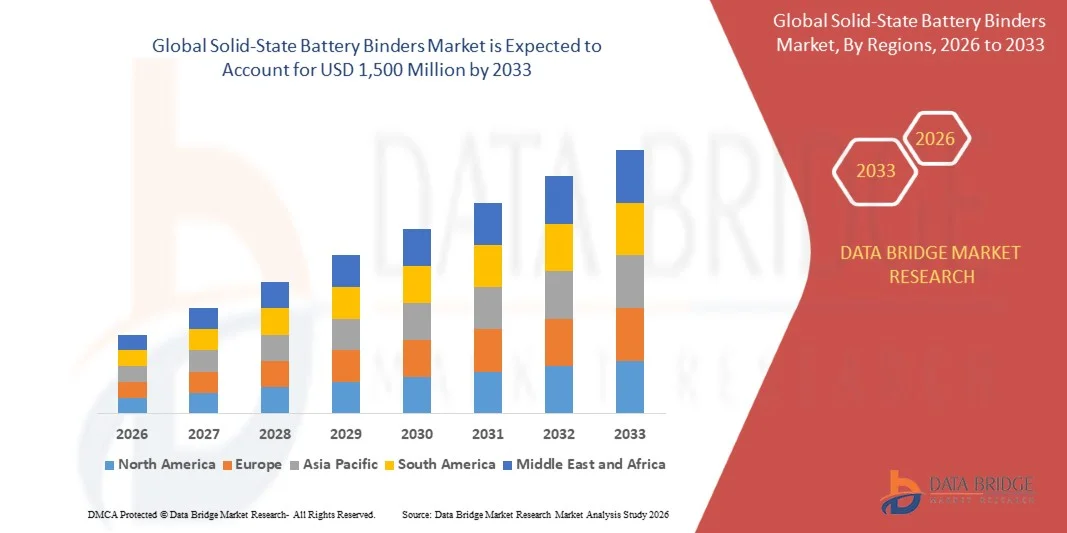
- As per Data Bridge Market Research analysis, the solid-state battery binders market was valued at USD 260 million in 2025 and is projected to reach USD 1,500 million by 2033, growing at a CAGR of 24.50% from 2026 to 2033.
- The market is experiencing consistent growth driven by the increasing commercialization of solid-state batteries, rising investments in next-generation battery technologies, and growing demand for high-performance binder materials that enhance electrode stability, ionic conductivity, and overall battery safety across electric vehicles, consumer electronics, and energy storage applications.
- The rising adoption of electric vehicles globally, coupled with increasing investments in solid-state battery research and pilot-scale manufacturing by automotive OEMs and battery manufacturers, is accelerating the demand for advanced binder materials. Functional polymer binders are increasingly replacing conventional binder systems by improving interfacial stability, mechanical integrity, and electrochemical performance, thereby supporting the commercialization of high-energy-density solid-state batteries.
Market Size & Forecast
- Global Market Value (2025): USD 260 Million
- Expected Market Value (2033): USD 1,500 Million
- Forecast CAGR (2026–2033): 24.50%
- Leading Region in 2025: North America
- Fastest Growing Region: Asia-Pacific
What are the Major Takeaways of the Solid-State Battery Binders Market?
- North America dominated the global solid-state battery binders market with the largest revenue share of approximately 32.0% in 2025, supported by the United States' robust investment pipeline in next-generation energy storage technologies and the early-stage commercialization of solid-state batteries for electric vehicles and aerospace applications.
- Asia-Pacific is expected to be the fastest-growing region at a CAGR of approximately 16.0% from 2026 to 2033, fueled by the rapid scale-up of solid-state battery production, increasing investments in battery manufacturing, and expanding commercialization activities across China, Japan, South Korea, and increasingly India.
- The polyvinylidene fluoride (PVDF) segment led the market in 2025, driven by its excellent chemical stability, superior adhesion properties, and widespread use in high-performance solid-state battery electrodes.
- The sulfide-based segment is expected to register the fastest growth during the forecast period, reflecting increasing commercialization of sulfide solid electrolytes owing to their high ionic conductivity and compatibility with next-generation electric vehicle batteries.
- The automotive segment dominated the end-use industry in 2025, led by growing investments from automotive OEMs and battery manufacturers in solid-state battery technologies to improve electric vehicle range, safety, and fast-charging capabilities.
- The energy storage segment is projected to witness significant growth during the forecast period, driven by increasing deployment of renewable energy projects and rising demand for high-performance stationary battery storage systems.
Report Scope and Solid-State Battery Binders Market Segmentation
|
Attributes |
Solid-State Battery Binders Key Market Insights |
|
Segments Covered |
|
|
Countries Covered |
North America
Europe
Asia-Pacific
Middle East and Africa
South America
|
|
Key Market Players |
|
|
Market Opportunities |
|
|
Value Added Data Infosets |
In addition to the insights on market scenarios such as market value, growth rate, segmentation, geographical coverage, and major players, the market reports curated by the Data Bridge Market Research also include import export analysis, production capacity overview, production consumption analysis, price trend analysis, climate change scenario, supply chain analysis, value chain analysis, raw material/consumables overview, vendor selection criteria, PESTLE Analysis, Porter Analysis, and regulatory framework. |
What is the Key Trend in the Solid-State Battery Binders Market?
- Battery material developers are increasingly focusing on advanced polymer binders that provide high mechanical strength, strong particle adhesion, and compatibility with solid electrolytes, particularly sulfide-based systems. These binders are being developed to enable thinner solid electrolyte membranes, improve structural integrity, and support efficient electrode and electrolyte processing for high-energy-density solid-state batteries.
- For instance, in 2024, researchers from the Ningbo Institute of Materials Technology and Engineering of the Chinese Academy of Sciences demonstrated a binder-assisted wet-coating approach for producing thin sulfide solid electrolyte membranes. The research addressed the limitations of conventional freestanding sulfide electrolyte membranes, which can require thicknesses of several hundred micrometers and are susceptible to fracture because of their brittle nature. The use of a polymeric binder improved the mechanical strength of the membrane while enabling thinner electrolyte layers, which can contribute to higher energy density and improved battery performance.
- Binder-assisted slurry and coating processes allow manufacturers to improve the flexibility, adhesion, and mechanical stability of solid electrolyte layers while accommodating the stresses associated with battery fabrication and cycling. These capabilities are becoming increasingly important as manufacturers seek to develop thinner, more uniform, and mechanically stable solid-state battery components.
- At the same time, battery manufacturers and material suppliers are advancing solid-electrolyte formulations and manufacturing processes to improve the integration of sulfide electrolytes into next-generation battery cells. This broader commercialization push is increasing the need for binder systems that can maintain mechanical integrity without compromising ionic transport and electrochemical performance.
- For instance, in October 2025, Samsung SDI, BMW Group, and Solid Power entered a trilateral collaboration to validate all-solid-state battery technology using Solid Power's sulfide-based solid electrolyte. Under the agreement, Solid Power supplies the sulfide electrolyte, Samsung SDI incorporates it into battery cells, and BMW evaluates the resulting cells for potential integration into next-generation evaluation vehicles. The collaboration reflects growing industry efforts to advance sulfide-based solid-state battery technologies from materials development toward automotive validation and commercialization.
- As researchers, battery manufacturers, and material suppliers continue to optimize binder chemistries for mechanical strength, adhesion, processability, and compatibility with solid electrolytes, advanced binder technologies are expected to become increasingly important in enabling the scale-up and commercialization of high-performance solid-state batteries.
What are the Key Drivers of the Solid-State Battery Binders Market?
- The growing demand for electric vehicles (EVs) and energy storage systems (ESS) is accelerating the development of next-generation batteries with higher energy density, improved safety, and longer operating life. This trend is increasing demand for advanced binder materials capable of supporting robust electrode structures, strong interfacial adhesion, mechanical stability, and reliable electrochemical performance in solid-state battery architectures.
- For instance, in February 2025, Arkema announced a 15% expansion of its PVDF production capacity at its Calvert City, Kentucky, facility through an investment of approximately USD 20 million. The expansion was intended to support rising demand for high-performance PVDF materials used in lithium-ion batteries, EVs, and energy storage systems. Arkema subsequently announced in June 2026 that the additional capacity had successfully started up on schedule, strengthening regional supply for battery and other high-growth applications.
- The shift toward advanced battery manufacturing methods, including dry-electrode processing, is also encouraging material suppliers to develop binder technologies that can deliver high adhesion, mechanical strength, and efficient processing with reduced reliance on conventional solvent-based coating methods.
- For instance, at Battery Show Europe 2025, Arkema highlighted its Kynar PVDF electrode binders for more efficient and sustainable dry-electrode coating processes and showcased materials supporting current and next-generation battery technologies. The company has also expanded its research activities around dry coating and next-generation battery technologies, including solid-state and semi-solid battery systems.
- As EV adoption, energy storage deployment, and investments in next-generation battery manufacturing continue to expand, demand for advanced binder systems that provide superior adhesion, mechanical stability, processability, and compatibility with emerging battery architectures is expected to remain a key growth driver for the solid-state battery binders market.
Which Factors are Challenging the Growth of the Solid-State Battery Binders Market?
- Developing polymer binders that are compatible with sulfide-based solid electrolytes remains technically challenging because many sulfide electrolytes are sensitive to moisture and can react adversely with certain solvents and processing conditions. As a result, binder selection and slurry formulation must be carefully optimized to preserve electrolyte stability while maintaining sufficient mechanical strength and ionic conductivity.
- In addition, binder formulations often require a balance between mechanical robustness and electrochemical performance. Excessive binder content can reduce the proportion of electrochemically active materials or impede ionic transport, while insufficient binder content may result in poor structural integrity, cracking, or weak interfacial contact. These competing requirements increase formulation complexity and can slow the transition from laboratory-scale research to high-volume manufacturing.
- The high cost of certain raw materials used to produce sulfide solid electrolytes also presents a broader commercialization challenge for the solid-state battery industry. For instance, research published in Nature Communications in 2025 identified the high cost of lithium sulfide (Li₂S), a key precursor for sulfide-based solid electrolytes, as a barrier to wider adoption. The researchers developed a scalable synthesis route that reduced projected laboratory-scale production costs by up to 92.9% for the synthesis of a specific argyrodite electrolyte, highlighting ongoing efforts to reduce material costs and improve the economic feasibility of sulfide solid-state battery technologies.
- The combination of moisture-sensitive processing requirements, limited compatibility between binders and solid electrolytes, complex formulation requirements, and high material costs continues to constrain the large-scale adoption of solid-state battery binder technologies. These challenges are particularly significant for smaller material suppliers and battery manufacturers seeking to scale production while maintaining consistent product quality, performance, and cost competitiveness.
- As a result, continued advances in binder chemistry, solvent selection, dry-processing techniques, and low-cost solid-electrolyte manufacturing will be essential to overcome technical and economic barriers and accelerate the commercial deployment of solid-state batteries.
How is the Solid-State Battery Binders Market Segmented?
The solid-state battery binders market is segmented on the basis of material, solid-state battery type, and end-use industry.
- By Material
On the basis of material, the global solid-state battery binders market is segmented into polyvinylidene fluoride (PVDF), styrene butadiene rubber (SBR), carboxymethyl cellulose (CMC), and others. The polyvinylidene fluoride (PVDF) segment is expected to dominate the market owing to its excellent electrochemical stability, strong adhesion, chemical resistance, and widespread use as the preferred cathode binder in advanced battery systems. Its proven compatibility with high-energy-density electrodes and established commercial adoption continue to support its leading position.
The styrene butadiene rubber (SBR) segment is expected to witness significant growth during the forecast period due to the increasing adoption of water-based binder systems for silicon- and graphite-based electrodes. When combined with Carboxymethyl Cellulose (CMC), SBR provides superior elasticity, enhanced mechanical integrity, and improved resistance to electrode volume expansion, making it increasingly attractive for next-generation battery manufacturing focused on sustainability and high cycling performance.
- By Solid-State Battery Type
On the basis of solid-state battery type, the global solid-state battery binders market is segmented into sulfide-based, oxide-based, polymer-based, composite, and others. The sulfide-based segment is expected to dominate the market owing to its exceptionally high ionic conductivity, which is comparable to conventional liquid electrolytes, enabling high-energy-density batteries with superior charging performance. Increasing investments by automotive OEMs and battery manufacturers in sulfide-based solid-state battery commercialization, coupled with advancements in compatible binder technologies that enhance electrode adhesion and interfacial stability, continue to strengthen the segment's market position.
The sulfide-based segment is also expected to register the fastest growth during the forecast period, driven by the increasing commercialization of sulfide solid electrolytes owing to their exceptionally high ionic conductivity, superior energy density, and compatibility with next-generation electric vehicle batteries. Growing investments by automotive OEMs and battery manufacturers, coupled with continuous advancements in compatible binder technologies that improve electrode adhesion, interfacial stability, and manufacturing efficiency, are expected to accelerate the adoption of sulfide-based solid-state battery systems.
- By End-use Industry
On the basis of end-use industry, the global solid-state battery binders market is segmented into automotive, consumer electronics, energy storage, industrial, and others. The automotive segment is expected to dominate the market owing to the accelerating commercialization of solid-state batteries for electric vehicles (EVs), driven by the need for higher energy density, faster charging capabilities, improved safety, and extended driving range. Growing investments by automotive manufacturers and battery developers in next-generation battery technologies are further increasing the demand for advanced binder materials that enhance electrode durability, mechanical stability, and electrochemical performance.
The energy storage segment is expected to witness the fastest growth during the forecast period, supported by the increasing deployment of grid-scale energy storage systems to integrate renewable energy sources and strengthen grid reliability. The growing focus on long-duration energy storage and the adoption of safer, high-performance solid-state battery technologies are driving demand for specialized binder systems that improve electrode integrity, cycling stability, and long-term operational performance in stationary energy storage applications.
Which Region Holds the Largest Share of the Solid-State Battery Binders Market?
- North America dominated the solid-state battery binders market and accounted for the largest revenue share of approximately 32.0% in 2025, driven by strong investments in next-generation battery technologies, the presence of leading material suppliers, and increasing commercialization of solid-state batteries across the electric vehicle and energy storage sectors.
- The region also benefits from robust government funding for domestic battery manufacturing, expanding research collaborations between battery developers and material companies, and growing investments in localized battery supply chains. The presence of major binder manufacturers, continuous advancements in polymer material technologies, and rising demand for high-performance battery materials are expected to further strengthen North America's leadership in the global solid-state battery binders market.
Asia-Pacific Solid-State Battery Binders Market Insight
The Asia-Pacific solid-state battery binders market is expected to witness the fastest growth at a CAGR of approximately 16.0% from 2026 to 2033, driven by expanding solid-state battery production, increasing investments in battery manufacturing, and rising demand for electric vehicles and energy storage systems across China, Japan, South Korea, and India. Supportive government initiatives and continuous advancements in battery materials are further accelerating regional market growth.
Japan Solid-State Battery Binders Market Insight
The Japan solid-state battery binders market is witnessing steady growth, driven by the country's leadership in solid-state battery innovation, increasing investments in next-generation battery technologies, and the presence of major battery manufacturers and material suppliers. Growing R&D activities and the rising focus on electric vehicles are further supporting market expansion.
China Solid-State Battery Binders Market Insight
The China solid-state battery binders market is expanding rapidly, supported by large-scale battery manufacturing, increasing electric vehicle production, and strong government support for domestic battery technologies. Rising investments in solid-state battery commercialization and continuous advancements in battery materials are further driving demand for high-performance binder systems.
Which are the Top Companies in Solid-State Battery Binders Market?
The solid-state battery binders industry is primarily led by well-established companies, including:
- Arkema (France)
- Kureha Corporation (Japan)
- JSR Corporation (Japan)
- ZEON Corporation (Japan)
- BASF (Germany)
- Syensqo (Belgium)
- Mitsubishi Chemical Group Corporation (Japan)
- LG Chem (South Korea)
- Evonik Industries AG (Germany)
- Celanese Corporation (U.S.)
- Mitsui Chemicals, Inc. (Japan)
- Daicel Corporation (Japan)
- Sumitomo Chemical Co., Ltd. (Japan)
- Asahi Kasei Corporation (Japan)
- Resonac Holdings Corporation (Japan)
- Nippon Shokubai Co., Ltd. (Japan)
- Covestro AG (Germany)
- Shanghai Putailai New Energy Technology Co., Ltd. (China)
- Shenzhen Capchem Technology Co., Ltd. (China)
- Solvay (Belgium)
What are Latest Developments in Solid-State Battery Binders Market?
- In October 2025, Solid Power entered a joint evaluation agreement with Samsung SDI and BMW Group to evaluate its sulfide-based solid electrolyte technology for demonstration vehicles, supporting the commercialization of solid-state batteries and increasing demand for compatible advanced binder materials that improve electrode integration and mechanical stability.
- In November 2025, researchers from the Ningbo Institute of Materials Technology and Engineering (Chinese Academy of Sciences) demonstrated a binder-assisted wet-coating process for sulfide solid electrolyte membranes, enabling thinner, mechanically stable electrolyte membranes and improving the manufacturability of next-generation solid-state batteries.
- In May 2025, BASF announced plans to expand its portfolio of water-based anode binder solutions for lithium-ion batteries, supporting the industry's transition toward more sustainable battery manufacturing by reducing reliance on solvent-based processing while improving the environmental performance of battery components.
- In March 2025, Solvay introduced a new heat- and flame-retardant grade within its Xydar® liquid crystal polymer portfolio, designed to meet stringent safety and thermal management requirements for electric vehicle battery components, further supporting the development of advanced battery materials for next-generation energy storage systems.

- Interactive Data Analysis Dashboard
- Company Analysis Dashboard for high growth potential opportunities
- Research Analyst Access for customization & queries
- Competitor Analysis with Interactive dashboard
- Latest News, Updates & Trend analysis
- Harness the Power of Benchmark Analysis for Comprehensive Competitor Tracking
Global Solid State Battery Binders Market, Supply Chain Analysis and Ecosystem Framework
To support market growth and help clients navigate the impact of geopolitical shifts, DBMR has integrated in-depth supply chain analysis into its Global Solid State Battery Binders Market research reports. This addition empowers clients to respond effectively to global changes affecting their industries. The supply chain analysis section includes detailed insights such as Global Solid State Battery Binders Market consumption and production by country, price trend analysis, the impact of tariffs and geopolitical developments, and import and export trends by country and HSN code. It also highlights major suppliers with data on production capacity and company profiles, as well as key importers and exporters. In addition to research, DBMR offers specialized supply chain consulting services backed by over a decade of experience, providing solutions like supplier discovery, supplier risk assessment, price trend analysis, impact evaluation of inflation and trade route changes, and comprehensive market trend analysis.
Data collection and base year analysis are done using data collection modules with large sample sizes. The stage includes obtaining market information or related data through various sources and strategies. It includes examining and planning all the data acquired from the past in advance. It likewise envelops the examination of information inconsistencies seen across different information sources. The market data is analysed and estimated using market statistical and coherent models. Also, market share analysis and key trend analysis are the major success factors in the market report. To know more, please request an analyst call or drop down your inquiry.
The key research methodology used by DBMR research team is data triangulation which involves data mining, analysis of the impact of data variables on the market and primary (industry expert) validation. Data models include Vendor Positioning Grid, Market Time Line Analysis, Market Overview and Guide, Company Positioning Grid, Patent Analysis, Pricing Analysis, Company Market Share Analysis, Standards of Measurement, Global versus Regional and Vendor Share Analysis. To know more about the research methodology, drop in an inquiry to speak to our industry experts.
Data Bridge Market Research is a leader in advanced formative research. We take pride in servicing our existing and new customers with data and analysis that match and suits their goal. The report can be customized to include price trend analysis of target brands understanding the market for additional countries (ask for the list of countries), clinical trial results data, literature review, refurbished market and product base analysis. Market analysis of target competitors can be analyzed from technology-based analysis to market portfolio strategies. We can add as many competitors that you require data about in the format and data style you are looking for. Our team of analysts can also provide you data in crude raw excel files pivot tables (Fact book) or can assist you in creating presentations from the data sets available in the report.













