What is the Spirulina Powder Market Size and Growth Rate?
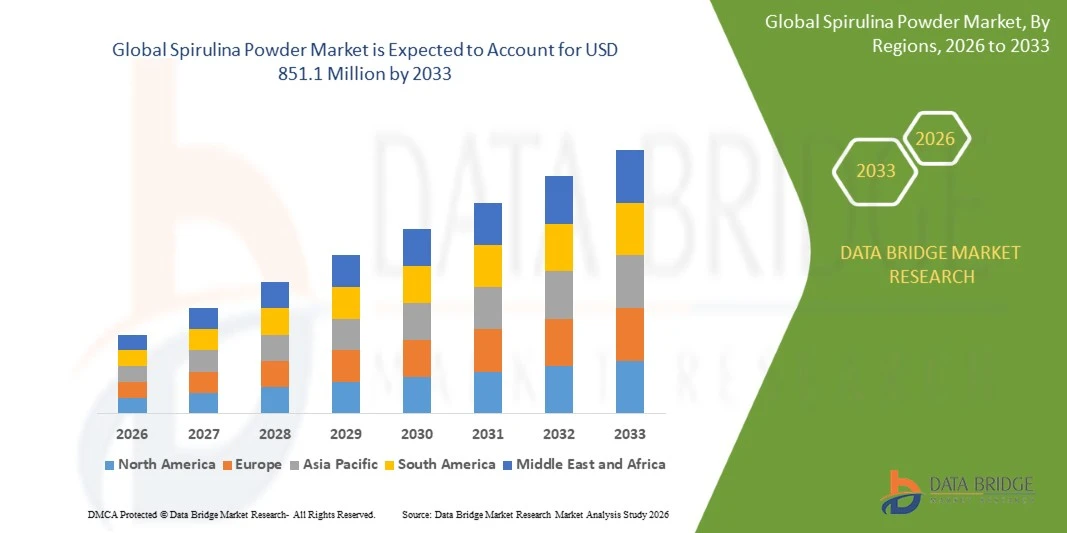
- As per Data Bridge Market Research analysis, the spirulina powder market was valued at USD 533.96 million in 2025 and is projected to reach USD 851.1 million by 2033, growing at a CAGR of 6.0% from 2026 to 2033.
- The market is expanding due to increasing consumer awareness regarding the nutritional benefits of spirulina, growing demand for plant-based protein and natural protein sources, rising adoption of functional foods and dietary supplements, and increasing utilization of spirulina powder across food, beverage, nutraceutical, and animal feed applications.
- Spirulina powder is a nutrient-dense blue-green microalgae product containing proteins, vitamins, minerals, antioxidants, and other bioactive compounds. Its commercial adoption is increasing as consumers and food manufacturers seek natural, plant-based ingredients that support nutritional enrichment, functional food development, and health-oriented dietary products.
Market Size & Forecast
- Global Market Value (2025): USD 533.96 Million
- Expected Market Value (2033): USD 851.1 Million
- Forecast CAGR (2026–2033): 6.0%
- Leading Region in 2025: North America
- Fastest Growing Region: Asia-Pacific
What are the Major Takeaways of the Spirulina Powder Market?
- North America dominated the global spirulina powder market with the largest revenue share of 36.98% in 2025, supported by strong demand for dietary supplements, increasing adoption of plant-based nutrition, and growing use of spirulina in functional food products.
- Asia-Pacific is expected to be the fastest-growing region at a CAGR of 9.3% from 2026 to 2033, driven by rising consumer awareness of natural superfoods, expanding nutraceutical industries, increasing demand for sustainable protein sources, and growing adoption in countries such as China, India, and Japan.
- The powder segment dominated the form category with a 55.60% market share in 2025, owing to its extensive utilization across dietary supplements, functional foods, beverages, and sports nutrition products.
- The tablets/capsules segment is expected to be the fastest-growing form segment, registering a CAGR of 8.10% from 2026 to 2033, reflecting increasing consumer demand for convenient, portable, and ready-to-consume nutritional supplement formats.
- The open pond cultivation segment dominated the cultivation method category with a 65.70% revenue share in 2025, supported by lower infrastructure costs, established cultivation practices, and suitability for large-scale commercial spirulina production.
- The closed photobioreactor systems segment is expected to record the fastest growth at a CAGR of 10.12% from 2026 to 2033, driven by increasing demand for premium-quality spirulina, controlled production environments, improved contamination management, and growing investment in advanced algae cultivation technologies.
- The spray drying segment dominated the processing method category with a 60.65% market share in 2025, while the freeze drying segment is projected to grow at a CAGR of 9.11% from 2026 to 2033, supported by increasing demand for premium spirulina products with enhanced nutritional retention.
Report Scope and Spirulina Powder Market Segmentation
|
Attributes |
Spirulina Powder Key Market Insights |
|
Segments Covered |
|
|
Countries Covered |
North America
Europe
Asia-Pacific
Middle East and Africa
South America
|
|
Key Market Players |
|
|
Market Opportunities |
|
|
Value Added Data Infosets |
In addition to the insights on market scenarios such as market value, growth rate, segmentation, geographical coverage, and major players, the market reports curated by the Data Bridge Market Research also include in-depth expert analysis, pricing analysis, brand share analysis, consumer survey, demography analysis, supply chain analysis, value chain analysis, raw material/consumables overview, vendor selection criteria, PESTLE Analysis, Porter Analysis, and regulatory framework. |
What is the Key Trend in the Spirulina Powder Market?
- Increasing demand for clean-label, plant-based, and functional nutrition is becoming a major trend in the spirulina powder market, as consumers increasingly seek natural sources of protein, antioxidants, vitamins, minerals, and other bioactive nutrients. This is supporting the incorporation of spirulina powder into dietary supplements, functional foods, beverages, and wellness products.
- For instance, in June 2025, Trace launched its ConcenTrace Daily Mineral Powder, combining its mineral complex with blue spirulina in flavored powdered drink mixes. The launch demonstrates the growing use of spirulina in convenient functional beverage formats beyond traditional tablets and standalone powders.
- Sustainable and controlled spirulina cultivation is also gaining importance, with producers adopting smart farming, AI-based monitoring, automation, and advanced cultivation technologies to improve productivity, quality consistency, resource efficiency, and scalability. This trend is particularly relevant as manufacturers seek greater control over contamination and production conditions.
- Natural blue colorants and phycocyanin-based ingredients are emerging as another important growth area, as food and beverage manufacturers seek alternatives to synthetic colors while maintaining attractive visual characteristics.
- Overall, the spirulina powder market is increasingly shaped by clean-label nutrition, sustainable cultivation, natural color applications, premium-quality ingredients, and convenient product formats. Manufacturers are therefore focusing not only on increasing spirulina production but also on improving cultivation technology, sensory characteristics, traceability, and the integration of spirulina into mainstream food, beverage, nutraceutical, and functional nutrition products.
What are the Key Drivers of the Spirulina Powder Market?
- Growing demand for plant-based and nutrient-dense nutrition is driving the spirulina powder market as consumers increasingly seek natural sources of protein, antioxidants, vitamins, minerals, and other bioactive nutrients. Spirulina is being incorporated into dietary supplements, functional foods, beverages, and sports nutrition products, supporting its adoption as a convenient plant-based nutritional ingredient.
- Expansion of spirulina applications beyond traditional dietary supplements is creating additional demand for spirulina powder and its derivatives. Food and beverage manufacturers are increasingly exploring spirulina for natural coloring, nutritional enrichment, smoothies, functional beverages, and other clean-label formulations.
- For instance, in January 2025, Oterra announced Arctic Blue, a spirulina-based natural blue color developed through its partnership with Iceland-based VAXA Technologies. The product uses spirulina cultivated through a carbon-neutral production process and is intended for food and beverage applications, demonstrating the increasing commercial use of spirulina-derived ingredients as alternatives to synthetic colorants.
- Overall, the spirulina powder market is increasingly shaped by the convergence of plant-based nutrition, clean-label food preferences, natural colorant demand, sustainable cultivation, and value-added algae applications.
- Manufacturers are therefore focusing not only on increasing spirulina production but also on improving cultivation technologies, developing convenient product formats, enhancing sensory characteristics, and expanding applications across nutraceuticals, food and beverages, cosmetics, and other functional-product categories.
What Factors Are Challenging the Growth of the Spirulina Powder Market?
- Maintaining consistent quality and purity across batches remains a major challenge in the spirulina powder market, as product quality is highly dependent on cultivation conditions such as water quality, nutrient composition, temperature, and light exposure. Contamination by heavy metals, microorganisms, or unwanted algal species can affect product safety and increase testing and quality-control costs.
- For instance, In April 2026, testing reported by Cyanotech found that 18 of 37 top-selling spirulina and greens products initially exceeded California Proposition 65 lead exposure limits, highlighting concerns regarding contamination and upstream supply-chain controls.
- Contamination control and regulatory compliance are becoming increasingly important as food and nutraceutical manufacturers demand stronger traceability and documented safety standards. Spirulina can accumulate contaminants from its aquatic cultivation environment, making water quality and production-site controls particularly important.
- High production and infrastructure costs can constrain the expansion of premium spirulina production. Controlled cultivation systems require investment in water management, environmental monitoring, harvesting, drying, and contamination-control infrastructure, while energy and operational costs can increase the cost of higher-purity products.
- Scaling advanced cultivation and processing technologies economically remains a challenge for producers seeking higher purity and consistent nutritional profiles. Supply-chain quality differentiation and premium pricing are becoming increasingly important as the market develops into bulk and premium ingredient categories.
How is the Spirulina Powder Market Segmented?
The spirulina powder market is segmented on the basis of form, cultivation method, processing method, certification, end user, and distribution channel.
- By Form
On the basis of form, the global spirulina powder market is segmented into powder, tablets/capsules, liquid, and granules. The powder segment dominated the market with a 55.60% share in 2025, owing to its extensive utilization across dietary supplements, functional foods, beverages, and sports nutrition products. The powder format also offers flexibility for incorporation into different food, beverage, and nutraceutical formulations.
The tablets/capsules segment is projected to register the fastest growth at a CAGR of 8.10% from 2026 to 2033, supported by increasing consumer preference for convenient, portable, and ready-to-consume nutritional supplement formats.
- By Connectivity
On the basis of connectivity, the global spirulina powder market is segmented into Bluetooth/wireless, wired/USB, and hybrid. The Bluetooth/wireless segment dominated the market with a share of 68.72% in 2025, favoured for the mobility, reduced cable dependency, and seamless multi-device pairing capability it offers relative to wired alternatives.
The hybrid segment is expected to witness the fastest CAGR of 14.8% from 2026 to 2033, driven by rising demand for pens that combine wireless connectivity with onboard memory, allowing users to capture and store notes even when not actively connected to a paired device.
- By Cultivation Method
On the basis of cultivation method, the global spirulina powder market is segmented into open pond cultivation, closed photobioreactor systems, and hybrid systems. The open pond cultivation segment dominated the market with a 65.70% share in 2025, owing to lower infrastructure costs, established cultivation practices, and suitability for large-scale commercial production. Open pond systems are widely adopted because they enable high-volume biomass production with comparatively lower capital investment.
The closed photobioreactor systems segment is expected to witness the fastest growth at a CAGR of 10.12% from 2026 to 2033, driven by increasing demand for premium-quality spirulina and controlled production environments. These systems provide greater control over temperature, light exposure, nutrients, and contamination risks.
- By Processing Method
On the basis of processing method, the global spirulina powder market is segmented into spray drying, freeze drying, and sun drying. The spray drying segment dominated the market with a 60.65% share in 2025, supported by its high production efficiency, scalability, and widespread application in commercial spirulina powder manufacturing. Spray drying also supports consistent processing and extended product shelf life.
The freeze drying segment is projected to register the fastest growth at a CAGR of 9.11% from 2026 to 2033, driven by increasing demand for premium spirulina products with enhanced nutritional retention.
- By Certification
On the basis of certification, the global spirulina powder market is segmented into organic, non-GMO, vegan, and gluten free. The organic segment is assumed to account for a 42.35% market share in 2025, supported by increasing consumer preference for naturally produced, clean-label, and sustainably sourced nutritional products.
The non-GMO, vegan, and gluten-free segments are also expected to grow the CAGR 7.20% from 2026 to 2033, benefit from increasing consumer interest in specialized dietary products, clean-label formulations, and plant-based nutrition. Certification-based differentiation is expected to remain important for manufacturers targeting premium food, nutraceutical, and dietary supplement markets.
- By End User
On the basis of end user, the global spirulina powder market is segmented into food and beverages, nutraceuticals, cosmetics & personal care, feed, and pharmaceutical. The nutraceuticals segment is assumed to dominate with a 38.60% market share in 2025, supported by increasing consumer awareness of spirulina as a nutrient-dense ingredient and its incorporation into dietary supplements, functional nutrition products, and wellness formulations.
The food and beverages segment are projected to grow at a CAGR of 6.80% from 2026 to 2033, driven by increasing incorporation of spirulina into functional foods, beverages, nutritional products, and natural-color formulations. Cosmetics & personal care, feed, and pharmaceutical applications are also expected to contribute to market expansion as manufacturers explore the nutritional and bioactive properties of spirulina.
- By Distribution Channel
On the basis of distribution channel, the global spirulina powder market is segmented into super stores, department stores, grocery and online retailers. Online retailers are assumed to account for a 34.80% market share in 2025, supported by increasing consumer adoption of e-commerce platforms for dietary supplements, functional foods, and health-oriented products.
Super stores are fastest growth at a CAGR of 8.20% from 2026 to 2033. The combination of physical retail accessibility and expanding online distribution is expected to support broader consumer access to spirulina powder products.
Which Region Holds the Largest Share of the Spirulina Powder Market?
- North America accounted for the largest share of the global spirulina powder market, with a 36.98% revenue share in 2025, supported by strong consumer demand for dietary supplements, increasing adoption of plant-based and functional nutrition products, and growing utilization of spirulina across food, beverage, nutraceutical, and wellness applications.
- The region also benefits from established nutraceutical and dietary supplement industries, high consumer awareness of superfoods, and strong demand for clean-label and natural nutritional ingredients. Increasing interest in plant-based protein sources and functional ingredients across the U.S. and Canada continues to support the adoption of spirulina powder in dietary supplements, functional foods, beverages, and sports nutrition products.
U.S. Spirulina Powder Market Insight
The U.S. Spirulina Powder market is expanding due to rising consumer interest in plant-based nutrition, functional foods, dietary supplements, and natural sources of protein and antioxidants. Growing awareness of spirulina’s nutritional profile is supporting its incorporation into smoothies, nutritional beverages, sports nutrition products, and supplement formulations. Demand is further supported by established nutraceutical and health-food industries, increasing clean-label preferences, and expanding availability through online and specialty retail channels. Product innovation, including organic, non-GMO, and sustainably cultivated spirulina products, is also contributing to market development as consumers increasingly seek natural and functional nutritional ingredients.
Canada Spirulina Powder Market Insight
The Canada spirulina powder market is supported by increasing consumer interest in plant-based nutrition, functional foods, dietary supplements, and natural sources of protein and antioxidants. Growing awareness of spirulina’s nutritional profile is encouraging its use in smoothies, health beverages, nutraceutical formulations, and wellness products. Demand is further supported by the expansion of clean-label and vegan product offerings, particularly among health-conscious consumers. Online retail and specialty health stores are improving product accessibility across Canada, while continued innovation in algae cultivation, processing, and formulation is expected to create opportunities for market expansion.
Asia-Pacific Spirulina Powder Market Insight
The Asia-Pacific Spirulina Powder market is expected to witness the fastest growth globally, driven by a large student population, expanding creative industries, rising smartphone and tablet penetration, and substantial government investment in digital classroom infrastructure across China, India, Japan, and South Korea. Affordable digital pens from regional manufacturers, combined with government-funded e-learning initiatives, continue to accelerate adoption across both urban and semi-urban markets in the region.
China Spirulina Powder Market Insight
China’s spirulina powder market is supported by growing demand for nutrient-rich, plant-based ingredients across dietary supplements, functional foods, beverages, cosmetics, and animal nutrition. Increasing consumer awareness of natural health products and the nutritional profile of spirulina, including proteins, vitamins, minerals, and antioxidants, is encouraging broader adoption. China’s established algae cultivation and processing capabilities also support domestic production and supply availability. In addition, expanding nutraceutical and health-food industries, rising interest in clean-label products, and growing online retail penetration are creating opportunities for spirulina powder manufacturers and distributors.
Japan Spirulina Powder Market Insight
Japan’s spirulina powder market is supported by growing consumer interest in functional foods, plant-based nutrition, and natural health supplements. Spirulina is increasingly used in dietary supplements, functional beverages, health foods, and nutraceutical formulations due to its protein content, vitamins, minerals, antioxidants, and other bioactive compounds. Demand is further supported by Japan’s established wellness and nutraceutical sector, an aging population seeking nutrient-dense products, and increasing preference for clean-label and natural ingredients. However, product quality, regulatory compliance, contamination control, and consistent nutritional composition remain important factors influencing market development and consumer acceptance.
Germany Spirulina Powder Market Insight
Germany’s spirulina powder market is supported by increasing consumer interest in plant-based nutrition, functional foods, dietary supplements, and natural sources of protein and antioxidants. Demand is being strengthened by growing awareness of health and wellness products, particularly among consumers seeking vegan and clean-label nutritional ingredients. Spirulina powder is increasingly incorporated into smoothies, nutritional products, food supplements, and specialized wellness formulations. Germany’s established organic food sector and strong emphasis on product quality and sustainability further support market development. Rising interest in nutrient-dense superfoods and environmentally conscious consumption is expected to sustain adoption of spirulina powder across multiple applications.
U.K. Spirulina Powder Market Insight
The U.K. spirulina powder market is supported by growing consumer interest in plant-based nutrition, functional foods, and natural dietary supplements. Increasing awareness of spirulina’s protein, antioxidant, vitamin, and mineral content is encouraging its incorporation into smoothies, health beverages, nutritional supplements, and wellness products. Demand for clean-label, vegan, and sustainable ingredients is further supporting market adoption. The expansion of online retail and specialty health-food channels is improving product accessibility. In addition, rising interest in preventive nutrition and sustainable alternative protein sources is expected to create further opportunities for spirulina powder suppliers in the U.K.
Which are the Top Companies in Spirulina Powder Market?
The spirulina powder industry is primarily led by well-established companies, including:
- DIC CORPORATION (Japan)
- Earthrise Nutritionals, LLC (U.S.)
- Cyanotech Corporation (U.S.)
- NOW Health Group, Inc. (U.S.)
- Nutrex Hawaii (U.S.)
- Parry Nutraceuticals (India)
- Algatec Eco Business Park Ltd. (Israel)
- E.I.D. Parry (India) Limited (India)
- Allmicroalgae S.A. (Portugal)
- Tavelmout Corporation (China)
- Dongtai City Spirulina Bio-Engineering Co., Ltd. (China)
- Shaanxi Green Bio-Engineering Co., Ltd. (China)
- King Dnarmsa Spirulina Co., Ltd. (China)
- Hainan DIC Marketing Co., Ltd. (China)
- Tianjin Norland Biotech Co., Ltd. (China)
- Xi’an High-Tech Bioengineering Co., Ltd. (China)
- Shandong Algaetech International Co., Ltd. (China)
- Roquette Frères. (Germany)
- ALGAENERGY (Spain)
- Algatech LTD (Israel)
What are Latest Developments in Spirulina Powder Market?
- In May 2026, Arborea and Vita Actives announced a partnership to scale and commercialize BioSolar Spirulina, produced using a sealed cultivation system designed to reduce contamination, improve consistency, and enhance sensory characteristics for food, beverage, and nutrition applications.
- In July 2026, India’s Technology Development Board provided financial assistance to K. N. Biosciences to commercialize IIT Guwahati’s indigenous technology for producing high-purity C-phycocyanin from Spirulina, targeting food, nutraceutical, feed, agriculture, and other applications.
- In July 2025, Latvian biotechnology company SpirulinaNord announced an investment exceeding EUR 1 million in a new production facility in Riga. The first phase increased cultivation capacity sixfold, supporting expanded production and European exports.
- In April 2025, DIC Corporation announced that its U.S. subsidiary Earthrise Nutritionals had commenced operations at a new edible-algae cultivation facility in California. The facility uses SCADA, AI-based growth monitoring, robotics, advanced water management, and drone-based analysis to support sustainable spirulina production.
- In June 2025, research published in Computers and Electronics in Agriculture demonstrated a Smart Microalgae Incubator for Spirulina cultivation, integrating IoT-based monitoring, automated harvesting, and culture-medium recycling for small-scale food production.
- In January 2025, ICAR organized a training program focused on Spirulina cultivation, processing, and value-added product development, covering large-scale production, harvesting, drying, processing, and formulation for dietary supplements and functional foods.

- Interactive Data Analysis Dashboard
- Company Analysis Dashboard for high growth potential opportunities
- Research Analyst Access for customization & queries
- Competitor Analysis with Interactive dashboard
- Latest News, Updates & Trend analysis
- Harness the Power of Benchmark Analysis for Comprehensive Competitor Tracking
Global Spirulina Powder Market, Supply Chain Analysis and Ecosystem Framework
To support market growth and help clients navigate the impact of geopolitical shifts, DBMR has integrated in-depth supply chain analysis into its Global Spirulina Powder Market research reports. This addition empowers clients to respond effectively to global changes affecting their industries. The supply chain analysis section includes detailed insights such as Global Spirulina Powder Market consumption and production by country, price trend analysis, the impact of tariffs and geopolitical developments, and import and export trends by country and HSN code. It also highlights major suppliers with data on production capacity and company profiles, as well as key importers and exporters. In addition to research, DBMR offers specialized supply chain consulting services backed by over a decade of experience, providing solutions like supplier discovery, supplier risk assessment, price trend analysis, impact evaluation of inflation and trade route changes, and comprehensive market trend analysis.
Data collection and base year analysis are done using data collection modules with large sample sizes. The stage includes obtaining market information or related data through various sources and strategies. It includes examining and planning all the data acquired from the past in advance. It likewise envelops the examination of information inconsistencies seen across different information sources. The market data is analysed and estimated using market statistical and coherent models. Also, market share analysis and key trend analysis are the major success factors in the market report. To know more, please request an analyst call or drop down your inquiry.
The key research methodology used by DBMR research team is data triangulation which involves data mining, analysis of the impact of data variables on the market and primary (industry expert) validation. Data models include Vendor Positioning Grid, Market Time Line Analysis, Market Overview and Guide, Company Positioning Grid, Patent Analysis, Pricing Analysis, Company Market Share Analysis, Standards of Measurement, Global versus Regional and Vendor Share Analysis. To know more about the research methodology, drop in an inquiry to speak to our industry experts.
Data Bridge Market Research is a leader in advanced formative research. We take pride in servicing our existing and new customers with data and analysis that match and suits their goal. The report can be customized to include price trend analysis of target brands understanding the market for additional countries (ask for the list of countries), clinical trial results data, literature review, refurbished market and product base analysis. Market analysis of target competitors can be analyzed from technology-based analysis to market portfolio strategies. We can add as many competitors that you require data about in the format and data style you are looking for. Our team of analysts can also provide you data in crude raw excel files pivot tables (Fact book) or can assist you in creating presentations from the data sets available in the report.