


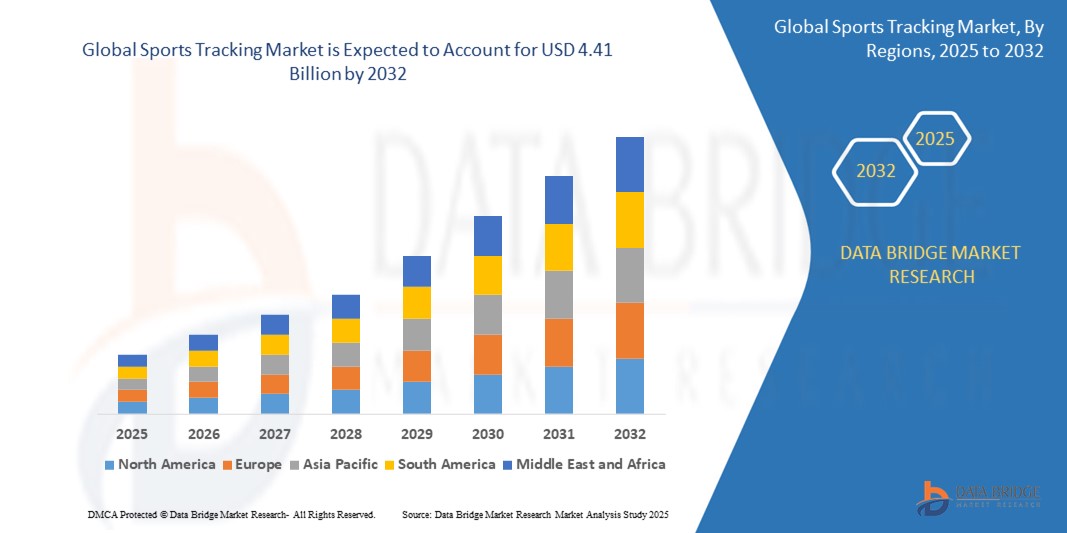
Sports Tracking Market Size
- The global sports tracking market size was valued at USD 2.77 billion in 2024 and is expected to reach USD 4.41 billion by 2032, at a CAGR of 5.95% during the forecast period
- The market growth is primarily driven by the increasing adoption of advanced analytics in sports, growing demand for performance optimization, and technological advancements in wearable devices and data analytics platforms
- Rising consumer interest in fitness tracking, coupled with the integration of AI and IoT in sports technology, is positioning sports tracking solutions as essential tools for athletes, coaches, and teams, significantly boosting industry expansion
Sports Tracking Market Analysis
- Sports tracking solutions, encompassing software and services for monitoring and analyzing athletic performance, are becoming critical in both individual and team sports due to their ability to provide real-time data, enhance training efficiency, and reduce injury risks
- The surge in demand for sports tracking is fueled by the growing adoption of wearable technologies, increasing emphasis on data-driven decision-making in sports, and the rising popularity of health and fitness monitoring
- North America dominated the sports tracking market with the largest revenue share of 42.5% in 2024, driven by early adoption of sports analytics, high investment in sports technology, and a strong presence of key industry players
- Asia-Pacific is expected to be the fastest-growing region during the forecast period, propelled by increasing sports participation, rising disposable incomes, and growing investments in sports infrastructure
- The software segment dominated the largest market revenue share of 62% in 2024, driven by the increasing need for real-time data processing, visualization, and predictive modelling in sports. Software solutions enable crucial functions such as player performance tracking, game strategy development, injury prediction, and opponent analysis
Report Scope and Sports Tracking Market Segmentation
|
Attributes |
Sports Tracking Key Market Insights |
|
Segments Covered |
|
|
Countries Covered |
North America
Europe
Asia-Pacific
Middle East and Africa
South America
|
|
Key Market Players |
|
|
Market Opportunities |
|
|
Value Added Data Infosets |
In addition to the market insights such as market value, growth rate, market segments, geographical coverage, market players, and market scenario, the market report curated by the Data Bridge Market Research team includes in-depth expert analysis, import/export analysis, pricing analysis, production consumption analysis, and pestle analysis. |
Sports Tracking Market Trends
“Increasing Integration of AI and Big Data Analytics”
- The global sports tracking market is experiencing a significant trend toward the integration of Artificial Intelligence (AI) and Big Data analytics
- These technologies enable advanced data processing and analysis, providing deeper insights into athlete performance, team strategies, and injury prevention
- AI-powered sports tracking solutions facilitate proactive decision-making, identifying potential performance issues or health risks before they impact outcomes
- For instances, companies are developing AI-driven platforms that analyze player movements to optimize training regimens, enhance game strategies, or personalize recovery plans based on real-time biometric data
- This trend enhances the value of sports tracking systems, making them increasingly appealing to sports organizations, coaches, and individual athletes
- AI algorithms can analyze a wide range of data, including player speed, heart rate, fatigue levels, tactical positioning, and even fan engagement metrics
Sports Tracking Market Dynamics
Driver
“Rising Demand for Data-Driven Performance and Fan Engagement”
- Increasing demand for data-driven insights in sports, such as real-time player tracking, performance analytics, and fan engagement tools, is a major driver for the global sports tracking market
- Sports tracking systems enhance team and player performance by providing features such as movement analysis, health monitoring, video analysis, and strategic insights
- Governing bodies and leagues, particularly in North America, are mandating the use of advanced tracking technologies to improve player safety and game quality
- The proliferation of IoT and advancements in cloud computing are enabling faster data processing and real-time analytics, supporting more sophisticated applications in sports tracking
- Sports organizations are increasingly adopting integrated tracking systems as standard tools to meet the expectations of coaches, players, and fans, while enhancing competitive advantage
Restraint/Challenge
“High Implementation Costs and Data Privacy Concerns”
- The significant initial investment required for hardware, software, and integration of sports tracking systems can be a barrier to adoption, particularly for smaller teams or organizations in emerging markets
- Integrating tracking technologies, such as wearables or video analysis systems, into existing sports infrastructure can be complex and costly
- Data security and privacy concerns are a major challenge, as sports tracking systems collect and transmit sensitive athlete and team data, raising risks of breaches or misuse
- The fragmented regulatory landscape across countries regarding data collection, storage, and usage complicates compliance for global sports organizations and technology providers
- These factors may deter adoption in regions with high cost sensitivity or strong data privacy awareness, potentially limiting market growth
Sports Tracking market Scope
The market is segmented on the basis of component, application, deployment type, and sports type.
- By Component
On the basis of component, the global sports tracking market is segmented into software and services. The software segment dominated the largest market revenue share of 62% in 2024, driven by the increasing need for real-time data processing, visualization, and predictive modelling in sports. Software solutions enable crucial functions such as player performance tracking, game strategy development, injury prediction, and opponent analysis.
The services segment is expected to witness the fastest growth rate from 2025 to 2032, playing a vital role by offering expertise, customization, and ongoing support for implementing analytics solutions. This includes consulting services, data management, system integration, and training programs tailored to specific sports and performance goals.
- By Application
On the basis of application, the global sports tracking market is segmented into player analysis, team analysis, health assessment, video analysis, and others. The player analysis segment is expected to hold a significant market share, driven by the critical need for real-time monitoring of athlete performance, movements, and physiological data to optimize training and in-game strategies. The integration of advanced technologies such as GPS, AI, and IoT for personalized insights further accelerates its adoption.
The health assessment segment is anticipated to experience robust growth from 2025 to 2032. The rising prevalence of injuries and the increasing focus on player safety and well-being are driving the demand for telematics solutions that provide early injury detection, recovery monitoring, and overall health management through biometric analysis.
- By Deployment Type
On the basis of deployment type, the global sports tracking market is segmented into on-premise and cloud. The cloud segment is expected to dominate the market revenue share, primarily driven by its cost-effectiveness, scalability, and high-end computing solutions, which are essential for handling complex data streaming in sports analytics. The increasing demand for real-time data access and flexibility also contributes to its dominance.
The on-premise segment is expected to witness steady growth from 2025 to 2032, particularly for organizations with strict data security requirements or those that prefer to maintain full control over their IT infrastructure and data.
- By Sports Type
On the basis of sports type, the global sports tracking market is segmented into individual and team. The team segment is expected to hold the largest market revenue share, primarily driven by the widespread adoption of sports tracking solutions in professional team for comprehensive player and team performance analysis, strategy development, and injury prevention.
The individual segment is anticipated to witness significant growth from 2025 to 2032. This growth is fueled by the increasing popularity of fitness and wellness activities among individuals, leading to a rising demand for personal sports tracking devices and applications for monitoring activities, performance, and health metrics in sports such as running, cycling, and golf.
Sports Tracking Market Regional Analysis
- North America dominated the sports tracking market with the largest revenue share of 42.5% in 2024, driven by early adoption of sports analytics, high investment in sports technology, and a strong presence of key industry players
- Asia-Pacific is expected to be the fastest-growing region during the forecast period, propelled by increasing sports participation, rising disposable incomes, and growing investments in sports infrastructure
U.S. Sports Tracking Market Insight
The U.S. sports tracking market captured the largest revenue share of 85.4% in 2024 within North America, fueled by strong demand for player and team analysis tools in professional sports. The adoption of wearable technologies, such as GPS trackers and heart rate monitors, and cloud-based analytics platforms drives growth. Increasing investments in sports technology startups and the use of AI for performance prediction further enhance market expansion. The trend toward data-driven decision-making in sports leagues and collegiate programs supports both on-premise and cloud deployments.
Europe Sports Tracking Market Insight
The European sports tracking market is expected to exhibit significant growth, driven by a strong sports culture and increasing adoption of analytics in football, rugby, and other sports. Countries such as Germany and the U.K. show notable uptake due to regulatory emphasis on player safety and performance optimization. The market benefits from advancements in video analysis and health assessment tools, with cloud-based solutions gaining traction for their scalability. Both team and individual sports applications contribute to growth in new and retrofit projects.
U.K. Sports Tracking Market Insight
The U.K. market for sports tracking is expected to witness rapid growth, driven by demand for performance analytics and fan engagement solutions in football and rugby. Premier League clubs are increasingly adopting software for player and team analysis, while wearable devices enhance health assessments. Growing consumer awareness of data-driven coaching and compliance with safety regulations fuels adoption. The integration of cloud-based platforms supports real-time data access, boosting both individual and team sports applications.
Germany Sports Tracking Market Insight
Germany is expected to experience significant growth in the sports tracking market, attributed to its advanced sports infrastructure and focus on performance optimization in football and other disciplines. Consumers and teams prioritize software and services that enhance player analysis and reduce injury risks through health assessments. The adoption of AI-based tools and cloud deployments in premium sports organizations supports market growth. Germany’s emphasis on technological innovation and data-driven strategies drives demand in both OEM and aftermarket segments.
Asia-Pacific Sports Tracking Market Insight
The Asia-Pacific region is expected to witness the fastest growth rate in the Global Sports Tracking Market, driven by expanding sports participation, rising disposable incomes, and digital transformation in countries such as China, Japan, and India. Increasing awareness of health assessment and performance analytics, coupled with government initiatives promoting sports technology, boosts demand. The market benefits from advancements in wearable devices and cloud-based platforms, with applications spanning player analysis, team analysis, and video analysis for both individual and team sports.
Japan Sports Tracking Market Insight
Japan’s sports tracking market is expected to grow rapidly due to strong consumer demand for high-quality software and services that enhance performance and safety in sports such as baseball and soccer. The integration of tracking technologies in OEM sports equipment and aftermarket solutions accelerates market penetration. Japan’s focus on technological innovation, exemplified by the Tokyo 2020 Olympics, supports the adoption of video analysis and health assessment tools. Cloud-based deployments are gaining popularity for their scalability and real-time capabilities.
China Sports Tracking Market Insight
China holds the largest share of the Asia-Pacific sports tracking market, driven by rapid urbanization, increasing sports participation, and strong domestic manufacturing capabilities. The growing middle class and government initiatives to develop a global sports powerhouse by 2030 fuel demand for player and team analysis tools. The adoption of wearable devices, AI-based performance prediction, and cloud-based platforms supports market accessibility. Competitive pricing and advancements in video analysis and health assessment applications enhance growth in both individual and team sports.
Sports Tracking Market Share
The sports tracking industry is primarily led by well-established companies, including:
- IBM Corporation (U.S.)
- Sportradar AG (Switzerland)
- Synergy Sports (U.S.)
- DataArt (U.S.)
- SAP SE (Germany)
- TABLEAU SOFTWARE, LLC (U.S.)
- SALESFORCE Inc. (U.S.)
- Oracle (U.S.)
- Qualitas Global (India)
- SAS Institute Inc (U.S.)
- HCL Technologies Limited (India)
- GlobalStep, LLC (U.S.)
- TruMedia Networks, Inc. (U.S.)
- ICEBERG Sports Analytics (Canada)
- SPORTSMECHANICS (India)
- Stats Perform (U.K.)
- Experfy, Inc. (U.S.)
- Catapult Group International Ltd. (U.S.)
- Orreco Limited (Ireland)
- Zebra Technologies Corp. (U.S.)
- Exasol (Germany)
What are the Recent Developments in Global Sports Tracking Market?
- In April 2025, Ryan Smith, owner of the Utah Jazz and Utah Hockey Club, partnered with Accel’s Ryan Sweeney to launch the Halo Experience Company (HXCOO) investment firm focused on technology startups in sports, media, and entertainment. HXCO aims to support 20–25 growth-stage companies that are transforming the fan experience, venue operations, and the broader experience economy. Operating independently from Smith’s sports franchises and Accel, the initiative reflects a bold commitment to leveraging sports as a platform for technological innovation and cultural impact
- In February 2025, Sportradar Group AG, a Switzerland-based sports technology company, announced an expanded long-term partnership with Major League Baseball (MLB), set to begin with the 2025 season. As part of the agreement, MLB acquired an equity stake in Sportradar, deepening their collaboration. Sportradar will exclusively distribute MLB’s official ultra-low latency data, including Statcast and audiovisual (AV) content, to a global network of sportsbooks and media outlets. The partnership also includes the development of AI-powered fan engagement tools and continued integrity services, reinforcing MLB’s commitment to innovation and global growth
- In August 2024, Catapult, a global leader in athlete performance technology, introduced a cutting-edge sideline video solution tailored for college football, following the NCAA Football Rules Committee’s approval of live sideline video use earlier that year. Developed in partnership with the Southeastern Conference (SEC), this solution enables coaches to access real-time video and data on any tablet during games, log plays, and evaluate performance instantly. It also streamlines post-game analysis, saving up to 6–8 hours of review time. The innovation marks a major leap in in-game decision-making and coaching efficiency
- In July 2024, Catapult extended its strategic partnership with USA Volleyball, reinforcing its role in supporting elite athletic performance ahead of the 2024 Summer Olympics in Paris. Through this collaboration, Catapult provided its advanced athlete monitoring technology to the USA Volleyball national teams—across indoor, beach, and sitting disciplines—to optimize training, reduce injury risk, and accelerate recovery. By analyzing key metrics such as jump counts and high-intensity loads, coaches gained real-time insights into player workload and performance. This partnership reflects a shared commitment to leveraging data-driven solutions for Olympic-level preparation and long-term athlete development
- In May 2023, KINEXON, a leading provider of real-time sports tracking solutions, introduced the KINEXON PERFORM GPS Pro, a next-generation GPS-based system tailored for outdoor team sports such as soccer and football. This advanced solution enables real-time player tracking and captures approximately 120 live performance and load metrics, offering coaches deep insights into training intensity, recovery, and tactical execution. With cloud-based streaming, offline functionality, and wireless charging, it enhances both on-field decision-making and post-session analysis. The system stands out for its data accuracy and operational efficiency, making it a powerful tool for modern sports performance management

- Interactive Data Analysis Dashboard
- Company Analysis Dashboard for high growth potential opportunities
- Research Analyst Access for customization & queries
- Competitor Analysis with Interactive dashboard
- Latest News, Updates & Trend analysis
- Harness the Power of Benchmark Analysis for Comprehensive Competitor Tracking
Table of Content
1 INTRODUCTION
1.1 OBJECTIVES OF THE STUDY
1.2 MARKET DEFINITION
1.3 OVERVIEW OF GLOBAL SPORTS TRACKING MARKET
1.4 CURRENCY AND PRICING
1.5 LIMITATION
1.6 MARKETS COVERED
2 MARKET SEGMENTATION
2.1 KEY TAKEAWAYS
2.2 ARRIVING AT THE GLOBAL SPORTS TRACKING MARKET SIZE
2.3 VENDOR POSITIONING GRID
2.4 MARKETS COVERED
2.5 GEOGRAPHIC SCOPE
2.6 YEARS CONSIDERED FOR THE STUDY
2.7 RESEARCH METHODOLOGY
2.8 TECHNOLOGY LIFE LINE CURVE
2.9 MULTIVARIATE MODELLING
2.1 PRIMARY INTERVIEWS WITH KEY OPINION LEADERS
2.11 DBMR MARKET POSITION GRID
2.12 MARKET APPLICATION COVERAGE GRID
2.13 DBMR MARKET CHALLENGE MATRIX
2.14 IMPORT AND EXPORT DATA
2.15 SECONDARY SOURCES
2.16 GLOBAL SPORTS TRACKING MARKET : RESEARCH SNAPSHOT
2.17 ASSUMPTIONS
3 MARKET OVERVIEW
3.1 DRIVERS
3.2 RESTRAINTS
3.3 OPPORTUNITIES
3.4 CHALLENGES
4 EXECUTIVE SUMMARY
5 PREMIUM INSIGHTS
6 GLOBAL SPORTS TRACKING MARKET, BY SOLUTION
6.1 OVERVIEW
6.2 WEARABLES TECHNOLOGY
6.2.1 LEG WEAR
6.2.2 SMART GARMENTS
6.2.3 SMART GLASSES
6.2.4 SMART WATCHES
6.2.5 FITNESS BANDS
6.2.6 OTHERS
6.3 OPTICALS
6.4 PERFORMANCE ANALYSIS
6.5 APPLICATION BASED
7 GLOBAL SPORTS TRACKING MARKET, BY END-USER
7.1 OVERVIEW
7.2 INDIVIDUAL SPORTS
7.2.1 GOLF
7.2.2 TENNIS
7.2.3 ATHLETICS
7.2.4 FORMULA 1
7.2.5 BOXING
7.2.6 OTHERS
7.3 TEAM SPORTS
7.3.1 SOCCER
7.3.2 HOCKEY
7.3.3 BASEBALL
7.3.4 VOLLEYBALL
7.3.5 BASKETBALL
7.3.6 RUGBY
7.3.7 CRICKET
7.3.8 OTHERS
8 GLOBAL SPORTS TRACKING MARKET, BY CONNECTIVITY
8.1 OVERVIEW
8.2 BLUETOOTH
8.3 WI-FI
8.4 CELLULAR
8.5 NFC
8.6 OTHERS
9 GLOBAL SPORTS TRACKING MARKET, BY OPERATING SYSTEM
9.1 OVERVIEW
9.2 ANDRIOD
9.3 IOS
9.4 WINDOWS
9.5 TIZEN
10 GLOBAL SPORTS TRACKING MARKET, BY APPLICATION
10.1 OVERVIEW
10.2 FITNESS TRACKING
10.3 PERFORMANCE TRACKING
10.4 FRAUD DETECTION
10.5 PLAYER SAFETY
11 GLOBAL SPORTS TRACKING MARKET, BY GEOGRAPHY
Global SPORTS TRACKING Market, (ALL SEGMENTATION PROVIDED ABOVE IS REPRESENTED IN THIS CHAPTER BY COUNTRY)
11.1 NORTH AMERICA
11.1.1 U.S.
11.1.2 CANADA
11.1.3 MEXICO
11.2 EUROPE
11.2.1 GERMANY
11.2.2 U.K.
11.2.3 ITALY
11.2.4 FRANCE
11.2.5 SPAIN
11.2.6 SWITZERLAND
11.2.7 RUSSIA
11.2.8 TURKEY
11.2.9 BELGIUM
11.2.10 NETHERLANDS
11.2.11 REST OF EUROPE
11.3 ASIA-PACIFIC
11.3.1 JAPAN
11.3.2 CHINA
11.3.3 SOUTH KOREA
11.3.4 INDIA
11.3.5 SINGAPORE
11.3.6 THAILAND
11.3.7 INDONESIA
11.3.8 MALAYSIA
11.3.9 PHILIPPINES
11.3.10 AUSTRALIA AND NEW ZEALAND
11.3.11 HONG KONG
11.3.12 TAIWAN
11.3.13 REST OF ASIA-PACIFIC
11.4 SOUTH AMERICA
11.4.1 BRAZIL
11.4.2 ARGENTINA
11.4.3 REST OF SOUTH AMERICA
11.5 MIDDLE EAST AND AFRICA
11.5.1 SOUTH AFRICA
11.5.2 EGYPT
11.5.3 SAUDI ARABIA
11.5.4 UNITED ARAB EMIRATES
11.5.5 ISRAEL
11.5.6 REST OF MIDDLE EAST AND AMERICA
12 GLOBAL SPORTS TRACKING MARKET, COMPANY LANDSCAPE
12.1 COMPANY SHARE ANALYSIS: GLOBAL
12.2 COMPANY SHARE ANALYSIS: NORTH AMERICA
12.3 COMPANY SHARE ANALYSIS: EUROPE
12.4 COMPANY SHARE ANALYSIS: ASIA-PACIFIC
12.5 MERGERS & ACQUISITIONS
12.6 NEW PRODUCT DEVELOPMENT & APPROVALS
12.7 EXPANSIONS
12.8 PARTNERSHIP AND OTHER STRATEGIC DEVELOPMENTS
13 SWOT ANALYSIS
14 GLOBAL SPORTS TRACKING MARKET – COMPANY PROFILE
14.1 ZEBRA TECHNOLOGIES
14.1.1 COMPANY SNAPSHOT
14.1.2 REVENUE ANALYSIS
14.1.3 PRODUCT PORTFOLIO
14.1.4 RECENT DEVELOPMENTS
14.2 CATAPULT SPORTS
14.2.1 COMPANY SNAPSHOT
14.2.2 REVENUE ANALYSIS
14.2.3 PRODUCT PORTFOLIO
14.2.4 RECENT DEVELOPMENTS
14.3 STATSPORTS
14.3.1 COMPANY SNAPSHOT
14.3.2 REVENUE ANALYSIS
14.3.3 PRODUCT PORTFOLIO
14.3.4 RECENT DEVELOPMENTS
14.4 CHYRONHEGO
14.4.1 COMPANY SNAPSHOT
14.4.2 REVENUE ANALYSIS
14.4.3 PRODUCT PORTFOLIO
14.4.4 RECENT DEVELOPMENTS
14.5 STATS
14.5.1 COMPANY SNAPSHOT
14.5.2 REVENUE ANALYSIS
14.5.3 PRODUCT PORTFOLIO
14.5.4 RECENT DEVELOPMENTS
14.6 KINEXON
14.6.1 COMPANY SNAPSHOT
14.6.2 REVENUE ANALYSIS
14.6.3 PRODUCT PORTFOLIO
14.6.4 RECENT DEVELOPMENTS
14.7 POLAR
14.7.1 COMPANY SNAPSHOT
14.7.2 REVENUE ANALYSIS
14.7.3 PRODUCT PORTFOLIO
14.7.4 RECENT DEVELOPMENTS
14.8 PLAYGINEERING
14.8.1 COMPANY SNAPSHOT
14.8.2 REVENUE ANALYSIS
14.8.3 PRODUCT PORTFOLIO
14.8.4 RECENT DEVELOPMENTS
14.9 SONDA SPORTS
14.9.1 COMPANY SNAPSHOT
14.9.2 REVENUE ANALYSIS
14.9.3 PRODUCT PORTFOLIO
14.9.4 RECENT DEVELOPMENTS
14.1 JOHAN SPORTS
14.10.1 COMPANY SNAPSHOT
14.10.2 REVENUE ANALYSIS
14.10.3 PRODUCT PORTFOLIO
14.10.4 RECENT DEVELOPMENTS
14.11 EXELIO
14.11.1 COMPANY SNAPSHOT
14.11.2 REVENUE ANALYSIS
14.11.3 PRODUCT PORTFOLIO
14.11.4 RECENT DEVELOPMENTS
14.12 Q-TRACK
14.12.1 COMPANY SNAPSHOT
14.12.2 REVENUE ANALYSIS
14.12.3 PRODUCT PORTFOLIO
14.12.4 RECENT DEVELOPMENTS
14.13 ADVANCED SPORTS ANALYTICS
14.13.1 COMPANY SNAPSHOT
14.13.2 REVENUE ANALYSIS
14.13.3 PRODUCT PORTFOLIO
14.13.4 RECENT DEVELOPMENTS
14.14 XAMPION
14.14.1 COMPANY SNAPSHOT
14.14.2 REVENUE ANALYSIS
14.14.3 PRODUCT PORTFOLIO
14.14.4 RECENT DEVELOPMENTS
14.15 SPORTS PERFORMANCE TRACKING
14.15.1 COMPANY SNAPSHOT
14.15.2 REVENUE ANALYSIS
14.15.3 PRODUCT PORTFOLIO
14.15.4 RECENT DEVELOPMENTS
14.16 NUEROTRAINER, INC.
14.16.1 COMPANY SNAPSHOT
14.16.2 REVENUE ANALYSIS
14.16.3 PRODUCT PORTFOLIO
14.16.4 RECENT DEVELOPMENTS
14.17 NOWSTA
14.17.1 COMPANY SNAPSHOT
14.17.2 REVENUE ANALYSIS
14.17.3 PRODUCT PORTFOLIO
14.17.4 RECENT DEVELOPMENTS
14.18 OURA
14.18.1 COMPANY SNAPSHOT
14.18.2 REVENUE ANALYSIS
14.18.3 PRODUCT PORTFOLIO
14.18.4 RECENT DEVELOPMENTS
14.19 SENEPTEC
14.19.1 COMPANY SNAPSHOT
14.19.2 REVENUE ANALYSIS
14.19.3 PRODUCT PORTFOLIO
14.19.4 RECENT DEVELOPMENTS
14.2 WAGERWIRE
14.20.1 COMPANY SNAPSHOT
14.20.2 REVENUE ANALYSIS
14.20.3 PRODUCT PORTFOLIO
14.20.4 RECENT DEVELOPMENTS
NOTE: THE COMPANIES PROFILED IS NOT EXHAUSTIVE LIST AND IS AS PER OUR PREVIOUS CLIENT REQUIREMENT. WE PROFILE MORE THAN 100 COMPANIES IN OUR STUDY AND HENCE THE LIST OF COMPANIES CAN BE MODIFIED OR REPLACED ON REQUEST
15 QUESTIONNAIRE
16 RELATED REPORTS
17 ABOUT DATA BRIDGE MARKET RESEARCH

Data collection and base year analysis are done using data collection modules with large sample sizes. The stage includes obtaining market information or related data through various sources and strategies. It includes examining and planning all the data acquired from the past in advance. It likewise envelops the examination of information inconsistencies seen across different information sources. The market data is analysed and estimated using market statistical and coherent models. Also, market share analysis and key trend analysis are the major success factors in the market report. To know more, please request an analyst call or drop down your inquiry.
The key research methodology used by DBMR research team is data triangulation which involves data mining, analysis of the impact of data variables on the market and primary (industry expert) validation. Data models include Vendor Positioning Grid, Market Time Line Analysis, Market Overview and Guide, Company Positioning Grid, Patent Analysis, Pricing Analysis, Company Market Share Analysis, Standards of Measurement, Global versus Regional and Vendor Share Analysis. To know more about the research methodology, drop in an inquiry to speak to our industry experts.
Data Bridge Market Research is a leader in advanced formative research. We take pride in servicing our existing and new customers with data and analysis that match and suits their goal. The report can be customized to include price trend analysis of target brands understanding the market for additional countries (ask for the list of countries), clinical trial results data, literature review, refurbished market and product base analysis. Market analysis of target competitors can be analyzed from technology-based analysis to market portfolio strategies. We can add as many competitors that you require data about in the format and data style you are looking for. Our team of analysts can also provide you data in crude raw excel files pivot tables (Fact book) or can assist you in creating presentations from the data sets available in the report.













