


What is the Sterility Testing Market Size and Growth Rate?
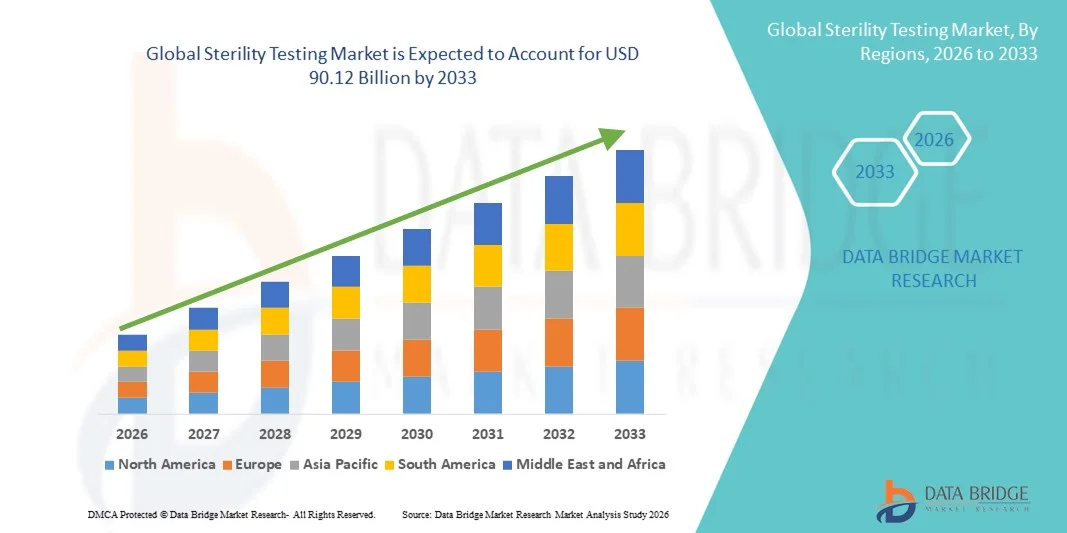
- As per Data Bridge Market Research Analysis the global sterility testing market size was valued at USD 35.78 billion in 2025 and is expected to reach USD 90.12 billion by 2033, at a CAGR of 12.24% during the forecast period
- The market growth is largely fueled by the increasing production of pharmaceuticals, biologics, and cell & gene therapies, leading to higher demand for reliable sterility assurance across manufacturing processes
- Furthermore, stringent regulatory requirements for product safety and quality, along with growing adoption of rapid microbiological testing technologies by pharmaceutical and biotechnology companies, are establishing sterility testing as a critical component of quality control. These converging factors are accelerating the adoption of sterility testing solutions, thereby significantly boosting the industry's growth
Market Size & Forecast
- Global Market Value (2025): USD 35.78
- Expected Market Value (2033): USD 90.12 billion
- Forecast CAGR (2026–2033): 12.24%
What are the Major Takeaways of Sterility Testing Market?
- Sterility testing, which ensures that pharmaceutical, biotechnology, and medical products are free from viable contaminating microorganisms, has become an essential component of quality control and regulatory compliance in drug manufacturing and healthcare product development due to the critical need for patient safety and product integrity
- The increasing demand for sterility testing is primarily driven by the rapid growth of the pharmaceutical and biotechnology industries, rising production of biologics, vaccines, and cell and gene therapies, and stringent regulatory requirements mandating sterility assurance for injectable drugs and medical devices
- North America dominated the sterility testing market with the largest revenue share of 39.6% in 2025, supported by a strong pharmaceutical manufacturing base, advanced laboratory infrastructure, and strict regulatory frameworks, with the U.S. witnessing significant adoption of rapid sterility testing methods by major pharmaceutical and biotechnology companies to accelerate product release timelines
- Asia-Pacific is expected to be the fastest growing region in the sterility testing market during the forecast period due to expanding pharmaceutical manufacturing activities, increasing contract research and manufacturing organizations, and growing regulatory focus on product quality and safety
- Kits and reagents segment dominated the sterility testing market with a market share of 45.8% in 2025, driven by their extensive use in routine sterility testing procedures across pharmaceutical companies, biotechnology firms, and quality control laboratories for reliable and standardized testing processes
Report Scope and Sterility Testing Market Segmentation
|
Attributes |
Sterility Testing Key Market Insights |
|
Segments Covered |
|
|
Countries Covered |
North America
Europe
Asia-Pacific
Middle East and Africa
South America
|
|
Key Market Players |
|
|
Market Opportunities |
|
|
Value Added Data Infosets |
In addition to the insights on market scenarios such as market value, growth rate, segmentation, geographical coverage, and major players, the market reports curated by the Data Bridge Market Research also include in-depth expert analysis, patient epidemiology, pipeline analysis, pricing analysis, and regulatory framework |
What is the Key Trend in the Sterility Testing Market?
Growing Adoption of Rapid Microbiological Testing Technologies
- A significant and accelerating trend in the global sterility testing market is the increasing adoption of rapid microbiological testing technologies that enable faster and more reliable detection of microbial contamination in pharmaceutical and biotechnology products. This advancement is significantly improving efficiency and reducing product release timelines
- For instance, the Merck KGaA Milliflex Rapid System enables pharmaceutical manufacturers to detect microbial contamination much faster than traditional sterility testing methods, allowing quicker decision-making during quality control processes. Similarly, bioMérieux SA provides advanced automated microbial detection platforms widely used in pharmaceutical laboratories
- Rapid sterility testing technologies support features such as automated microbial detection, shorter incubation times, and enhanced data accuracy. For instance, some modern rapid systems utilize ATP bioluminescence or nucleic acid amplification techniques to identify contamination much earlier in the testing cycle. Furthermore, automation capabilities offer laboratories improved workflow efficiency, reducing manual intervention and the risk of human error
- The seamless integration of automated sterility testing instruments with digital laboratory systems facilitates centralized monitoring and improved data management across quality control operations. Through integrated laboratory platforms, manufacturers can manage sterility testing results alongside environmental monitoring and other microbiological quality control processes, creating a more efficient and compliant testing environment
- This trend toward faster, automated, and more reliable sterility testing solutions is fundamentally reshaping expectations for pharmaceutical quality control and product safety. Consequently, companies such as Charles River Laboratories are developing advanced rapid sterility testing platforms designed to support accelerated drug development and faster regulatory approvals
- The demand for sterility testing technologies that provide rapid and automated microbial detection is growing rapidly across pharmaceutical, biotechnology, and medical device sectors as manufacturers increasingly prioritize efficiency, regulatory compliance, and faster product release timelines
- Furthermore, the growing shift toward automated and digitalized laboratory environments is driving demand for sterility testing platforms that can integrate with laboratory information management systems, enabling streamlined data tracking and regulatory documentation
Sterility Testing Market Dynamics
Driver
Growing Demand Due to Expanding Biopharmaceutical Production and Stringent Regulatory Requirements
- The increasing expansion of biopharmaceutical manufacturing activities, coupled with stringent regulatory requirements for product safety and quality assurance, is a significant driver for the growing demand for sterility testing solutions across pharmaceutical and biotechnology industries
- For instance, in March 2024, Thermo Fisher Scientific Inc. announced enhancements to its microbiology testing portfolio aimed at supporting pharmaceutical manufacturers with advanced sterility testing solutions for biologics and sterile injectable drug production. Such strategies by key companies are expected to drive sterility testing industry growth in the forecast period
- As pharmaceutical and biotechnology companies continue to increase the production of sterile products such as vaccines, biologics, and injectable drugs, sterility testing plays a critical role in ensuring that these products remain free from microbial contamination before reaching patients
- Furthermore, regulatory authorities including U.S. Food and Drug Administration and European Medicines Agency require strict sterility assurance testing during pharmaceutical manufacturing processes, making sterility testing an essential component of quality control and regulatory compliance
- The growth of contract manufacturing organizations and contract research organizations is further increasing demand for specialized sterility testing services, as pharmaceutical companies increasingly outsource quality control testing activities to improve efficiency and reduce operational costs
- In addition, the rising global demand for vaccines and sterile injectable therapies is encouraging pharmaceutical manufacturers to strengthen sterility assurance processes throughout the drug production lifecycle
- Increasing investments in biotechnology innovation and cell and gene therapy development are also creating a greater need for advanced sterility testing technologies to ensure contamination-free production environments
Restraint/Challenge
High Operational Costs and Complex Regulatory Compliance Requirements
- Concerns high operational costs associated with sterility testing procedures and the complex regulatory compliance requirements involved in pharmaceutical quality control present significant challenges to broader adoption and implementation of sterility testing solutions
- For instance, strict sterility testing protocols required by regulatory bodies often involve specialized laboratory infrastructure, trained personnel, and controlled testing environments, which can significantly increase operational costs for pharmaceutical manufacturers and testing laboratories
- Addressing these challenges requires substantial investment in laboratory equipment, sterile testing facilities, and advanced automated testing platforms that meet international regulatory standards and ensure reliable results. Furthermore, maintaining compliance with evolving global regulatory frameworks adds additional operational complexity for manufacturers
- In addition, sterility testing procedures often require incubation periods and controlled laboratory conditions that can delay product release timelines, particularly when using traditional compendial sterility testing methods that require extended testing durations
- Another challenge is the need for highly skilled microbiologists and laboratory professionals capable of performing complex sterility testing procedures while maintaining strict contamination-free conditions
- Variability in regulatory standards across different regions can also complicate testing processes for multinational pharmaceutical companies seeking global product approvals
- Overcoming these challenges through the adoption of rapid sterility testing technologies, improved laboratory automation, and streamlined regulatory processes will be critical for ensuring efficient pharmaceutical production and maintaining high standards of product safety and quality
How is the Sterility Testing Market Segmented?
The market is segmented on the basis of product, test, application, and end users.
- By Product
On the basis of product, the sterility testing market is segmented into kits and reagents, services, and instruments. The kits and reagents segment dominated the market with the largest market revenue share of 45.8% in 2025, driven by their widespread use in routine sterility testing procedures across pharmaceutical and biotechnology laboratories. These products are essential consumables used repeatedly during testing processes, making them a consistent revenue contributor in the market. Kits and reagents provide standardized and validated components that help laboratories perform sterility tests efficiently while complying with regulatory guidelines. Pharmaceutical manufacturers prefer these solutions because they simplify testing procedures and reduce the risk of contamination during analysis. In addition, the increasing production of sterile drugs, vaccines, and biologics is further increasing the demand for reliable sterility testing kits and reagents across quality control laboratories.
The services segment is anticipated to witness the fastest growth rate from 2026 to 2033, fueled by the increasing outsourcing of sterility testing by pharmaceutical and biotechnology companies to specialized testing laboratories. Many manufacturers prefer outsourcing sterility testing to contract testing providers due to the high costs associated with establishing and maintaining sterile laboratory environments. Outsourced testing services help pharmaceutical companies accelerate product development and ensure compliance with stringent regulatory requirements. In addition, the rapid expansion of contract research organizations and contract manufacturing organizations is driving demand for professional sterility testing services. These service providers offer specialized expertise, advanced testing infrastructure, and faster turnaround times, making them attractive partners for pharmaceutical companies seeking efficient quality control solutions.
- By Test
On the basis of test, the sterility testing market is segmented into membrane filtration, direct inoculation, and others. The membrane filtration segment dominated the market with the largest market revenue share in 2025, primarily due to its high sensitivity and effectiveness in detecting microbial contamination in pharmaceutical products. This method is widely used for testing products that can be filtered, such as liquid pharmaceuticals and biologics. Membrane filtration allows microorganisms to be trapped on a filter surface, which is then incubated in culture media to detect microbial growth. The method is widely recommended by regulatory agencies due to its reliability and accuracy in sterility testing procedures. Furthermore, pharmaceutical companies prefer membrane filtration because it enables testing of larger sample volumes, increasing the likelihood of detecting potential contamination.
The direct inoculation segment is expected to witness the fastest CAGR from 2026 to 2033, driven by its suitability for testing products that cannot be filtered, such as oily or highly viscous formulations. In this method, the product sample is directly introduced into culture media and incubated to detect microbial growth. The method is commonly used in pharmaceutical manufacturing for certain biologics and medical products where filtration methods are not feasible. Increasing production of complex biologics and advanced therapeutics is contributing to the rising demand for direct inoculation sterility testing methods. In addition, improvements in culture media and automated incubation systems are making direct inoculation testing more efficient and reliable for modern pharmaceutical laboratories.
- By Application
On the basis of application, the sterility testing market is segmented into pharmaceutical and biological manufacturing, medical device manufacturing, and others. The pharmaceutical and biological manufacturing segment dominated the market with the largest market revenue share in 2025, driven by the large-scale production of sterile pharmaceutical products such as vaccines, injectable drugs, and biologics. Sterility testing is a critical regulatory requirement in pharmaceutical manufacturing to ensure that injectable and sterile products are free from microbial contamination before being released to the market. The growing demand for biologics, biosimilars, and advanced therapies has significantly increased the need for reliable sterility testing solutions. Pharmaceutical companies are increasingly adopting advanced sterility testing technologies to ensure compliance with global regulatory standards and maintain product quality and patient safety.
The medical device manufacturing segment is anticipated to witness the fastest growth rate from 2026 to 2033, fueled by the increasing production of sterile medical devices such as implants, surgical instruments, and catheters. Sterility assurance is essential in medical device manufacturing because contaminated devices can pose serious health risks to patients. Regulatory authorities require strict sterility validation and testing before medical devices can be approved for clinical use. The rapid growth of the global medical device industry and the increasing adoption of minimally invasive surgical procedures are driving demand for sterility testing in device manufacturing processes. As a result, manufacturers are investing in advanced sterility testing technologies to ensure product safety and regulatory compliance.
- By End Users
On the basis of end users, the sterility testing market is segmented into pharmaceutical, biotechnology, and contract manufacturing organizations. The pharmaceutical segment dominated the market with the largest market revenue share in 2025, supported by the large number of pharmaceutical manufacturing facilities that require routine sterility testing for sterile drug products. Pharmaceutical companies conduct sterility testing at multiple stages of drug development and manufacturing to ensure compliance with regulatory guidelines and maintain product safety. The increasing global demand for vaccines, injectable therapies, and sterile pharmaceutical products is significantly driving the need for sterility testing in pharmaceutical manufacturing facilities. Furthermore, pharmaceutical companies are investing heavily in advanced microbiological testing technologies to improve efficiency and accelerate product release timelines.
The contract manufacturing organization segment is expected to witness the fastest CAGR from 2026 to 2033, driven by the growing trend of pharmaceutical companies outsourcing drug manufacturing and quality control activities. Contract manufacturing organizations provide specialized production and testing services to pharmaceutical and biotechnology companies, including sterility testing for sterile drug products. These organizations operate advanced laboratories equipped with specialized sterility testing equipment and trained microbiologists. Outsourcing sterility testing allows pharmaceutical companies to reduce operational costs while ensuring compliance with strict regulatory standards. As the global pharmaceutical outsourcing market continues to expand, demand for sterility testing services within contract manufacturing organizations is expected to increase significantly.
Sterility Testing Market Regional Analysis
- North America dominated the sterility testing market with the largest revenue share of 39.6% in 2025, supported by a strong pharmaceutical manufacturing base, advanced laboratory infrastructure, and strict regulatory frameworks
- Manufacturers and laboratories in the region highly prioritize reliable sterility testing solutions to ensure compliance with strict regulatory requirements and to maintain the safety of pharmaceutical products such as vaccines, biologics, and injectable drugs
- This widespread adoption is further supported by advanced laboratory infrastructure, a well-established pharmaceutical manufacturing ecosystem, and increasing investments in biotechnology research, establishing sterility testing as a critical component of quality control processes across pharmaceutical and medical device industries
U.S. Sterility Testing Market Insight
The U.S. sterility testing market captured the largest revenue share of 79% in 2025 within North America, fueled by the strong presence of pharmaceutical and biotechnology companies and the increasing demand for sterile drug manufacturing. Pharmaceutical manufacturers are increasingly prioritizing strict sterility assurance to comply with regulatory standards and ensure patient safety. The growing production of biologics, vaccines, and injectable therapies, combined with the rising adoption of rapid microbiological testing technologies, further propels the sterility testing industry. Moreover, the increasing focus on pharmaceutical quality control and regulatory compliance by agencies such as the U.S. Food and Drug Administration is significantly contributing to the market's expansion.
Europe Sterility Testing Market Insight
The Europe sterility testing market is projected to expand at a substantial CAGR throughout the forecast period, primarily driven by stringent regulatory standards and the increasing demand for high-quality pharmaceutical products. The expansion of biotechnology research and pharmaceutical manufacturing is fostering the adoption of advanced sterility testing technologies. European manufacturers are also focusing on ensuring product safety and regulatory compliance through reliable sterility testing procedures. The region is experiencing significant growth across pharmaceutical, biotechnology, and medical device manufacturing sectors, with sterility testing becoming a key component of quality assurance processes in both production facilities and research laboratories.
U.K. Sterility Testing Market Insight
The U.K. sterility testing market is anticipated to grow at a noteworthy CAGR during the forecast period, driven by increasing pharmaceutical research activities and the demand for high-quality sterile drug products. In addition, strict regulatory requirements for pharmaceutical manufacturing are encouraging companies to adopt advanced sterility testing solutions. The country’s strong biotechnology ecosystem, along with growing investments in life sciences research and development, is expected to continue to stimulate market growth. Furthermore, the rising development of biologics and innovative therapies is increasing the need for reliable sterility testing procedures in pharmaceutical laboratories.
Germany Sterility Testing Market Insight
The Germany sterility testing market is expected to expand at a considerable CAGR during the forecast period, fueled by a well-established pharmaceutical manufacturing sector and increasing focus on product safety and quality assurance. Germany’s strong biotechnology and life sciences industry, combined with its emphasis on technological innovation, promotes the adoption of advanced sterility testing solutions. Pharmaceutical manufacturers in the country are increasingly integrating automated microbiological testing technologies to improve laboratory efficiency and regulatory compliance. The demand for reliable sterility testing is also growing in medical device manufacturing facilities across the country.
Asia-Pacific Sterility Testing Market Insight
The Asia-Pacific sterility testing market is poised to grow at the fastest CAGR during the forecast period of 2026 to 2033, driven by the rapid expansion of pharmaceutical manufacturing, increasing biotechnology research activities, and rising healthcare investments in countries such as China, Japan, and India. The region's growing role as a global pharmaceutical manufacturing hub is driving the demand for advanced sterility testing technologies. Furthermore, the increasing presence of contract manufacturing organizations and contract research organizations is contributing to the adoption of sterility testing solutions. As pharmaceutical production continues to expand across the region, the need for reliable quality control testing is increasing significantly.
Japan Sterility Testing Market Insight
The Japan sterility testing market is gaining momentum due to the country’s advanced biotechnology sector, strong pharmaceutical research capabilities, and increasing demand for high-quality sterile drug products. The Japanese market places a significant emphasis on product safety and regulatory compliance, driving the adoption of advanced sterility testing technologies. The integration of automated laboratory systems and rapid microbiological testing methods is further supporting market growth. Moreover, Japan's continuous investments in pharmaceutical innovation and biologics manufacturing are likely to increase the demand for sterility testing across pharmaceutical and biotechnology laboratories.
India Sterility Testing Market Insight
The India sterility testing market accounted for the largest market revenue share in Asia Pacific in 2025, attributed to the country's rapidly expanding pharmaceutical manufacturing industry and increasing global demand for generic drugs and vaccines. India is one of the largest pharmaceutical producers globally, and sterility testing plays a critical role in ensuring the safety and quality of exported pharmaceutical products. The expansion of biotechnology research, contract manufacturing organizations, and pharmaceutical testing laboratories is further boosting market growth. In addition, government initiatives supporting pharmaceutical manufacturing and life sciences research are encouraging the adoption of advanced sterility testing technologies across the country.
Which are the Top Companies in Sterility Testing Market?
The Sterility Testing industry is primarily led by well-established companies, including:
- Thermo Fisher Scientific Inc. (U.S.)
- Sartorius AG (Germany)
- Charles River Laboratories (U.S.)
- BIOMÉRIEUX (France)
- Merck KGaA (Germany)
- SGS SA https://www.merckgroup.com/(Switzerland)
- WuXi AppTec (China)
- Rapid Micro Biosystems, Inc. (U.S.)
- STERIS (U.K.)
- Eurofins Scientific (Luxembourg)
- Intertek Group plc (U.K.)
- Labcorp (U.S.)
- PerkinElmer Inc. (U.S.)
- Lonza Group Ltd (Switzerland)
- Nelson Laboratories, LLC (U.S.)
- Pacific BioLabs, Inc. (U.S.)
- Pace Analytical Services, LLC (U.S.)
- Solvias AG (Switzerland)
- Toxikon Corporation (U.S.)
- Boston Analytical (U.S.)
What are the Recent Developments in Global Sterility Testing Market?
- In August 2025, bioMérieux announced the launch of its GENE-UP® PRO HRM test, the first DNA-based molecular solution designed to detect heat-resistant molds at the molecular level. The technology significantly reduces microbial testing time from about 15 days to nearly 72 hours, helping manufacturers improve contamination detection and quality control in production environments
- In February 2025, bioMérieux announced the launch of GENE-UP® TYPER, a real-time PCR solution designed for rapid strain characterization and contamination root-cause analysis. The platform combines a molecular assay with a web-based analytics application, enabling laboratories to quickly identify sources of microbial contamination and accelerate decision-making in quality control environments
- In May 2024, Merck KGaA launched the M-Trace® Software and Mobile App to digitize sterility testing workflows in pharmaceutical quality control laboratories. The digital solution automatically records and tracks every step of sterility testing, enabling complete data traceability and improving compliance with regulatory requirements. The platform helps laboratories reduce human error, prevent deviations, and strengthen quality assurance processes in sterile drug manufacturing
- In September 2023, Merck KGaA introduced the Milliflex® Rapid System 2.0, an advanced automated solution for rapid sterility and bioburden testing in pharmaceutical manufacturing. The system uses ATP bioluminescence and automated image analysis to detect microbial contamination much faster than traditional sterility tests, which typically require 14 days
- In September 2023, Merck KGaA highlighted the enhanced capabilities of the Milliflex® Rapid 2.0 system for detecting microbial contamination earlier during pharmaceutical production processes. The solution integrates membrane filtration with ATP bioluminescence technology to automatically detect, image, and quantify microorganisms, enabling laboratories to identify contamination earlier and improve process control during sterile drug manufacturing

- Interactive Data Analysis Dashboard
- Company Analysis Dashboard for high growth potential opportunities
- Research Analyst Access for customization & queries
- Competitor Analysis with Interactive dashboard
- Latest News, Updates & Trend analysis
- Harness the Power of Benchmark Analysis for Comprehensive Competitor Tracking
Data collection and base year analysis are done using data collection modules with large sample sizes. The stage includes obtaining market information or related data through various sources and strategies. It includes examining and planning all the data acquired from the past in advance. It likewise envelops the examination of information inconsistencies seen across different information sources. The market data is analysed and estimated using market statistical and coherent models. Also, market share analysis and key trend analysis are the major success factors in the market report. To know more, please request an analyst call or drop down your inquiry.
The key research methodology used by DBMR research team is data triangulation which involves data mining, analysis of the impact of data variables on the market and primary (industry expert) validation. Data models include Vendor Positioning Grid, Market Time Line Analysis, Market Overview and Guide, Company Positioning Grid, Patent Analysis, Pricing Analysis, Company Market Share Analysis, Standards of Measurement, Global versus Regional and Vendor Share Analysis. To know more about the research methodology, drop in an inquiry to speak to our industry experts.
Data Bridge Market Research is a leader in advanced formative research. We take pride in servicing our existing and new customers with data and analysis that match and suits their goal. The report can be customized to include price trend analysis of target brands understanding the market for additional countries (ask for the list of countries), clinical trial results data, literature review, refurbished market and product base analysis. Market analysis of target competitors can be analyzed from technology-based analysis to market portfolio strategies. We can add as many competitors that you require data about in the format and data style you are looking for. Our team of analysts can also provide you data in crude raw excel files pivot tables (Fact book) or can assist you in creating presentations from the data sets available in the report.













