


What is the Sticker Labeling Machine Market Size and Growth Rate?
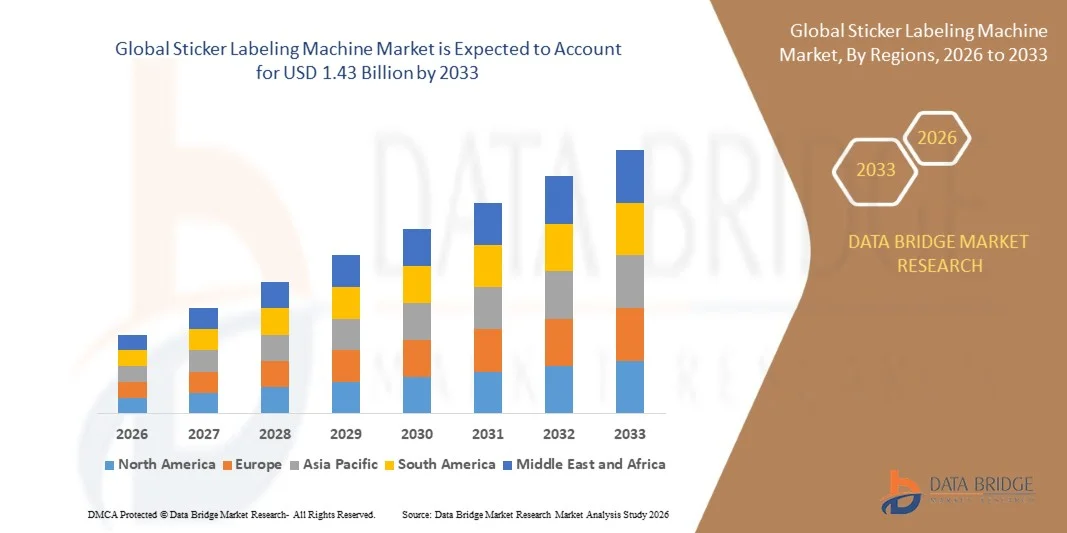
- As per Data Bridge Market Research analysis, the sticker labeling machine market was valued at USD 1.03 billion in 2025 and is projected to reach USD 1.43 billion by 2033, growing at a CAGR of 4.20% from 2026 to 2033.
- The market is experiencing consistent growth driven by rising demand for automated packaging solutions, increasing adoption of labeling automation across food and beverage, pharmaceutical, and cosmetic industries, and growing requirements for accurate, efficient, and traceable product labeling.
- The increasing focus on product traceability and stringent regulatory labeling requirements, combined with the global shift toward factory automation and digitalization, is compelling manufacturers to adopt advanced sticker labeling machines. Automated and high-speed labeling systems are increasingly replacing manual labeling processes, offering improved productivity, precision, operational efficiency, and reduced labor costs across diverse packaging applications
Market Size & Forecast
- Global Market Value (2025): USD 1.03 Billion
- Expected Market Value (2033): USD 1.43 Billion
- Forecast CAGR (2026–2033): 4.20%
- Leading Region in 2025: North America
- Fastest Growing Region: Asia Pacific
What are the Major Takeaways of the Sticker Labeling Machine Market?
- North America dominated the sticker labeling machine market with the largest revenue share of 36.24% in 2025, supported by high demand for automated packaging solutions, advanced manufacturing infrastructure, and substantial consumption of merchandise goods across the region.
- Asia-Pacific is expected to be the fastest-growing region at a CAGR of 6.8% from 2026 to 2033, fueled by rapid industrialization, expanding food and beverage and pharmaceutical manufacturing, increasing packaging automation, and growing adoption of advanced labeling systems
- The automatic segment led the market with a 70.6% share in 2025, driven by their high production capacity, consistent label placement, and reduced dependence on manual labor.
- Semi-automatic are the fastest-growing machine type, projected to register a CAGR of 5.0%, reflecting the surge in demand from small and medium-sized manufacturers and businesses handling lower production volumes.
- The linear labelers segment dominated the structure category with a 60% revenue share in 2025, led by its versatility, comparatively simple configuration, and suitability for a broad range of bottles, cartons, boxes, jars, and other containers
- Bottle accounted for 40% of the market share in 2025, preferred by extensive use of sticker labeling machines across beverages, pharmaceuticals, cosmetics, household products, and other packaged goods.
- The vials and ampules segment is the fastest-growing application category, with a CAGR of 4.8%, driven by increasing pharmaceutical production and the need for highly precise labeling of small containers
Report Scope and Sticker Labeling Machine Market Segmentation
|
Attributes |
Sticker Labeling Machine Key Market Insights |
|
Segments Covered |
|
|
Countries Covered |
North America
Europe
Asia-Pacific
Middle East and Africa
South America
|
|
Key Market Players |
|
|
Market Opportunities |
|
|
Value Added Data Infosets |
In addition to the insights on market scenarios such as market value, growth rate, segmentation, geographical coverage, and major players, the market reports curated by the Data Bridge Market Research also include import export analysis, production capacity overview, production consumption analysis, price trend analysis, climate change scenario, supply chain analysis, value chain analysis, raw material/consumables overview, vendor selection criteria, PESTLE Analysis, Porter Analysis, and regulatory framework. |
What is the Key Trend in the Sticker Labeling Machine Market?
- Manufacturers are increasingly adopting high-speed, flexible, and automated sticker labeling machines to improve labeling accuracy, reduce manual handling, accommodate multiple packaging formats, and increase throughput across food, beverage, pharmaceutical, and consumer-goods production lines.
- For instance, in March 2025, AM Labels introduced an automatic packet feeding system that integrates with its LabelPack Label X JR applicator, automating the feeding and labeling of packets, pouches, cartons, and boxes at speeds of up to 30 meters per minute.
- Modern labeling systems are increasingly incorporating quick-changeover capabilities, automated feeding, intelligent controls, and connectivity, enabling manufacturers to manage diverse SKUs and packaging formats while minimizing production interruptions and improving overall equipment efficiency.
- Sustainability is also becoming increasingly important, with manufacturers developing linerless labeling technologies that can increase label yield, reduce material consumption, and minimize reel changes while supporting efficient packaging operations across beverage, personal-care, and household-product applications.
- For instance, in June 2025, Ravenwood Packaging launched its Nobac 40B Bottle Labeller, capable of applying linerless labels at speeds of up to 75 bottles per minute and providing up to 40% more labels per roll, reducing reel changes and production downtime.
- As manufacturers increasingly prioritize automation, flexibility, sustainability, and production efficiency, adoption of advanced sticker labeling machines is expected to accelerate, reinforcing automated labeling as an essential component of modern high-volume packaging operations.
What are the Key Drivers of the Sticker Labeling Machine Market?
- The rapid expansion of packaged food, beverages, pharmaceuticals, cosmetics, and consumer goods is increasing demand for automated labeling equipment capable of delivering consistent label placement, high throughput, product identification, and reliable packaging-line integration.
- For instance, in July 2025, Fortress Technology announced its Vyper Vision automated label inspection solution, designed to inspect label placement, dates, allergens, ingredients, batch numbers, and barcodes at speeds of up to 200 packs per minute, addressing stringent food-labeling requirements.
- Increasing requirements for product traceability, barcode identification, and supply-chain visibility are encouraging manufacturers to integrate automated labeling systems with coding and data-management technologies, improving accuracy while reducing manual labeling errors across logistics and production operations.
- For instance, in January 2024, Domino Printing Sciences launched its Mx-Series print-and-apply labeling machines, designed for automated, GS1-compliant traceability coding of products and pallets to support growing requirements for accurate logistics labeling and supply-chain data sharing.
- With manufacturers increasingly seeking higher productivity, lower labor requirements, improved traceability, and automated quality control, demand for technologically advanced sticker labeling machines is expected to remain strong across diverse packaging applications.
Which Factors are Challenging the Growth of the Sticker Labeling Machine Market?
- Advanced sticker labeling machines require significant initial capital expenditure because automated feeding systems, precision applicators, conveyors, sensors, vision inspection, coding technologies, and integrated controls increase equipment and installation costs.
- For instance, in February 2025, Packaging Europe reported that Krones’ new Contiroll HS labelling machine incorporates advanced automation and high-speed labeling capabilities, illustrating the increasing technological complexity and investment required for modern automated labeling lines.
- These high investment requirements can limit adoption among small and medium-sized manufacturers, particularly businesses with low production volumes or frequently changing product formats that may find fully automated labeling systems difficult to justify economically.
- The market also faces challenges related to skilled personnel, machine integration, maintenance, and production-line compatibility, as manufacturers may require specialized expertise to install, operate, troubleshoot, and integrate automated labeling equipment with existing packaging systems.
- For instance, in October 2024, Sidel introduced its EvoDECO Multi labelling machine with automated changeover capabilities, highlighting the sophisticated equipment and integration requirements manufacturers face when upgrading to flexible, high-performance labeling systems.
- These capital, integration, maintenance, and workforce challenges can slow the adoption of advanced sticker labeling machines, particularly among smaller manufacturers and businesses operating in price-sensitive markets despite the productivity benefits offered by automated labeling technologies.
How is the Sticker Labeling Machine Market Segmented?
The sticker labeling machine market is segmented on the basis of machine type, structure, application, and end-use.
- By Machine Type
On the basis of machine type, the sticker labeling machine market is segmented into automatic and semi-automatic machines. The automatic sticker labeling machines segment dominated the market with 70.6% share in 2025, owing to their high production capacity, consistent label placement, and reduced dependence on manual labor. These machines are widely deployed across high-volume food and beverage, pharmaceutical, cosmetic, and consumer-goods packaging operations. Their ability to integrate with conveyors, filling systems, coding equipment, and inspection systems further improves packaging-line efficiency. Automatic systems also support precise labeling at high speeds while reducing human errors and product handling. Increasing labor costs and the broader shift toward packaging automation are encouraging manufacturers to replace manual and semi-automated processes.
The semi-automatic sticker labeling machines segment is projected to register the fastest growth at CAGR of 5.0% from 2026 to 2033, supported by demand from small and medium-sized manufacturers and businesses handling lower production volumes. These machines provide a balance between manual operation and automated label application, reducing labor requirements without requiring the capital investment associated with fully automatic systems. They are particularly suitable for small-batch production, multiple SKUs, and applications requiring frequent product changes. Their compact designs and relatively simple operation also make them easier to install and operate. Growing manufacturing activity in emerging markets is creating additional demand for affordable automation solutions
- By Structure
On the basis of structure, the sticker labeling machine market is segmented into linear labelers and rotary labelers. The linear labelers segment dominated the market with 60% share in 2025, supported by its versatility, comparatively simple configuration, and suitability for a broad range of bottles, cartons, boxes, jars, and other containers. Linear systems move products sequentially along a conveyor while labels are applied at designated points, making them suitable for diverse packaging operations. Their relatively straightforward installation and integration make them attractive to manufacturers seeking flexible labeling solutions. They can accommodate different product sizes and shapes with appropriate change parts and adjustments. Linear machines are also widely used where production volumes do not require the extremely high throughput of rotary systems.
The rotary labelers segment is projected to register the fastest growth at CAGR of 5.2% from 2026 to 2033, driven by increasing demand for high-speed labeling in large-scale manufacturing operations. Rotary systems use rotating platforms or carousels to continuously position products for labeling, enabling high throughput and consistent application accuracy. They are particularly suited to high-volume bottling and packaging lines where minimizing cycle time is critical. Increasing production volumes in food and beverage, pharmaceutical, and consumer-product manufacturing are creating demand for high-speed rotary equipment. Technological improvements in servo drives, sensors, and automated changeover systems are further enhancing rotary-machine flexibility and productivity.
- By Application
On the basis of application, the sticker labeling machine market is segmented into vials and ampules, carton, box, jar, pouch, bottle, and others. The bottle segment dominated the application category with 40% share in 2025, supported by extensive use of sticker labeling machines across beverages, pharmaceuticals, cosmetics, household products, and other packaged goods. Bottles require accurate label positioning for branding, product information, regulatory details, barcodes, and traceability information. The large global production volume of bottled products creates substantial demand for automated labeling equipment. Sticker labeling machines can accommodate round, oval, and other bottle geometries through appropriate handling and labeling configurations. Increasing demand for packaged beverages, personal-care products, and pharmaceutical bottles is further supporting the segment.
The vials and ampules segment is projected to register the fastest growth at CAGR of 4.8% from 2026 to 2033, driven by increasing pharmaceutical production and the need for highly precise labeling of small containers. Pharmaceutical vials and ampules require accurate application of product information, batch numbers, expiration dates, barcodes, and other regulatory information. Automated labeling reduces the risk of positioning errors and improves consistency in high-value pharmaceutical packaging. Rising demand for injectable medicines, vaccines, biologics, and other sterile pharmaceutical products is increasing the need for specialized labeling systems. Advanced machines can handle small cylindrical containers while maintaining precise label placement and minimizing product damage.
- By End-Use
On the basis of end-use, the sticker labeling machine market is segmented into pharmaceuticals, food and beverages, chemical and petrochemicals, industrial packaging, shipping and logistics, retail, and others. The food and beverages segment dominated the market with 40.5% share in 2025, driven by high production volumes and the widespread requirement for accurate labeling of packaged foods and beverages. Manufacturers use sticker labeling machines for bottles, jars, cartons, pouches, cans, and other food-packaging formats. Increasing consumption of packaged and branded food products is generating sustained demand for automated labeling equipment. Food manufacturers also require labels containing ingredients, nutritional information, allergens, barcodes, and other regulatory information. High-speed automated labeling enables producers to maintain throughput while achieving consistent label placement.
The pharmaceuticals segment is projected to witness the fastest growth at a CAGR of 6.0% from 2026 to 2033, supported by increasing pharmaceutical manufacturing and stringent requirements for product identification and traceability. Pharmaceutical packaging requires highly accurate labels containing dosage information, batch numbers, expiration dates, barcodes, and serialization data. Automated sticker labeling machines help manufacturers achieve consistent placement while reducing manual errors in regulated production environments. Rising demand for injectable drugs, vaccines, biologics, and other packaged medicines is further increasing the need for specialized labeling solutions. Integration with vision inspection, coding, serialization, and track-and-trace systems is enhancing the value of automated pharmaceutical labeling equipment.
Which Region Holds the Largest Share of the Sticker Labeling Machine Market?
- North America dominated the sticker labeling machine market with the largest revenue share of 36.24% in 2025, supported by high demand for automated packaging solutions, advanced manufacturing infrastructure, and substantial consumption of merchandise goods across the region.
- The region also benefits from stringent labeling and traceability requirements, widespread use of automated packaging equipment, and strong demand from pharmaceutical, food and beverage, and industrial packaging applications. Increasing investments in smart manufacturing, e-commerce fulfillment, and integrated labeling technologies continue to strengthen North America’s position in the global market.
U.S. Sticker Labeling Machine Market Insight
The U.S. sticker labeling machine market is witnessing strong growth due to rising investments in automated packaging systems, pharmaceutical traceability, and advanced labeling technologies. The country’s mature food and beverage, pharmaceutical, consumer goods, and logistics industries, along with increasing adoption of automated and connected labeling equipment, is driving demand across multiple applications. In addition, growing emphasis on accurate product identification, regulatory compliance, and efficient packaging operations is accelerating the adoption of sticker labeling machines across manufacturers.
Asia-Pacific Sticker Labeling Machine Market Insight
The Asia-Pacific sticker labeling machine market is expected to witness rapid growth, driven by expanding manufacturing activities, increasing packaged food and beverage production, and rising investments in automated packaging infrastructure across countries such as China, India, and Japan. Growing adoption of high-speed and flexible labeling technologies, rising pharmaceutical production, and increasing demand for efficient packaging solutions are supporting regional market expansion. In addition, the region’s expanding export manufacturing base and growing automation ecosystem are accelerating sticker labeling machine adoption across industrial sectors.
Japan Sticker Labeling Machine Market Insight
The Japan sticker labeling machine market is witnessing consistent growth due to rising investments in advanced packaging automation, pharmaceutical manufacturing, and precision labeling technologies. Food and beverage manufacturers, pharmaceutical companies, and industrial producers are increasingly adopting automated labeling systems to improve operational efficiency, labeling accuracy, and product presentation. Moreover, increasing adoption of sustainable labeling solutions and the country’s focus on advanced manufacturing technologies are further contributing to market growth.
China Sticker Labeling Machine Market Insight
The China sticker labeling machine market is growing rapidly, driven by expanding manufacturing activities, increasing packaged food and beverage production, and rising pharmaceutical and consumer goods output. Growing adoption of automated and high-speed labeling systems across manufacturing and packaging facilities is significantly boosting market demand. In addition, increasing investments in pharmaceutical serialization, product traceability, e-commerce packaging, and export-oriented manufacturing are positioning China as one of the fastest-growing markets for sticker labeling machines globally.
U.K. Sticker Labeling Machine Market Insight
The U.K. sticker labeling machine market is experiencing steady growth, supported by rising adoption of automated labeling technologies in food and beverage, pharmaceutical, consumer goods, and logistics applications. Increasing investments in efficient packaging infrastructure and growing demand for accurate, flexible, and cost-effective labeling solutions are contributing to market growth. Furthermore, integration of automation, traceability, and advanced control technologies is improving labeling efficiency and supporting the modernization of packaging operations across the U.K.
Germany Sticker Labeling Machine Market Insight
The Germany sticker labeling machine market is expanding steadily due to the country’s strong manufacturing base, advanced packaging machinery ecosystem, and increasing adoption of next-generation automation technologies. Food and beverage manufacturers, pharmaceutical companies, and industrial producers are increasingly utilizing automated labeling systems for product identification, packaging efficiency, and regulatory compliance. Continuous advancements in flexible labeling equipment, automation, and sustainable packaging technologies, along with Germany’s strong industrial innovation capabilities, are further driving market growth in the country.
Which are the Top Companies in Sticker Labeling Machine Market?
The sticker labeling machine industry is primarily led by well-established companies, including:
- HERMA GmbH (Germany)
- Pack Leader Machinery Inc. (Taiwan)
- Accutek Packaging Company, Inc. (U.S.)
- Ketan Automated Equipment, Inc. (U.S.)
- Label-Aire, Inc. (U.S.)
- Quadrel Labeling Systems, Inc. (U.S.)
- Nita Labeling Equipment Inc. (Canada)
- Newman Labelling Systems Ltd. (U.K.)
- Etipack S.p.A. (Italy)
- ALTECH S.r.l. (Italy)
- CDA S.A.S. (France)
- Krones AG (Germany)
- KHS GmbH (Germany)
- SACMI Cooperativa Meccanici Imola S.C. (Italy)
- Marchesini Group S.p.A. (Italy)
- Pro Mach, Inc. (U.S.)
- Shemesh Automation (Israel)
- IMA S.p.A. (Italy)
- Coesia S.p.A. (Italy)
- ACG Worldwide (India)
What are Latest Developments in Sticker Labeling Machine Market?
- In June 2025, Ravenwood Packaging launched the Nobac 40B Bottle Labeller, an entry-level linerless labeling machine designed to expand sustainable labeling applications for bottles. The airless system uses Ravenwood’s linerless technology and is designed to provide efficient labeling across a range of bottle formats. The launch expands Ravenwood’s Nobac 40 portfolio and supports growing demand for linerless solutions that reduce packaging waste while maintaining labeling efficiency.
- In July 2024, Videojet Technologies introduced the Videojet 9560 print-and-apply labeling system, an upgraded labeling solution designed for cases, boxes, and shrink wrap applications. The system incorporates Intelligent Motion technology, expanded connectivity, and a design intended to reduce manual adjustments and label jams. The launch highlights the growing integration of automation, connectivity, and precision into end-of-line labeling operations.
- In September 2023, Ravenwood Packaging unveiled the Nobac 1500 and Nobac 40 Vac linerless labeling machines at Labelexpo Europe 2023. The new machines were developed to provide flexible linerless labeling for packaging applications, including top and base labeling of trays. Their introduction demonstrated the industry's increasing focus on linerless technology, flexible machine configurations, and packaging solutions designed to reduce material waste.
- In September 2022, WLS, a ProMach product brand, introduced its VVM label applicator for applying temperature-sensitive vaccine vial monitor labels. The new applicator was designed for installation on WLS labeling systems and provided accurate placement and rapid changeovers for pharmaceutical and healthcare applications. The development addressed the need for reliable labeling of temperature-sensitive products and demonstrated the increasing specialization of labeling equipment for pharmaceutical packaging.
- In March 2021, HERMA US introduced continuous labeling capabilities for its 132M HC wrap-around labeler, using the new EasySplicer and EasyCutter modules. The retrofit solution enabled label and backing-paper reels to be changed without stopping the labeling machine, supporting continuous operation for high-volume pharmaceutical and healthcare applications. The development was particularly relevant to vaccine production and demonstrated how labeling equipment manufacturers were improving machine uptime and production continuity.

- Interactive Data Analysis Dashboard
- Company Analysis Dashboard for high growth potential opportunities
- Research Analyst Access for customization & queries
- Competitor Analysis with Interactive dashboard
- Latest News, Updates & Trend analysis
- Harness the Power of Benchmark Analysis for Comprehensive Competitor Tracking
Global Sticker Labeling Machine Market, Supply Chain Analysis and Ecosystem Framework
To support market growth and help clients navigate the impact of geopolitical shifts, DBMR has integrated in-depth supply chain analysis into its Global Sticker Labeling Machine Market research reports. This addition empowers clients to respond effectively to global changes affecting their industries. The supply chain analysis section includes detailed insights such as Global Sticker Labeling Machine Market consumption and production by country, price trend analysis, the impact of tariffs and geopolitical developments, and import and export trends by country and HSN code. It also highlights major suppliers with data on production capacity and company profiles, as well as key importers and exporters. In addition to research, DBMR offers specialized supply chain consulting services backed by over a decade of experience, providing solutions like supplier discovery, supplier risk assessment, price trend analysis, impact evaluation of inflation and trade route changes, and comprehensive market trend analysis.
Data collection and base year analysis are done using data collection modules with large sample sizes. The stage includes obtaining market information or related data through various sources and strategies. It includes examining and planning all the data acquired from the past in advance. It likewise envelops the examination of information inconsistencies seen across different information sources. The market data is analysed and estimated using market statistical and coherent models. Also, market share analysis and key trend analysis are the major success factors in the market report. To know more, please request an analyst call or drop down your inquiry.
The key research methodology used by DBMR research team is data triangulation which involves data mining, analysis of the impact of data variables on the market and primary (industry expert) validation. Data models include Vendor Positioning Grid, Market Time Line Analysis, Market Overview and Guide, Company Positioning Grid, Patent Analysis, Pricing Analysis, Company Market Share Analysis, Standards of Measurement, Global versus Regional and Vendor Share Analysis. To know more about the research methodology, drop in an inquiry to speak to our industry experts.
Data Bridge Market Research is a leader in advanced formative research. We take pride in servicing our existing and new customers with data and analysis that match and suits their goal. The report can be customized to include price trend analysis of target brands understanding the market for additional countries (ask for the list of countries), clinical trial results data, literature review, refurbished market and product base analysis. Market analysis of target competitors can be analyzed from technology-based analysis to market portfolio strategies. We can add as many competitors that you require data about in the format and data style you are looking for. Our team of analysts can also provide you data in crude raw excel files pivot tables (Fact book) or can assist you in creating presentations from the data sets available in the report.













