


What is the Strategy Management Software Market Size and Growth Rate?
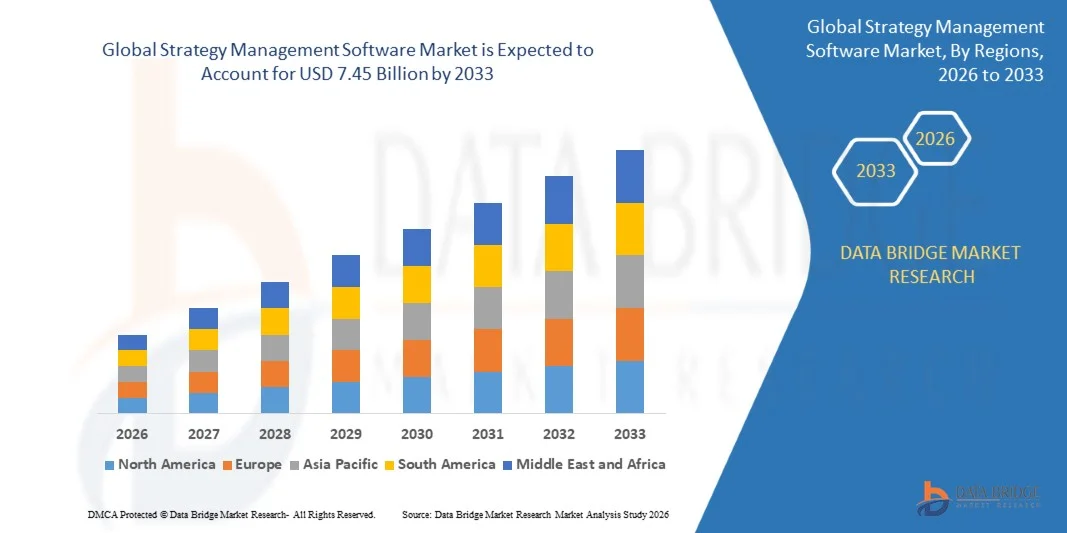
- As per Data Bridge Market Research analysis, the strategy management software market was valued at USD 2.74 billion in 2025 and is projected to reach USD 7.45 billion by 2033, growing at a CAGR of 13.30% from 2026 to 2033.
- The market is expanding rapidly as organizations move away from spreadsheet-based strategic planning toward dedicated software that cascades goals, tracks objectives and key results (OKRs) or balanced scorecards, and gives leadership real-time visibility into whether strategy is actually being executed.
- The rapid integration of generative AI and agentic AI assistants into strategy execution platforms is accelerating this shift further, as vendors compete to automate routine reporting, surface execution risks earlier, and give managers an always-on digital partner for driving strategic priorities into day-to-day work.
Market Size & Forecast
- Global Market Value (2025): USD 2.74 Billion
- Expected Market Value (2033): USD 7.45 Billion
- Forecast CAGR (2026–2033): 13.30%
- Leading Region in 2025: North America
- Fastest Growing Region: Asia-Pacific
What are the Major Takeaways of the Strategy Management Software Market?
- North America dominated the global strategy management software market with the largest revenue share of 39.62% in 2025, supported by high enterprise software adoption rates, strong presence of leading vendors, and rapid uptake of AI-enabled strategy execution platforms among large enterprises.
- Asia-Pacific is expected to be the fastest-growing region at a CAGR of 15.8% from 2026 to 2033, driven by rapid digital transformation among enterprises in China, India, and Japan, and growing adoption of cloud-based strategy management platforms by expanding regional businesses.
- The software segment led the market with a 74.36% share in 2025, driven by increasing enterprise adoption of dedicated strategic planning, OKR, and balanced scorecard platforms in place of spreadsheet-based processes.
- The services segment is the fastest-growing component category, projected to register a CAGR of 14.9%, reflecting rising demand for implementation, training, and AI-configuration consulting as organizations roll out more sophisticated strategy execution platforms.
- Large enterprises accounted for 61.84% of the market share in 2025, driven by their greater budget capacity for enterprise-wide strategy execution platforms spanning multiple business units and geographies.
- The small and medium-sized enterprises (SMEs) segment is the fastest-growing organization size category, with a CAGR of 15.4%, as lower-cost cloud-based OKR and strategy tools make dedicated software accessible to smaller organizations for the first time.
- The BFSI vertical dominated the market with a 22.75% revenue share in 2025, owing to the sector's need for rigorous strategic planning and performance tracking amid evolving regulatory and competitive pressures.
Report Scope and Strategy Management Software Market Segmentation
|
Attributes |
Strategy Management Software Market Key Market Insights |
|
Segments Covered |
|
|
Countries Covered |
North America
Europe
Asia-Pacific
Middle East and Africa
South America
|
|
Key Market Players |
|
|
Market Opportunities |
|
|
Value Added Data Infosets |
In addition to the market insights such as market value, growth rate, market segments, geographical coverage, market players, and market scenario, the market report curated by the Data Bridge Market Research team includes in-depth expert analysis, import/export analysis, pricing analysis, production consumption analysis, and pestle analysis. |
What is the Key Trend in the Strategy Management Software Market?
- Vendors are rapidly moving beyond dashboards and static reporting toward AI agents that actively assist strategy teams with drafting updates, flagging execution risks, and coaching managers.
- For instance, in May 2025, WorkBoard announced general availability of its Digital Chief of Staff and Leadership Coach AI agents, which use knowledge of company strategy and team objectives to help managers with alignment, accountability, and coaching, alongside expanded integration with Microsoft 365 Copilot.
- Established platforms are similarly embedding AI copilots directly into everyday planning and reporting workflows rather than offering them as separate add-on modules.
- As these AI-native capabilities mature, strategy management software is evolving from a passive reporting tool into an active participant in an organization's day-to-day strategic decision-making.
What are the Key Drivers of the Strategy Management Software Market?
- Organizations are increasingly replacing spreadsheet-based strategic planning with dedicated software that gives leadership real-time visibility into whether strategy is actually being executed across business units.
- For instance, in July 2025, Planview reported expanded AI capabilities across its Connected Work platform, including its AI-powered assistant Planview Copilot, which delivers proactive insights and personalized recommendations to help teams make informed decisions and adapt to changes in real time.
- Consolidation among strategy execution vendors is also expanding platform capabilities and accelerating enterprise adoption of unified strategy-to-execution systems.
- For instance, in the second quarter of 2025, WorkBoard acquired Quantive Inc., with 40 large enterprise customers migrating to the WorkBoardAI platform following the acquisition, reinforcing WorkBoard's position as a leading enterprise strategy execution and OKR platform.
- As executive urgency to demonstrate measurable strategy execution grows amid a fast-changing business environment, enterprises across industries are expected to continue increasing investment in dedicated strategy management software.
Which Factors are Challenging the Growth of the Strategy Management Software Market?
- Successfully deploying strategy management software requires significant organizational change management, as it often means replacing deeply embedded spreadsheet-based planning habits across many teams.
- Enterprise-wide platforms can involve substantial licensing and implementation costs, which continues to limit adoption among smaller organizations despite the emergence of lower-cost cloud alternatives.
- For instance, ClearPoint Strategy's introduction of new customizable dashboards and Microsoft Teams integration in January 2024 illustrates the continuous feature investment vendors must sustain to keep pace with evolving customer expectations for AI-enhanced strategy execution tools.
- Ensuring the accuracy and trustworthiness of AI-generated strategic insights and recommendations remains an ongoing challenge for vendors, as executives require a high degree of confidence before acting on AI-surfaced risks or suggestions.
How is the Strategy Management Software Market Segmented?
The strategy management software market is segmented on the basis of component, deployment mode, organization size, vertical, application.
- By Component
On the basis of component, the global strategy management software market is segmented into Software, Services. The software segment dominated the market with a share of 74.36% in 2025 due to enterprises are increasingly replacing spreadsheet-based strategic planning with dedicated software that cascades goals and tracks execution in real time. Additionally, continued feature expansion, including built-in AI analysis and reporting automation, is reinforcing software's central role in strategy management purchases.
The services segment is expected to witness the fastest CAGR of 14.9% from 2026 to 2033, driven by rising demand for implementation, training, and change-management support is growing as organizations roll out enterprise-wide strategy execution platforms. Additionally, the growing complexity of configuring AI-powered strategy assistants is increasing demand for specialized consulting and onboarding services.
- By Deployment mode
On the basis of deployment mode, the global strategy management software market is segmented into Cloud, On-Premises. The on-premises segment dominated the market with a share of 43.28% in 2025 due to large enterprises in regulated industries such as BFSI and government continue to rely on on-premises deployments to meet strict data residency and security requirements. Additionally, established on-premises strategy management installations in large organizations are being renewed and upgraded rather than replaced outright.
The cloud segment is expected to witness the fastest CAGR of 15.6% from 2026 to 2033, driven by cloud-based strategy management platforms offer lower upfront costs, faster deployment, and easier scaling, making them increasingly attractive to organizations of all sizes. Additionally, growing enterprise comfort with cloud-hosted business software following broader SaaS adoption is accelerating migration away from on-premises strategy tools.
- By Organization size
On the basis of organization size, the global strategy management software market is segmented into Small & Medium-Sized Enterprises (SMEs), Large Enterprises. The large enterprises segment dominated the market with a share of 61.84% in 2025 due to large enterprises typically have greater budget capacity and more complex, multi-business-unit strategic planning needs that justify investment in dedicated enterprise-wide platforms. Additionally, large organizations are also the primary adopters of advanced AI agent features such as automated chief-of-staff and leadership-coach assistants.
The small & medium-sized enterprises (SMEs) segment is expected to witness the fastest CAGR of 15.4% from 2026 to 2033, driven by the availability of lower-cost, cloud-based OKR and strategy tools with free or low-tier plans is making dedicated strategy management software accessible to smaller organizations for the first time. Additionally, growing competitive pressure is pushing SMEs to formalize strategic planning processes that were previously managed informally or through spreadsheets.
- By Vertical
On the basis of vertical, the global strategy management software market is segmented into BFSI, IT & Telecom, Healthcare, Retail, Manufacturing, Others. The BFSI segment dominated the market with a share of 22.75% in 2025 due to banks, insurers, and financial services firms require rigorous strategic planning and performance tracking to navigate evolving regulatory requirements and competitive pressure. Additionally, the sector's long history of using balanced scorecard methodologies gives it a natural fit with dedicated strategy management software.
The IT & telecom segment is expected to witness the fastest CAGR of 15.9% from 2026 to 2033, driven by IT and telecom companies operating in fast-moving, technology-driven markets are increasingly adopting strategy execution software to keep pace with rapidly shifting competitive priorities. Additionally, the sector's high existing familiarity with SaaS tools is accelerating adoption of cloud-based strategy management platforms.
- By Application
On the basis of application, the global strategy management software market is segmented into Strategic Planning, Performance Management, Scorecarding & KPI Tracking, Portfolio & Roadmap Management. The strategic planning segment dominated the market with a share of 34.62% in 2025 due to strategic planning remains the foundational use case for the software category, as organizations use it to define, cascade, and communicate top-level objectives across the enterprise. Additionally, growing integration of AI-assisted plan drafting is reinforcing strategic planning as the anchor application within broader strategy management platforms.
The scorecarding & KPI tracking segment is expected to witness the fastest CAGR of 15.2% from 2026 to 2033, driven by rising demand for real-time, AI-analyzed scorecards is allowing leaders to track execution progress more continuously rather than through periodic manual reporting. Additionally, growing integration between scorecarding tools and everyday collaboration platforms, such as Microsoft Teams, is embedding KPI tracking into daily workflows.
Which Region Holds the Largest Share of the Strategy Management Software Market?
- North America dominated the global strategy management software market with the largest revenue share of 39.62% in 2025, supported by high enterprise software adoption rates, strong presence of leading vendors, and rapid uptake of AI-enabled strategy execution platforms among large enterprises.
- Asia-Pacific is expected to be the fastest-growing region at a CAGR of 15.8% from 2026 to 2033, driven by rapid digital transformation among enterprises in China, India, and Japan, and growing adoption of cloud-based strategy management platforms by expanding regional businesses.
U.S. Strategy Management Software Market Insight
The U.S. strategy management software market is expanding steadily, supported by a high concentration of leading vendors and rapid enterprise adoption of AI-enabled strategy execution platforms. Continued investment in agentic AI features, such as digital chief-of-staff assistants, is further strengthening the country's leadership position.
Germany Strategy Management Software Market Insight
The Germany strategy management software market is growing steadily, underpinned by strong enterprise software adoption among the country's large industrial and financial services companies. Continued innovation from European vendors is reinforcing Germany's position as a key hub for enterprise strategy management software in Europe.
Asia-Pacific Strategy Management Software Market Insight
The Asia-Pacific strategy management software market is expected to witness rapid growth, driven by rapid digital transformation among enterprises in China, India, and Japan and growing adoption of cloud-based strategy management platforms by expanding regional businesses. Increasing regional investment in enterprise software infrastructure is further accelerating adoption.
India Strategy Management Software Market Insight
The India strategy management software market is growing at a healthy pace, supported by a rapidly expanding enterprise software sector and rising adoption of cloud-based OKR and strategic planning tools among fast-growing domestic businesses. Growing availability of lower-cost, cloud-native strategy platforms is further contributing to market growth in India.
China Strategy Management Software Market Insight
The China strategy management software market is expanding rapidly, driven by rising enterprise digital transformation investment and growing domestic demand for structured strategic planning and performance management tools. Rising investment by domestic software vendors in AI-enabled strategy platforms is further supporting regional market growth.
Which are the Top Companies in the Strategy Management Software Market?
The strategy management software market is primarily led by well-established companies, including:
- SAP SE (Germany)
- IBM Corporation (U.S.)
- Oracle Corporation (U.S.)
- Planview, Inc. (U.S.)
- Anaplan, Inc. (U.S.)
- Planful, Inc. (U.S.)
- ClearPoint Strategy, Inc. (U.S.)
- Workboard, Inc. (U.S.)
- Cascade Strategy (New Zealand)
- SAS Institute Inc. (U.S.)
- Workday, Inc. (U.S.)
- Tability (Australia)
- Perdoo GmbH (Germany)
- Betterworks Systems, Inc. (U.S.)
- AchieveIt, Inc. (U.S.)
- Quantive (Bulgaria)
- Spider Strategies (U.S.)
- Board International S.A. (Switzerland)
- OnStrategy (U.S.)
- Corporater AS (Norway)
What are Latest Developments in the Strategy Management Software Market?
- In September 2025, WorkBoard reported record first-half 2025 growth, with year-over-year sales rising 30% and strong adoption of its new AI agents, following its acquisition of Quantive Inc. and expanded partnerships with Workday and Microsoft.
- In May 2025, WorkBoard announced general availability of its Digital Chief of Staff and Leadership Coach AI agents, alongside expanded functionality in its Microsoft 365 Copilot agent, marking a broader integration with next-generation agentic ecosystems from Microsoft and Workday.
- In the second quarter of 2025, WorkBoard acquired Quantive Inc., with 40 large enterprise customers migrating to the WorkBoardAI platform following the acquisition, consolidating expertise and accelerating innovation in the enterprise strategy execution and OKR category.
- In the first half of 2025, Planview expanded AI capabilities across its Connected Work platform, including its AI-powered assistant Planview Copilot, which received a DEVOPS Tech Ascension Award for Best AI/ML-Powered Solution and was named a Leader in The Forrester Wave for Value Stream Management Solutions.
- In January 2024, ClearPoint Strategy introduced customizable public-facing dashboards and enhanced AI analysis capabilities, alongside integration with Microsoft Teams, allowing organizations to share strategic plans and progress with stakeholders and interact with the platform through familiar collaboration tools.

- Interactive Data Analysis Dashboard
- Company Analysis Dashboard for high growth potential opportunities
- Research Analyst Access for customization & queries
- Competitor Analysis with Interactive dashboard
- Latest News, Updates & Trend analysis
- Harness the Power of Benchmark Analysis for Comprehensive Competitor Tracking
Data collection and base year analysis are done using data collection modules with large sample sizes. The stage includes obtaining market information or related data through various sources and strategies. It includes examining and planning all the data acquired from the past in advance. It likewise envelops the examination of information inconsistencies seen across different information sources. The market data is analysed and estimated using market statistical and coherent models. Also, market share analysis and key trend analysis are the major success factors in the market report. To know more, please request an analyst call or drop down your inquiry.
The key research methodology used by DBMR research team is data triangulation which involves data mining, analysis of the impact of data variables on the market and primary (industry expert) validation. Data models include Vendor Positioning Grid, Market Time Line Analysis, Market Overview and Guide, Company Positioning Grid, Patent Analysis, Pricing Analysis, Company Market Share Analysis, Standards of Measurement, Global versus Regional and Vendor Share Analysis. To know more about the research methodology, drop in an inquiry to speak to our industry experts.
Data Bridge Market Research is a leader in advanced formative research. We take pride in servicing our existing and new customers with data and analysis that match and suits their goal. The report can be customized to include price trend analysis of target brands understanding the market for additional countries (ask for the list of countries), clinical trial results data, literature review, refurbished market and product base analysis. Market analysis of target competitors can be analyzed from technology-based analysis to market portfolio strategies. We can add as many competitors that you require data about in the format and data style you are looking for. Our team of analysts can also provide you data in crude raw excel files pivot tables (Fact book) or can assist you in creating presentations from the data sets available in the report.













