What is the Structural Insulated Panel Market Size and Growth Rate?
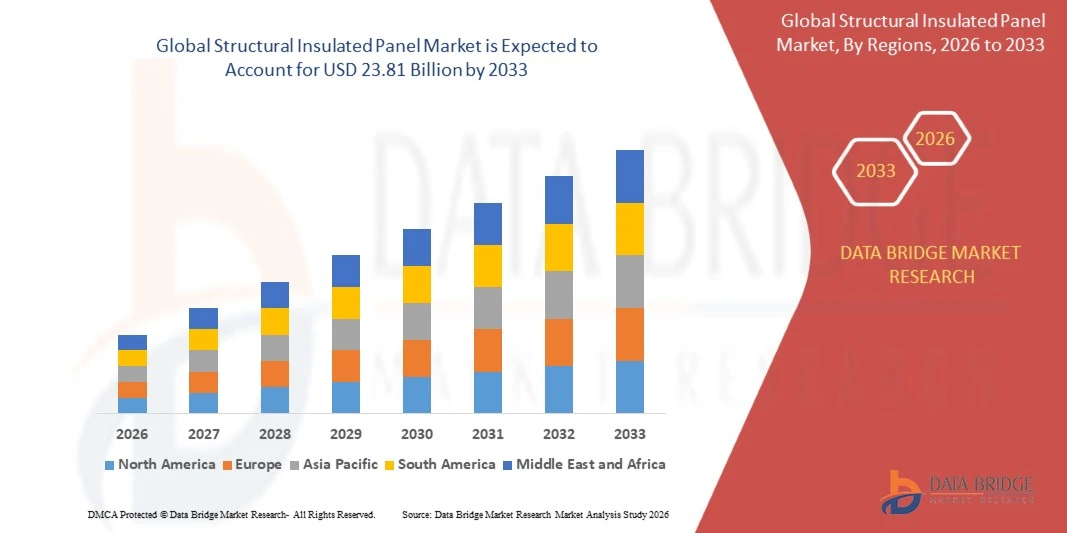
- As per Data Bridge Market Research analysis, the structural insulated panel market was valued at USD 14.94 billion in 2025 and is projected to reach USD 23.81 billion by 2033, growing at a CAGR of 6.00% from 2026 to 2033.
- The market is experiencing consistent growth driven by rising demand for energy-efficient building materials, increasing adoption of sustainable construction practices, and expanding applications across residential, commercial, and industrial construction.
- The growing emphasis on reducing energy consumption in buildings, combined with stricter energy-efficiency standards and green building initiatives, is encouraging construction companies, developers, and homeowners to adopt structural insulated panels. These panels are increasingly used as an alternative to conventional building materials, offering improved thermal insulation, faster construction, reduced energy costs, and enhanced structural performance.
Market Size & Forecast
- Global Market Value (2025): USD 14.94 Billion
- Expected Market Value (2033): USD 23.81 Billion
- Forecast CAGR (2026–2033): 6.00%
- Leading Region in 2025: North America
- Fastest Growing Region: Asia Pacific
What are the Major Takeaways of the Structural Insulated Panel Market?
- North America dominated the structural insulated panel market with the largest revenue share of 38.0% in 2025, supported by growing demand for energy-efficient buildings, advanced construction technologies, and stringent building energy codes.
- Asia-Pacific is expected to be the fastest-growing region at a CAGR of 7.5% from 2026 to 2033, fueled by rapid urbanization, increasing residential and commercial construction, and rising investments in sustainable building infrastructure across China, India, and Japan.
- The expanded polystyrene (EPS) panel segment led the market with a 60.0% share in 2025, driven by its cost-effectiveness, lightweight structure, and reliable thermal insulation properties.
- PU/PIR are the fastest-growing product type, projected to register a CAGR of 7.5%, reflecting the surge in demand for high-performance insulation materials in energy-efficient buildings.
- The OSB two sides segment dominated the skin type category with a 75.0% revenue share in 2025, led by its widespread use in conventional structural insulated panel construction.
- Walls accounted for 55.0% of the market share in 2025, preferred by the extensive use of insulated panels in exterior and interior building wall assemblies.
- The roofs segment is the fastest-growing application category, with a CAGR of 7.0%, driven by increasing demand for energy-efficient roofing systems and improved building-envelope performance.
Report Scope and Structural Insulated Panel Market Segmentation
|
Attributes |
Structural Insulated Panel Key Market Insights |
|
Segments Covered |
|
|
Countries Covered |
North America
Europe
Asia-Pacific
Middle East and Africa
South America
|
|
Key Market Players |
|
|
Market Opportunities |
|
|
Value Added Data Infosets |
In addition to the insights on market scenarios such as market value, growth rate, segmentation, geographical coverage, and major players, the market reports curated by the Data Bridge Market Research also include import export analysis, production capacity overview, production consumption analysis, price trend analysis, climate change scenario, supply chain analysis, value chain analysis, raw material/consumables overview, vendor selection criteria, PESTLE Analysis, Porter Analysis, and regulatory framework. |
What is the Key Trend in the Structural Insulated Panel Market?
- Construction companies are increasingly adopting structural insulated panels to improve building energy efficiency, reduce construction time, and support sustainable building practices across residential and commercial projects.
- For instance, in September 2024, Hemsec reported that a new community hub in Newcastle, U.K., was constructed using 2,200 m² of 175 mm structural insulated panels, with a predicted airtightness of 2.0 m³/(h·m²) at 50 Pa, highlighting the use of SIPs to improve thermal efficiency and accelerate commercial construction.
- Growing demand for high-performance building envelopes is encouraging manufacturers to develop structural insulated panels with improved thermal resistance, airtightness, and compatibility with prefabricated construction methods.
- Structural insulated panels combine structural facings with an insulating core, helping reduce heat transfer and supporting energy-efficient building design.
- Builders and developers are increasingly incorporating prefabricated panel systems into projects to minimize material waste, improve construction consistency, and reduce dependence on labor-intensive on-site processes.
- For instance, in March 2025, the Structural Insulated Panel Association reported that the SIP industry had finalized its first industry-wide Environmental Product Declaration (EPD), providing third-party-verified lifecycle environmental data to help architects, builders, and developers evaluate SIPs for energy-efficient and lower-impact construction.
- As construction stakeholders continue prioritizing energy efficiency, faster project delivery, and lower operational energy consumption, structural insulated panels are gaining relevance as a building-envelope solution for modern construction.
What are the Key Drivers of the Structural Insulated Panel Market?
- The growing emphasis on energy-efficient buildings and reduced heating and cooling consumption has significantly increased demand for structural insulated panels that provide continuous insulation and airtight building envelopes.
- For instance, in February 2024, the U.S. Department of Energy announced funding of USD 1,499,962 for Rensselaer Polytechnic Institute’s Hemp Retrofit SIPS project, which aims to develop a hemp-based insulated cladding system targeting 15–25% HVAC energy savings in residential building retrofits, supporting demand for energy-efficient building-envelope solutions
- Construction companies, architects, and developers are integrating prefabricated building systems into project designs to reduce on-site labor requirements, accelerate construction schedules, and improve building-envelope consistency.
- For instance, in March 2023, the U.S. Department of Energy announced USD 5 million in funding for Syracuse University’s integrated building-efficiency retrofit project, which combines highly insulated prefabricated envelope panels with integrated high-efficiency mechanical systems to improve energy performance in student residential buildings
- With construction industries increasingly prioritizing energy performance, prefabrication, and faster project completion, structural insulated panels are becoming an important solution for modern building design and construction.
What Factors are Challenging the Growth of the Structural Insulated Panel Market?
- Structural insulated panels can require higher upfront material costs than some conventional framing systems, creating financial challenges for builders and developers working with limited construction budgets.
- For instance, in August 2024, a study published in Energies examining challenges associated with exterior insulated panels for residential energy retrofits, identifying cost, architectural diversity, structural considerations, moisture resilience, and air- and water-sealing requirements as important technical risks.
- These initial costs, along with specialized installation requirements and the need for experienced contractors, can limit adoption among smaller construction firms and builders in price-sensitive markets.
- In addition, transporting large prefabricated panels, coordinating building designs, and ensuring appropriate moisture control and airtight connections can increase project complexity, particularly where experienced installers and established supply chains are limited.
- For instance, in April 2022, a study published in Sustainability examined barriers to off-site construction in India and identified initial capital requirements, storage and transportation difficulties, supply-chain weaknesses, and shortages of skilled workers as major implementation challenges.
- The upfront cost considerations, specialized installation needs, and coordination requirements associated with structural insulated panels continue to challenge adoption among budget-conscious builders and smaller construction companies, despite their potential long-term energy and labor savings.
How is the Structural Insulated Panel Market Segmented?
The structural insulated panel market is segmented on the basis of product, skin type, application, and end user.
- By Product
On the basis of product, the structural insulated panel market is segmented into glass wool, stone wool, expanded polystyrene (EPS) panel, extruded polystyrene foam panel, phenolics, PU/PIR, and flexible insulation. The expanded polystyrene (EPS) panel segment dominated the market with an 60.0% share in 2025, owing to its cost-effectiveness, lightweight structure, and reliable thermal insulation properties. EPS panels are widely used in residential and commercial buildings to improve energy efficiency and reduce heat transfer. Their ease of handling and installation supports faster construction timelines. The material also offers versatility across different building designs and prefabricated construction systems. Growing demand for affordable, energy-efficient housing continues to support adoption.
The PU/PIR segment is projected to register the fastest growth at CAGR of 7.5% from 2026 to 2033, driven by demand for high-performance insulation materials in energy-efficient buildings. Polyurethane and polyisocyanurate cores offer high thermal resistance relative to their thickness, helping optimize usable interior space. These panels are suitable for buildings with stringent energy-efficiency requirements. Their insulation properties can reduce heating and cooling loads when incorporated into properly designed building envelopes. Increasing investment in commercial facilities, cold-storage buildings, and industrial infrastructure supports their application. Improvements in panel manufacturing and building-envelope design are further encouraging adoption.
- By Skin Type
On the basis of skin type, the structural insulated panel market is segmented into OSB two sides and OSB one side. The OSB two sides segment dominated the market with 75.0% share in 2025, driven by its widespread use in conventional structural insulated panel construction. These panels feature oriented strand board facings on both sides of an insulating core, providing structural strength and thermal performance. Their configuration supports load-bearing applications when appropriately engineered and installed. They are widely used in residential walls, roofs, and floors. Standardized manufacturing processes and compatibility with established construction practices further support adoption.
The OSB one side segment is projected to register the fastest growth at CAGR of 6.5% from 2026 to 2033, supported by demand for panel configurations suited to specialized building assemblies. These panels can be incorporated into designs where one OSB facing is combined with an alternative facing or substrate. Their suitability depends on structural requirements, moisture exposure, fire performance, and the intended installation method. Builders may use such configurations for particular retrofit, cladding, or prefabricated building applications where the system design permits. Growing interest in flexible construction solutions supports product development. However, adoption depends on compliance with building codes and the availability of tested panel assemblies.
- By Application
On the basis of application, the structural insulated panel market is segmented into walls, roofs, and floors. The walls segment dominated the market with 55.0% share in 2025, driven by the extensive use of insulated panels in exterior and interior building wall assemblies. Wall panels provide structural support and continuous insulation, helping reduce heat transfer through building envelopes. They are widely adopted in residential housing, commercial buildings, and prefabricated construction projects. Their factory-manufactured design can improve dimensional consistency and reduce on-site construction time. Growing demand for energy-efficient buildings and airtight construction systems further supports adoption.
The roofs segment is projected to register the fastest growth at CAGR of 7.0% from 2026 to 2033, driven by increasing demand for energy-efficient roofing systems and improved building-envelope performance. Structural insulated roof panels combine insulation and structural functions within a single assembly. They can help reduce thermal bridging and limit unwanted heat transfer when correctly installed. Their prefabricated nature can shorten roof installation times and reduce on-site material handling. Demand is supported by residential construction, commercial facilities, and projects requiring efficient roof insulation. Growing emphasis on reducing building energy consumption is encouraging developers to consider high-performance roofing solutions.
- By End User
On the basis of end user, the structural insulated panel market is segmented into residential, commercial, and non-building applications. The residential segment dominated the market with 60.0% share in 2025, driven by increasing demand for energy-efficient homes, affordable housing, and faster construction methods. Structural insulated panels are used in exterior walls, roofs, and floors to create insulated building envelopes. Their prefabricated design can reduce on-site labor requirements and shorten construction schedules. Homebuilders are increasingly considering these systems to improve thermal comfort and manage long-term heating and cooling costs. Growing interest in sustainable housing and airtight building designs further supports adoption.
The commercial segment is projected to register the fastest growth at CAGR of 7.0% from 2026 to 2033, supported by rising investments in energy-efficient offices, educational institutions, healthcare facilities, and hospitality buildings. Commercial developers increasingly prioritize building-envelope performance to help control operational energy consumption. Structural insulated panels can support faster project delivery through prefabricated wall and roof assemblies. Their insulation performance can contribute to indoor temperature stability when integrated with appropriate ventilation and mechanical systems. Demand is also supported by construction projects seeking predictable installation processes and reduced on-site labor. Growing emphasis on sustainable building standards and long-term operating efficiency is encouraging the evaluation of insulated panel systems.
Which Region Holds the Largest Share of the Structural Insulated Panel Market?
- North America dominated the structural insulated panel market with the largest revenue share of 38.0% in 2025, supported by growing demand for energy-efficient buildings, advanced construction technologies, and stringent building energy codes.
- The region also benefits from stringent building energy-efficiency standards, rising investments in residential construction, and the presence of established structural insulated panel manufacturers. Increasing focus on reducing heating and cooling costs, improving building-envelope performance, and accelerating construction timelines continues to strengthen North America's leadership position in the global market.
U.S. Structural Insulated Panel Market Insight
The U.S. structural insulated panel market is witnessing strong growth due to rising investments in energy-efficient housing, sustainable construction practices, and prefabricated building technologies. The country’s established residential construction industry, along with increasing adoption of high-performance insulation materials and modular building systems, is driving demand across residential, commercial, and industrial applications. In addition, growing emphasis on reducing building energy consumption, improving thermal performance, and accelerating construction timelines is encouraging the adoption of structural insulated panels across the country.
Asia-Pacific Structural Insulated Panel Market Insight
The Asia-Pacific structural insulated panel market is expected to witness rapid growth, driven by increasing urbanization, expanding residential construction, and rising investments in modern building infrastructure across countries such as China, India, and Japan. Growing awareness regarding energy efficiency, increasing adoption of prefabricated construction technologies, and rising demand for sustainable building materials are supporting regional market expansion. In addition, expanding commercial infrastructure, affordable housing initiatives, and increasing focus on reducing construction time are accelerating structural insulated panel adoption across the region.
Japan Structural Insulated Panel Market Insight
The Japan structural insulated panel market is witnessing consistent growth due to rising investments in energy-efficient buildings, advanced construction technologies, and sustainable housing solutions. Construction companies and developers are increasingly exploring prefabricated building systems to improve thermal insulation, enhance construction quality, and reduce on-site labor requirements. Moreover, the country’s emphasis on energy conservation, earthquake-resilient building design, and efficient construction processes is supporting interest in structural insulated panels for residential and commercial applications.
China Structural Insulated Panel Market Insight
The China structural insulated panel market is growing rapidly, driven by expanding urban development, increasing investments in residential construction, and rising demand for energy-efficient building materials. Growing adoption of prefabricated construction systems and sustainable building technologies is supporting the use of insulated panels across residential, commercial, and industrial projects. In addition, government initiatives promoting green buildings, increasing infrastructure development, and growing awareness of long-term energy savings are strengthening China’s potential as an important growth market for structural insulated panels.
U.K. Structural Insulated Panel Market Insight
The U.K. structural insulated panel market is experiencing steady growth, supported by rising adoption of energy-efficient construction methods, prefabricated housing systems, and low-carbon building materials. Increasing demand for improved thermal insulation and reduced heating costs is encouraging builders and developers to consider structural insulated panels in residential and commercial projects. Furthermore, the emphasis on improving building energy performance, reducing construction waste, and accelerating project completion is supporting market development across the U.K.
Germany Structural Insulated Panel Market Insight
The Germany structural insulated panel market is expanding steadily due to the country’s strong construction industry, increasing focus on building energy efficiency, and growing adoption of prefabricated construction technologies. Builders, architects, and developers are increasingly prioritizing high-performance building envelopes to improve insulation, reduce energy consumption, and enhance indoor comfort. Continuous advancements in insulation materials, sustainable building design, and industrialized construction methods, along with Germany’s emphasis on energy-efficient buildings, are further supporting the adoption of structural insulated panels across residential and commercial projects.
Which are the Top Companies in Structural Insulated Panel Market?
The structural insulated panel industry is primarily led by well-established companies, including:
- ACME Panel Company (U.S.)
- Enercept, Inc. (U.S.)
- Energy Panel Structures, Inc. (U.S.)
- Extreme Panel Technologies, Inc. (U.S.)
- Foard Panel, Inc. (U.S.)
- FischerSIPS (U.S.)
- Premier SIPS (U.S.)
- R-Control SIPS, LLC (U.S.)
- Thermocore (U.S.)
- SIPs of America (U.S.)
- ThermaSteel, Inc. (U.S.)
- Porter Corp (U.S.)
- General Panel Corp. (U.S.)
- Timberline Panel Company (U.S.)
- SIP Building Systems Ltd (U.K.)
- Premier Sips UK Ltd (U.K.)
- Hemsec Manufacturing (U.K.)
- AFM Corporation (U.S.)
- Urban Industries of Ohio, Inc. (U.S.)
- Structural Insulated Panel Association (U.S.)
What are Latest Developments in Structural Insulated Panel Market?
- In March 2025, the Structural Insulated Panel Association (SIPA) announced the completion of the industry's first-wide Environmental Product Declaration (EPD) for structural insulated panels. Finalized with industry members in late 2024, the declaration provides third-party-verified lifecycle environmental data covering raw material extraction, manufacturing, transportation, use, and disposal. This development helps architects, builders, and developers assess the environmental footprint of SIPs and compare them with conventional construction materials, supporting greater transparency in sustainable building design.
- In November 2024, the Structural Insulated Panel Association reported findings from a multiyear collaborative research project conducted with the U.S. Department of Agriculture's Forest Products Laboratory and Mississippi State University. The research evaluated the long-term performance of structural insulated panels under sustained loads and examined their resistance to deflection, commonly known as creep. The findings indicated that SIP roof systems can match or potentially outperform traditional wood-framed roofing systems in long-term durability, providing additional technical evidence of their structural performance and reliability.
- In March 2023, the U.S. Department of Energy announced support for the Next Generation Wall Retrofit Panels with Integrated Vacuum Insulated Panels (VIPs) project, led by Home Innovation Research Labs and involving industry and research partners, including the Structural Insulated Panel Association. The project focused on developing advanced retrofit wall panels that combine vacuum insulation with prefabricated panel systems to improve building-envelope performance. The initiative aimed to enhance insulation effectiveness in existing multifamily buildings while addressing manufacturing feasibility, installation, and market adoption challenges. This development demonstrates continued innovation in insulated panel technologies for energy-efficient building renovations
- In January 2022, Owens Corning introduced FOAMGLAS PERINSUL SIB, a cellular-glass structural insulating block designed to reduce thermal bridging beneath exterior masonry veneer walls. The product was developed to provide both insulation and load-bearing capability at critical building-envelope junctions, where maintaining continuous thermal performance can be challenging. Its high compressive strength, dimensional stability, and resistance to moisture make it suitable for demanding building applications. This product introduction reflects continuing innovation in insulation components designed to improve the energy efficiency and durability of modern building envelopes.
- In December 2021, the U.S. Department of Energy documented research into next-generation retrofit wall panels incorporating vacuum-insulated panels and composite insulation materials. The project explored alternative panel configurations, including combinations of vacuum insulation, polyisocyanurate, and expanded polystyrene, to improve thermal resistance while managing panel thickness and manufacturing feasibility. The research also examined engineering challenges associated with structural performance, durability, and retrofit installation. This development highlighted ongoing efforts to advance high-performance insulated panel systems for upgrading existing buildings and reducing building energy consumption.

- Interactive Data Analysis Dashboard
- Company Analysis Dashboard for high growth potential opportunities
- Research Analyst Access for customization & queries
- Competitor Analysis with Interactive dashboard
- Latest News, Updates & Trend analysis
- Harness the Power of Benchmark Analysis for Comprehensive Competitor Tracking
Global Structural Insulated Panel Market, Supply Chain Analysis and Ecosystem Framework
To support market growth and help clients navigate the impact of geopolitical shifts, DBMR has integrated in-depth supply chain analysis into its Global Structural Insulated Panel Market research reports. This addition empowers clients to respond effectively to global changes affecting their industries. The supply chain analysis section includes detailed insights such as Global Structural Insulated Panel Market consumption and production by country, price trend analysis, the impact of tariffs and geopolitical developments, and import and export trends by country and HSN code. It also highlights major suppliers with data on production capacity and company profiles, as well as key importers and exporters. In addition to research, DBMR offers specialized supply chain consulting services backed by over a decade of experience, providing solutions like supplier discovery, supplier risk assessment, price trend analysis, impact evaluation of inflation and trade route changes, and comprehensive market trend analysis.
Data collection and base year analysis are done using data collection modules with large sample sizes. The stage includes obtaining market information or related data through various sources and strategies. It includes examining and planning all the data acquired from the past in advance. It likewise envelops the examination of information inconsistencies seen across different information sources. The market data is analysed and estimated using market statistical and coherent models. Also, market share analysis and key trend analysis are the major success factors in the market report. To know more, please request an analyst call or drop down your inquiry.
The key research methodology used by DBMR research team is data triangulation which involves data mining, analysis of the impact of data variables on the market and primary (industry expert) validation. Data models include Vendor Positioning Grid, Market Time Line Analysis, Market Overview and Guide, Company Positioning Grid, Patent Analysis, Pricing Analysis, Company Market Share Analysis, Standards of Measurement, Global versus Regional and Vendor Share Analysis. To know more about the research methodology, drop in an inquiry to speak to our industry experts.
Data Bridge Market Research is a leader in advanced formative research. We take pride in servicing our existing and new customers with data and analysis that match and suits their goal. The report can be customized to include price trend analysis of target brands understanding the market for additional countries (ask for the list of countries), clinical trial results data, literature review, refurbished market and product base analysis. Market analysis of target competitors can be analyzed from technology-based analysis to market portfolio strategies. We can add as many competitors that you require data about in the format and data style you are looking for. Our team of analysts can also provide you data in crude raw excel files pivot tables (Fact book) or can assist you in creating presentations from the data sets available in the report.