


What is the Sustainable Aerospace Materials Market Size and Growth Rate?
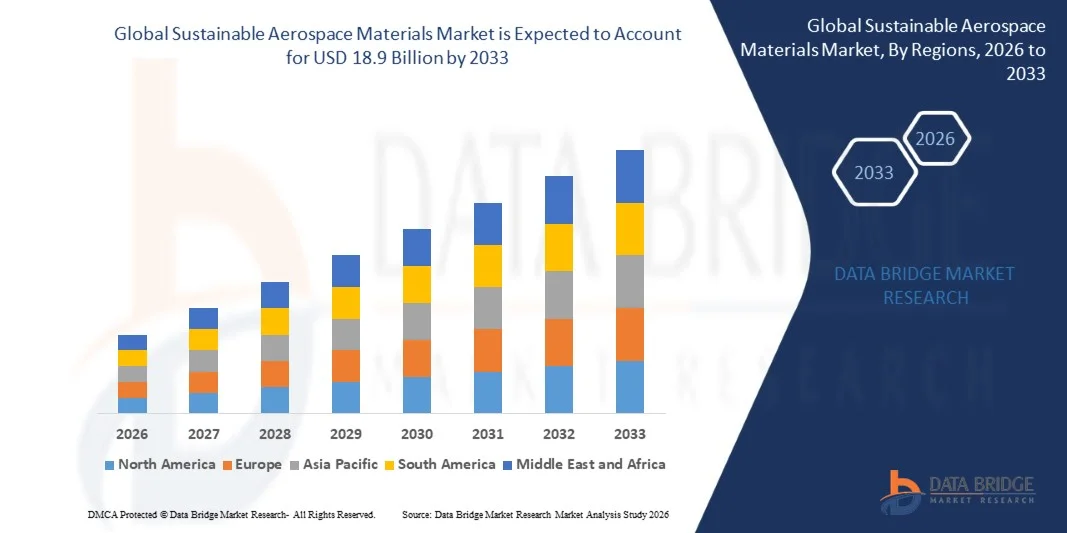
- As per Data Bridge Market Research analysis, the sustainable aerospace materials market was valued at USD 9.8 billion in 2025 and is projected to reach USD 18.9 billion by 2033, growing at a CAGR of 11.50% from 2026 to 2033.
- The market is experiencing consistent growth driven by rising industry-wide commitments to carbon-neutral aviation, increasing regulatory pressure to reduce aircraft lifecycle emissions, and expanding adoption of recycled, bio-based, and low-carbon materials across airframe, propulsion, and interior applications.
- The increasing focus on aircraft lightweighting and circularity, combined with stricter environmental and worker-safety regulations governing coatings and adhesives, is compelling aircraft OEMs and Tier-1 aerostructure manufacturers to qualify sustainable alternatives to conventional metals, composites, and surface treatments. Recycled carbon fiber composites and bio-based prepreg systems are increasingly complementing virgin material supply chains in many markets, offering reduced carbon footprint, improved circularity, and compatibility with existing processing equipment.
Market Size & Forecast
- Global Market Value (2025): USD 9.8 Billion
- Expected Market Value (2033): USD 18.9 Billion
- Forecast CAGR (2026–2033): 11.50%
- Leading Region in 2025: North America
- Fastest Growing Region: Asia-Pacific
What are the Major Takeaways of the Sustainable Aerospace Materials Market?
- North America dominated the global sustainable aerospace materials market in 2025, supported by the region's strong concentration of leading composite, coatings, and specialty metals producers, together with well-established commercial and defense aircraft manufacturing programs.
- Asia-Pacific is expected to be the fastest-growing region from 2026 to 2033, fueled by expanding commercial aircraft production, rising domestic sustainability mandates, and growing investment in recycled and bio-based aerospace material capacity across China, Japan, and India.
- The sustainable composite materials segment dominates the market by material type, supported by widespread and growing use of carbon-fiber-reinforced polymers and recycled carbon fiber composites across airframe and interior structures.
- The recycled carbon fiber composites segment is witnessing the fastest growth within sustainable composite materials, driven by rising industry focus on circularity and the need to supplement constrained virgin carbon fiber supply.
- The airframe structures segment leads the market by end product, given the large material volumes required for fuselage, wing, and structural component manufacturing.
- The advanced air mobility platforms segment is witnessing the fastest growth by aircraft and aerospace platform, driven by increasing development activity around electric and hybrid-electric aircraft designed around lightweight, sustainable material architectures.
Report Scope and Sustainable Aerospace Materials Market Segmentation
|
Attributes |
Sustainable Aerospace Materials Key Market Insights |
|
Segments Covered |
|
|
Countries Covered |
North America
Europe
Asia-Pacific
South America
Middle East and Africa
|
|
Key Market Players |
|
|
Market Opportunities |
|
|
Value Added Data Infosets |
In addition to insights on market value, growth rate, segmentation, geographic coverage, and major players, reports curated by Data Bridge Market Research also include in-depth expert analysis, geographically represented company-wise production and capacity, distributor and partner network layouts, detailed and updated price trend analysis, and deficit analysis of supply and demand. |
What is the Key Trend in the Sustainable Aerospace Materials Market?
- Aerospace material developers are increasingly introducing bio-based prepreg systems that can be processed on existing equipment, allowing aircraft interior manufacturers to reduce reliance on fossil-fuel-based resins without retooling production lines.
- These drop-in replacement materials enable manufacturers to meet carbon-neutral targets while maintaining established processing parameters, performance specifications, and certification pathways.
- For instance, Mitsubishi Chemical Group developed BIOpreg PFA, a bio-based prepreg intermediate using a formaldehyde-free furan resin system derived from sugar cane waste, designed as a sustainable alternative to conventional phenolic systems used in commercial aircraft interior panels.
- As aircraft OEMs and material suppliers continue to prioritize carbon-neutral targets, circularity, and drop-in compatibility with existing processes, the adoption of bio-based and recycled material systems is expected to accelerate, reinforcing sustainable materials as a core enabler of next-generation aircraft interiors and structures.
What are the Key Drivers of the Sustainable Aerospace Materials Market?
- The aviation industry's sustained commitment to reducing lifecycle emissions has significantly increased demand for recycled carbon fiber composites capable of supplementing constrained virgin fiber supply chains while lowering embodied carbon.
- For instance, industry discussions at JEC World 2025 highlighted the growing strategic importance of recycled carbon fiber in aerospace applications, with suppliers noting that guaranteed performance and competitive pricing relative to virgin fiber are strengthening its adoption amid potential carbon fiber supply constraints.
- Aircraft OEMs and coatings suppliers are increasingly qualifying chrome-free and waterborne surface treatment systems to meet tightening environmental and worker-safety regulations across production and MRO facilities.
- For instance, PPG Industries' Aerocron chromate-free e-coat primer has been qualified to AMS 3144 in multiple variations, offering aerospace manufacturers improved corrosion protection, more uniform application, and elimination of worker overspray exposure compared to conventional primer systems.
- With the aerospace industry increasingly relying on qualified sustainable materials to meet emissions, circularity, and regulatory commitments, sustainable aerospace materials will remain indispensable for both commercial and defense aviation programs.
Which Factors are Challenging the Growth of the Sustainable Aerospace Materials Market?
- Sustainable aerospace material adoption requires significant investment in new qualification testing, recycling infrastructure, and process validation to meet stringent aerospace certification standards.
- Recycled carbon fiber composites, in particular, continue to face technical challenges related to fiber strength retention and contamination control compared to virgin carbon fiber, which can limit their use in primary structural applications.
- For instance, ongoing industry and academic research into recycling methods such as mechanical grinding, pyrolysis, and solvolysis continues to explore trade-offs between fiber strength retention, processing cost, and environmental impact, reflecting the substantial technical investment required to scale recycled composite materials for structural aerospace applications.
- The high capital investment and lengthy qualification timelines associated with sustainable aerospace materials continue to restrict adoption, particularly among smaller material suppliers and regional manufacturers. This barrier slows market penetration in price-sensitive and emerging aerospace manufacturing regions, limiting the widespread deployment of sustainable material technologies despite growing demand.
How is the Sustainable Aerospace Materials Market Segmented?
The sustainable aerospace materials market is segmented on the basis of material type, sustainability attribute, composite matrix, reinforcement type, product form, manufacturing technology, aircraft & aerospace platform, end product, sustainability function, end user and distribution channel.
- By Material Type
On the basis of material type, the global sustainable aerospace materials market is segmented into sustainable metals & alloys, sustainable composite materials, sustainable polymers & engineering plastics, sustainable coatings & surface materials, and sustainable adhesives, sealants & resins. The sustainable composite materials segment dominates the market, supported by the widespread and growing use of carbon-fiber-reinforced polymers, recycled carbon fiber composites, and hybrid fiber composites across airframe, interior, and engine nacelle structures.
Within material type, the recycled carbon fiber composites and bio-based engineering polymers categories are witnessing the fastest growth, driven by rising industry focus on circularity, supply chain diversification, and reduced embodied carbon across composite and polymer applications.
- By Sustainability Attribute
On the basis of sustainability attribute, the global sustainable aerospace materials market is segmented into recycled-content materials, bio-based materials, low-carbon materials, lightweight materials, recyclable materials, low-toxicity materials, and durable & life-extending materials. The lightweight materials segment dominates the market, reflecting the aerospace industry's longstanding focus on weight reduction as a primary lever for improving fuel efficiency and reducing emissions.
The recycled-content materials segment is witnessing the fastest growth, driven by increasing supplier and OEM initiatives to incorporate recycled carbon fiber, recycled aluminum, and recycled engineering plastics into qualified aerospace material specifications.
- By Composite Matrix
On the basis of composite matrix, the global sustainable aerospace materials market is segmented into thermoset matrix composites, thermoplastic matrix composites, ceramic matrix composites, metal matrix composites, and hybrid matrix composites. The thermoset matrix composites segment dominates the market due to its widespread adoption across established aerospace manufacturing processes, increasing demand for proven, well-characterized resin systems, and strong compatibility with existing certification pathways. additionally, rising focus on process familiarity, supplier qualification history, and manufacturing scalability further supports the strong adoption of thermoset matrix composite solutions.
The thermoplastic matrix composites segment is witnessing the fastest growth, this growth is fueled by the increasing reliance on thermoplastic systems for their recyclability, weldability, and faster assembly characteristics relative to conventional thermoset composites. aerospace manufacturers, Tier-1 suppliers, and material developers are adopting thermoplastic matrix composites to conduct cost-effective, repeatable, and more sustainable structural manufacturing. additionally, the integration of thermoplastic systems into real-scale fuselage prototype testing is enhancing confidence in their performance, further driving segment growth.
- By Reinforcement Type
On the basis of reinforcement type, the global sustainable aerospace materials market is segmented into carbon fiber, glass fiber, aramid fiber, natural fiber, ceramic fiber, and hybrid reinforcement. The carbon fiber segment dominates the market due to its critical role in delivering high strength-to-weight performance across structural airframe and interior applications, supported by its established qualification history among aircraft OEMs and Tier-1 suppliers.
The natural fiber and hybrid reinforcement segments are witnessing the fastest growth, driven by rising research and early adoption of bio-based reinforcement materials in secondary aerospace structures and interior components seeking improved sustainability credentials.
- By Product Form
On the basis of product form, the global sustainable aerospace materials market is segmented into fibers & filaments, prepregs, tapes, fabrics & textiles, laminates & sheets, honeycomb & core materials, metal product forms, and resins, adhesives & coatings. The prepregs segment dominates the market due to its widespread use across automated fiber placement and automated tape laying manufacturing processes for structural composite components.
The resins, adhesives & coatings segment is witnessing the fastest growth, driven by increasing qualification of bio-based epoxy resins, low-VOC structural adhesives, and chrome-free coating systems across both new-build and MRO applications.
- By Manufacturing Technology
On the basis of manufacturing technology, the global sustainable aerospace materials market is segmented into automated fiber placement, automated tape laying, resin transfer molding, additive manufacturing, and reclamation & recycling. The automated fiber placement segment dominates the market due to its critical role in enabling precise, repeatable, and material-efficient layup of composite structures for large commercial aircraft programs. the widespread presence of established automated fiber placement infrastructure among Tier-1 aerostructure manufacturers facilitates faster adoption and reinforces this segment's leading market position.
The reclamation & recycling segment is witnessing the fastest growth, driven by this growth is primarily driven by increasing investment in mechanical recycling, pyrolysis, and solvolysis processes that recover carbon fiber and resin content from manufacturing waste and end-of-life components, supporting the industry's broader circularity objectives.
- By Aircraft & Aerospace Platform
On the basis of aircraft & aerospace platform, the global sustainable aerospace materials market is segmented into commercial aircraft, turboprop aircraft, commercial helicopters, business & general aviation, military aircraft, unmanned aerial vehicles, advanced air mobility platforms, and space platforms. The commercial aircraft segment dominates the market, supported by sustained narrow-body and wide-body aircraft production programs seeking to meet airline and regulatory sustainability commitments.
The advanced air mobility platforms segment is witnessing the fastest growth, driven by increasing development activity around electric and hybrid-electric aircraft designed from the outset around lightweight, sustainable material architectures.
- By End Product
On the basis of end product, the global sustainable aerospace materials market is segmented into airframe structures, propulsion systems, auxiliary power unit, aircraft interiors, aircraft systems, rotorcraft components, and airport ground support equipment. The airframe structures segment dominates the market, given the large material volumes required for fuselage, wing, and structural component manufacturing across commercial and military aircraft programs.
The aircraft interiors segment is witnessing the fastest growth, driven by rising adoption of bio-based prepreg and recycled composite panels that offer drop-in compatibility with existing interior manufacturing processes while meeting carbon-neutral targets.
- By Sustainability Function
On the basis of sustainability function, the global sustainable aerospace materials market is segmented into aircraft lightweighting, fuel & energy efficiency, emission reduction, circularity, manufacturing efficiency, and operational durability. The aircraft lightweighting segment dominates the market, reflecting its direct and well-established link to fuel efficiency and emissions performance across aircraft platforms.
The circularity segment is witnessing the fastest growth, driven by increasing OEM and supplier commitments to recycled-content sourcing, end-of-life material recovery, and closed-loop manufacturing processes.
- By End User
On the basis of end user, the global sustainable aerospace materials market is segmented into commercial aircraft manufacturers, business & general aviation manufacturers, military aircraft manufacturers, UAV manufacturers, advanced air mobility manufacturers, aircraft engine & APU manufacturers, aircraft interior & cabin-system manufacturers, aerostructure manufacturers, airport ground support equipment manufacturers, spacecraft & launch-vehicle manufacturers, Tier 1 aerospace component manufacturers, Tier 2 & Tier 3 aerospace component manufacturers, airlines & aircraft operators, MRO organizations, defense organizations, space agencies, and research institutions. The commercial aircraft manufacturers segment dominates the market, given their central role in specifying and qualifying sustainable materials across large-scale aircraft production programs.
The advanced air mobility manufacturers segment is witnessing the fastest growth, driven by new entrants and established OEMs designing next-generation aircraft platforms around sustainable, lightweight material architectures from program inception.
- By Distribution Channel
On the basis of distribution channel, the global sustainable aerospace materials market is segmented into direct sales, channel partner sales, project-based procurement, and online sales. The direct sales segment dominates the market, supported by long-term OEM supply agreements and tender sales arrangements with airlines and defense agencies that require qualified, traceable material sourcing.
The channel partner sales segment, supported by authorized distributors such as ThyssenKrupp Materials NA, Reliance Steel & Aluminum, VSMPO-AVISMA, Toray Industries, Hexcel Corporation, and Ducommun Incorporated, is witnessing the fastest growth, driven by rising demand among Tier-2 and Tier-3 manufacturers for value-added distribution and aerospace material service support.
Which Region Holds the Largest Share of the Sustainable Aerospace Materials Market?
- North America dominated the sustainable aerospace materials market, supported by the region's strong concentration of leading composite, coatings, and specialty metals producers, well-established commercial and defense aircraft manufacturing programs, and early adoption of recycled and bio-based material qualification across the U.S. and Canada.
- The region also benefits from sustained investment in recycling and reclamation infrastructure, growing OEM sustainability commitments, and continued expansion of chrome-free and waterborne coating qualification across production and MRO facilities. Rising investment in recycled carbon fiber and bio-based resin capacity continues to strengthen North America's leadership position in the global market.
U.S. Sustainable Aerospace Materials Market Insight
The U.S. sustainable aerospace materials market is experiencing steady growth, supported by the country's large commercial and defense aircraft manufacturing base, expanding sustainability commitments among leading aircraft OEMs, and increasing investment in recycled carbon fiber and bio-based resin production capacity. Rising investments in recycling and reclamation infrastructure are contributing to market growth. Furthermore, growing coatings supplier investment in chrome-free and waterborne primer capacity is reinforcing the U.S. position as the leading market for sustainable aerospace materials.
Canada Sustainable Aerospace Materials Market Insight
The Canada sustainable aerospace materials market is expanding steadily due to the country's established aerospace manufacturing base, growing investment in advanced sustainable materials research, and increasing collaboration between material developers and aircraft component manufacturers. Continuous advancements in bio-based and recycled composite processing are further driving market growth in Canada.
Asia-Pacific Sustainable Aerospace Materials Market Insight
The Asia-Pacific sustainable aerospace materials market is expected to witness the fastest growth globally, driven by expanding commercial aircraft production, rising domestic sustainability mandates, and growing investment in recycled and bio-based aerospace material capacity across China, Japan, and India. Growing awareness regarding circularity, rising adoption of sustainable coatings and composite technologies, and increasing demand for domestically produced sustainable materials are supporting regional market expansion. Additionally, the growing presence of regional aerospace OEM and component manufacturing facilities is accelerating sustainable material demand across the region.
China Sustainable Aerospace Materials Market Insight
The China sustainable aerospace materials market is witnessing consistent growth due to rising investments in domestic aerospace manufacturing capabilities, expanding commercial aircraft production programs, and growing government focus on sustainability across the aviation manufacturing sector. Material producers, Tier-1 aerostructure manufacturers, and component suppliers are increasingly investing in recycled and bio-based material production to reduce reliance on imported materials. Moreover, increasing integration of automated composite manufacturing processes and the country's focus on efficient, resilient aerospace supply chains are further contributing to market growth.
Japan Sustainable Aerospace Materials Market Insight
The Japan sustainable aerospace materials market is growing steadily, driven by the country's strong precision engineering base, established presence of global composite material manufacturers, and rising investment in next-generation sustainable material technologies. Growing adoption of bio-based prepreg and recycled composite platforms across commercial and defense aerospace programs is significantly boosting market demand. In addition, rising investments in aerospace material R&D and increasing collaboration with global aircraft OEMs are positioning Japan as a key growth market for sustainable aerospace materials.
Which are the Top Companies in the Sustainable Aerospace Materials Market?
The sustainable aerospace materials industry is primarily led by well-established companies, including:
- Hexcel Corporation (U.S.)
- Toray Industries, Inc. (Japan)
- Syensqo SA (Belgium)
- Teijin Limited (Japan)
- Mitsubishi Chemical Group Corporation (Japan)
- SGL Carbon SE (Germany)
- Victrex PLC (United Kingdom)
- Arkema S.A. (France)
- SABIC (Saudi Arabia)
- Evonik Industries AG (Germany)
- DuPont de Nemours, Inc. (U.S.)
- Park Aerospace Corp. (U.S.)
- 3M (U.S.)
- Henkel AG & Co. KGaA (Germany)
- PPG Industries, Inc. (U.S.)
- Akzo Nobel N.V. (Netherlands)
- The Sherwin-Williams Company (U.S.)
- Constellium SE (France)
- Alcoa Corporation (U.S.)
- Novelis Inc. (U.S.)
- Kaiser Aluminum Corporation (U.S.)
- ATI Inc. (U.S.)
- Carpenter Technology Corporation (U.S.)
- TIMET – Titanium Metals Corporation (U.S.)
- Aubert & Duval S.A. (France)
What are Latest Developments in the Sustainable Aerospace Materials Market?
- Mitsubishi Chemical Group developed BIOpreg PFA, a bio-based prepreg intermediate using a formaldehyde-free furan resin system derived from sugar cane waste, designed as a sustainable, drop-in alternative to conventional phenolic systems used in commercial aircraft interior panels, requiring no retooling of existing processing equipment.
- At JEC World 2025, industry discussions highlighted the growing strategic importance of recycled carbon fiber (RCF) in aerospace and adjacent applications, with suppliers noting that guaranteed performance and pricing competitive with virgin fiber are strengthening RCF adoption amid potential carbon fiber supply constraints.
- PPG Industries' Aerocron chromate-free e-coat primer, qualified to AMS 3144 in multiple variations, continued to gain customer interest across military, commercial, and general aviation applications, offering improved corrosion protection, more uniform application, and elimination of worker overspray exposure compared to conventional primer systems.
- AkzoNobel has been upgrading its Waukegan, Illinois aerospace coatings facility and adding warehouse space in Pleasant Prairie, Wisconsin, through 2030 to improve supply capabilities for aerospace customers adopting its chromate-free and waterborne coating systems.
- AkzoNobel, in collaboration with Airbus, qualified Aerodur HS 2121, a chromate-free exterior primer offering increased adhesion, improved corrosion performance, and enhanced wetting properties for aircraft exterior surfaces, reflecting continued industry progress toward chromate-free coating adoption.

- Interactive Data Analysis Dashboard
- Company Analysis Dashboard for high growth potential opportunities
- Research Analyst Access for customization & queries
- Competitor Analysis with Interactive dashboard
- Latest News, Updates & Trend analysis
- Harness the Power of Benchmark Analysis for Comprehensive Competitor Tracking
Data collection and base year analysis are done using data collection modules with large sample sizes. The stage includes obtaining market information or related data through various sources and strategies. It includes examining and planning all the data acquired from the past in advance. It likewise envelops the examination of information inconsistencies seen across different information sources. The market data is analysed and estimated using market statistical and coherent models. Also, market share analysis and key trend analysis are the major success factors in the market report. To know more, please request an analyst call or drop down your inquiry.
The key research methodology used by DBMR research team is data triangulation which involves data mining, analysis of the impact of data variables on the market and primary (industry expert) validation. Data models include Vendor Positioning Grid, Market Time Line Analysis, Market Overview and Guide, Company Positioning Grid, Patent Analysis, Pricing Analysis, Company Market Share Analysis, Standards of Measurement, Global versus Regional and Vendor Share Analysis. To know more about the research methodology, drop in an inquiry to speak to our industry experts.
Data Bridge Market Research is a leader in advanced formative research. We take pride in servicing our existing and new customers with data and analysis that match and suits their goal. The report can be customized to include price trend analysis of target brands understanding the market for additional countries (ask for the list of countries), clinical trial results data, literature review, refurbished market and product base analysis. Market analysis of target competitors can be analyzed from technology-based analysis to market portfolio strategies. We can add as many competitors that you require data about in the format and data style you are looking for. Our team of analysts can also provide you data in crude raw excel files pivot tables (Fact book) or can assist you in creating presentations from the data sets available in the report.












