


What is the System Basis Chip (SBC) Market Size and Growth Rate?
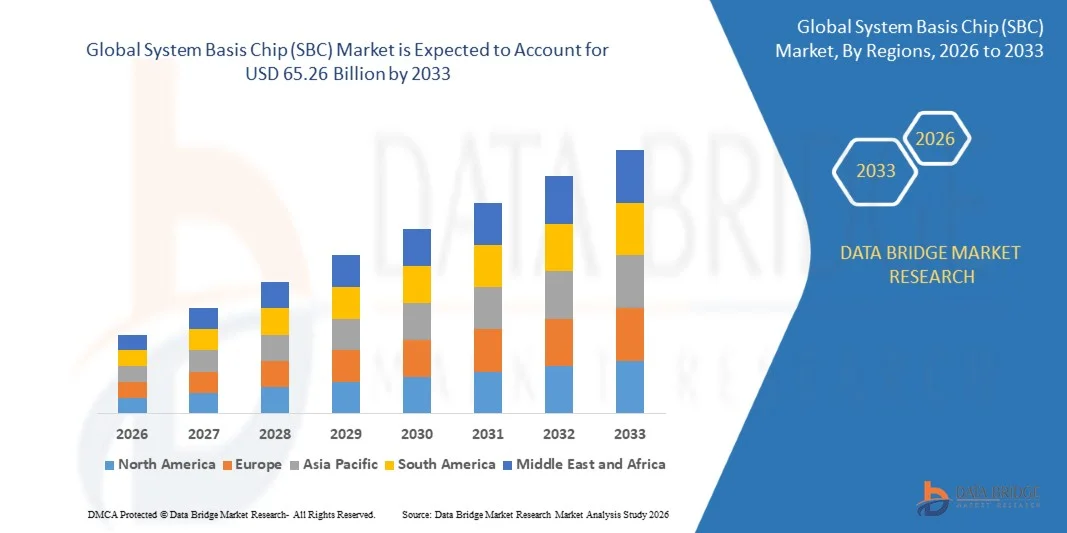
- As per Data Bridge Market Research analysis, the system basis chip (SBC) market was valued at USD 29.79 billion in 2025 and is projected to reach USD 65.26 billion by 2033, growing at a CAGR of 10.30% from 2026 to 2033.
- A system basis chip is an integrated circuit that consolidates voltage regulation, communication interfaces such as CAN and LIN, diagnostics, watchdog functions, and wake-up logic onto a single die, reducing component count and improving reliability across automotive electronic control units (ECUs).
- The market is expanding rapidly as vehicles integrate more electronic control units to support advanced driver-assistance systems (ADAS), electric powertrains, and vehicle-to-everything (V2X) connectivity, all of which require compact, reliable, and increasingly high-speed communication chips such as SBCs to function.
Market Size & Forecast
- Global Market Value (2025): USD 29.79 Billion
- Expected Market Value (2033): USD 65.26 Billion
- Forecast CAGR (2026–2033): 10.30%
- Leading Region in 2025: Asia-Pacific
- Fastest Growing Region: Asia-Pacific
What are the Major Takeaways of the System Basis Chip (SBC) Market?
- Asia-Pacific dominated the global system basis chip (SBC) market with the largest revenue share of 41.28% in 2025, supported by the region's position as the world's largest vehicle production hub and rapid growth in domestic electric vehicle manufacturing.
- Asia-Pacific is also expected to remain the fastest-growing region, recording a CAGR of 12.4% from 2026 to 2033, driven by continued expansion of EV production in China, growing ADAS adoption, and rising domestic semiconductor manufacturing investment.
- The passenger cars segment led the market with a 68.42% share in 2025, driven by the high electronic control unit count in modern passenger vehicles spanning body, safety, infotainment, and powertrain systems.
- Light commercial vehicles are the fastest-growing vehicle type segment, projected to register a CAGR of 11.8%, reflecting rising electrification and increasing adoption of advanced safety and telematics systems in delivery and logistics fleets.
- The body electronics application segment dominated the market with a 32.84% revenue share in 2025, led by the high number of SBCs required across body control modules, door modules, seat controls, and HVAC systems.
- The safety systems application segment is the fastest-growing, with a CAGR of 12.9%, driven by rapid growth in ADAS adoption and stricter global vehicle safety regulations requiring redundant, fail-safe electronic architectures.
- The CAN FD communication interface segment is the fastest-growing, with a CAGR of 13.2%, as automakers upgrade in-vehicle networks to support the higher data-transmission speeds required by connected and increasingly software-defined vehicles.
Report Scope and System Basis Chip (SBC) Market Segmentation
|
Attributes |
System Basis Chip (SBC) Market Key Market Insights |
|
Segments Covered |
|
|
Countries Covered |
North America
Europe
Asia-Pacific
Middle East and Africa
South America
|
|
Key Market Players |
|
|
Market Opportunities |
|
|
Value Added Data Infosets |
In addition to the insights on market scenarios such as market value, growth rate, segmentation, geographical coverage, and major players, the market reports curated by the Data Bridge Market Research also include in-depth expert analysis, geographically represented company-wise production and capacity, network layouts of distributors and partners, detailed and updated price trend analysis and deficit analysis of supply chain and demand. |
What is the Key Trend in the System Basis Chip (SBC) Market?
- Chipmakers are increasingly developing mini and highly integrated SBC variants that consolidate more functions onto smaller die sizes to meet automakers' demand for reduced PCB footprint and lower system cost.
- For instance, in June 2024, NXP Semiconductors introduced the FS24 SBC, a safety Mini CAN FD SBC designed for high reliability in safety-critical applications, featuring a battery-connected switched-mode regulator delivering up to 400 mA and support for a broad range of microcontrollers and communication devices.
- Automakers and Tier-1 suppliers are also increasingly favoring CAN FD-capable SBCs to support the higher data-transmission speeds required by connected, software-defined vehicle architectures.
- As vehicle electronic architectures continue to consolidate around fewer, more powerful zonal and domain controllers, demand for highly integrated, high-reliability SBCs is expected to keep accelerating.
What are the Key Drivers of the System Basis Chip (SBC) Market?
- The rapid global expansion of electric vehicle production is a major driver of SBC demand, as EVs require additional SBCs for battery management, power distribution, and electric powertrain control not present in conventional vehicles.
- For instance, chipmakers have continued to develop mini CAN FD SBC devices such as NXP's FS24 SBC, introduced in June 2024, specifically to improve in-vehicle communication reliability and support the growing electrical complexity of modern and electrified vehicles.
- Growing adoption of advanced driver-assistance systems (ADAS) is increasing the number of safety-critical electronic control units per vehicle, each requiring a high-reliability SBC to manage power and communication.
- Automakers' continued transition toward software-defined vehicle architectures is increasing demand for SBCs that support higher-speed communication protocols such as CAN FD, enabling the real-time data transmission these architectures require.
- As global vehicle electronic content continues to rise across both developed and emerging automotive markets, sustained demand for system basis chips is expected across body, safety, powertrain, and infotainment applications.
Which Factors are Challenging the Growth of the System Basis Chip (SBC) Market?
- The automotive semiconductor industry remains exposed to periodic chip shortages and supply chain disruptions, which can constrain SBC availability and delay vehicle production schedules.
- Rising development costs for increasingly complex, highly integrated SBCs capable of supporting functional safety standards such as ASIL-D add pricing pressure throughout the automotive supply chain.
- International trade tensions and tariffs on automotive integrated circuits can directly affect the cost and availability of SBCs, particularly those manufactured in key production hubs such as Germany and Malaysia, creating downstream cost pressure on advanced driver-assistance systems that rely heavily on these chips.
- The need to continuously support both legacy communication protocols, such as classic CAN and LIN, alongside newer standards like CAN FD requires manufacturers to maintain broader and more complex product portfolios, adding engineering and inventory complexity.
How is the System Basis Chip (SBC) Market Segmented?
The system basis chip (SBC) market is segmented on the basis of vehicle type, application, communication interface, current rating, vehicle propulsion.
- By Vehicle Type
On the basis of vehicle type, the global system basis chip (SBC) market is segmented into Passenger Cars, Light Commercial Vehicles, Heavy Commercial Vehicles. The passenger cars segment dominated the market with a share of 68.42% in 2025 due to modern passenger vehicles integrate a high number of electronic control units spanning body, safety, infotainment, and powertrain systems, each typically requiring at least one SBC. Additionally, rising consumer demand for connected and comfort features in passenger cars continues to increase the average SBC content per vehicle.
The light commercial vehicles segment is expected to witness the fastest CAGR of 11.8% from 2026 to 2033, driven by rising electrification of delivery and logistics fleets is increasing the number of electronic control units and associated SBCs required per vehicle. Additionally, growing adoption of advanced safety and telematics systems in light commercial vehicles is further expanding SBC content in this segment.
- By Application
On the basis of application, the global system basis chip (SBC) market is segmented into Powertrain, Safety Systems, Body Electronics, Chassis, Telematics & Infotainment. The body electronics segment dominated the market with a share of 32.84% in 2025 due to body control modules, door modules, seat controls, and HVAC systems each typically require a dedicated SBC to manage power and communication, giving this application the highest aggregate SBC demand. Additionally, rising vehicle comfort and convenience feature counts continue to expand the number of body electronics modules per vehicle.
The safety systems segment is expected to witness the fastest CAGR of 12.9% from 2026 to 2033, driven by rapid growth in ADAS adoption is increasing the number of safety-critical electronic control units that require high-reliability, fail-safe SBCs. Additionally, stricter global vehicle safety regulations are pushing automakers toward more redundant electronic architectures, further increasing SBC demand in safety systems.
- By Communication interface
On the basis of communication interface, the global system basis chip (SBC) market is segmented into CAN, LIN, FlexRay, CAN FD. The CAN segment dominated the market with a share of 46.75% in 2025 due to CAN remains the most widely deployed in-vehicle communication protocol across body, powertrain, and chassis applications due to its maturity, reliability, and cost-effectiveness. Additionally, the large installed base of CAN-based vehicle architectures continues to support strong ongoing demand for CAN-interface SBCs.
The CAN FD segment is expected to witness the fastest CAGR of 13.2% from 2026 to 2033, driven by automakers are increasingly upgrading in-vehicle networks to CAN FD to support the higher data-transmission speeds required by connected and software-defined vehicles. Additionally, rising adoption of CAN FD SBCs for high-reliability safety-critical applications is further accelerating growth of this interface segment.
- By Current rating
On the basis of current rating, the global system basis chip (SBC) market is segmented into 150 mA, 250 mA, 500 mA. The 250-mA segment dominated the market with a share of 38.64% in 2025 due to 250 mA current ratings provide a practical balance of power delivery and efficiency suited to the majority of body and comfort electronic control units. Additionally, wide availability of 250 mA SBC variants across major manufacturers' product families supports its dominant position.
The 500-mA segment is expected to witness the fastest CAGR of 12.6% from 2026 to 2033, driven by higher current-rating SBCs are increasingly required to support power-hungry electric and hybrid vehicle subsystems, including battery management and powertrain control units. Additionally, rising integration of additional peripherals per electronic control unit is increasing the power delivery requirements that favor higher current-rating SBCs.
- By Vehicle propulsion
On the basis of vehicle propulsion, the global system basis chip (SBC) market is segmented into Internal Combustion Engine (ICE), Electric & Hybrid Vehicles. The internal combustion engine (ICE) segment dominated the market with a share of 58.36% in 2025 due to ICE vehicles continue to represent the majority of the global vehicle parc and new vehicle production, sustaining strong ongoing SBC demand from this propulsion category. Additionally, even as electrification accelerates, ICE vehicles still require extensive body, safety, and infotainment electronics that rely on SBCs.
The electric & hybrid vehicles segment is expected to witness the fastest CAGR of 13.8% from 2026 to 2033, driven by electric and hybrid vehicles require additional SBCs for battery management, power distribution, and electric powertrain control that are not present in conventional ICE vehicles. Additionally, rapid global growth in electric vehicle production continues to expand this segment's share of total SBC demand.
Which Region Holds the Largest Share of the System Basis Chip (SBC) Market?
- Asia-Pacific dominated the global system basis chip (SBC) market with the largest revenue share of 41.28% in 2025, supported by the region's position as the world's largest vehicle production hub and rapid growth in domestic electric vehicle manufacturing.
- Asia-Pacific is also expected to remain the fastest-growing region, recording a CAGR of 12.4% from 2026 to 2033, driven by continued expansion of EV production in China, growing ADAS adoption, and rising domestic semiconductor manufacturing investment.
China System Basis Chip (SBC) Market Insight
The China system basis chip (SBC) market is expanding rapidly, driven by the country's position as the world's largest electric vehicle producer and growing domestic semiconductor manufacturing investment. Rising government support for automotive electronics self-sufficiency is further accelerating market growth in China.
Germany System Basis Chip (SBC) Market Insight
The Germany system basis chip (SBC) market is growing steadily, underpinned by the strong presence of leading European automotive semiconductor manufacturers and premium automakers driving high electronic content per vehicle. Continued innovation in functional-safety-compliant SBCs is reinforcing Germany's position as a key European hub for automotive semiconductors.
U.S. System Basis Chip (SBC) Market Insight
The U.S. system basis chip (SBC) market is expanding steadily, supported by growing domestic semiconductor manufacturing investment and rising ADAS adoption across the country's vehicle fleet. Continued collaboration between automakers and chipmakers on next-generation, software-defined vehicle architectures is further strengthening market growth.
Japan System Basis Chip (SBC) Market Insight
The Japan system basis chip (SBC) market is witnessing consistent growth, supported by the strong presence of major domestic automotive semiconductor manufacturers and a well-established automotive supply chain. Rising electric vehicle production is further contributing to market growth in Japan.
South Korea System Basis Chip (SBC) Market Insight
The South Korea system basis chip (SBC) market is growing at a healthy pace, driven by strong domestic electric vehicle production growth and expanding investment in domestic semiconductor manufacturing capacity. Rising adoption of advanced driver-assistance systems among domestic automakers is further supporting market growth.
Which are the Top Companies in the System Basis Chip (SBC) Market?
The system basis chip (SBC) market is primarily led by well-established companies, including:
- NXP Semiconductors N.V.v (Netherlands)
- Infineon Technologies AG (Germany)
- STMicroelectronics N.V. (Switzerland)
- Texas Instruments Incorporated (U.S.)
- Renesas Electronics Corporation (Japan)
- onsemi (U.S.)
- Microchip Technology Inc. (U.S.)
- Analog Devices, Inc. (U.S.)
- ROHM Co., Ltd. (Japan)
- Melexis NV (Belgium)
- Elmos Semiconductor SE (Germany)
- Robert Bosch GmbH (Germany)
- Toshiba Corporation (Japan)
- Marvell Technology, Inc. (U.S.)
- ams OSRAM AG (Austria)
- Denso Corporation (Japan)
- Continental AG (Germany)
- Qualcomm Technologies, Inc. (U.S.)
- Broadcom Inc. (U.S.)
- Diodes Incorporated (U.S.)
What are Latest Developments in the System Basis Chip (SBC) Market?
- In June 2024, NXP Semiconductors introduced the FS24 SBC, a safety Mini CAN FD SBC designed for high reliability in safety-critical automotive applications, featuring a battery-connected switched-mode regulator delivering up to 400 mA and a linear regulator providing up to 150 mA, supporting a broad range of microcontrollers and communication devices to improve in-vehicle communication reliability.
- In August 2023, Infineon Technologies introduced the TLE988x and TLE989x MOTIX embedded power IC families, extending the company's portfolio of highly integrated automotive system-on-chip solutions that combine a gate driver, microcontroller, CAN FD communication interface, and power supply on a single chip for automotive body, comfort, and thermal management applications.
- In January 2026, Infineon and Flex introduced a zone-controller development kit for software-defined vehicles. The platform uses modular building blocks and incorporates multiple CAN-FD, LIN and Ethernet interfaces alongside power-control and cybersecurity functions. The development approach supports configurable zone-controller designs and demonstrates the broader shift toward centralized vehicle electronics, creating demand for integrated power-management and communication components such as SBCs.
- In August 2026, NXP highlighted its FS23 safety SBC family, targeting body and comfort controllers as well as battery-management-system applications. The family combines power management, CAN and LIN communication, system management and safety functions, while supporting scalability and hardware/software compatibility across automotive platforms. NXP states that the FS23 family is developed according to the ISO 26262 process and reaches ASIL B.

- Interactive Data Analysis Dashboard
- Company Analysis Dashboard for high growth potential opportunities
- Research Analyst Access for customization & queries
- Competitor Analysis with Interactive dashboard
- Latest News, Updates & Trend analysis
- Harness the Power of Benchmark Analysis for Comprehensive Competitor Tracking
Data collection and base year analysis are done using data collection modules with large sample sizes. The stage includes obtaining market information or related data through various sources and strategies. It includes examining and planning all the data acquired from the past in advance. It likewise envelops the examination of information inconsistencies seen across different information sources. The market data is analysed and estimated using market statistical and coherent models. Also, market share analysis and key trend analysis are the major success factors in the market report. To know more, please request an analyst call or drop down your inquiry.
The key research methodology used by DBMR research team is data triangulation which involves data mining, analysis of the impact of data variables on the market and primary (industry expert) validation. Data models include Vendor Positioning Grid, Market Time Line Analysis, Market Overview and Guide, Company Positioning Grid, Patent Analysis, Pricing Analysis, Company Market Share Analysis, Standards of Measurement, Global versus Regional and Vendor Share Analysis. To know more about the research methodology, drop in an inquiry to speak to our industry experts.
Data Bridge Market Research is a leader in advanced formative research. We take pride in servicing our existing and new customers with data and analysis that match and suits their goal. The report can be customized to include price trend analysis of target brands understanding the market for additional countries (ask for the list of countries), clinical trial results data, literature review, refurbished market and product base analysis. Market analysis of target competitors can be analyzed from technology-based analysis to market portfolio strategies. We can add as many competitors that you require data about in the format and data style you are looking for. Our team of analysts can also provide you data in crude raw excel files pivot tables (Fact book) or can assist you in creating presentations from the data sets available in the report.













